
You’re facing a complex web of decisions. Fluctuating energy prices, grid stability demands, ambitious sustainability goals, and the constant pressure to maximize ROI on multi-million dollar assets. Traditional planning tools and spreadsheets, once reliable, now feel inadequate. They can’t model the sheer number of variables or the deep uncertainty inherent in today’s energy market. You know there has to be a better way to make strategic decisions, but how do you evaluate the advanced solutions that promise to deliver it?
This is the core challenge computational optimization solves. It’s not about faster calculations; it’s about finding the mathematically best path forward in a sea of complexity. By leveraging AI-driven techniques, energy leaders can move from reactive problem-solving to proactive, data-validated strategy. This guide will walk you through the essential computational methods, their real-world applications, and how to frame your evaluation process to choose a partner that can truly deliver a competitive advantage.
The Computational Toolkit for Modern Energy Strategy
At its heart, optimization is about using mathematics to find the best possible outcome from a set of options, given certain constraints. For energy companies, this translates to maximizing profit, minimizing cost, or reducing carbon emissions while adhering to operational and regulatory limits. AI doesn’t just automate this process—it elevates it using a sophisticated toolkit.
The primary tools fall into three broad categories:
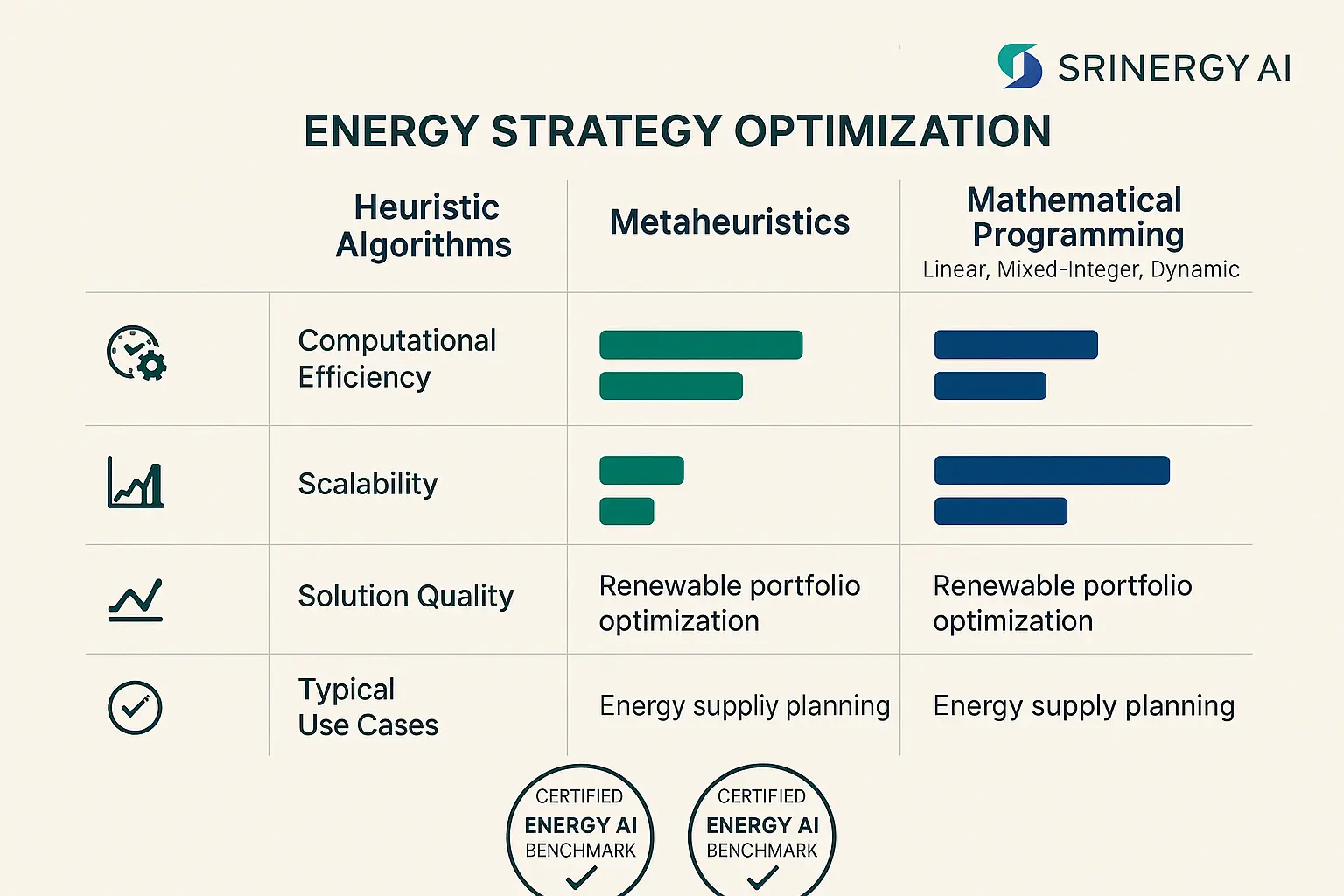
- Mathematical Programming: This is the bedrock of deterministic optimization. Techniques like Linear Programming (LP) and Mixed-Integer Linear Programming (MILP) are exceptional at solving problems with clear, linear relationships. Think of optimizing power dispatch from various generation sources to meet demand at the lowest cost. Research confirms that for large-scale, structured problems like unit commitment and economic dispatch, MILP provides highly accurate and provably optimal solutions.
- Heuristics: When a problem is so complex that finding the absolute perfect solution would take too long, heuristics are used to find a very good, practical solution quickly. They are essentially intelligent shortcuts or rules of thumb that guide the search for a solution.
- Metaheuristics: These are a step above. Metaheuristics are master strategies that guide other heuristic algorithms to avoid getting stuck in suboptimal solutions. Algorithms like Genetic Algorithms (GA), which mimic natural selection, and Particle Swarm Optimization (PSO), inspired by the social behavior of birds flocking, are brilliant at navigating vast and complex decision spaces. They are particularly powerful for challenges like optimizing the layout of a wind farm or managing a diverse renewable energy portfolio where variables are highly interdependent.
The key isn’t just knowing these algorithms exist, but knowing which one—or which combination—to apply to a specific energy challenge.
Algorithm Benchmarks and Performance Comparison
Not all algorithms are created equal for every task. The choice of optimization engine has a direct impact on solution quality, computational speed, and scalability. While a simple problem might be solvable with a standard linear model, complex, real-world energy strategies demand more.
Hybrid AI models, which often combine the precision of MILP with the exploratory power of metaheuristics like GA or PSO, consistently outperform single-algorithm approaches. For instance, studies show that for complex renewable asset scheduling—factoring in weather uncertainty and market price volatility—a hybrid approach can find solutions that are up to 10% more profitable than those found by a standalone algorithm. This is because the metaheuristic can explore a wide range of creative possibilities while the mathematical programming component refines the most promising options to guarantee feasibility and optimality.
When evaluating a solution, you need to look beyond the name of the algorithm and ask for performance data. For a deeper dive into our performance data, you can review our detailed algorithm benchmarks.
The right platform doesn’t have a favorite tool; it has a full toolbox and the expertise to select the best one for your specific challenge, ensuring you don’t leave value on the table.
Srinergy AI’s Methodology and Scenario Analysis
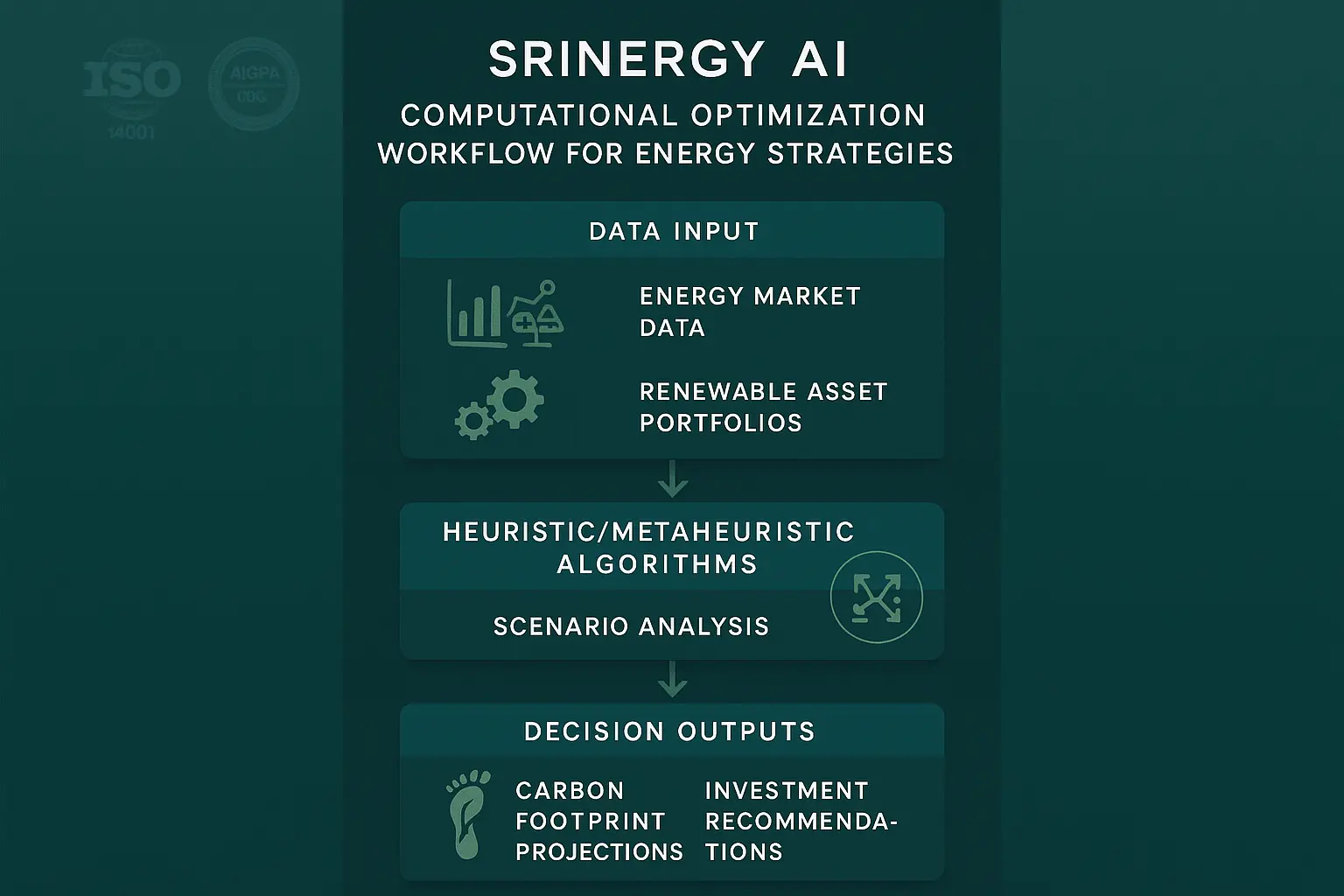
Choosing the right algorithm is just the first step. True strategic value emerges from a rigorous methodology that integrates these powerful tools into your decision-making workflow. The process must account for the inherent uncertainty of the energy market—from unpredictable fuel costs to the intermittent nature of renewables.
This is where scenario analysis becomes critical. Instead of solving for a single, static future, our platform runs thousands of optimizations against a range of potential scenarios. What if natural gas prices spike? What if a new carbon tax is implemented? What if renewable generation is 15% lower than forecasted?
By modeling these possibilities, we move beyond a simple “optimal” plan to a robust one. This rigorous approach allows us to conduct powerful scenario analysis for energy investments, modeling outcomes against market volatility and providing you with a clear risk-reward profile for each strategic option. The output isn’t just a number; it’s a strategic roadmap that builds confidence in your decisions.
This methodology transforms AI from a black box into a transparent decision-support partner, empowering your team to understand the “why” behind every recommendation.
Portfolio Optimization and Investment Decision Support
One of the most valuable applications of computational optimization is in portfolio management and investment planning. Whether you are expanding a fleet of renewable assets, upgrading existing infrastructure, or entering the energy storage market, AI-driven optimization provides the framework for making sound capital allocation decisions.
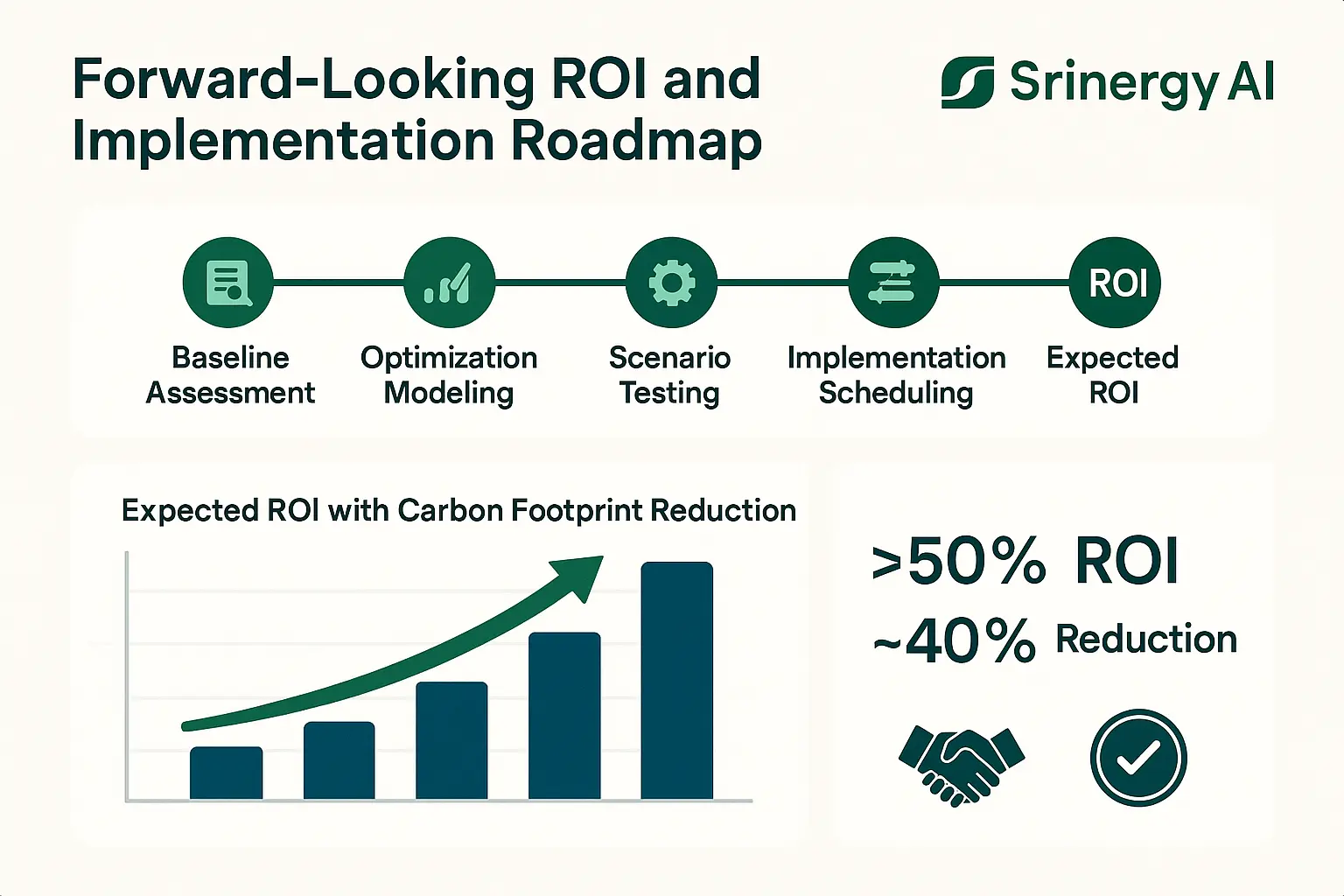
The process involves modeling your entire asset portfolio and optimizing for key objectives like maximizing risk-adjusted returns, ensuring grid stability, or meeting long-term decarbonization targets. Industry data shows that AI-driven optimization can improve grid stability by up to 15% and reduce operational costs by as much as 20% through more efficient resource allocation and scheduling.
For example, when optimizing a portfolio of solar, wind, and battery storage assets, our platform doesn’t just look at the levelized cost of energy for each. It models how they work together. It determines the optimal dispatch schedule for the battery to store cheap solar energy during the day and release it during peak evening demand, maximizing revenue while also providing crucial grid-stabilizing services. These are just a few examples of the complex optimization problem types we solve for our partners.
This comprehensive approach connects high-level strategic goals directly to operational execution, providing a clear line of sight from investment decision to measurable ROI and sustainability gains.
Frequently Asked Questions (FAQ)
How is this different from the planning software we already use?
Most traditional planning software operates on fixed rules and historical data. Computational optimization, by contrast, is forward-looking and dynamic. It explores millions of potential future pathways to identify the mathematically optimal strategy, rather than simply projecting past performance. It’s the difference between navigating with a paper map versus a real-time GPS that reroutes you around traffic you can’t see yet.
What kind of data is required to get started?
We typically start with data you already have: historical operational data, asset specifications, market price feeds, and demand forecasts. Our platform is designed to integrate with your existing systems (like SCADA and ETRM) to create a seamless data pipeline. The initial process involves a data audit to identify what’s available and where any gaps may be.
How do you ensure the AI’s recommendations are practical?
This is crucial. Our models are built with your real-world operational constraints from day one. This includes generator ramp rates, transmission capacity, maintenance schedules, and regulatory requirements. The optimization engine doesn’t produce theoretical ideals; it produces actionable plans that your operators can implement with confidence because they are grounded in your operational reality.
What is the typical ROI timeline for implementing an optimization solution?
While it varies by application, many of our partners see a significant return within the first 6-12 months. The 20% reduction in operational costs and 15% improvement in grid stability cited in industry research often translate directly to immediate financial gains through fuel savings, improved market bidding, and reduced ancillary service costs.
Your Next Strategic Move
You’ve seen how computational optimization provides a powerful framework for navigating the complexities of the modern energy landscape. The next step is to see how these advanced techniques can be applied to your specific challenges and strategic objectives.
We invite you to schedule a personalized strategy session with our energy optimization experts. In this collaborative discussion, we can explore your unique operational constraints, investment goals, and how a tailored AI-driven approach can unlock new levels of efficiency and profitability for your organization.
