
You know that upgrading to smart lighting is a good idea. The basic promises of LED efficiency and automated schedules are clear. But you’re past the introductory articles. Now, you’re facing the real questions: Which system architecture is right for a 50-story high-rise versus a sprawling warehouse? How do different AI algorithms actually impact my bottom line? And how do I choose a solution that won’t be obsolete in five years?
This isn’t just another post about the benefits of smart lighting. This is your decision-making framework. We’ll move beyond the surface-level claims and give you the technical and financial clarity needed to select, implement, and maximize the ROI of an AI-driven lighting system.
Decoding Smart Lighting: Beyond Basic Automation
In a commercial context, smart lighting isn’t about voice-controlled color changes. It’s an intelligent infrastructure that uses a network of sensors and controllers to manage illumination dynamically.
But the real transformation comes from adding a layer of artificial intelligence.
- Standard Automation is Rule-Based: “If a sensor detects motion, turn on the lights. If not, turn them off after 10 minutes.” It’s static and inefficient.
- AI-Driven Optimization is Adaptive: AI systems learn your building’s unique occupancy patterns, analyze daylight availability, and even predict future needs. It moves from simple on/off rules to a system that continuously fine-tunes itself for peak efficiency and occupant comfort. This is the difference between a tool and a strategy.
The Irrefutable ROI: Quantifying Your Smart Lighting Investment
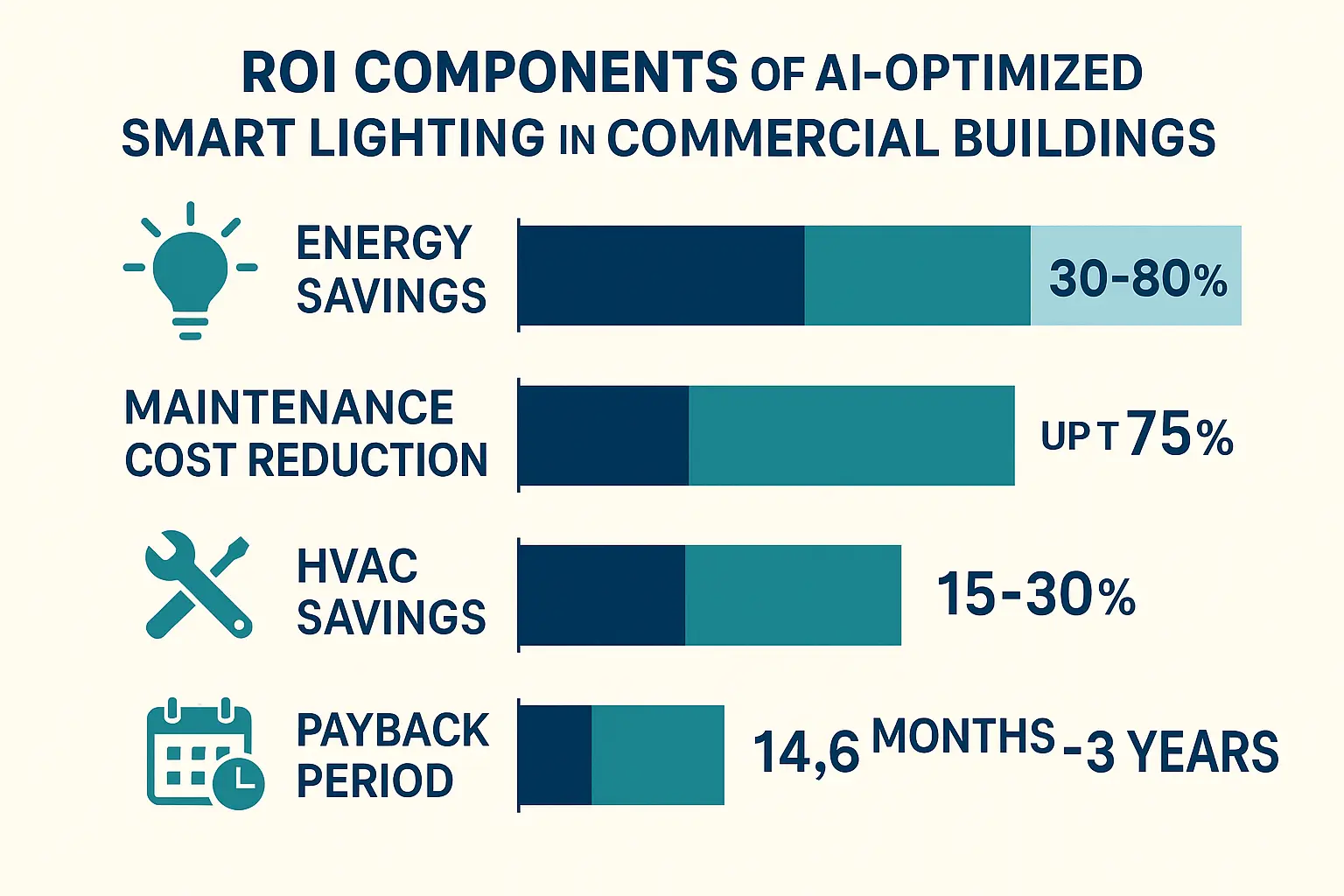
An AI-optimized lighting upgrade isn’t an expense; it’s a high-yield investment with cascading financial benefits. The numbers consistently show a compelling business case with a typical payback period between 18 months and 3 years. In logistics and warehouse environments, that can drop to as little as 14.6 months.
Let’s break down the returns:
- Drastic Energy Reduction: Combining LED fixtures with intelligent controls is the most powerful lever you can pull for energy savings. Expect a 50-80% reduction in lighting-related energy consumption. Crucially, this creates a ripple effect. Less heat from efficient lighting reduces the load on your HVAC system, cutting cooling costs by an additional 15-30%.
- Slashed Operational Costs: Modern LED systems are built to last. When managed by an AI that optimizes usage and prevents unnecessary strain, their lifespan is maximized. This, combined with AI-powered predictive maintenance that alerts you to potential failures before they happen, can slash lighting maintenance costs by up to 75%.
- Enhanced Productivity and Well-being: Human-centric lighting, which uses AI to adjust color temperature and intensity to match natural circadian rhythms, is proven to improve occupant focus and well-being. This isn’t a soft benefit; it translates to measurable gains in productivity and tenant satisfaction.
- Sustainability and Compliance: An intelligent lighting system is fundamental for achieving sustainability goals and securing certifications like LEED and WELL, enhancing your property’s value and brand reputation.
Architecting Intelligence: AI Algorithms & Network Foundations
To make a truly informed decision, you need to understand what’s happening under the hood. The long-term performance and scalability of your system depend on the sophistication of its AI and the robustness of its network architecture. This is a key area where solutions differ dramatically.
The AI That Powers Optimization
Not all AI is created equal. While competitors might talk vaguely about “learning,” a truly intelligent system uses specific machine learning models for different tasks:
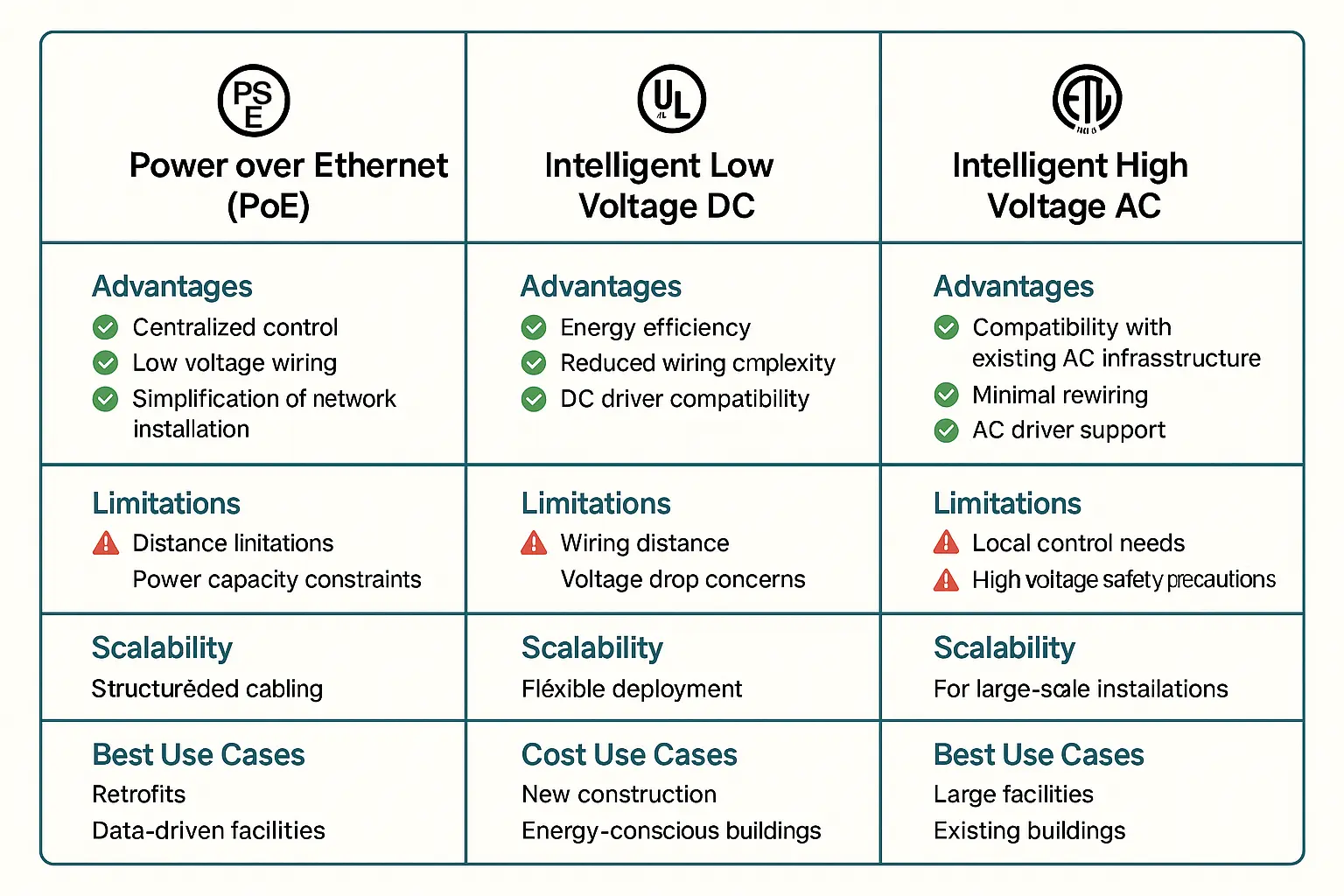
- Reinforcement Learning (e.g., DDPG): This is the gold standard for real-time dynamic control. The system constantly experiments with lighting levels, gets feedback from sensors (Is the room occupied? Is there enough daylight?), and learns the optimal strategy to minimize energy use while meeting comfort parameters. It doesn’t just follow a schedule; it creates the perfect schedule for every minute of the day.
- Supervised Learning: This model is trained on historical data to perform predictive tasks. Its most powerful application is in predictive maintenance, where it analyzes performance data from thousands of fixtures to predict when a specific unit is likely to fail, allowing you to replace it proactively. This approach can cut unexpected maintenance costs by up to 40%.
- Adaptive Scheduling: The system analyzes weeks or months of occupancy data to move beyond fixed schedules. It learns that the marketing department arrives later on Mondays or that the third floor is consistently empty on Friday afternoons, adjusting lighting and HVAC settings automatically. Basic systems can’t do this.
Network Architectures Built for Scale
The network is the backbone of your system. Choosing the right one is critical for reliability, security, and future expansion.
- Decentralized Mesh Networks (e.g., Zigbee, Thread): In a mesh network, every device can talk to every other device. This creates a highly resilient, self-healing system. If one light or sensor fails, the data simply finds another path. This is ideal for large, complex facilities where a single point of failure is unacceptable.
- Wired Protocols (e.g., DALI-2): DALI-2 is a robust, standardized protocol for digital lighting control. It allows for two-way communication, meaning you get granular control over every fixture and detailed feedback on its status (e.g., energy consumption, lamp life). It’s a proven solution for large-scale commercial deployments requiring precision and reliability.
- Hybrid Edge-Cloud Processing: The most advanced systems use a hybrid model. Real-time decisions (like turning on a light when someone enters a room) are made instantly at the “edge” (on the device or a local controller) to eliminate lag. The vast amounts of data collected are then sent to the cloud for deep AI analysis, pattern recognition, and system-wide optimization.
Integration Ecosystem: Smart Lighting as the Building’s Central Nervous System
Viewing smart lighting as a standalone system is a missed opportunity. Its true power is unlocked when it becomes the data-rich foundation for a fully integrated smart building. The occupancy, daylight, and temperature data collected by lighting sensors can be used to orchestrate other building systems with unparalleled efficiency.
- Synergy with HVAC: Why heat or cool an empty room? By sharing real-time occupancy data, your lighting system can inform the HVAC to enter an energy-saving setback mode the instant a space is vacated, amplifying your overall energy savings.
- Security & Safety: Integrated lighting can respond to security alerts by illuminating pathways, flashing lights in alarm zones, or mimicking occupancy patterns in an empty building to deter intruders.
- Plug Load Management: AI can identify workstations that are unoccupied but still have monitors and other devices drawing “vampire loads.” The system can then automatically power down those outlets, tackling a significant source of hidden energy waste.
- Unified Building Management (BMS): A truly intelligent system integrates seamlessly with your BMS, providing a single pane of glass to monitor, manage, and optimize every aspect of your building’s performance, from energy use to space utilization. Understanding your options for [smart building integration] is a critical step in this process.
Implementation Pathways: Choosing Your Smart Lighting Strategy
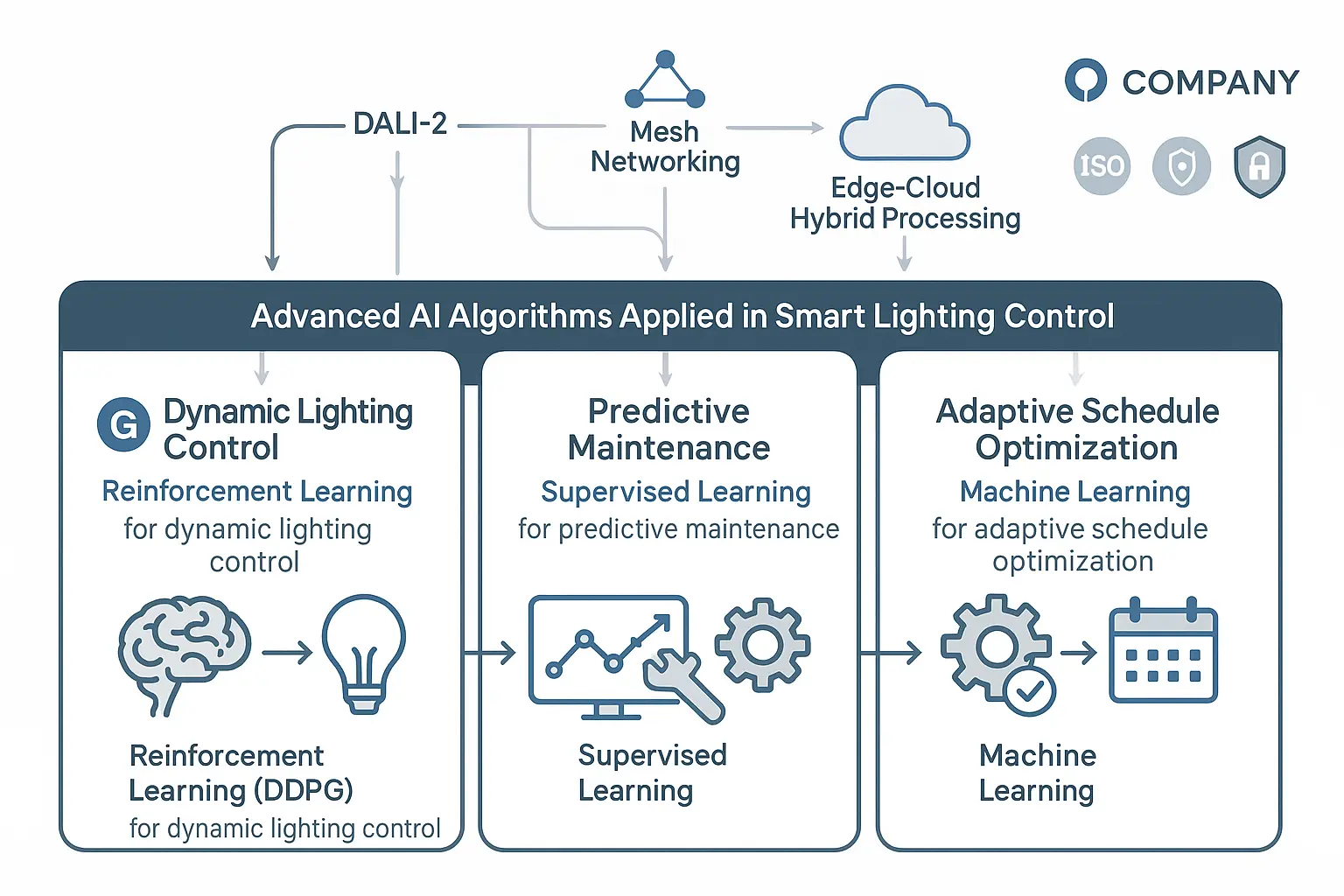
There is no one-size-fits-all approach to implementation. The right strategy depends on your building’s existing infrastructure, budget, and long-term goals. Here’s a breakdown of the three primary methods for powering and controlling a commercial smart lighting system.
1. Power over Ethernet (PoE)
- How it Works: Both power and data are delivered to light fixtures over a single standard Ethernet cable.
- Pros: Highly flexible and granular control. Easy to reconfigure spaces. Integrates natively with IT infrastructure.
- Cons: Higher upfront cost for PoE-enabled network switches and fixtures. Limited power delivery per cable can constrain fixture wattage.
- Best For: New construction or gut renovations of modern office spaces where flexibility and deep data integration are top priorities.
2. Intelligent Low Voltage DC Power Distribution
- How it Works: A central driver converts AC power to low-voltage DC, which is then distributed to multiple fixtures. Data is typically handled by a wireless mesh network.
- Pros: Highly energy-efficient, saving up to 20% of energy by eliminating redundant AC-to-DC conversions in every fixture. Safer to install and maintain.
- Cons: Requires specialized DC power infrastructure. May be less familiar to traditional electrical contractors.
- Best For: Large-scale new builds or retrofits where maximizing energy efficiency is the absolute primary goal, such as warehouses, data centers, and sustainable building projects.
3. Intelligent High Voltage AC Power Distribution
- How it Works: Utilizes existing AC wiring. Smart functionality is added through wireless controls, smart fixtures, and connected sensors that communicate over a mesh network.
- Pros: Lower installation cost and complexity, especially for retrofits. Leverages existing infrastructure.
- Cons: Less granular control than PoE. Can be less energy efficient due to multiple power conversions.
- Best For: Retrofitting existing commercial buildings where minimizing disruption and upfront capital expenditure is crucial.
Top Brands & Solutions: A Comparative Guide for Commercial Spaces
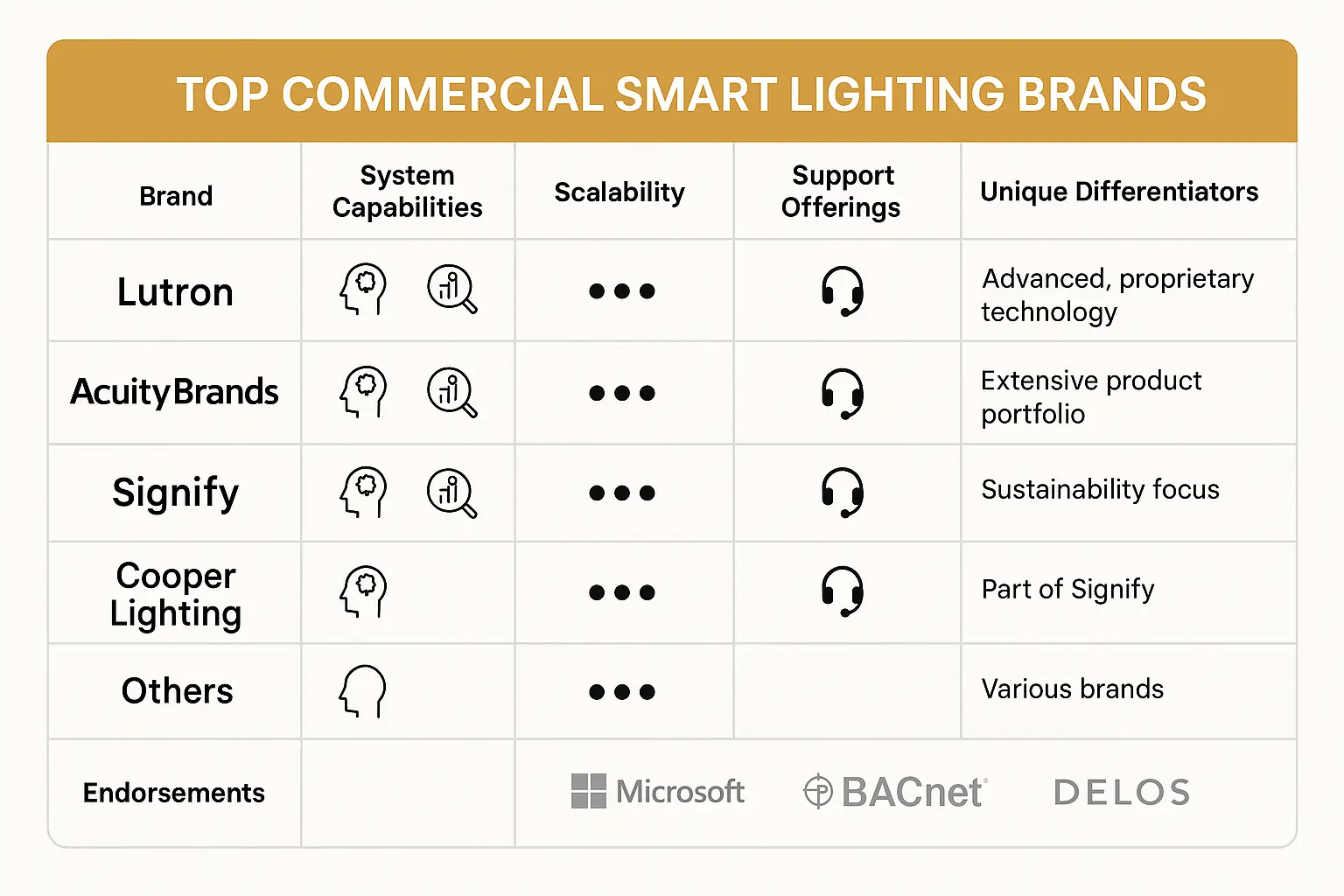
The market is crowded, but a few key players lead the way in commercial-grade solutions. When evaluating vendors, look beyond the hardware and focus on the intelligence of the platform, the ease of integration, and the quality of long-term support.
Your evaluation criteria should include:
- System Scalability: Can the system grow from a single floor to an entire portfolio of buildings without a complete overhaul?
- Integration Capabilities: Does it offer open APIs and certified partnerships with major BMS, HVAC, and security providers?
- Data & Analytics: What level of insight does the platform provide? Look for dashboards covering space utilization, energy consumption trends, and device health.
- Support & Future-Proofing: What is the vendor’s roadmap for future features? Do they provide robust support for a mission-critical system?
Navigating the Future: Emerging Trends & Untapped Opportunities
The evolution of intelligent lighting is accelerating. Staying ahead of these trends is key to future-proofing your investment.
- Generative AI in Lighting Design: AI will soon be able to design optimal lighting schemes based on architectural models, desired ambiance, and energy targets, creating highly personalized and adaptive environments.
- DC Microgrids & Resilience: As buildings generate and store more of their own renewable energy, intelligent DC-powered lighting systems will play a crucial role in creating resilient, self-sufficient DC microgrids.
- Cybersecurity as a Priority: As lighting systems become more connected, they also become potential vectors for cyberattacks. Choosing vendors with a robust, end-to-end security posture is non-negotiable.
Your Action Plan: Implementing AI-Optimized Smart Lighting
Moving from evaluation to implementation requires a structured approach.
- Conduct a Comprehensive Audit: Before you can plan for the future, you must understand the present. A professional [lighting system audit] will benchmark your current energy usage, identify areas of waste, and establish clear objectives for your upgrade.
- Define Your Strategy: Based on the audit, determine your primary goals. Is it maximum energy savings, enhanced occupant comfort, or deep BMS integration? This will guide your technology choices.
- Evaluate Vendors & Technologies: Use the frameworks in this guide to create a shortlist of solutions that match your architectural needs and strategic goals. Request detailed proposals and case studies.
- Plan for Phased Deployment: For large facilities, consider a pilot program on a single floor or area. This allows you to validate the technology, measure ROI, and refine your process before a full-scale rollout.
- Focus on Optimization: Installation is just the beginning. Work with your solution provider to continuously analyze the data and fine-tune the AI to unlock further efficiencies and capabilities over time.
Frequently Asked Questions
We’ve compiled answers to the most common questions and concerns we hear from facility managers, building owners, and IT directors during their evaluation process.
How complex is the integration with our existing Building Management System (BMS)?Leading smart lighting platforms are designed for integration. Look for solutions that use open standards like BACnet or offer well-documented APIs. A good provider will work directly with your team to ensure a seamless connection, allowing data to flow bi-directionally between the lighting system and your central BMS dashboard.
What are the biggest risks of vendor lock-in, and how can we avoid it?Vendor lock-in occurs when you’re tied to a single manufacturer’s proprietary hardware and software. To mitigate this, prioritize systems built on open protocols (like DALI-2, Zigbee 3.0, or the emerging Matter standard). This gives you the future flexibility to incorporate devices from different manufacturers into your ecosystem.
How do you ensure the system is scalable for our entire portfolio?Scalability depends on the network architecture and the cloud platform. A hybrid edge-cloud architecture is inherently scalable, as it can manage tens of thousands of devices across multiple locations from a single interface. Ask potential vendors for case studies of large-scale, multi-building deployments.
What are the cybersecurity implications of a networked lighting system?This is a critical concern. Your lighting network is part of your IT infrastructure. Insist on solutions with end-to-end encryption, regular security patching, secure boot processes on hardware, and role-based access control. The vendor should be able to provide detailed documentation on their security policies and procedures.
What kind of long-term support and maintenance should we expect?A commercial lighting system is a long-term asset, not a one-time purchase. Your agreement should include a comprehensive service level agreement (SLA) that covers software updates, security patches, hardware warranties, and access to technical support. Ensure you understand the long-term support model before signing a contract.
Illuminate Your Business’s Future with Intelligence
Moving to an AI-optimized lighting system is one of the highest-impact upgrades you can make to a commercial building. It delivers immediate and substantial energy and operational savings, while simultaneously creating healthier, more productive environments for occupants. More importantly, it lays the foundation for a truly intelligent, efficient, and future-ready building.
By focusing on the underlying AI technology, network architecture, and integration potential, you can confidently choose a solution that delivers value for decades to come.
