
Is your commercial property’s energy strategy still based on passively paying a utility bill? In today’s volatile market, that approach is no longer just inefficient—it’s a significant financial liability. With escalating energy costs, stringent sustainability mandates, and an increasingly fragile grid, the old model of energy consumption is broken.
The shift is already happening. Forward-thinking commercial real estate (CRE) leaders are no longer just consuming energy; they are becoming active, intelligent participants in the energy market. The tool enabling this transformation isn’t just another piece of hardware—it’s artificial intelligence.
This isn’t about simply dimming the lights. It’s about turning your portfolio’s largest operational expense into a dynamic, revenue-generating asset. This guide will walk you through the practical strategies and underlying technology you need to evaluate, moving beyond high-level concepts to the specific ways AI can master market volatility, unlock new revenue streams, and future-proof your assets.
The New Energy Imperative: Why Passive Management is a Losing Strategy
The pressure on commercial buildings has never been more intense. You’re facing a perfect storm of challenges that demand a more sophisticated response:
- Intensifying Costs & Volatility: Energy expenses are a top concern, with many CRE operators seeing unpredictable spikes that disrupt budgets. The fundamental dynamics of the grid are changing.
- Demanding ESG Mandates: Stakeholders, tenants, and regulators now require demonstrable progress on decarbonization. Vague commitments are no longer enough; you need quantifiable results.
- Unprecedented Grid Strain: The demand for electricity is soaring, driven in part by the very technology we’re discussing. AI data centers alone are projected to triple their energy demand by 2030, adding 140 GW to the peak load (S&P Global, Bismarck Analysis). This creates immense strain but also a massive opportunity for buildings that can provide stability and capacity.
AI-powered systems cut through this complexity. They don’t just react—they predict, optimize, and transact on your behalf, turning challenges into financial opportunities. With AI’s ability to reduce building energy waste by up to 30% (KPMG, 2025), the question is no longer if you should adopt these solutions, but how quickly you can get ahead of the curve.
AI-Powered Energy Procurement: Mastering Market Volatility
For most buildings, energy procurement is a static, reactive process: sign a long-term contract and hope for the best. AI transforms this into a dynamic, proactive financial strategy. It moves you from being a price-taker to a market-master.
Beyond the Basic Contract
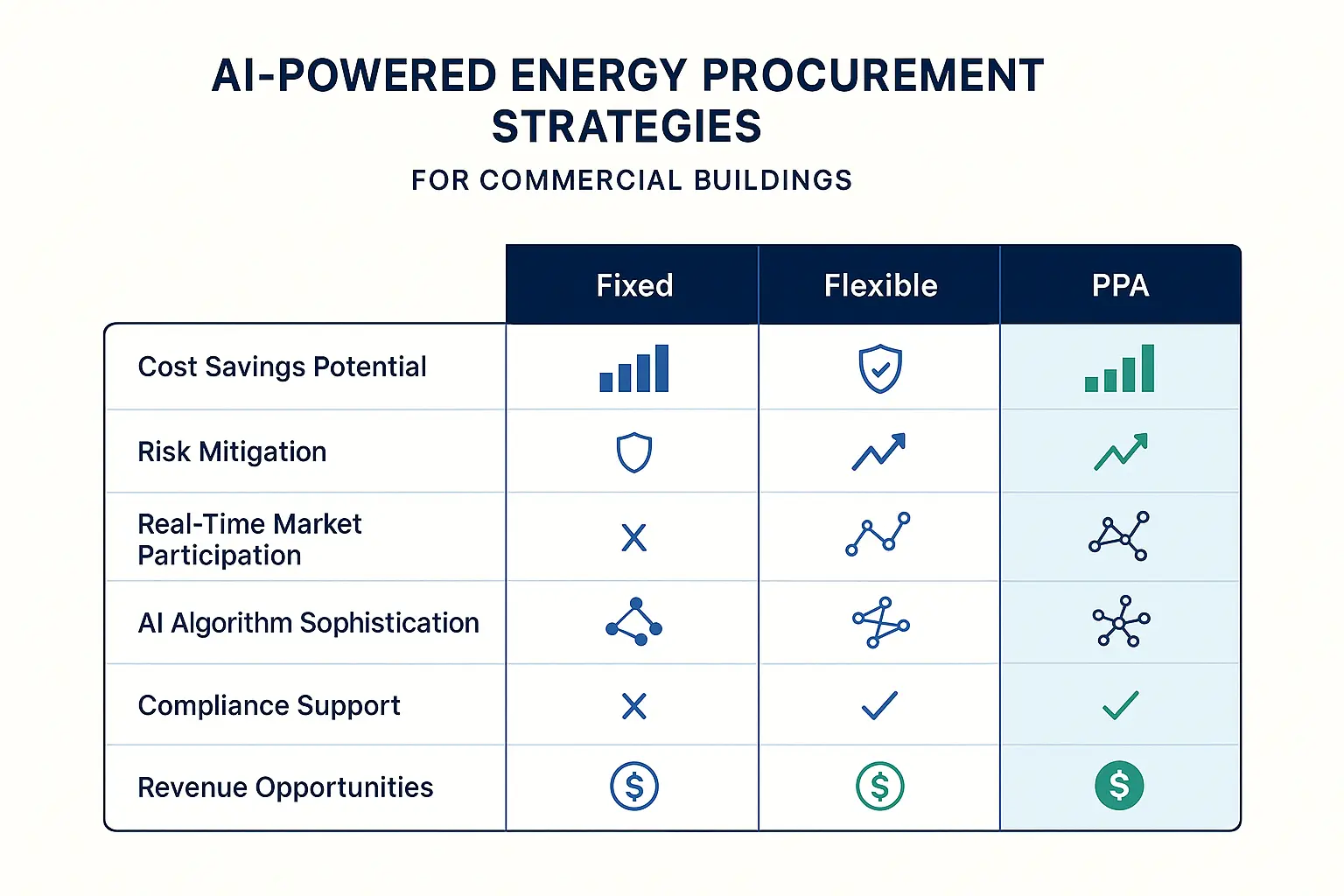
AI analyzes thousands of data points—historical usage, weather forecasts, market trends, and regulatory changes—to optimize your procurement strategy. This isn’t just about finding the cheapest rate; it’s about structuring the right blend of contracts. This could mean a flexible contract for one building and a strategic Power Purchase Agreement (PPA) for another, all managed within a single, intelligent platform. The goal is to move beyond a one-size-fits-all approach to a portfolio-wide strategy that hedges risk and maximizes savings.
Dynamic Pricing and Real-Time Market Interaction
The real game-changer is AI’s ability to engage with real-time energy markets. Instead of being locked into a flat rate, an AI-powered system can:
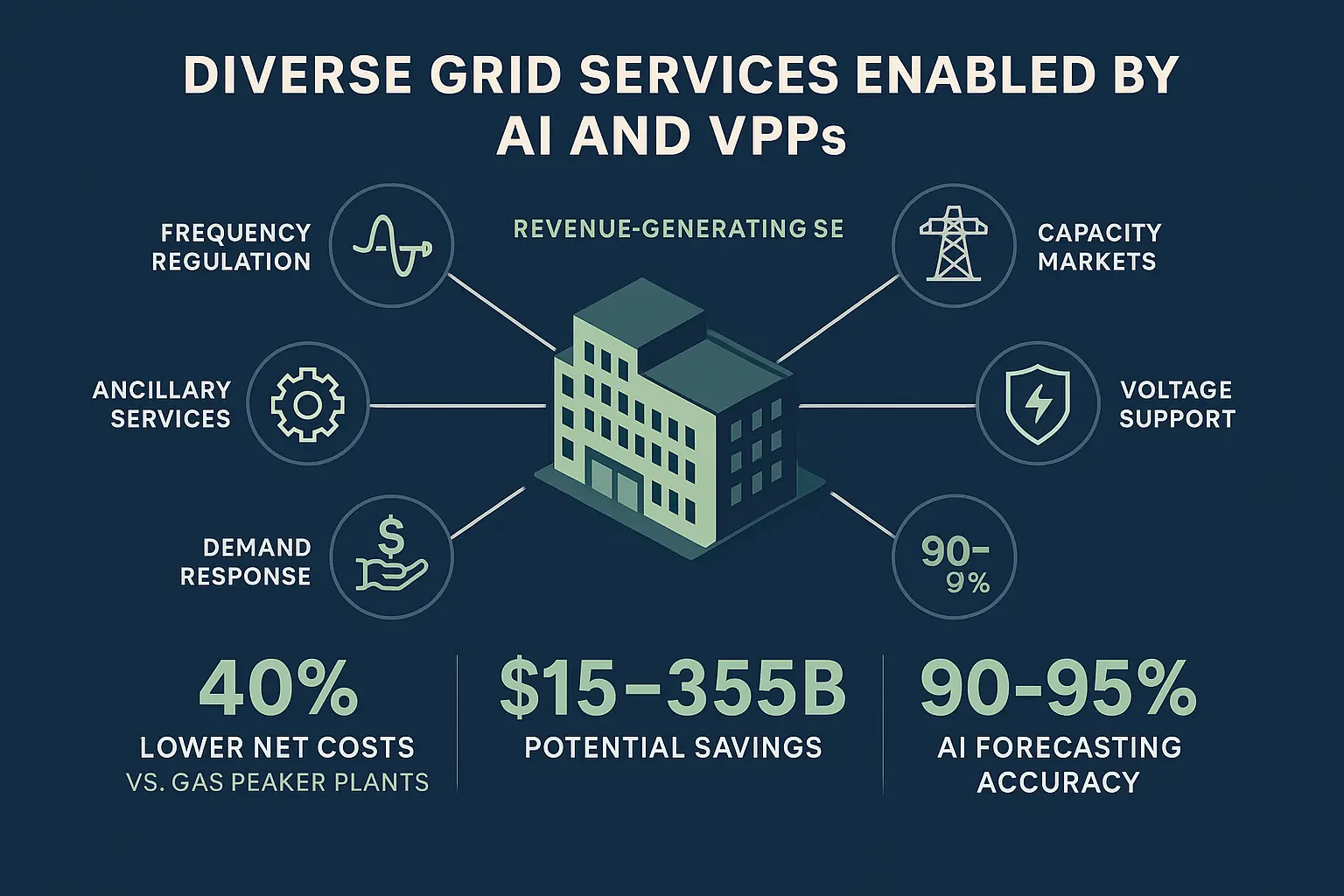
- Predict Price Spikes: Using machine learning models with 90-95% accuracy (Verde Solutions), the system can foresee periods of high cost and proactively reduce consumption.
- Execute Optimal Trades: In markets with dynamic pricing, the AI can automatically purchase electricity when it’s cheapest (e.g., overnight) to charge onsite batteries or pre-cool a building, avoiding peak prices entirely.
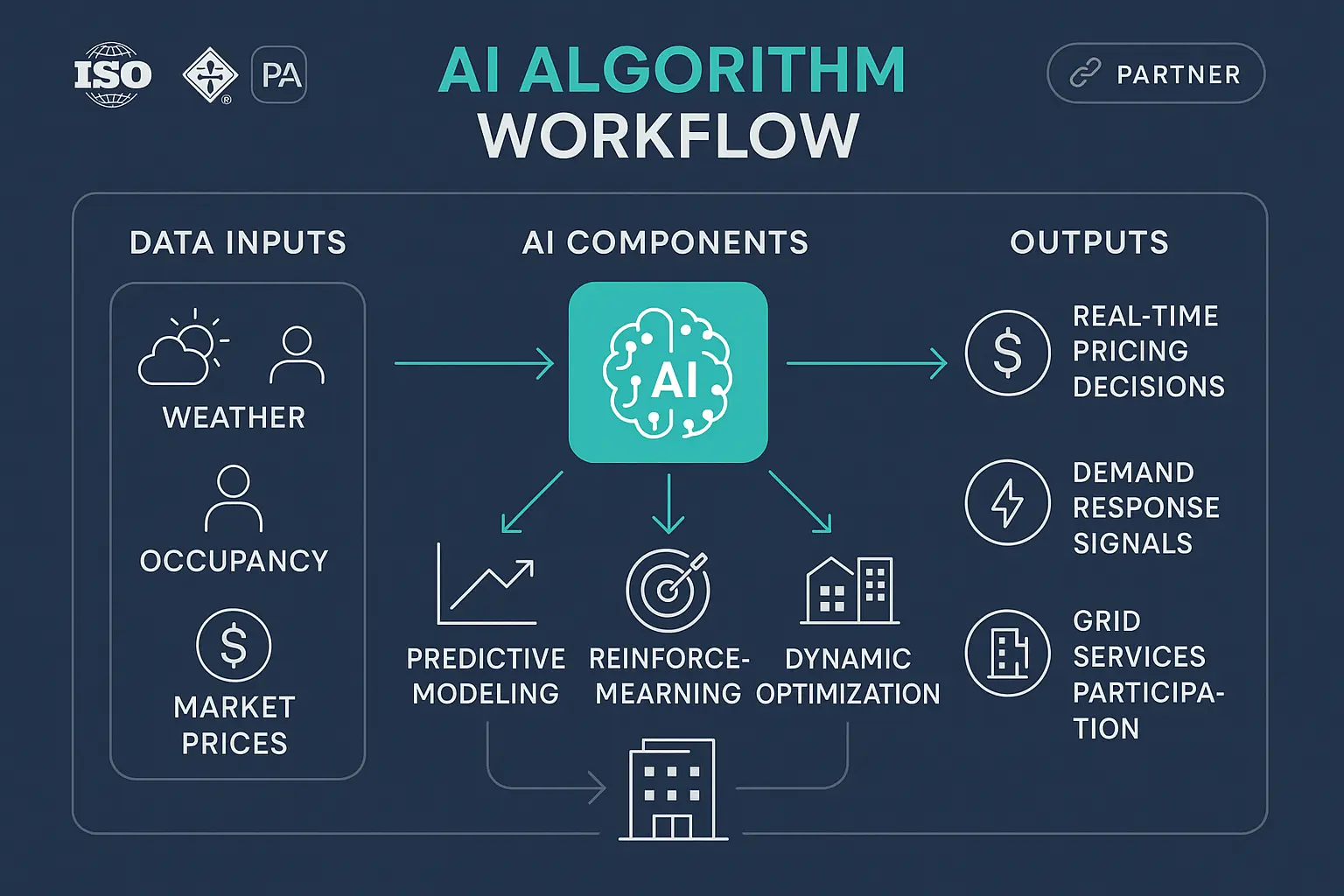
- Leverage Reinforcement Learning: Think of this as an expert energy trader working 24/7. Through continuous trial and error in simulated environments, the AI learns the most profitable buying and selling strategies for your specific assets and market, constantly adapting to new conditions.
Commercial Buildings as Active Grid Participants: Unlocking New Revenue
The most significant shift AI enables is turning your building from a simple energy consumer into an active grid participant—a prosumer that both consumes and provides energy services for profit. This is where you unlock entirely new revenue streams that go straight to your bottom line.
Advanced Demand Response: More Than Just Peak Shaving
Traditional demand response is a blunt instrument: you get paid to curtail energy use during a few peak events per year. AI enables a far more sophisticated and lucrative approach. By integrating with grid operator signals, your building can automatically participate in a variety of ancillary services markets, such as:
- Frequency Regulation: Making micro-adjustments to your energy consumption or battery discharge to help keep the grid’s frequency stable. You get paid continuously for being available to provide this service.
- Capacity Markets: Committing to be available to reduce load or provide power during critical periods, securing consistent capacity payments regardless of whether you are dispatched.
Virtual Power Plants (VPPs) for Commercial Real Estate
A Virtual Power Plant is the ultimate expression of active energy management. An AI platform aggregates your building’s Distributed Energy Resources (DERs)—like solar panels, battery storage, EV chargers, and even smart thermostats and controllable HVAC systems—with those of other buildings.
This aggregated portfolio is then operated as a single, dispatchable power plant. Instead of one building offering a small amount of load flexibility, the VPP can offer megawatts of capacity, reliability, and clean energy to the grid. The financial benefits are compelling: VPPs offer 40% lower net costs than traditional gas peaker plants and can deliver grid-wide savings of $15B-$35B (The Brattle Group, May 2023). For you, this means consistent revenue payments for contributing your assets to the VPP, all managed seamlessly by the AI without disrupting tenant comfort.
The Technical Edge: AI Algorithms & Overlooked Opportunities
Many solutions claim to use “AI,” but the sophistication of the underlying technology determines the results. When evaluating options, it’s crucial to look beyond the marketing buzzwords and understand the technical differentiators that deliver real value.
Predictive Modeling & Dynamic Optimization
At its core, a powerful energy AI relies on two functions. First, predictive modeling uses machine learning to forecast energy load, generation from solar, and market prices with incredible accuracy. Second, dynamic optimization algorithms act on these predictions. This is the technology that allowed Google’s DeepMind to simultaneously analyze weather, occupancy, and equipment settings to reduce its data center cooling costs by 40%. The same principle applies to your building, orchestrating HVAC, lighting, and battery charging to hit the perfect balance of cost, comfort, and grid revenue.
The Untapped Potential of Digital Twins
A digital twin is a virtual, real-time model of your building. While many have heard of them, their practical deployment for energy management remains limited (Vert Energy Group, 2025). Advanced AI platforms leverage digital twins as a risk-free environment to simulate and validate energy strategies. Before deploying a new demand response tactic or adjusting HVAC setpoints in the real world, the AI can test thousands of scenarios in the digital twin to guarantee the optimal financial outcome without impacting operations.
Closing the Grid Integration Gap
Finally, truly advanced AI goes beyond the obvious. While many systems focus on HVAC and lighting, a huge amount of optimization potential lies in other building systems like elevators, water heating, and industrial plug loads (ACEEE, 2025). A comprehensive solution integrates with and optimizes these underserved assets, unlocking deeper savings and more significant opportunities for grid service participation.
Implementation Roadmap: From Concept to Commercial Advantage
Adopting an AI-powered energy strategy doesn’t have to be a disruptive overhaul. A strategic, phased approach ensures a smooth transition and rapid time-to-value.
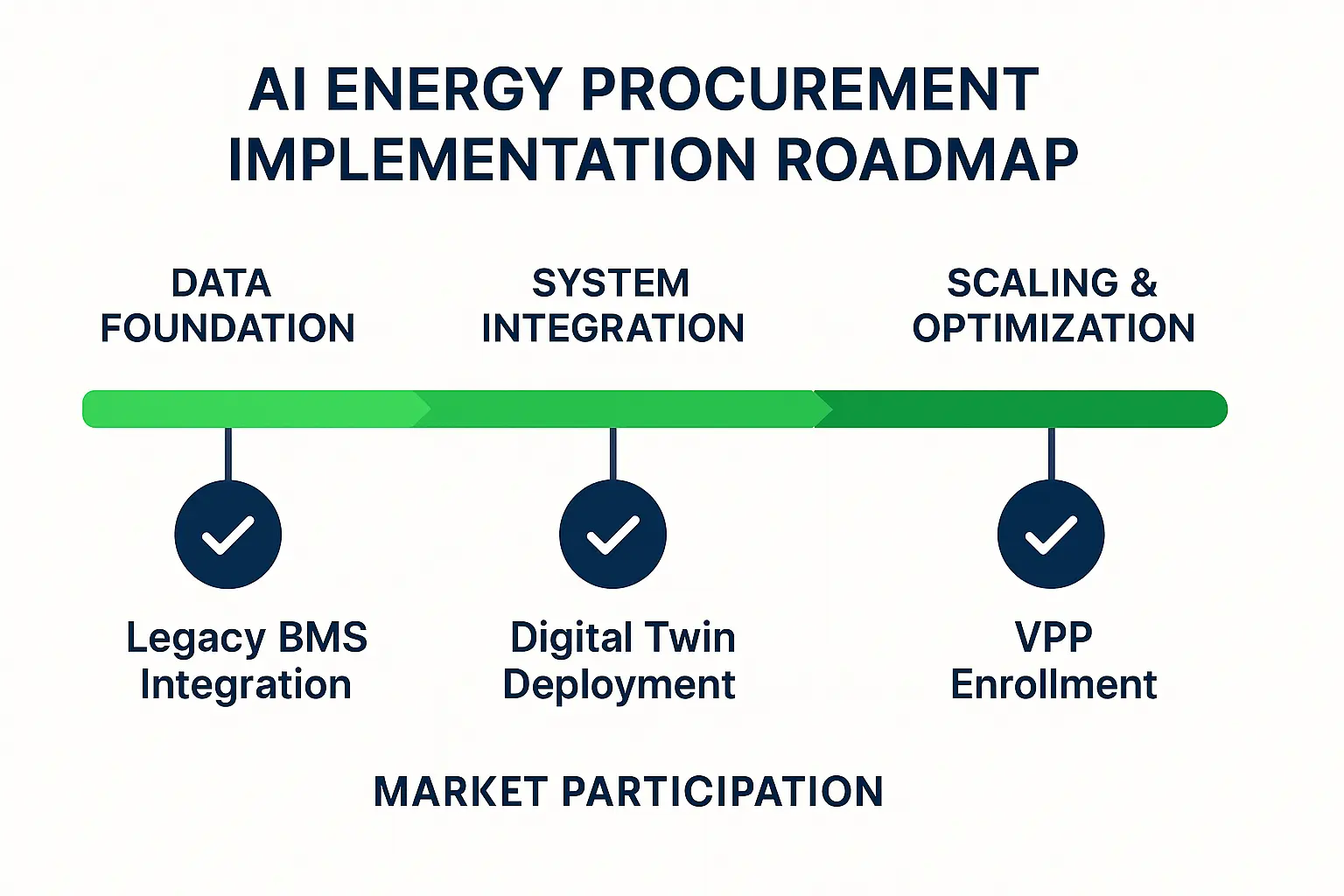
- Establish the Data Foundation: The first step is integrating with your existing Building Management System (BMS), utility meters, and any onsite DERs. A robust AI platform can work with messy data, cleaning and structuring it to create a reliable baseline.
- Deploy Predictive Analytics & Optimization: Once the data is flowing, the AI begins learning your building’s unique energy patterns. You’ll quickly see savings from initial optimizations in HVAC and lighting, providing an immediate return on investment.
- Activate Market Participation: With the system optimized for internal efficiency, the next phase is to connect it to external markets. This involves enrolling in advanced demand response programs and, where applicable, joining a virtual power plant (VPP) to begin generating revenue.
- Scale & Evolve: The AI continuously learns and improves. Over time, you can integrate more assets (like a new EV charging fleet) and participate in more sophisticated grid services, constantly expanding your building’s financial performance.
Frequently Asked Questions
What if my building’s data is messy or incomplete?
This is a common and solvable challenge. Modern AI platforms are designed with sophisticated data ingestion and cleansing tools. They can identify and fill gaps, flag anomalies, and integrate data from disparate sources (BMS, submeters, utility portals) to create a single source of truth for optimization.
How much upfront investment is required?
This varies, but many providers now offer “as-a-service” models, such as software subscriptions or shared savings agreements. These models minimize or eliminate upfront capital expenditure, tying the provider’s compensation directly to the savings and revenue they generate for you, which significantly de-risks the investment.
Will this interfere with tenant comfort or critical operations?
No. Tenant comfort and safety are primary constraints programmed into the AI. The system operates within set parameters for temperature, air quality, and operational uptime. All optimization strategies are designed to be imperceptible to occupants while delivering maximum financial benefit.
How do I get buy-in from my facilities team and leadership?
The key is to frame the investment around financial outcomes. Start with a clear business case highlighting projected cost savings, new revenue streams, and risk mitigation against volatile energy prices. For facilities teams, emphasize how AI automates tedious manual analysis, freeing them to focus on strategic maintenance and higher-value tasks. For leadership, focus on the direct impact on Net Operating Income (NOI) and improved ESG scores.
The Future is Active, Not Passive
The era of treating commercial buildings as passive energy consumers is over. The technology, the market mechanisms, and the financial incentives are all aligned to empower your portfolio as a key player in the new energy economy.
By leveraging AI, you can move beyond simple efficiency measures to master energy procurement, participate directly in grid services, and generate predictable, high-margin revenue. This transformation builds financial resilience, achieves critical sustainability goals, and secures a significant competitive advantage for years to come.
Ready to explore how your portfolio can transition from a cost center to a profit center? Schedule a personalized energy strategy assessment with our experts today to identify the specific revenue opportunities hidden in your buildings.
