
The Architect’s Playbook: Choosing the Right AI Agent Design for Scalable Impact
You’ve seen the potential. With the AI agent market projected to hit nearly $50 billion by 2030 and 79% of executives already reporting adoption, the question is no longer if you should build AI agents, but how. The internet is flooded with basic tutorials on frameworks like LangChain or AutoGen, but they often skip the most critical step: choosing the right underlying architecture.
Picking an architecture isn’t just a technical detail—it’s the foundation that determines whether your agent will be a simple script, a powerful autonomous system, or a collaborative team of specialists. Get it right, and you unlock the productivity gains and speed-to-market improvements seen by top performers. Get it wrong, and you’re left with a brittle, unscalable system that can’t adapt to real-world complexity.
This guide is your architect’s playbook. We’ll move beyond the surface-level framework comparisons to dissect the foundational blueprints for AI agents. You’ll gain the clarity needed to evaluate different models, understand their trade-offs, and confidently select the architecture that aligns with your specific business goals.
Decoding the DNA of AI Agents: Core Components & Foundational Principles
Before we can build a house, we need to understand the materials. An AI agent, at its core, is a system designed to perceive its environment, make decisions, and take actions to achieve a specific goal. While the tools and models are evolving rapidly, the fundamental components remain consistent.
This process is often visualized as a continuous loop—a cycle of observation, thought, and action that powers intelligent behavior.
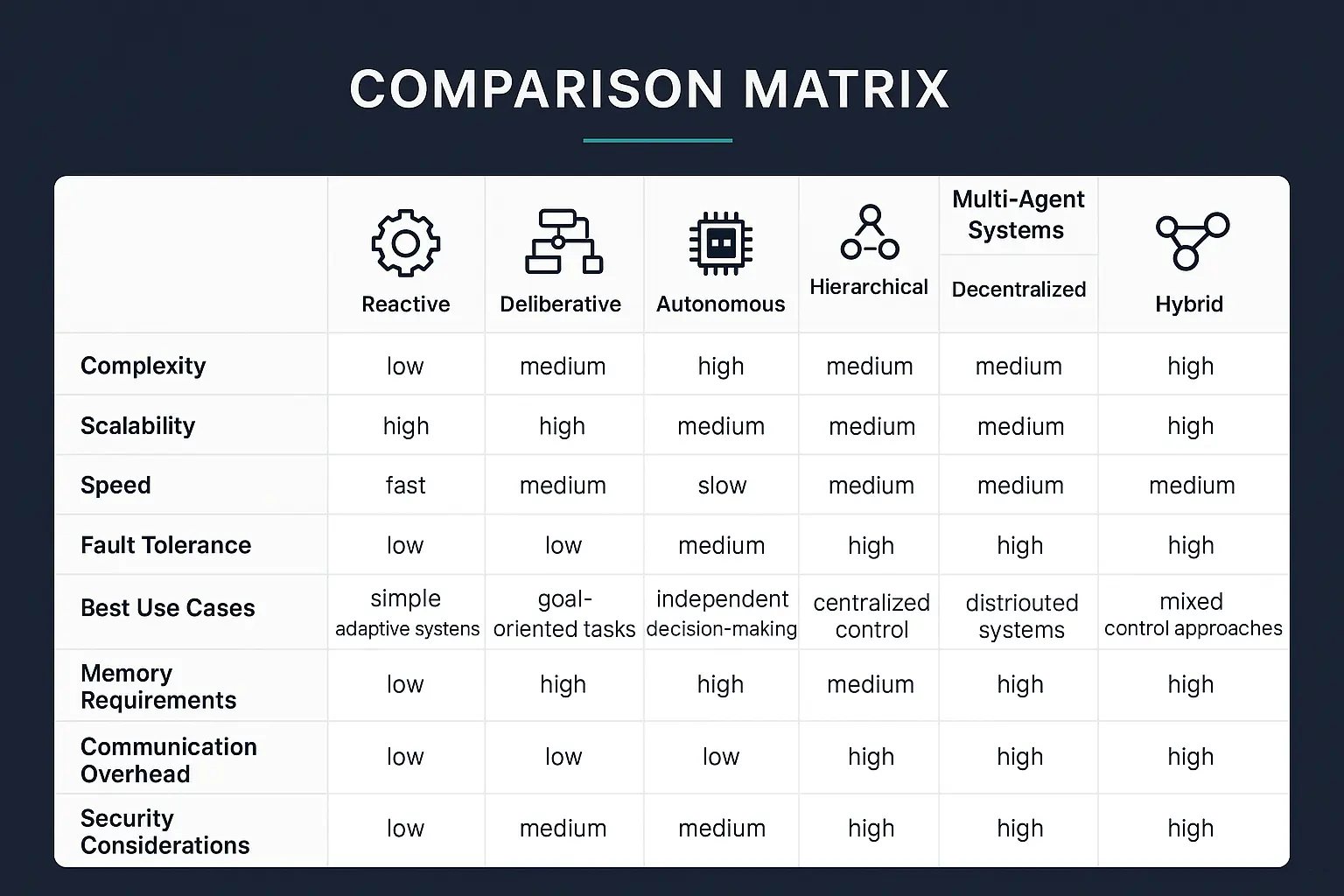
The agent’s effectiveness is governed by a set of key design principles:
- Autonomy: The ability to operate without direct human intervention. This is the cornerstone of scaling agentic workflows.
- Goal-Oriented: Every action is driven by a clear objective, ensuring the agent’s work remains aligned with business needs.
- Adaptability: The capacity to learn from feedback and adjust its strategy in dynamic environments.
- Specialization: Designing agents to excel at specific tasks (e.g., data analysis, coding, customer communication) often yields better results than a single, generalist agent.
- Tool Integration: The power of an agent is magnified by the external tools it can use, from APIs and databases to web browsers.
- Human-in-the-Loop: A critical principle for maintaining control, providing oversight, and handling edge cases where human judgment is irreplaceable.
Architectural Paradigms: Choosing the Right Blueprint for Your AI Agent
The true art of agent design lies in selecting the right architectural paradigm. This choice dictates how an agent thinks, reacts, and collaborates. While top resources from AWS and Salesforce define autonomous agents, and IBM explains agentic frameworks, a direct, practical comparison of these models is often missing.
Here’s a breakdown of the primary architectural blueprints, moving from simplest to most complex.
Reactive Architectures
The simplest form of AI agent. It operates on a direct condition-action rule (if X happens, do Y). It doesn’t maintain a memory of past events or plan for the future.
- Best for: Simple, repetitive tasks like basic customer service chatbots or content moderation filters.
- Limitation: Fails in complex scenarios that require context or long-term planning.
Deliberative Architectures
A more sophisticated model that builds an internal representation of its world. It can analyze the current state, consider future possibilities, and create a plan to achieve its goals.
- Best for: Problems requiring planning and reasoning, such as logistics optimization, financial modeling, or complex travel itinerary creation.
- Limitation: Can be slower to respond as it requires time for deliberation, making it less suitable for real-time applications.
Autonomous Agent Architectures
This isn’t just a single architecture but an evolution of deliberative models with a higher degree of self-governance. An autonomous agent can set its own sub-goals, learn from experience, and operate over long periods to achieve a high-level objective with minimal human input. This is the paradigm that’s capturing the attention of enterprise leaders, driving the 88% of companies planning to increase AI budgets.
Multi-Agent Systems (MAS): The Power of Collaboration
Why use one agent when you can have a team? A Multi-Agent System orchestrates multiple, often specialized, agents to tackle problems that are too large or complex for a single agent. This is where the most significant business transformations are happening, with adopters reporting a median 23% gain in speed-to-market.
MAS itself has several architectural patterns:
- Hierarchical: A “manager” agent breaks down a task and assigns sub-tasks to “worker” agents. Ideal for structured workflows like report generation.
- Centralized: A single orchestrator controls the flow of information and tasks between agents, ensuring consistency. Useful for complex projects requiring tight coordination.
- Decentralized (Swarm): Agents communicate and collaborate as peers without a central authority. This model fosters emergent behavior and is excellent for brainstorming, market simulation, or distributed problem-solving.
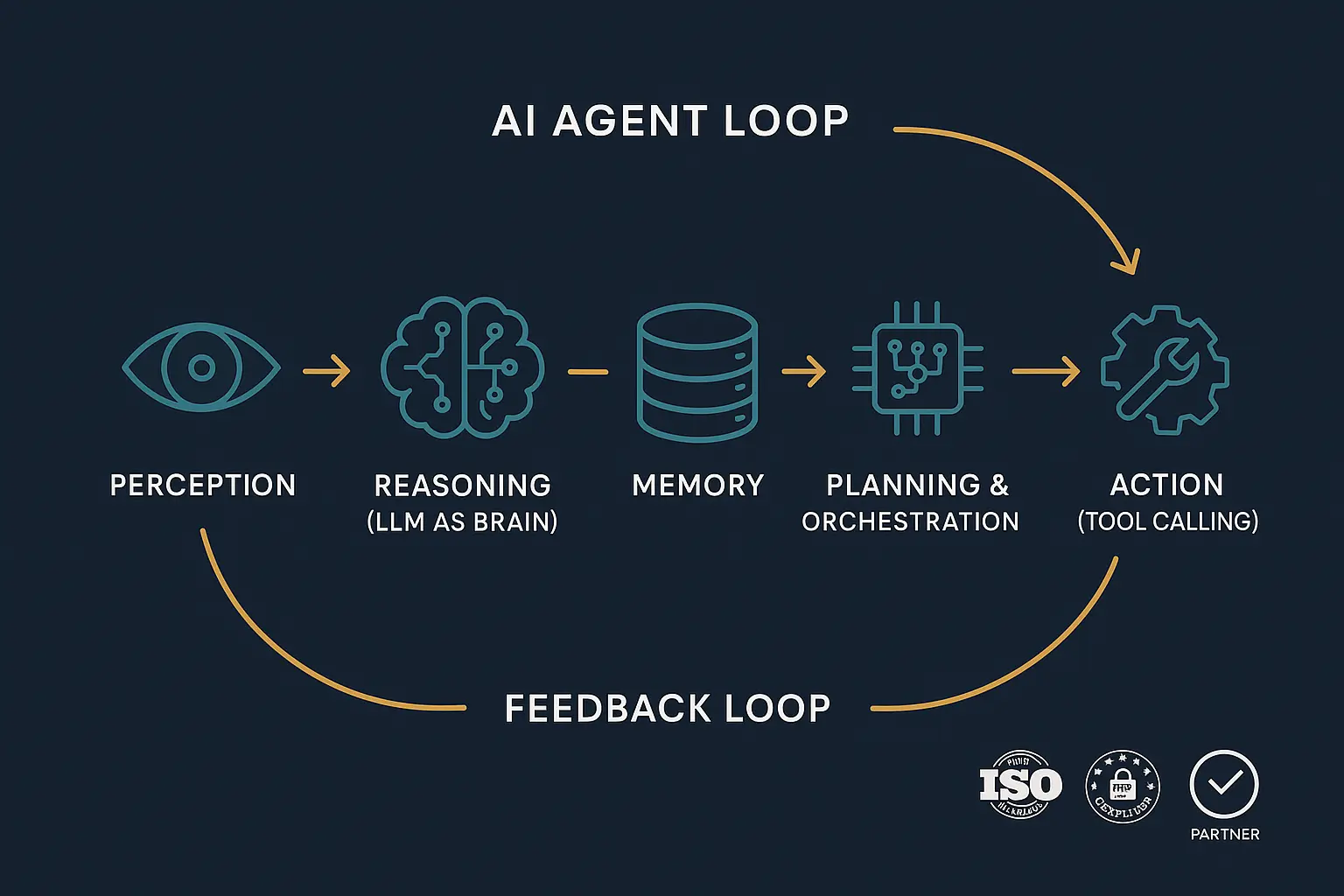
To help you decide, we’ve created a comprehensive matrix comparing these architectural paradigms across key decision criteria.
Deep Dive into Overlooked Technical Details & Advanced Design Considerations
Building a proof-of-concept is one thing; deploying a reliable, secure, and scalable agentic system is another. Many guides gloss over the critical engineering challenges that make or break a production-level deployment. This is where deep architectural expertise becomes non-negotiable.
Inter-Agent Communication Protocols
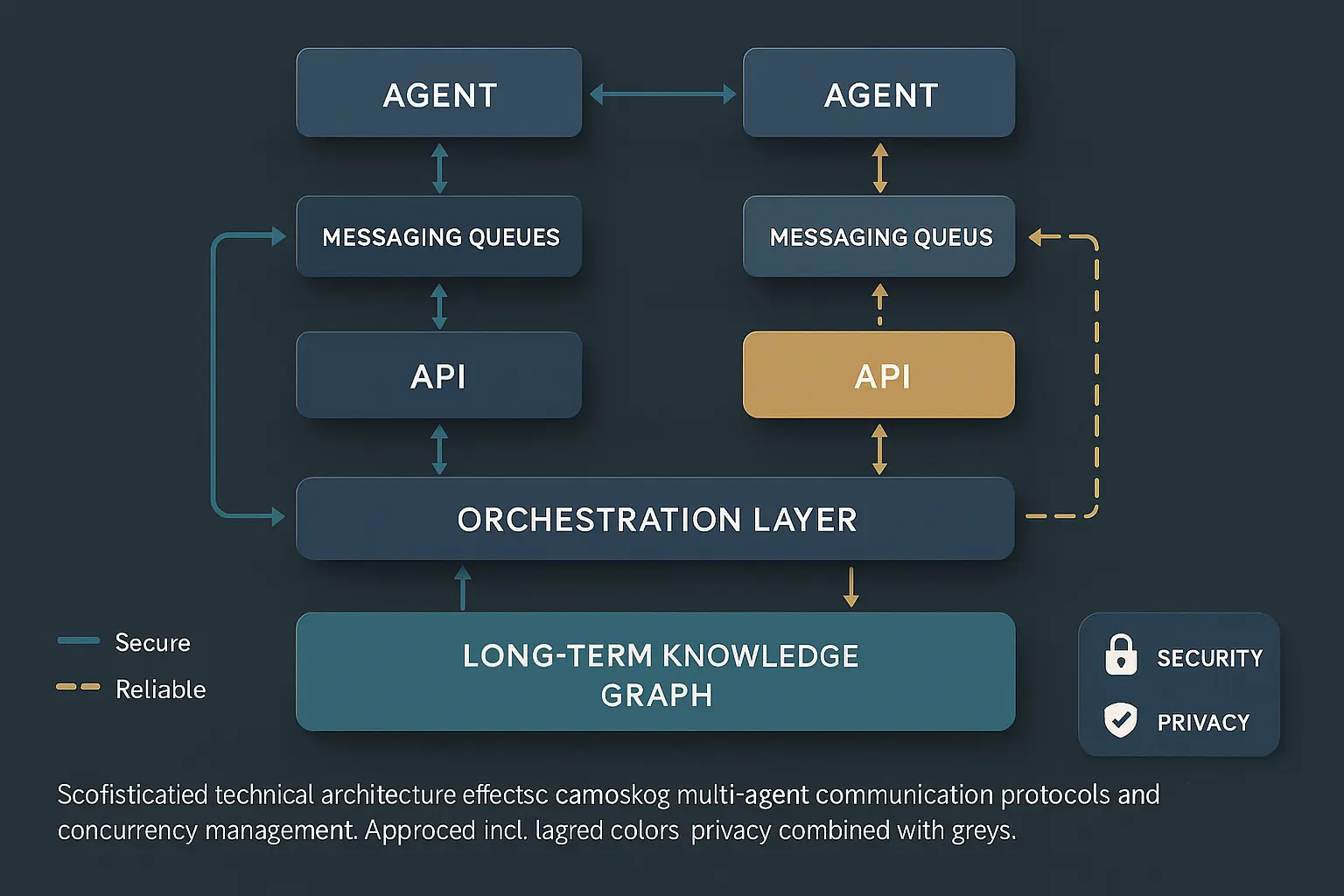
In a multi-agent system, how do agents actually talk to each other? Simply passing text back and forth is inefficient and prone to errors. Robust systems use structured data formats (like JSON), dedicated messaging queues, or API contracts to ensure information is exchanged reliably. This is a core challenge in designing robust multi-agent systems.
Concurrency and State Management
When multiple agents operate in parallel, how do you prevent them from overwriting each other’s work or making decisions based on outdated information? Advanced architectures implement sophisticated state management and locking mechanisms to handle concurrency, ensuring data integrity and consistent performance.
Advanced Memory Architectures
An agent’s memory is its source of context and learning. While basic agents rely on the limited context window of an LLM, production-grade systems require more. This involves implementing a hierarchy of memory:
- Working Memory: For short-term task context.
- Episodic Memory: A long-term store of past interactions and outcomes, allowing the agent to learn from experience.
- Knowledge Graphs & Vector Databases: For storing and retrieving vast amounts of domain-specific information efficiently.Exploring advanced agent memory solutions is key to building truly intelligent agents.
Robust Error Handling & Observability
What happens when an agent fails or an external tool is unavailable? A resilient architecture includes comprehensive logging, monitoring, and error-handling routines. It can detect failures, attempt retries with different strategies, and alert a human supervisor when necessary. This level of observability is crucial for debugging and maintaining trust in the system.
Leading Frameworks & Implementation Patterns: A Practical Guide
Frameworks like AutoGen, CrewAI, and LangChain are powerful tools for accelerating development. However, they are not architectures themselves; they are toolkits that help you implement an architecture. The mistake many teams make is picking a framework before they’ve chosen their architectural blueprint.
Your architectural choice should guide your framework selection, not the other way around.
- Building a Hierarchical MAS? Microsoft’s AutoGen or CrewAI, with their clear structures for agent collaboration, could be a great fit.
- Need a flexible, single Deliberative Agent? LangChain’s Expression Language (LCEL) provides the building blocks for creating complex chains of logic.
- Focusing on an ecosystem like Azure? Semantic Kernel might offer the tightest integration.
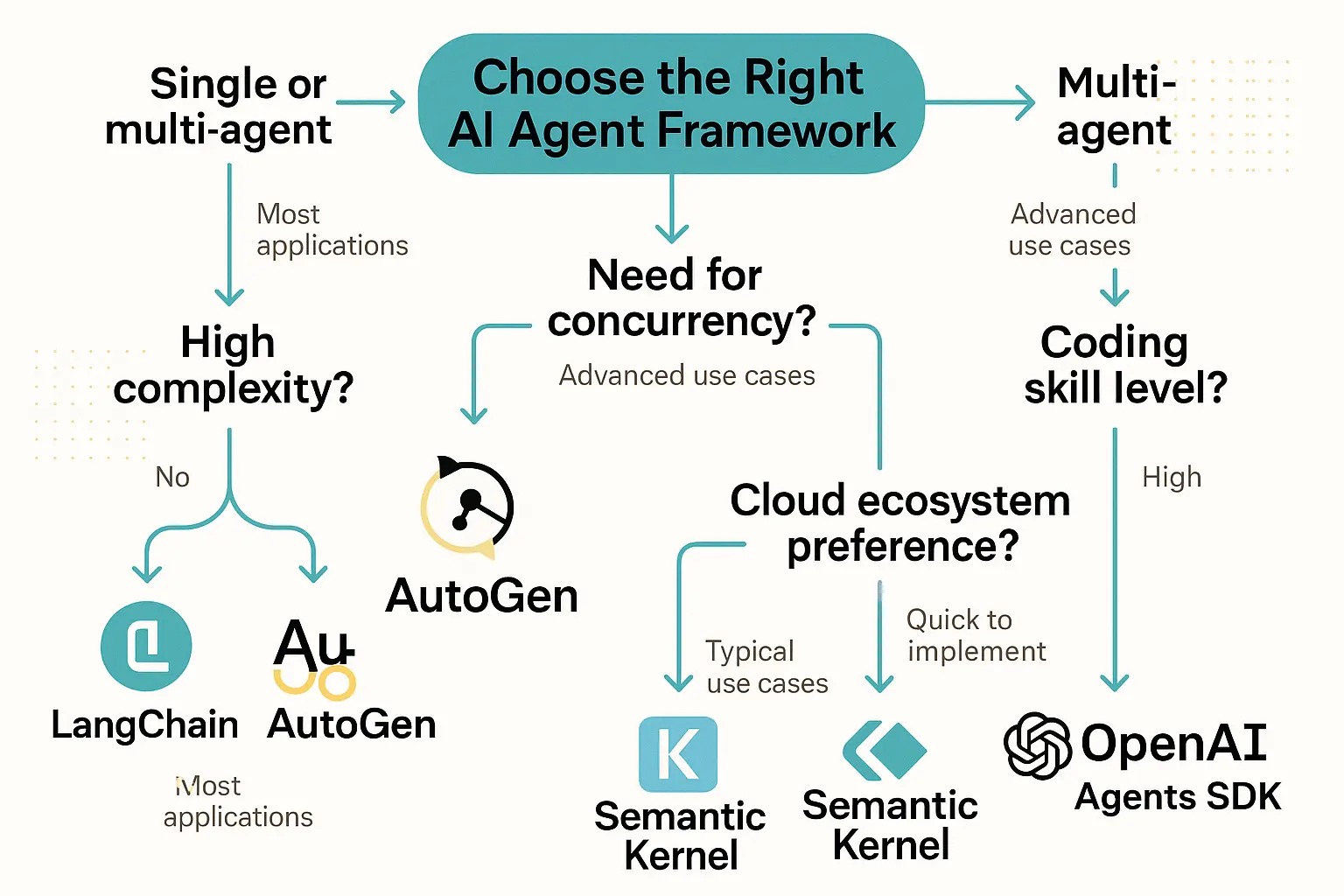
To simplify this critical decision, use this decision tree to map your project requirements to the most suitable starting point.
Frequently Asked Questions (FAQ)
Q: How do I justify the ROI of building a complex multi-agent system over a simpler one?
The justification lies in tackling problems that are impossible for a single agent and unlocking exponential gains. While a single agent might automate a task, a multi-agent system can automate an entire workflow. The data supports this: G2 research found a median 23% speed-to-market gain, and two-thirds of adopters in a PwC survey reported measurable productivity improvements. The ROI comes from scalability, robustness (if one agent fails, others can adapt), and the ability to solve higher-order business challenges.
Q: Aren’t autonomous agents a security risk? How do we balance autonomy and control?
This is a critical concern and must be addressed at the architectural level. A well-designed system never grants full, unchecked autonomy. The key is implementing strong guardrails:
- Tool Vetting: Strictly define and limit the tools and APIs an agent can access.
- Human-in-the-Loop (HITL): Designate critical decision points where human approval is required before an action is taken.
- Accountability Frameworks: Implement clear logging and monitoring to trace every action back to a specific agent and its reasoning process.Balancing autonomy and control is a core principle of securing your autonomous agents.
Q: What’s the biggest mistake companies make when designing their first AI agent?
The most common mistake is focusing on the Large Language Model (LLM) or a specific framework while neglecting the agent’s architecture. They build a powerful engine but put it in a poorly designed car. This leads to prototypes that are impressive in demos but fail to scale or adapt to real-world data and exceptions. Starting with a clear architectural plan prevents costly rework and ensures the foundation is solid enough to build upon.
Q: How do we move from a simple prototype to a production-ready agent?
The path from prototype to production is paved with robust engineering. It involves shifting focus from “can it work?” to “can it run reliably, securely, and at scale?” This means implementing the “overlooked details” we discussed: advanced error handling, comprehensive observability (logging and monitoring), scalable memory solutions, and concurrent processing capabilities. It’s about building a system that you can trust to operate without constant supervision.
Mastering Agent Architecture for Transformative Impact
The era of agentic AI is here, and the opportunity is immense. But capturing its true value requires moving beyond simple scripts and tutorials. It demands a deliberate, architectural approach.
By understanding the fundamental design principles, carefully evaluating architectural paradigms, and planning for production-level challenges from day one, you can build AI agent systems that are not just intelligent, but also resilient, scalable, and deeply aligned with your business objectives. The right blueprint doesn’t just get you started—it ensures you build something that lasts.
Ready to design the right AI agent architecture for your business? Schedule a consultation with our AI architects to translate your vision into a production-ready system.
