
Beyond the Buzz: A Practical Guide to Digital Twins and Simulation-Driven AI in Energy
You’re facing a critical inflection point. The energy grid is more complex than ever, strained by intermittent renewables, aging infrastructure, and rising consumer demands. At the same time, the pressure to hit aggressive sustainability targets and maintain operational resilience has never been higher. Traditional monitoring and management methods are showing their limits, leaving you looking for a solution that offers more than just incremental improvements.
You’ve heard the terms “Digital Twin” and “AI,” but you need to move past the definitions and understand the practical, operational reality. How do these technologies actually work together to solve tangible problems? How do you de-risk such a significant investment? This guide is designed to give you those answers, providing a clear framework for evaluating how this synergy can transform your energy system’s entire lifecycle, from initial design to daily operations.
What Does “Simulation-Driven AI” Actually Mean for Energy Systems?
Let’s first clarify a common point of confusion. A digital twin is far more than a 3D model or a simple dashboard. It is a dynamic, virtual replica of a physical asset or system—be it a wind turbine, a substation, or an entire grid—that is continuously updated with real-world data from sensors.
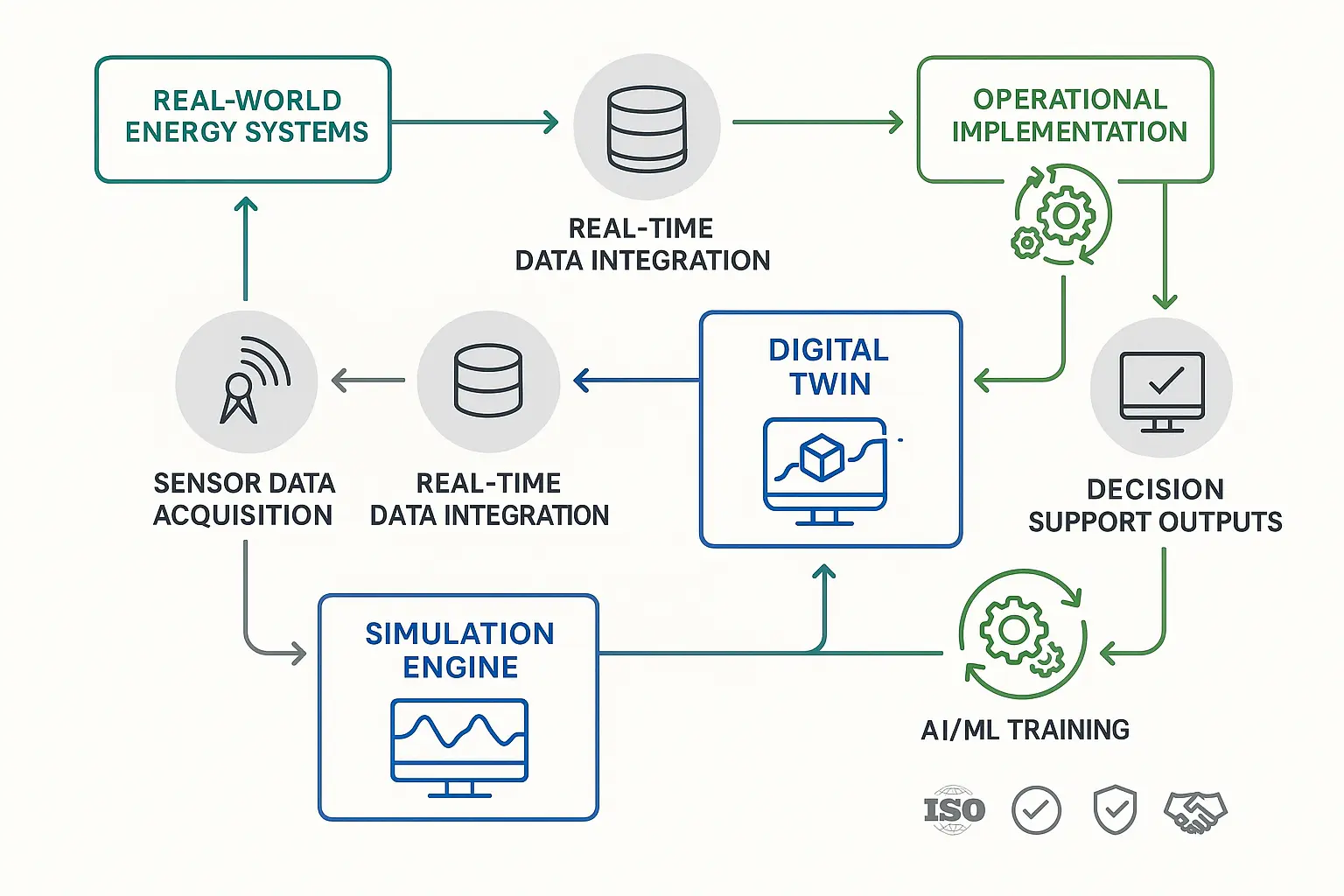
But the real transformation happens when you introduce simulation-driven AI. This isn’t just about applying AI to the data you have. It’s about creating a powerful feedback loop:
- Ingest: The digital twin pulls in real-time operational data (e.g., temperature, voltage, output, weather conditions).
- Simulate: This data feeds hyper-realistic simulations that can model thousands of potential future scenarios—what happens if demand spikes? What if a key transformer fails? What’s the impact of a sudden weather change?
- Train: AI and machine learning models are trained on the outputs of these countless simulations, not just on historical data. This allows them to learn the complex physics and operational nuances of your system with unparalleled depth.
- Predict & Prescribe: The refined AI can then make highly accurate predictions about future performance, potential failures, and grid instability. More importantly, it can prescribe the optimal actions to take, whether it’s adjusting a turbine’s pitch or re-routing power to prevent an outage.
This continuous cycle of real-world data feeding simulation, which in turn trains smarter AI, is what separates a truly intelligent system from a passive one. It’s the engine that powers the next generation of energy management.
Core Applications: From De-Risking Design to Optimizing Operations
When simulation and AI converge within a digital twin, the applications move from theoretical to profoundly practical. This approach fundamentally changes how you manage assets and plan for the future, delivering measurable results across the board.
Predictive Maintenance & Asset Lifecycle Management
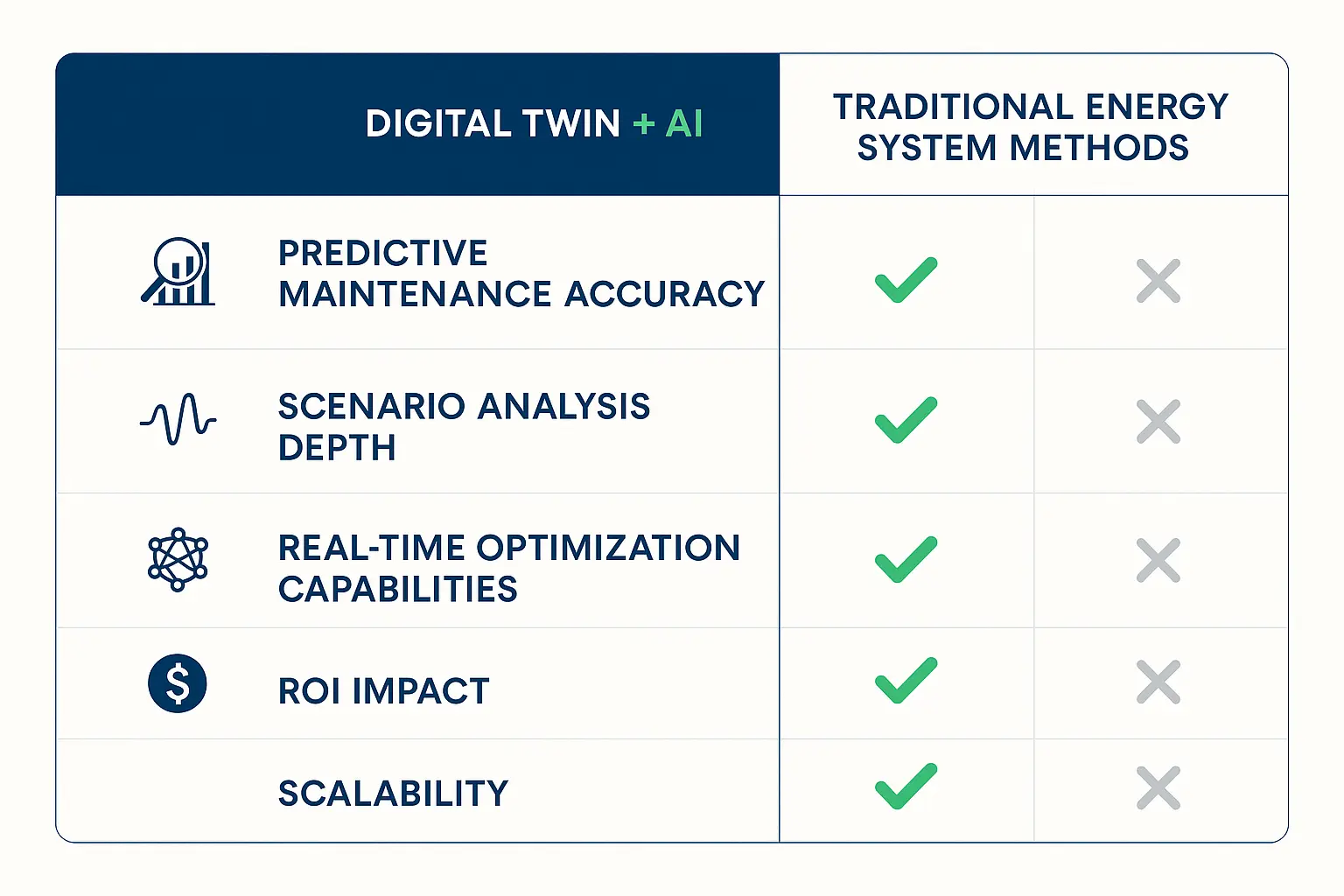
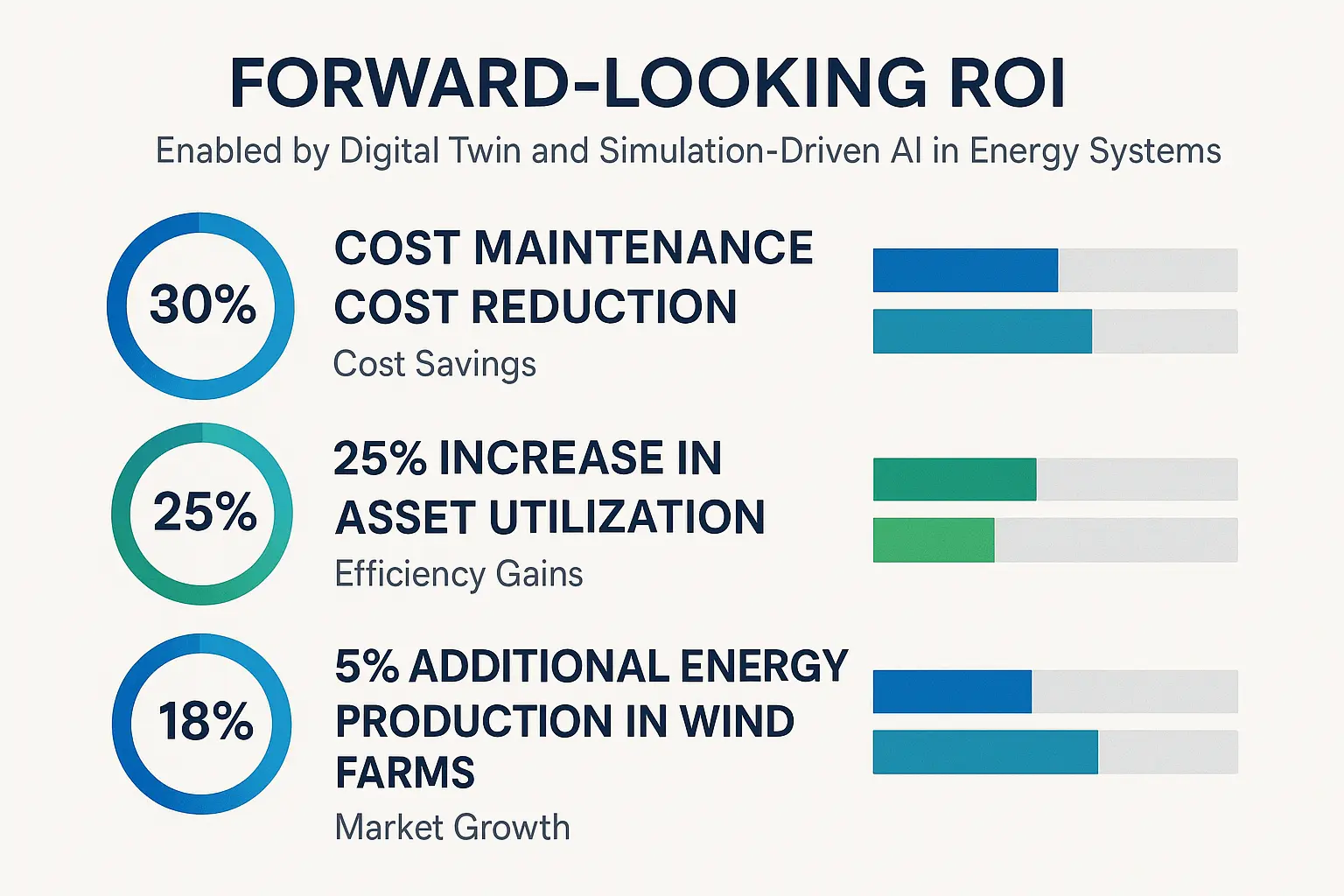
Instead of reacting to failures or relying on rigid maintenance schedules, you can predict them with stunning accuracy. By simulating component degradation under real-world conditions, AI models can identify subtle anomalies that precede a failure. This approach allows you to optimize MRO schedules, reduce unplanned downtime, and extend asset lifespan. The results are significant, with organizations reporting up to a 30% reduction in maintenance costs and a 25% improvement in asset utilization after implementing these technologies. This creates a direct, positive feedback loop into your enterprise asset management solutions.
Renewable Energy Integration & Grid Stability
Integrating intermittent sources like wind and solar is one of the biggest challenges for modern grids. A digital twin can simulate the impact of weather patterns on renewable generation and model the grid’s response in real time. AI uses this data to forecast output with over 25% greater accuracy than traditional methods. It can then prescribe the optimal use of energy storage and dynamically balance loads to maintain stability, improving renewable integration efficiency by as much as 25-40% and drastically reducing costly curtailment.
New Infrastructure Design & “What-If” Scenario Analysis
This is a critical differentiator often overlooked. Before a single shovel hits the ground on a new substation or wind farm, you can build and test its digital twin. You can run thousands of “what-if” scenarios: How will the design hold up to extreme weather events? What is the optimal layout for maximum efficiency and minimal environmental impact? Which component choices deliver the best lifecycle value? This simulation-driven design process de-risks multi-million dollar investments and ensures new infrastructure is optimized for performance from day one.
Energy Consumption Optimization
For large industrial users or utility-scale operations, a digital twin can model energy consumption patterns across the entire system. AI algorithms analyze this data to identify areas of significant waste and simulate the impact of potential efficiency improvements. This allows for targeted interventions that can lead to substantial reductions in both operational costs and carbon footprint, aligning with Net Zero objectives.
Overcoming the Integration Complexities: A Technical Roadmap
Implementing a digital twin and AI ecosystem is a sophisticated endeavor, and decision-makers are right to be concerned about the technical hurdles. Acknowledging these challenges is the first step; having a clear strategy to solve them is what builds confidence.
The Data Challenge: Quality & Interoperability
Your data comes from countless sources: SCADA systems, IoT sensors, weather feeds, and asset management databases, each with its own format.
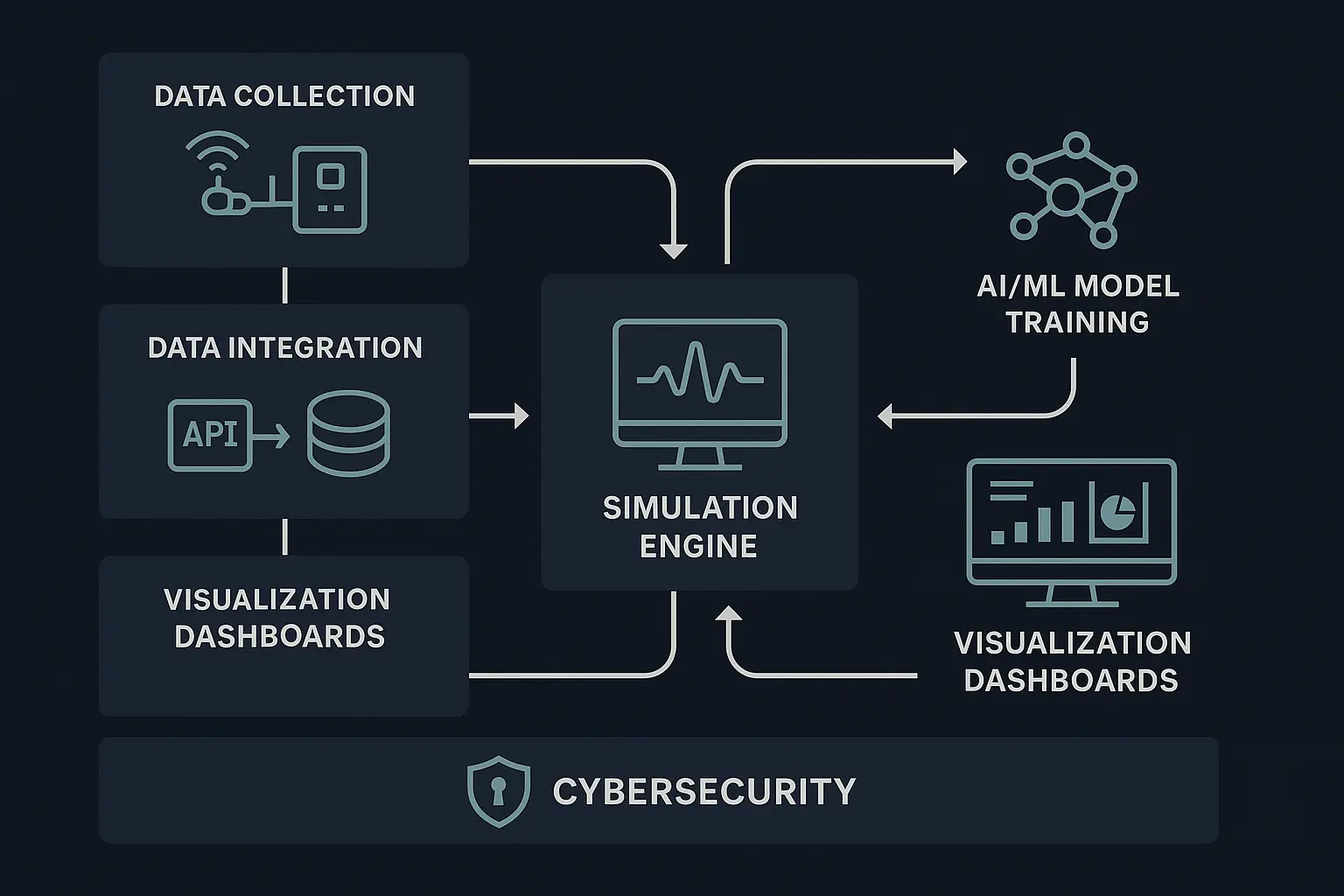
- The Solution: A successful strategy starts with a unified data architecture, often built on a data lake. Robust APIs and standardized data models are used to ingest and harmonize heterogeneous data. For real-time applications, edge computing is deployed to process data locally, reducing latency and bandwidth requirements.
The Legacy Challenge: Bridging OT and IT
Your operational technology (OT) has been reliable for decades, but it wasn’t built to communicate with modern IT and cloud platforms.
- The Solution: A “rip and replace” approach is rarely feasible. Instead, a phased integration using middleware and protocol converters acts as a bridge between legacy systems and the new digital twin platform. This allows you to leverage existing infrastructure while progressively introducing new capabilities.
The Power Challenge: Computational Demands & Scalability
Running thousands of complex simulations and training advanced AI models requires immense computational power.
- The Solution: A hybrid cloud-edge architecture provides the necessary flexibility and scale. Intensive simulation and AI training workloads are run on powerful cloud servers, while real-time analytics and control actions are handled at the edge, closer to the physical assets.
The Security Challenge: Protecting Critical Infrastructure
A digital twin is a virtual map of your most critical assets, making it a high-value target for cyber threats.
- The Solution: Security cannot be an afterthought. A zero-trust architecture, which assumes no user or device is inherently trustworthy, is essential. End-to-end encryption, continuous threat monitoring, and granular access controls are foundational components for protecting both the platform and the sensitive operational data it contains.
Quantifying the Impact: The Business Case for Intelligent Energy Systems
Ultimately, the decision to invest comes down to value. While the technical capabilities are impressive, their true power lies in the tangible business outcomes they generate. The economic and strategic benefits create a compelling case for adoption.
- Drastic Cost Reduction: By optimizing maintenance and operations, digital twins can reduce operational costs by up to 30%. In wind farms, for example, this technology has been shown to increase annual energy production by 5%, directly boosting revenue.
- Enhanced Resilience & Reliability: The ability to predict and prevent outages by forecasting remedies for grid congestion from one minute to 30 years into the future is a game-changer for grid operators.
- De-Risked Capital Investments: Scenario analysis for new infrastructure ensures that capital is deployed for maximum impact and long-term performance, avoiding costly design flaws.
- Accelerated Sustainability Goals: Optimizing renewable integration and reducing system-wide energy waste provides a clear, measurable path toward achieving your Net Zero and GHG reduction targets.
The Future: Towards Autonomous, Self-Optimizing Grids
This is just the beginning. As these technologies mature, we are moving toward a future of increasingly autonomous energy ecosystems. Imagine a grid that can not only predict a potential outage but can also automatically re-route power, deploy storage assets, and stabilize itself without human intervention. Picture a fleet of wind turbines that collectively learn from each other to optimize their performance based on real-time atmospheric conditions. This is the future that simulation-driven AI and digital twins are building—a more resilient, efficient, and sustainable energy landscape.
Frequently Asked Questions (FAQ)
What’s the real cost of implementing a digital twin?
Implementation costs can vary widely, with comprehensive systems potentially exceeding $500,000. However, the key is to start with a focused pilot project on a high-value asset or system. This allows you to prove the ROI and build a business case for a phased, system-wide rollout, aligning investment with demonstrated value.
How does this differ from our existing SCADA and monitoring systems?
SCADA systems are excellent for real-time visibility and control—they tell you what is happening right now. A digital twin with simulation-driven AI tells you why it’s happening, what will happen next, and what you should do about it. It adds a predictive and prescriptive layer on top of the real-time data your SCADA system already provides.
Our operational data is messy. How do you ensure it’s usable for AI?
This is one of the most common and critical challenges. The process begins with a thorough data audit and the implementation of a robust data pipeline. This involves using data harmonization tools to clean, standardize, and contextualize information from various sources. For AI models, techniques are used to identify and fill gaps, ensuring the data is of sufficient quality to train reliable predictive models.
How long does it take to see a return on investment?
While full-scale implementations are long-term projects, a well-defined pilot can demonstrate tangible value within 12-18 months. Early wins are often found in predictive maintenance, where preventing just one major asset failure can deliver an immediate and significant return on the initial investment.
Your Next Step in Energy Transformation
Moving from evaluation to implementation requires a partner with deep expertise not just in technology, but in the specific complexities of the energy sector. You need a team that can help you navigate the technical challenges, define a clear roadmap, and build a powerful business case for change.
If you’re ready to explore how a simulation-driven approach can de-risk your investments and unlock new levels of efficiency and resilience, let’s have a conversation. Schedule a consultation with our energy systems experts to discuss your specific challenges and map out a practical path forward.
