
The Definitive Guide to Energy IoT Cybersecurity & Data Governance
You’re staring at a digital map of your grid, a sprawling network of smart meters, sensors, and automated controls. You know this converged IT/OT infrastructure is the future, but you also know it presents an attack surface that keeps you up at night. You’ve read the high-level threat reports, but now you need to move from awareness to action. How do you build a security architecture that not only stops sophisticated threats but also satisfies the conflicting demands of NERC-CIP, GDPR, and CCPA?
You’re not alone in this challenge. Many energy sector leaders find themselves caught between generic cybersecurity advice that doesn’t fit OT realities and regulatory checklists that fail to provide a cohesive technical strategy. This guide is different. It’s built for IT security teams and compliance officers who need to make informed, defensible decisions. We’ll go beyond the “what” and “why” to deliver the deep technical “how”—providing actionable frameworks for securing your energy IoT ecosystem from the silicon to the cloud.
Chapter 1: The Evolving Threat Landscape for Energy IoT & Smart Grids
The abstract threat of a cyberattack has become a clear and present danger to energy infrastructure. The consequences are no longer theoretical; they are measured in millions of dollars and real-world operational disruptions. To build a resilient defense, we first need to understand the precise nature of the offense.
1.1 Current State: Unpacking the 2024-2026 Threat Intelligence
The data paints a stark picture of an escalating conflict. Cyberattacks on U.S. utilities surged by nearly 70% from 2023 to 2024, a dramatic rise from 689 to 1,162 incidents. This isn’t random noise; it’s a targeted campaign by sophisticated adversaries.
- The Ransomware Epidemic: The energy sector is a prime target. In 2024, a staggering 67% of energy and utilities organizations were hit by ransomware, with a devastating 80% of those attacks resulting in data encryption. The average recovery cost now stands at approximately $3.12 million per incident, a figure that doesn’t even account for reputational damage and regulatory fines.
- Nation-State Actors: Geopolitics is now a primary driver of cyber risk, cited by 64% of organizations as their top concern. Threat actors like VOLTZITE and BAUXITE are actively targeting critical infrastructure, with motives ranging from espionage to sabotage. The April 2025 attack on a Norwegian Hydropower Dam serves as a chilling reminder of how digital intrusions can cause physical disruption.
- Attack Vectors of Choice: While the attackers are sophisticated, their entry points are often tragically common: phishing, exploitation of remote services, and unpatched vulnerabilities in internet-facing systems.
1.2 The IoT & OT Achilles’ Heel: Why Digitalization Magnifies Vulnerabilities
The very digitalization that promises efficiency has also created a perfect storm for cyber threats. Energy professionals report a 71% greater vulnerability to OT cyber events primarily due to sprawling legacy infrastructure that was never designed for internet connectivity.
This IT/OT convergence erases the traditional “air gap,” connecting once-isolated control systems to corporate networks and the internet. IoT devices, often deployed by the thousands, become new entry points. Threat actors exploit weak or default credentials to build massive botnets, and unencrypted telemetry traffic can be intercepted and manipulated. In fact, data manipulation is 3x more common in energy environments than other attack techniques, threatening the very integrity of grid operations.
1.3 Emerging Threats: AI, Quantum, and Geopolitical Risks
The threat landscape is not static. Looking ahead, we see three forces that will reshape energy cybersecurity:
- AI-Powered Attacks: Artificial intelligence is already being used to accelerate OT threats, enabling attackers to conduct reconnaissance, identify vulnerabilities, and craft highly convincing phishing attacks at an unprecedented scale.
- The Quantum Threat: While still on the horizon, quantum computing poses an existential risk to current encryption standards. A “harvest now, decrypt later” strategy by nation-states means data stolen today could be decrypted in the future, making early adoption of quantum-resistant cryptography a strategic imperative.
- The Software Supply Chain: The Colonial Pipeline incident was a wake-up call, but it was just the beginning. Attacks on the software supply chain for energy networks are projected to cost $60 billion globally in 2025. Your security is only as strong as your most vulnerable vendor.
Chapter 2: Secure Device Provisioning: Building a Root of Trust for Energy IoT
You cannot secure a network if you cannot trust the devices on it. Secure device provisioning is the foundational layer of energy IoT security, establishing a unique, unforgeable identity for every sensor, meter, and controller from the moment it’s manufactured. This goes far beyond simple password protection.
2.1 The Foundational Layer: Hardware-Rooted Identities
A true Root of Trust (RoT) must be anchored in hardware, making it physically impossible to tamper with. This is achieved using technologies like:
- Hardware Security Modules (HSMs) & Trusted Platform Modules (TPMs): These are specialized, tamper-resistant microchips that generate, store, and protect cryptographic keys. They ensure that a device’s private key never leaves the secure hardware boundary.
- Embedded Secure Elements (eSE) & eFuses: These integrate security functions directly into the device’s main silicon, providing a cost-effective way to establish a hardware RoT in smaller, constrained IoT devices.
This hardware foundation enables zero-touch provisioning, where a device securely and automatically onboards itself to the network in the field without manual intervention, using x.509 certificates to prove its identity.
2.2 Advanced Provisioning Techniques for Constrained Environments
Energy IoT devices often operate with limited power and processing capabilities, requiring specialized cryptographic approaches.
- Elliptic Curve Cryptography (ECC): ECC provides the same level of security as traditional RSA encryption but with much smaller key sizes, making it ideal for resource-constrained smart meters and sensors.
- Arm TrustZone: This technology creates an isolated, secure execution environment within the device’s processor. It partitions the system into a “secure world” for handling sensitive operations like key management and a “normal world” for the main operating system, preventing compromised application code from accessing critical security functions.
- Root of Trust for Reporting (RTR): A device’s state must be verifiable throughout its lifecycle. RTR allows the device to cryptographically attest to its current firmware and configuration. This ensures that a secure boot process was completed and that over-the-air (OTA) updates have not been corrupted, a key requirement for NERC-CIP compliance.
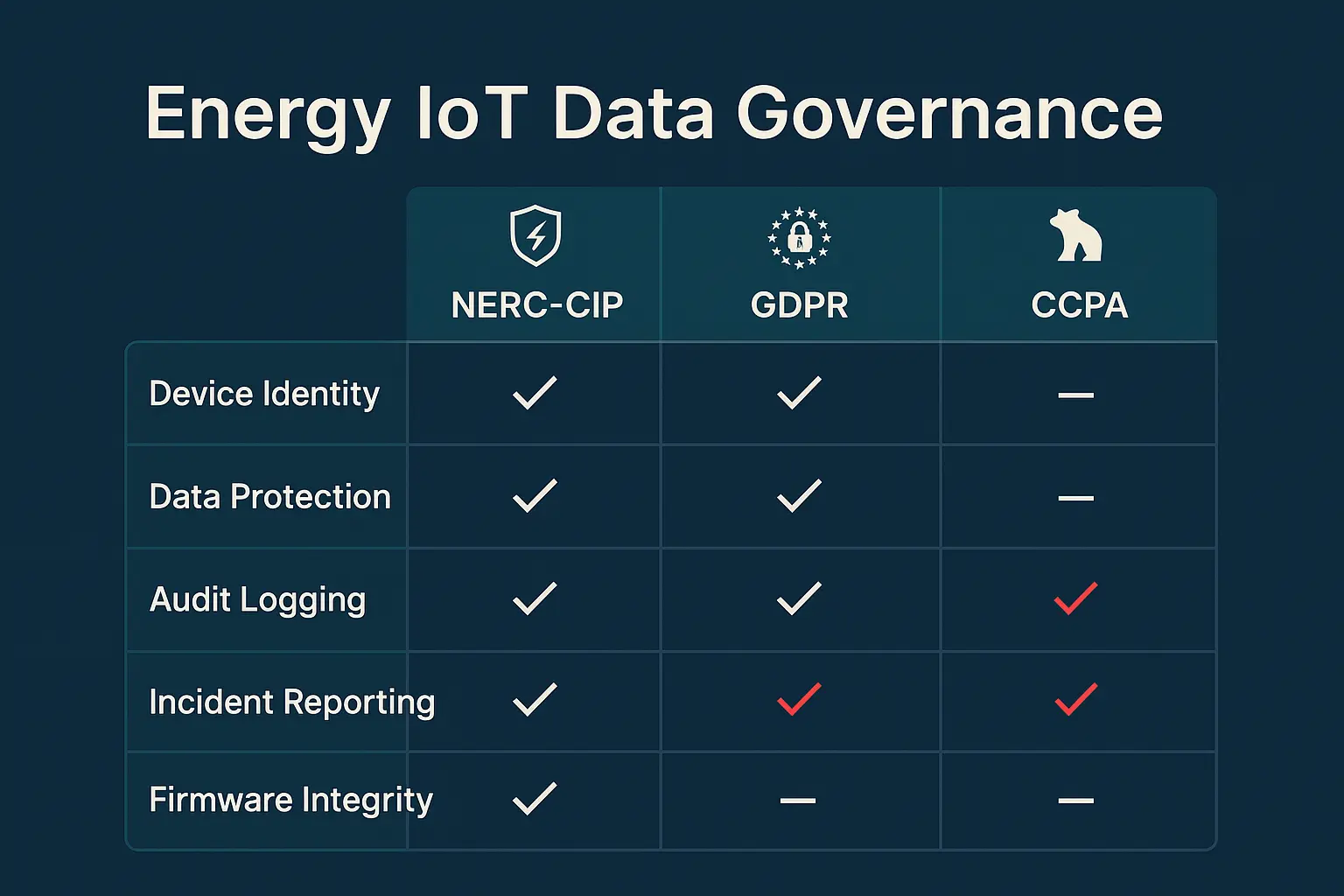 Comprehensive decision tree simplifies selecting optimal network segmentation approaches in complex Energy IoT OT/IT environments, enabling confident, informed architecture decisions.
2.3 Beyond Technical: Process & Lifecycle Management
Secure provisioning isn’t a one-time event; it’s a continuous lifecycle. This requires robust processes for secure OTA updates, validated by signed firmware images and a secure bootloader. This entire device identity lifecycle must be integrated into your broader IT and OT asset management systems, giving you a single, trusted view of every connected asset on your grid.
Chapter 3: Deep Network Segmentation: Air-Gapping for the OT/IT Converged Grid
The convergence of IT and OT networks means the old model of a single perimeter defense is obsolete. An attacker who compromises the corporate network must be prevented from moving laterally into the operational control network. This is where deep network segmentation becomes your most powerful defensive strategy.
3.1 Principles of OT/IT Segmentation: Beyond the DMZ
Effective segmentation treats the network not as a fortress with one big wall, but as a ship with multiple watertight compartments. If one compartment is breached, the damage is contained.
- Micro-segmentation: This strategy goes beyond separating IT and OT. It involves creating small, isolated network zones around specific assets or groups of assets. A group of substation controllers, for instance, would be in its own micro-segment, only able to communicate with explicitly authorized systems.
- Least Privilege Access: Devices and users should only be granted the absolute minimum level of access required to perform their function. A smart meter should only be able to send its telemetry data to a specific collection server, not browse the entire network.
3.2 Implementing Zero Trust Architectures in OT Environments
The core principle of a Zero Trust architecture is “never trust, always verify.” No device or user is trusted by default, regardless of its location on the network. While this is a standard concept in IT, applying it to OT environments requires careful consideration of legacy protocols (like Modbus and DNP3) and latency-sensitive systems.
The gold standard for achieving this is PKI-enforced segmentation. In this model, every connection attempt is authenticated using a certificate tied to the device’s hardware-bound identity. This effectively creates a cryptographic “air gap,” ensuring that only authenticated and authorized devices can communicate, even within the same physical network segment. This is especially critical for securing brownfield sites with a mix of legacy and modern equipment.
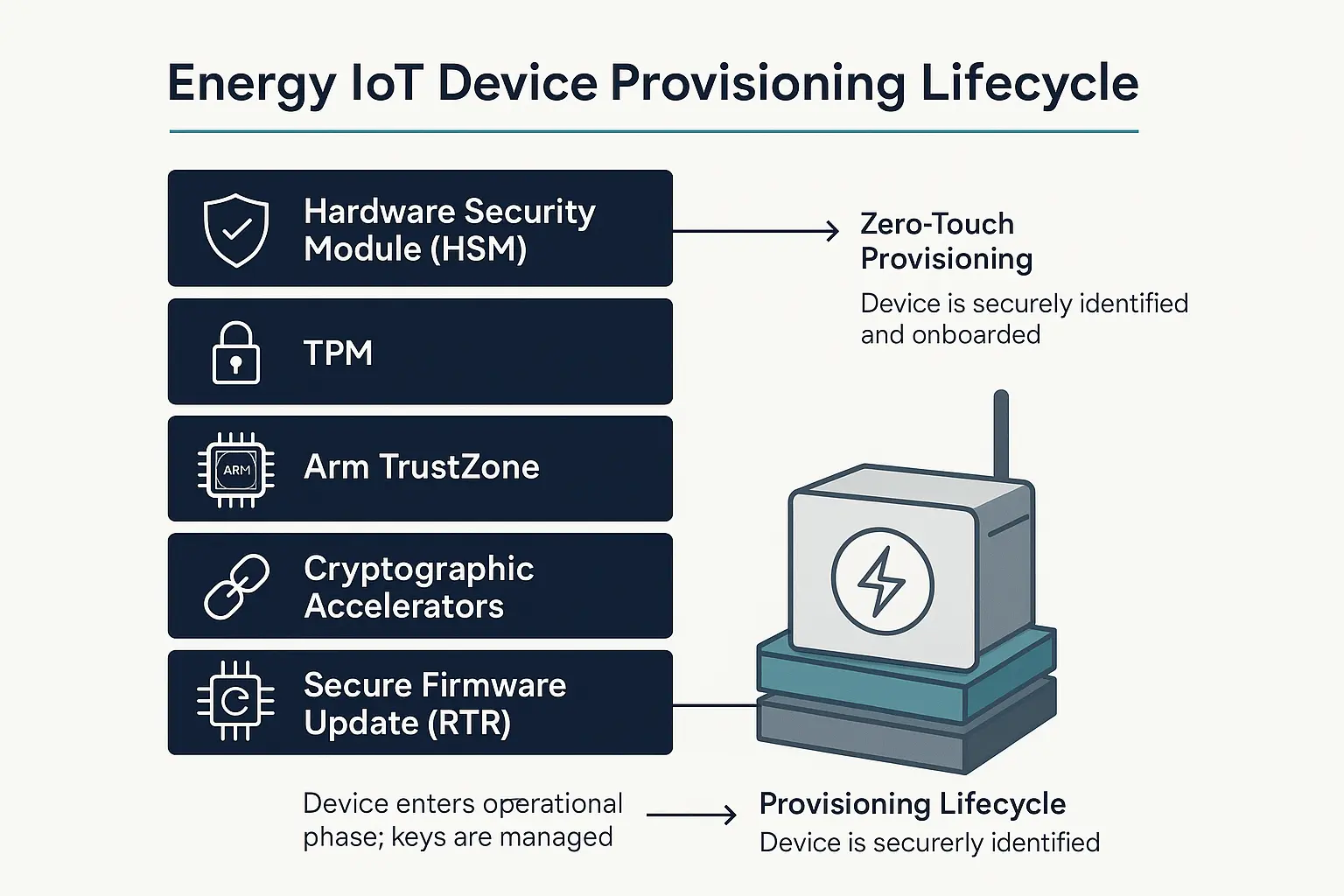 Comprehensive decision tree simplifies selecting optimal network segmentation approaches in complex Energy IoT OT/IT environments, enabling confident, informed architecture decisions.
3.3 Network Monitoring & Anomaly Detection at the Edge
You can’t protect what you can’t see. Because active scanning can disrupt sensitive OT equipment, passive network monitoring is essential. These tools analyze network traffic without interfering with operations, creating a baseline of normal behavior. By applying behavioral analytics and AI/ML models at the network edge, you can detect anomalies—like a meter trying to connect to an unknown server—in real-time, often before an attack can cause damage.
Chapter 4: Data Governance & Compliance: Navigating the Regulatory Minefield (NERC-CIP, GDPR, CCPA)
For energy providers, cybersecurity isn’t just about preventing attacks; it’s about demonstrating compliance with a complex web of regulations. The challenge is that standards like NERC-CIP (focused on grid reliability) and data privacy laws like GDPR/CCPA (focused on consumer rights) were not designed to work together. A truly resilient strategy must satisfy them all.
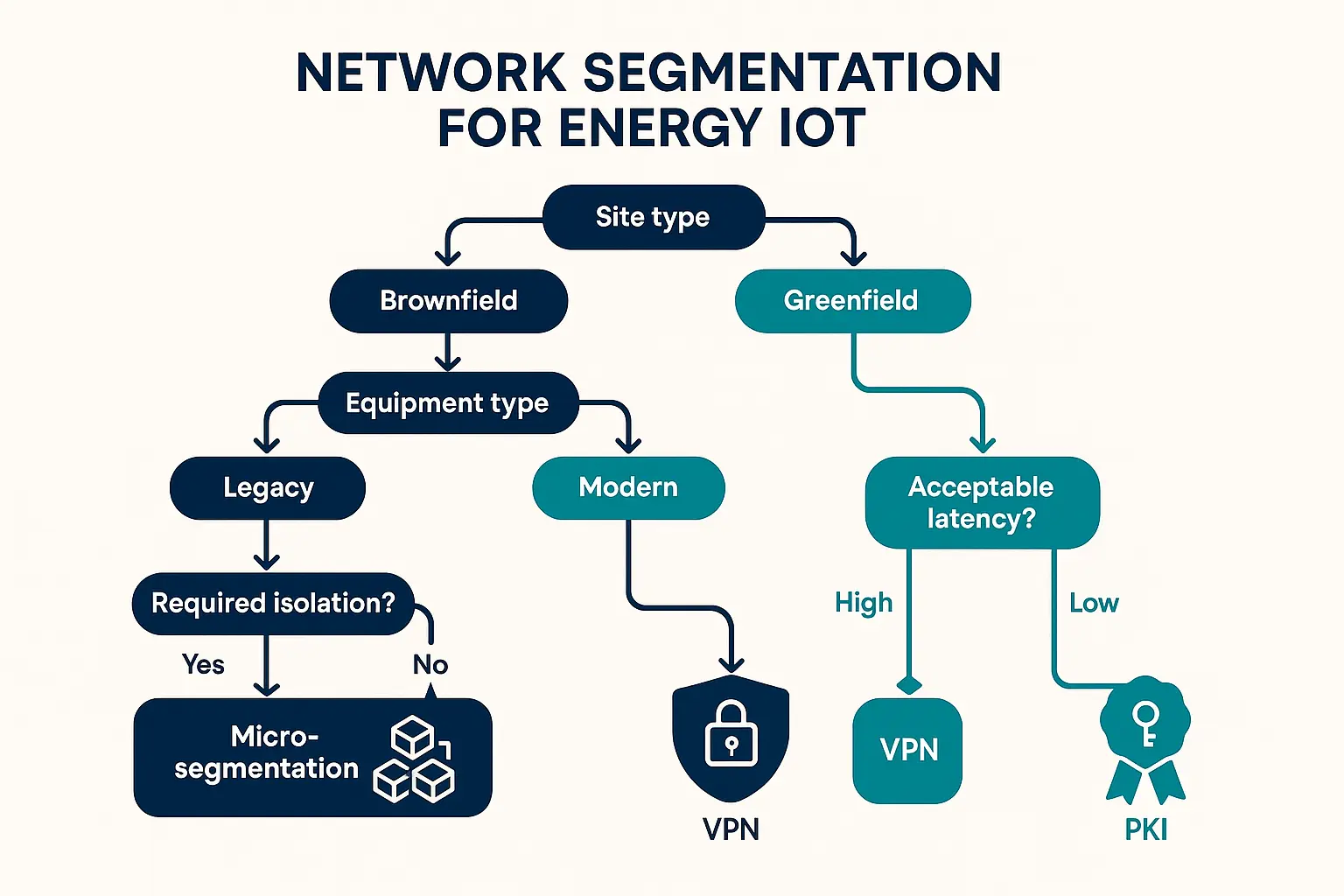 Comprehensive compliance comparison of NERC-CIP, GDPR, and CCPA highlight critical regulatory demands for Energy IoT data governance, empowering informed multi-regulation strategy decisions.
4.1 NERC-CIP Deep Dive: Protecting Critical Cyber Assets (CCAs)
NERC-CIP standards are the bedrock of North American grid security. For energy IoT, this means translating its requirements into specific technical controls:
- CIP-010 (Configuration Change Management): Requires verification of software integrity. This maps directly to using a hardware RoT and secure boot processes to cryptographically attest to the firmware running on an IoT device.
- CIP-005 & CIP-007 (Electronic Security Perimeters & Systems Security Management): Mandate network segmentation and access control. This is achieved through the micro-segmentation and Zero Trust principles discussed earlier.
- CIP-013 (Supply Chain Risk Management): Requires you to manage risk from your vendors. This starts with mandating hardware-rooted identities and verifiable software bills of materials (SBOMs) for all IoT devices you procure.
4.2 GDPR & CCPA in Energy IoT: Data Privacy Beyond Personal Identifiers
Privacy regulations introduce a different set of challenges. While a smart meter’s serial number may not seem like personal data, when correlated with usage patterns and location, it can be.
- Pseudonymization and Data Minimization: To comply with GDPR, it’s crucial to disassociate device identities from consumer identities. Using a locally significant Device ID (LDevID) that is cryptographically generated and not tied to a customer account helps meet data minimization principles.
- Consent and Data Subject Rights: Customers have the right to access, erase, or opt-out of the collection of their data. Your architecture must be able to manage these requests across a distributed network of millions of devices, which is a significant technical and logistical challenge.
4.3 The Reconciliation Challenge: A Unified Architecture
Herein lies the central challenge and opportunity. How can you build a system that meets all these demands at once? The key is to use technology that serves multiple purposes.
For example, a robust Public Key Infrastructure (PKI) built on HSMs can:
- Serve NERC-CIP: Issue and manage the x.509 certificates that prove device identity and secure communications within your Electronic Security Perimeter.
- Serve GDPR/CCPA: Manage the lifecycle of pseudonymous device identities (LDevIDs), ensuring you can track data for operational purposes without tying it directly to a consumer, and securely revoke access if a customer exercises their right to be forgotten.
This unified approach turns compliance from a series of disconnected checklist items into a cohesive, efficient, and more secure architecture.
Chapter 5: Incident Response & Resilience: Preparing for the Inevitable
Even with the best defenses, a breach is always possible. In the energy sector, an incident response (IR) plan isn’t just about recovering data; it’s about maintaining grid stability and ensuring public safety.
5.1 Crafting Energy-Specific Incident Response Playbooks
Your IR plan must account for the unique operational constraints of the energy world.
- Integrate IT, OT, and Business Leadership: A response cannot be run solely by the IT security team. OT engineers, grid operators, legal counsel, and corporate communications must be involved from the outset.
- Plan for Physical Consequences: Scenarios must go beyond data exfiltration. What is the playbook for a ransomware attack that locks up SCADA systems? What are the manual override procedures if substation controllers are compromised?
- Conduct Regular Drills: Tabletop exercises based on realistic scenarios—like a supply chain compromise or a coordinated physical and cyber attack—are crucial for testing your plan and building muscle memory across teams.
5.2 Business Continuity for Critical Infrastructure
Business continuity in the energy sector means more than just restoring servers from backups. It means ensuring the continuous delivery of power. This requires a plan for:
- Operational System Recovery: How do you safely bring control systems back online in a verified, clean state?
- Manual and Offline Operations: What procedures are in place for field crews to operate equipment manually if remote command and control is lost?
- Grid Isolation: What are the protocols for isolating segments of the grid to contain the impact of a cyberattack?
A robust, well-rehearsed plan is the ultimate backstop that transforms a potentially catastrophic event into a manageable incident.
Chapter 6: Building a Cyber Resilience Roadmap for Energy Organizations
Achieving true cyber resilience is a journey, not a destination. It requires a strategic, multi-year roadmap that aligns security initiatives with business objectives and progressively matures your capabilities.
6.1 Comprehensive Risk Assessments & Quantifying Risk (FAIR Model)
To get executive buy-in, you must translate technical risks into business terms. Frameworks like Factor Analysis of Information Risk (FAIR) allow you to quantify cyber risk in financial terms. Instead of saying “we have unpatched vulnerabilities,” you can say “this vulnerability creates a 15% probability of a $5 million loss event over the next year.” This language enables leadership to make informed, risk-based investment decisions.
6.2 Cybersecurity Maturity Frameworks (NIST CSF for OT)
You can’t map out a journey without knowing your starting point. Using a framework like the NIST Cybersecurity Framework (CSF), adapted for OT environments, allows you to benchmark your current capabilities across five key functions: Identify, Protect, Detect, Respond, and Recover. This assessment forms the basis of a strategic roadmap, helping you prioritize investments to move from your current state to your desired target state over time.
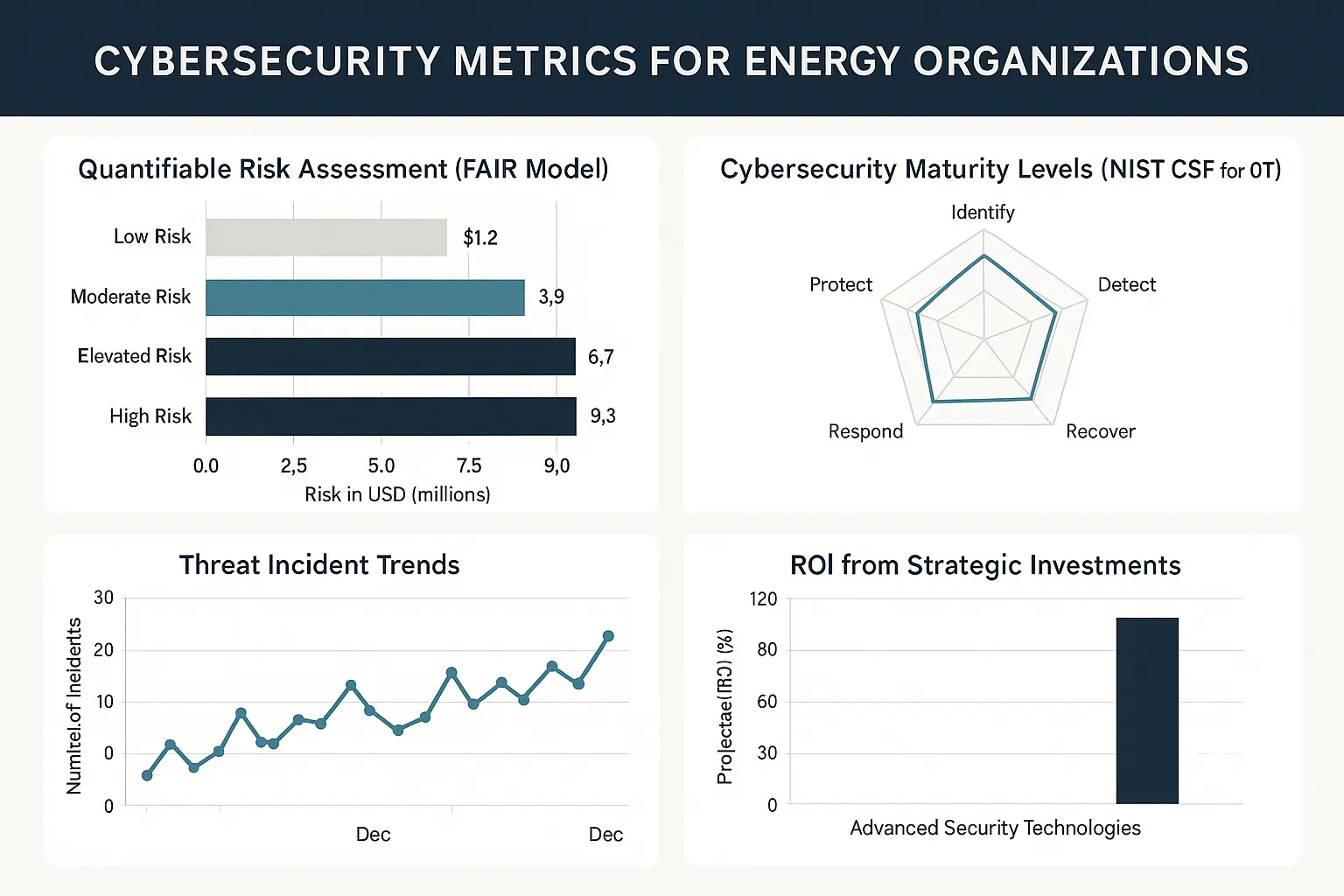 Integrated cybersecurity metrics dashboard empowers executive leadership with clear, actionable insights to prioritize energy IoT security investments and roadmap development.
6.3 Talent, Training, and Collaboration
Technology alone is not enough. The OT security skills gap is one of the biggest challenges facing the industry. Your roadmap must include investments in specialized training to upskill both IT staff in OT concepts and OT staff in cybersecurity principles. Furthermore, no organization can stand alone. Active participation in industry information sharing and analysis centers (ISACs) is crucial for staying ahead of emerging threats and learning from the experiences of your peers.
Frequently Asked Questions (FAQ)
1. Our OT systems are old. Isn’t it too complex and risky to implement these advanced security measures on legacy equipment?
This is a critical concern for any brownfield environment. A phased approach is key. You can start by implementing network-level controls like micro-segmentation and passive monitoring, which provide significant protection without touching the legacy endpoints themselves. For newer deployments, you can mandate devices with built-in hardware Root of Trust. The goal is progressive improvement, not a disruptive “rip and replace.”
2. What is the real ROI on this level of cybersecurity investment?
The ROI is measured in risk reduction and operational resilience. When the average ransomware recovery cost is over $3 million per incident, preventing just one attack can deliver a massive return. More importantly, it’s about avoiding unquantifiable costs: regulatory fines for non-compliance, catastrophic damage to brand reputation, and the potential for physical harm or widespread power outages. These investments are less of a cost center and more of an insurance policy for your core business operations.
3. We struggle to find staff with both IT and OT security skills. How can we address this skills gap?
The skills gap is real, but it can be managed. Focus on a three-pronged strategy:
- Cross-training: Invest in programs that train your IT security team on the unique constraints of OT environments (e.g., latency, safety protocols) and your OT engineers on cybersecurity fundamentals.
- Technology as a Force Multiplier: Utilize modern security platforms with automation and AI-driven analytics to reduce the manual workload on your team, allowing them to focus on high-level strategic tasks.
- Strategic Partnerships: Work with specialized managed security service providers (MSSPs) or consultants who have deep expertise in OT and critical infrastructure security to augment your internal team.
4. How do we get executive buy-in for a comprehensive, multi-year security roadmap?
The key is to speak the language of the business: risk and money. Use frameworks like FAIR to translate technical vulnerabilities into potential financial losses. Present your plan not as a list of technologies to buy, but as a strategic roadmap for maturing the organization’s resilience. Use the metrics and dashboard examples from Chapter 6 to show how you will measure and report on progress, demonstrating clear value and accountability to the board.
Conclusion: Beyond Compliance – Achieving True Energy IoT Cyber Resilience
The stakes for the energy sector have never been higher. Navigating the convergence of IoT, OT, and IT requires moving beyond a reactive, compliance-focused mindset. The old approach of treating security and compliance as separate, box-checking exercises is no longer defensible.
True cyber resilience is achieved through an integrated strategy where a unified technical architecture is designed from the ground up to secure your devices, segment your network, and satisfy multiple regulatory demands simultaneously. By building on a foundation of hardware-rooted trust and applying Zero Trust principles across your entire grid, you transform security from a burden into a strategic enabler of innovation and reliability.
The path forward requires a clear-eyed assessment of the threats, a deep understanding of the technology, and a strategic roadmap for execution. The time to build that future is now.
