
The Playbook for Unbreakable Energy: A Guide to Resilience Engineering in AI-Driven Grids
You’re evaluating how to integrate AI into your energy systems, but a critical question looms: How do you build a system that doesn’t just perform, but endures? Traditional reliability models feel inadequate for the complex, unpredictable nature of AI. You need a framework that moves beyond simple failover to create a truly resilient infrastructure that can anticipate, absorb, and adapt to any disruption.
This isn’t just about preventing blackouts; it’s about building the confidence to innovate. You need a clear-eyed approach to designing fault-tolerant AI architectures that safeguard critical operations while unlocking new levels of efficiency and control. This guide provides that playbook, transforming complex principles into an actionable strategy for building energy systems that are not just intelligent, but invincible.
The “Why Now?”: A Grid at the Tipping Point
The energy landscape is being reshaped by a powerful paradox: AI is both a massive new source of strain and our most promising solution for managing it. This “double-edged sword” creates an urgent need for a new resilience paradigm.
- The Demand Tsunami: AI workloads, particularly from data centers, are causing unprecedented grid strain. These facilities can induce power swings of hundreds of megawatts in seconds, destabilizing transmission lines. By 2030, data centers are projected to consume a staggering 9% of all electricity in the US, up from 4% in 2023. This isn’t a future problem; it’s happening now.
- A Volatile Supply Mix: Integrating intermittent renewables like solar and wind adds a layer of unpredictability that legacy systems struggle to manage. AI can optimize this mix, but it also introduces new complexities and potential failure points.
- An Evolving Threat Landscape: Cyberattacks on energy infrastructure are growing in sophistication. Adversaries are no longer just targeting IT systems; they are aiming at the operational technology (OT) that controls the physical grid, with AI itself becoming a new attack vector.
Without a deliberate strategy for resilience, simply layering AI onto existing infrastructure is a recipe for catastrophic, hard-to-diagnose failures.
Foundational Concepts: Deconstructing Resilience & Fault Tolerance
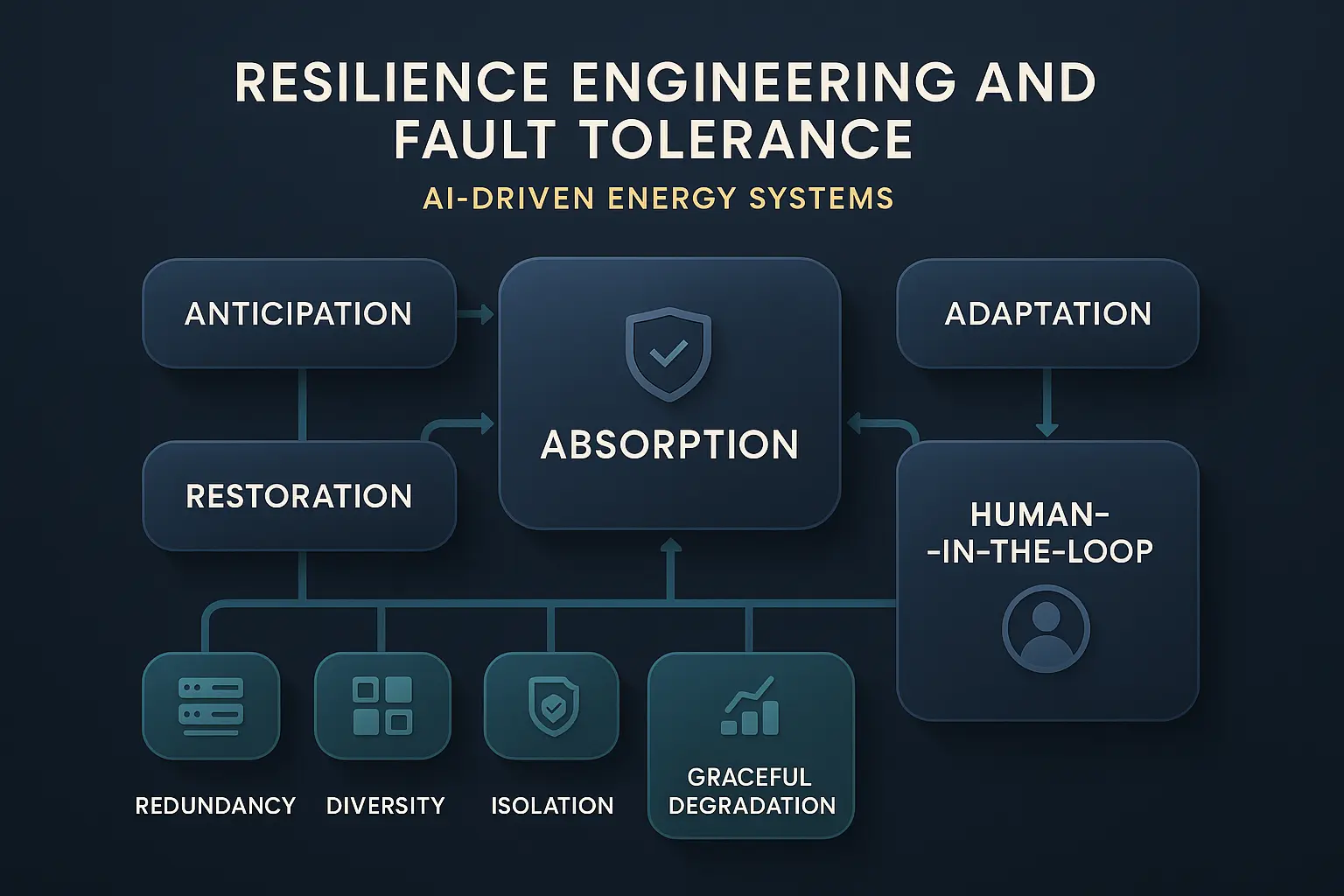
To build for the future, we must first redefine what it means for a system to be “strong.” Resilience isn’t just about recovering from failure; it’s a dynamic capability built on four pillars: the ability to anticipate, absorb, adapt, and restore.
- Anticipation: Proactively identifying threats, from cyber vulnerabilities to impending equipment failure.
- Absorption: Withstanding a disruptive event without catastrophic failure (e.g., isolating a fault to a small section of the grid).
- Adaptation: Reconfiguring operations in real-time to maintain critical functions during a disruption.
- Restoration: Recovering full operational capacity quickly and efficiently after an event.
Fault tolerance is the set of mechanisms that brings these principles to life. But as one practitioner on LinkedIn Pulse notes, AI breaks traditional assumptions. Failures are no longer always loud and obvious; they can be silent, stochastic, and entangled, emerging from the complex interplay of data, algorithms, and physical systems. This new reality demands a more sophisticated approach.
 Caption: Understand the foundational resilience engineering principles that underpin fault-tolerant AI energy systems and their interconnections.
AI Methodologies: The Right Tools for a Resilient Grid
Choosing the right AI techniques is critical. It’s not about finding the single “best” algorithm, but about deploying a portfolio of specialized models that work in concert to predict, adapt, and protect.
Predictive Maintenance & Anomaly Detection
The goal here is to fix problems before they happen. Deep Learning models have proven superior to standard machine learning for fault detection, analyzing sensor data to identify subtle patterns that precede equipment failure. This is where you can see the tangible value of AI predictive maintenance for energy assets.
Adaptive Control & Self-Healing
When disruptions occur, the system must react intelligently. Reinforcement Learning (RL), particularly models like Deep Q-Networks (DQN), can train an AI to make optimal decisions in real-time, such as rerouting power or shedding non-critical loads to prevent a wider outage.
Intelligent Forecasting
Accuracy in forecasting is the bedrock of grid stability. Research published in ScienceDirect highlights the power of specific models:
- Long Short-Term Memory (LSTM) networks achieve best-in-class accuracy for wind energy forecasting (R² = 0.9955).
- Random Forest models excel at solar energy prediction (R² = 0.827).
By combining these forecasts, operators gain a much clearer picture of both future supply and demand, enabling proactive resource allocation.
Designing for Robustness: Architectures & Strategies (The “How-To”)
Theoretical knowledge is one thing; building a working, resilient system is another. The most effective approach is built on five core design principles that address the unique failure modes of AI.
- Observability by Default: You cannot trust a black box. Your AI systems must provide continuous, interpretable data on their decision-making processes, including confidence scores and real-time inputs and outputs.
- Graceful Degradation: When an AI model’s confidence drops below a certain threshold or it encounters novel conditions, its influence must be automatically throttled. The system should fall back to a simpler, deterministic state and alert human operators.
- Isolation & Containment: Deploy AI in “shadow mode” first to validate its decisions against human actions. Implement digital firebreaks to prevent a fault in one AI agent from cascading across the entire network.
- Human-in-the-Loop by Design: The goal is not to replace human operators but to empower them. Interfaces must provide clear visibility into AI actions and give operators the training and authority to intervene and override the system when necessary. Gartner predicts that by 2027, 40% of utilities will deploy AI-driven operators, a role that blends engineering expertise with data oversight.
- Explicit Failure Contracts: Define, in advance, exactly how an AI system should behave under specific failure conditions (e.g., sensor loss, communication blackout). This removes ambiguity and ensures predictable, safe responses during a crisis.
On the security front, designing a truly resilient system requires mastering cyber resilience for AI-powered grids. Integrating the NIST Cybersecurity Framework is a proven starting point. According to EPRI, utilities that combine AI-based anomaly detection with frameworks like NIST can see a 27% reduction in system downtime caused by cyber events.
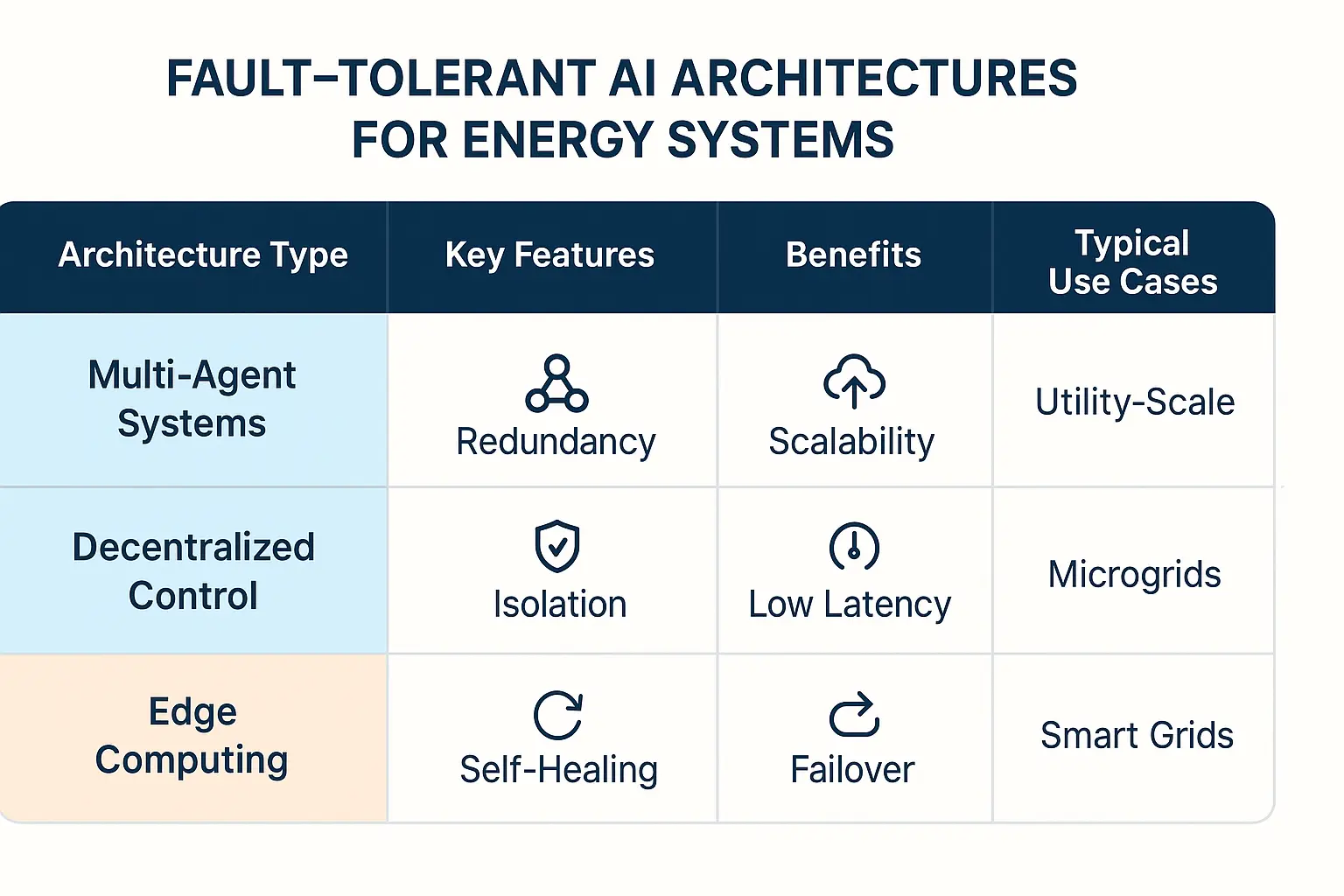
 Caption: Compare fault-tolerant AI architectures to identify the best fit for your energy system resilience needs.
Real-World Applications & Case Studies
Applying these principles yields tangible results across different energy environments. Let’s look at how this playbook translates into practice.
Case Study: Resilient Island Microgrid
- Challenge: A remote island community relies on a microgrid with solar, battery storage, and a diesel generator. Unpredictable weather and fluctuating tourist demand create constant stability challenges.
- Solution: A multi-agent AI system is deployed. An LSTM model provides hyper-accurate solar generation forecasts. A Random Forest model predicts tourist-driven load spikes. A Reinforcement Learning agent acts as the central controller, using these inputs to dynamically manage battery charging/discharging and generator dispatch to ensure 24/7 reliability and minimize diesel consumption.
- Outcome: Grid stability increases by 40%, fuel costs are reduced by 30%, and the system can automatically isolate from the main grid and operate autonomously during a storm, providing uninterrupted power to critical facilities.
Case Study: Utility-Scale Cyber Defense
- Challenge: A major utility faces thousands of daily cyber alerts, overwhelming its security operations center (SOC). They fear a sophisticated attack could compromise grid control systems.
- Solution: Drawing inspiration from the EPRI/Duke Energy collaboration, the utility deploys an AI-powered threat detection platform. The AI analyzes network traffic across both IT and OT systems, learning the baseline of normal behavior. It automatically flags and contains anomalous activity that could indicate a breach, escalating only the most critical, validated threats to human analysts.
- Outcome: False positive alerts are reduced by 95%. The time to detect a genuine threat drops from hours to seconds. The utility successfully thwarts a malware attack targeting its distribution management system with zero impact on operations.
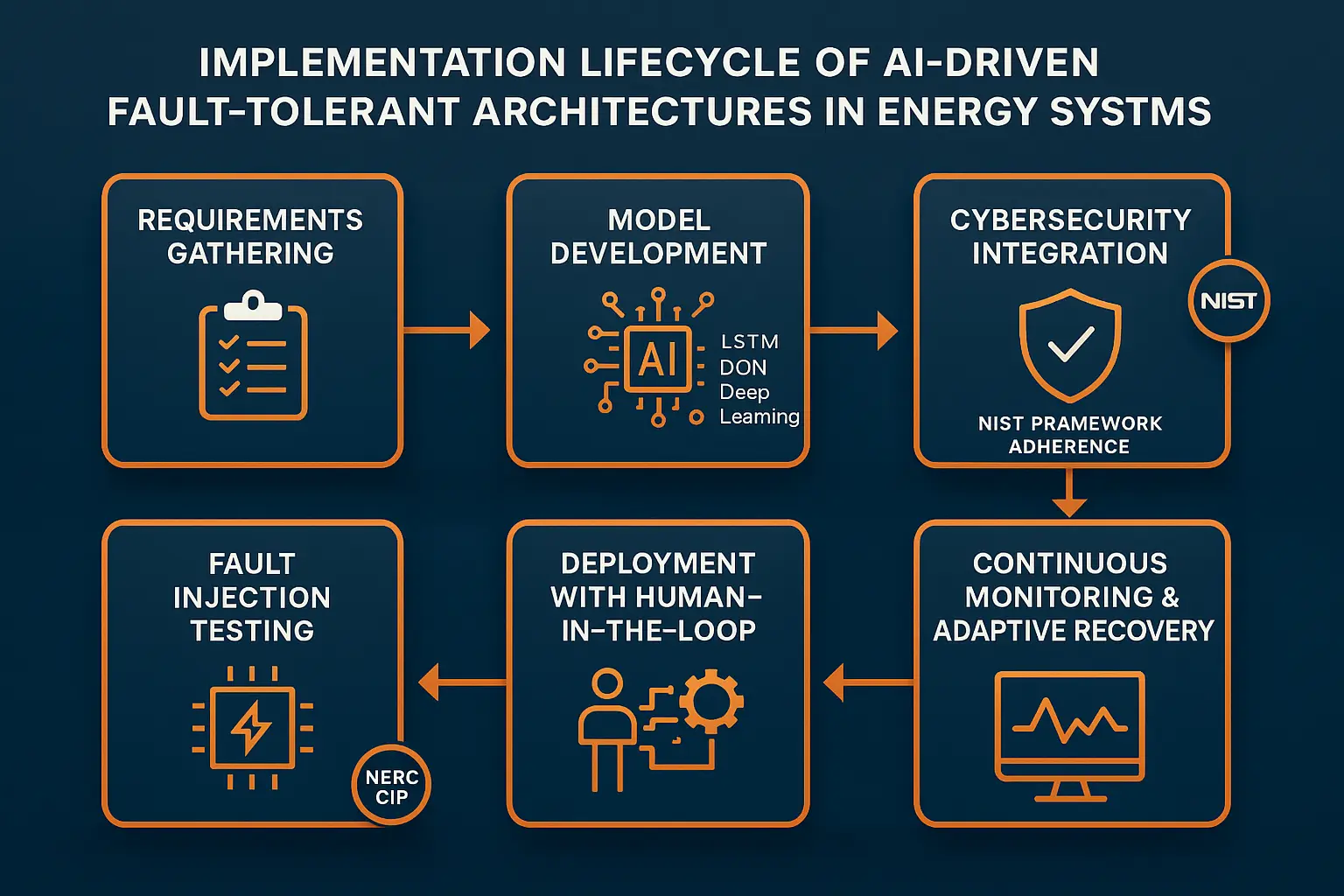
 Caption: Follow the proven implementation lifecycle integrating AI fault tolerance, security, and human oversight to ensure resilient energy operations.
Choosing Your Path: Evaluation Criteria & Decision Factors
As you evaluate solutions, it’s easy to get lost in technical specifications. Focus instead on the outcomes and capabilities that truly define a resilient system. Ask potential partners and vendors these critical questions:
- Transparency: How does your system explain its decisions? Can we audit the logic and data behind a critical action?
- Controllability: What mechanisms are in place for graceful degradation and human override? How do we train our operators for this?
- Adaptability: How does the model handle sensor failure or data corruption? Does it have defined failure contracts?
- Security: Is security designed in from the start (“security by design”)? How does the solution help us meet regulatory standards like NERC CIP?
- Validation: How has the system been tested against real-world or high-fidelity simulated disruptions? Can you share performance metrics beyond simple accuracy?
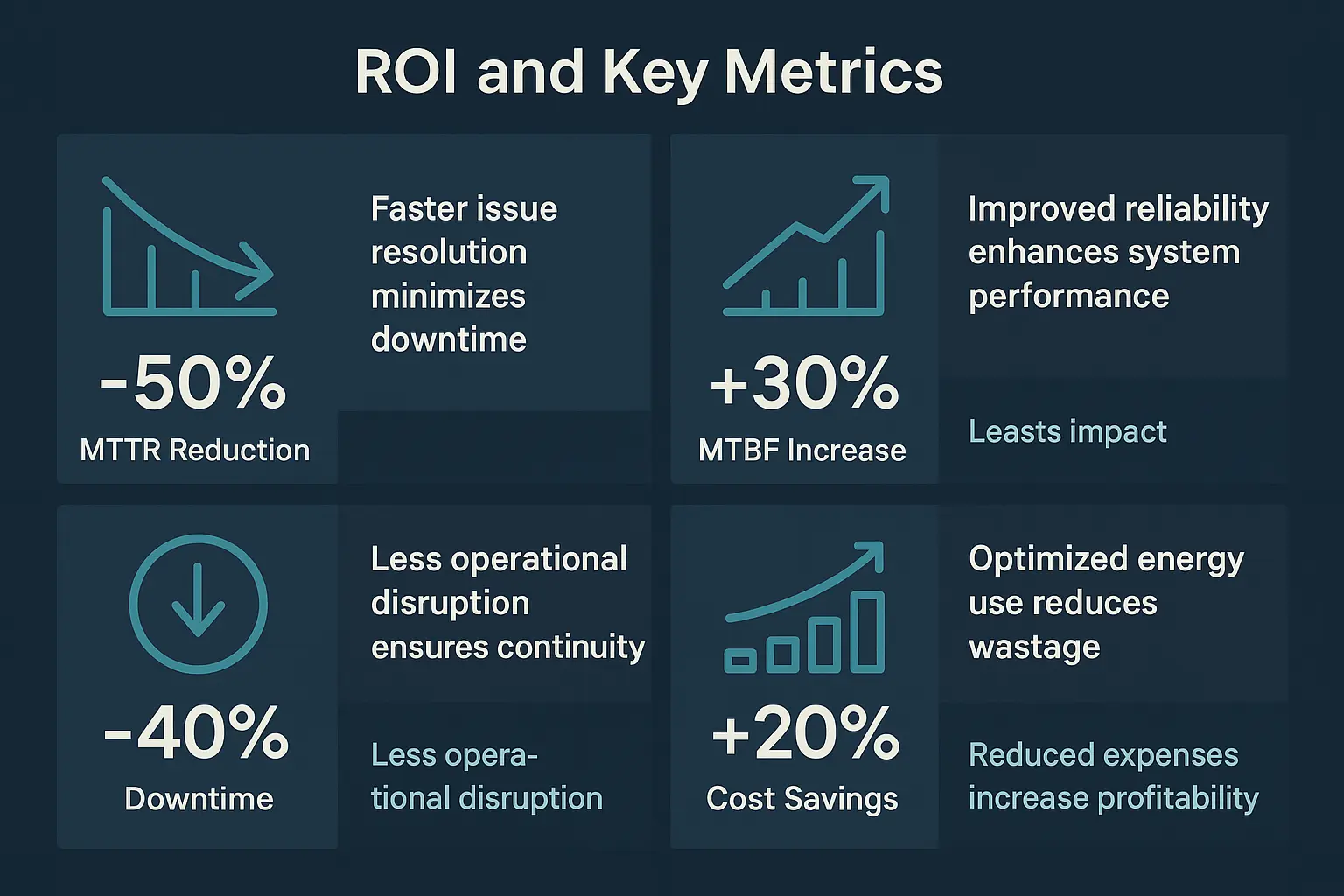
Measure success with metrics that matter for resilience:
- Mean Time To Recovery (MTTR): How fast can the system restore itself after a fault?
- Mean Time Between Failures (MTBF): How effectively does the system prevent faults from occurring in the first place?
- Downtime Reduction: What is the quantifiable impact on service availability?
- Operational Savings: How does improved efficiency and predictive maintenance translate to bottom-line cost reductions? AI has the potential to unlock US$240 billion in cost reductions globally by 2030.
 Caption: Evaluate AI resilience solutions with key performance indicators and ROI metrics to make informed investment decisions.
Frequently Asked Questions
Isn’t implementing fault-tolerant AI too complex and expensive for our current operations?
While the technology is advanced, the implementation can be phased. Starting with a high-value area like predictive maintenance for critical assets can generate immediate ROI that funds broader deployment. The cost of inaction—a single major outage or cyber event—often far exceeds the investment in a resilient architecture.
How do we prevent the AI from becoming a ‘black box’ we can’t control?
This is a critical concern, addressed by the “Observability by Default” and “Human-in-the-Loop” design principles. The right solution will prioritize transparent, interpretable AI and provide your team with intuitive tools to monitor, understand, and, when necessary, override automated decisions. It’s about augmenting your experts, not replacing them.
Our biggest concern is cybersecurity. How does this increase or decrease our risk?
AI introduces new potential attack surfaces, but it also provides our most powerful tools for defense. An AI-driven security system can detect threats that are invisible to human analysts and traditional rule-based systems. A resilient architecture built on principles like isolation and containment ensures that even if one component is compromised, the failure can be contained without bringing down the entire grid.
What kind of skills does my team need to manage these systems effectively?
The role of the grid operator is evolving. Future control rooms will require “AI-driven operators” who are skilled at interpreting data, overseeing automated systems, and managing the human-AI interface. The best solutions are designed with this in mind, simplifying complexity and providing the training and support needed to upskill your existing workforce for these new roles.
Your Next Step Toward a Resilient Future
Building a resilient, AI-driven energy system is the most important engineering challenge of our time. It requires a shift in mindset from preventing every failure to designing systems that can endure and adapt to any disruption. By adopting a principled approach focused on observability, controllability, and security, you can build the confidence to harness the full power of AI.
The technology is ready. The playbook is here. The next step is to assess your own organization’s resilience readiness and identify the most critical areas for improvement.
Ready to design your unbreakable energy future? Schedule a personalized resilience strategy session with our experts to map out your implementation path.
