
The AI Agent Governance Blueprint: From Ethical Principles to Actionable Practice
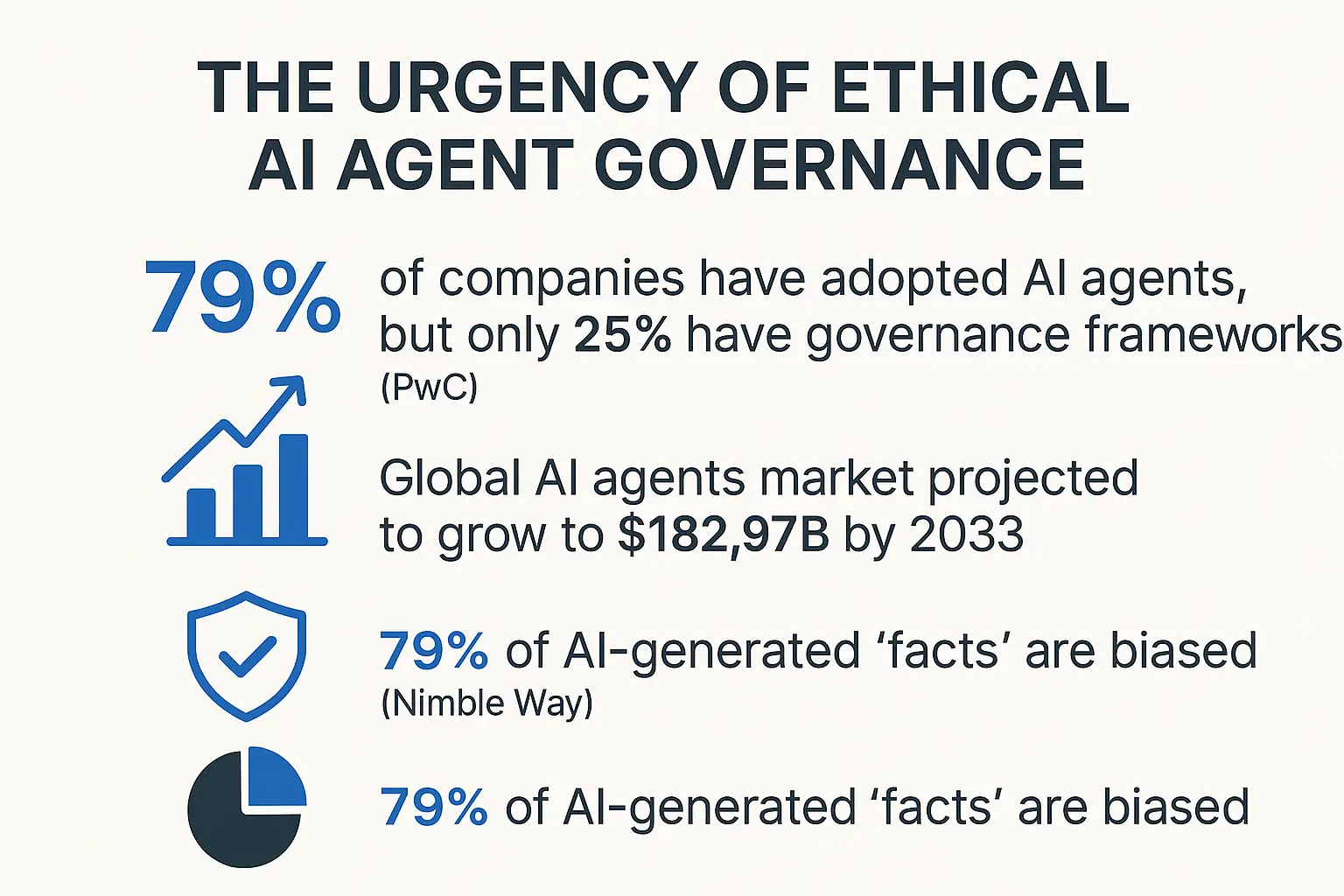
You’re seeing the potential of autonomous AI agents—to streamline workflows, personalize customer experiences, and unlock new revenue streams. But a nagging question keeps you up at night: How do we control them? You’re not alone. While 79% of organizations are adopting AI agents, a staggering 75% lack an established AI governance framework to manage them, according to PwC research.
This isn’t just a compliance gap; it’s a strategic chasm. Without a robust governance plan, you’re exposing your organization to significant reputational damage, legal liability, and a decline in customer trust. The truth is, the old rules for managing AI don’t apply here. You need a new blueprint, one designed for an era of autonomous action.
This guide provides that blueprint. We’ll move beyond the theoretical and give you a practical, lifecycle-based framework for developing and governing AI agents responsibly. We’ll show you how to transform ethical principles from abstract concepts into tangible controls that build confidence, mitigate risk, and turn responsible AI into your greatest competitive advantage.
Understanding Agentic AI: A Paradigm Shift in Responsibility
First, it’s crucial to understand why AI agents demand a different approach. Unlike traditional AI models that analyze data and provide predictions, AI agents possess “agenticness”—the ability to set goals, reason, and take autonomous actions in a digital or physical environment to achieve those goals.
As researchers at Carnegie Mellon University highlight, this shifts them from being mere “tools” to active “agents.” A tool is wielded by a person; an agent acts on their behalf. This distinction has profound implications for governance. When an AI chatbot provides a wrong answer, it’s a flaw in the tool. When an AI agent autonomously negotiates a contract or executes a trade based on incorrect information, who is liable? The developer? The user? The organization? This is the central challenge that traditional governance frameworks were never designed to address.
The Core Ethical Imperatives of AI Agent Development
To build a governance framework that works, you must first embed four core ethical principles into your development culture. These aren’t just checkboxes; they are the pillars that support trustworthy and effective AI.
Transparency & Explainability
Decision-makers need to understand why an AI agent made a particular decision, especially when it has significant consequences. The “black box” problem, where an AI’s inner workings are opaque, is no longer acceptable. Achieving transparency requires a commitment to:
- Model Explainability: Using techniques to interpret and explain the outputs of complex models.
- Traceable Decision-Making: Logging the agent’s reasoning process, data inputs, and actions so they can be audited later.
- Clear Communication: Ensuring the agent can articulate its goals, constraints, and the rationale for its actions in plain language.
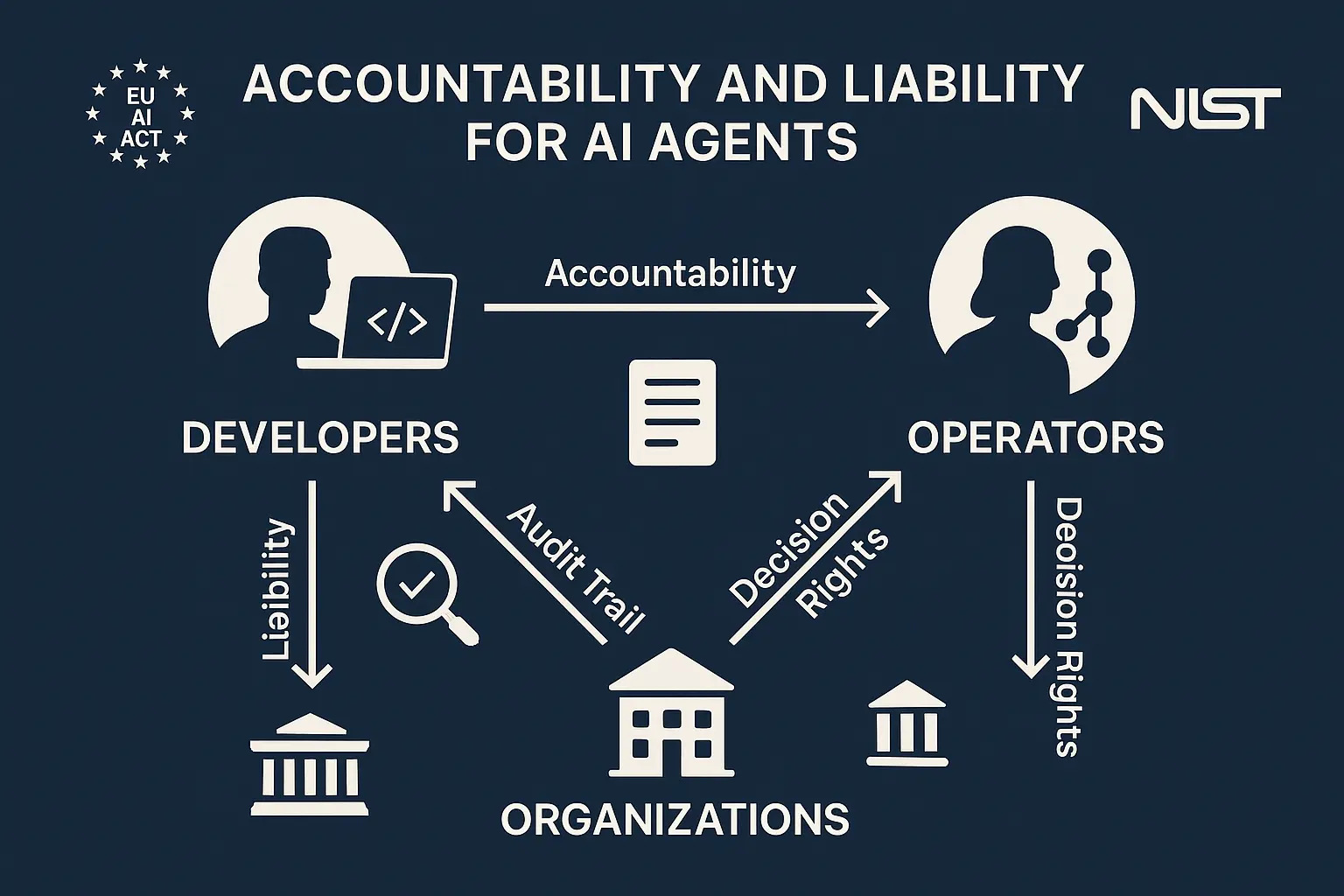
Accountability & Liability
When an autonomous agent causes harm, lines of responsibility must be crystal clear. The Air Canada case, where a chatbot fabricated a bereavement policy leading to a lawsuit, underscores this point. Establishing accountability means defining who is responsible at every stage—from the data scientists who train the model to the business unit that deploys the agent.
A robust framework for accountability includes:
- Defined Roles: Clearly assigning ownership for the agent’s design, deployment, and ongoing monitoring.
- Incident Response Plans: Creating protocols for when an agent acts outside its intended parameters.
- Legal & Compliance Oversight: Involving legal teams early to navigate the evolving landscape of AI liability.
Fairness & Bias Mitigation
Bias is one of the most insidious risks in AI. A study cited by Nimble Way found that 79% of ‘facts’ generated by AI models were biased. For autonomous agents, this bias can lead to discriminatory outcomes in areas like hiring, lending, or customer service. Mitigating bias requires a multi-layered strategy:
- Data-Centric: Auditing and cleaning training data to remove historical biases. Using techniques like data augmentation to ensure representative datasets.
- Algorithmic: Employing fairness-aware algorithms, such as adversarial debiasing or counterfactual fairness, during model development.
- Human-Centric: Implementing continuous human oversight and feedback loops to catch and correct biased behavior after deployment. Our AI bias detection tools can help automate this process.
Human Dignity & Oversight
Ultimately, AI agents should augment human capabilities, not replace human judgment in critical scenarios. As IBM researchers note, preserving human dignity is a key ethical challenge. This means designing systems that empower users and maintain meaningful human control.
Effective oversight models include:
- Human-in-the-Loop (HITL): Requiring human approval for high-stakes decisions before the agent can act.
- Human-on-the-Loop (HOTL): Allowing agents to operate autonomously but having a human monitor their actions and intervene if necessary.
- Clear “Off-Switches”: Building reliable mechanisms to halt an agent’s operation immediately if it behaves unexpectedly.
Building a Robust AI Agent Governance Framework: A Lifecycle Approach
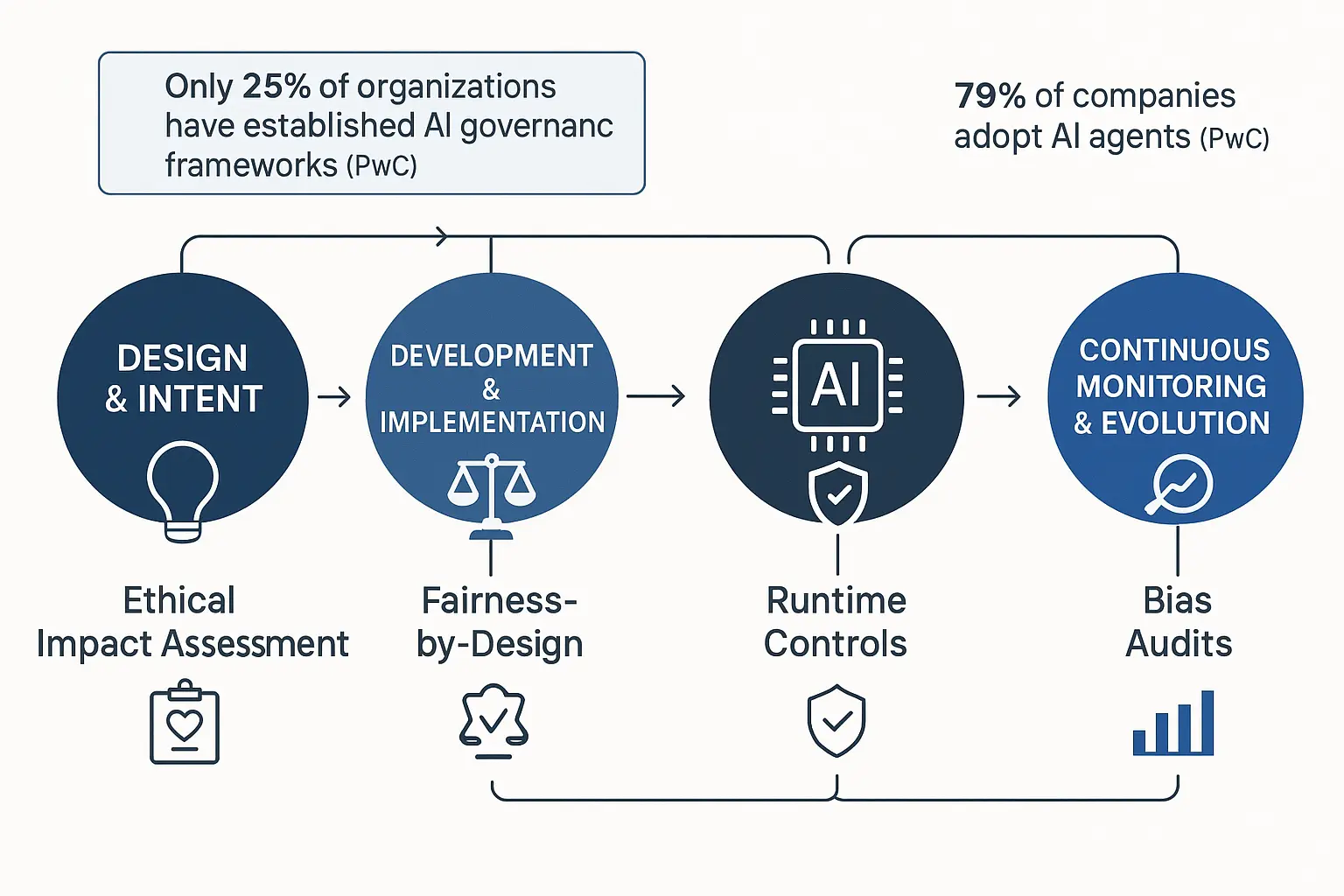
Ethical principles are meaningless without a structure to implement and enforce them. The most effective approach is to embed governance into every stage of the AI agent lifecycle. A Deloitte report warns that 80% of companies lack the infrastructure for safe scaling because they treat governance as an afterthought.
By adopting a lifecycle approach, you move from reactive problem-solving to proactive risk management.
Phase 1: Design & Intent
Strong governance starts before a single line of code is written. This phase is about defining the “why” and setting the right boundaries.
- Define Scope & Objectives: Clearly document the agent’s purpose, intended capabilities, and limitations.
- Conduct Impact Assessments: Proactively evaluate potential ethical, societal, and legal risks associated with the agent’s deployment.
- Establish Ethical Guardrails: Define non-negotiable rules and values the agent must adhere to. This is where concepts like IBM’s “Alignment Studio” become practical, allowing you to fine-tune agents based on company policies.
Phase 2: Development & Implementation
Here, you translate the principles from the design phase into technical reality.
- Implement Fairness-by-Design: Integrate bias mitigation techniques directly into the development workflow.
- Secure the Agent’s Identity: As Palo Alto Networks advises, treat AI agents like any other identity. Implement robust access management controls to prevent privilege escalation or misuse.
- Build for Explainability: Choose model architectures and development practices that prioritize transparency and allow for clear explanations of the agent’s behavior.
Phase 3: Deployment & Runtime
This is where the agent begins interacting with the real world, and where continuous oversight is critical.
- Establish Runtime Controls: Implement real-time monitoring to track the agent’s actions, decisions, and data interactions.
- Detect Anomalous Behavior: Use automated systems to flag deviations from expected behavior, potential bias drift, or security threats.
- Implement Failsafes: Ensure that your human-on-the-loop oversight includes clear procedures and technical mechanisms for immediate intervention or shutdown.
Phase 4: Continuous Monitoring & Evolution
An AI agent is not a static product; it learns and evolves. Your governance must, too.
- Conduct Regular Audits: Periodically perform bias impact assessments and model performance reviews to ensure the agent remains aligned with its original intent.
- Monitor for Behavioral Drift: Track changes in the agent’s behavior over time as it interacts with new data, and retrain or recalibrate as needed.
- Adapt to Regulatory Changes: Stay informed about the evolving legal landscape and update your governance framework to maintain compliance.
Navigating the Regulatory Landscape & Global Harmonization
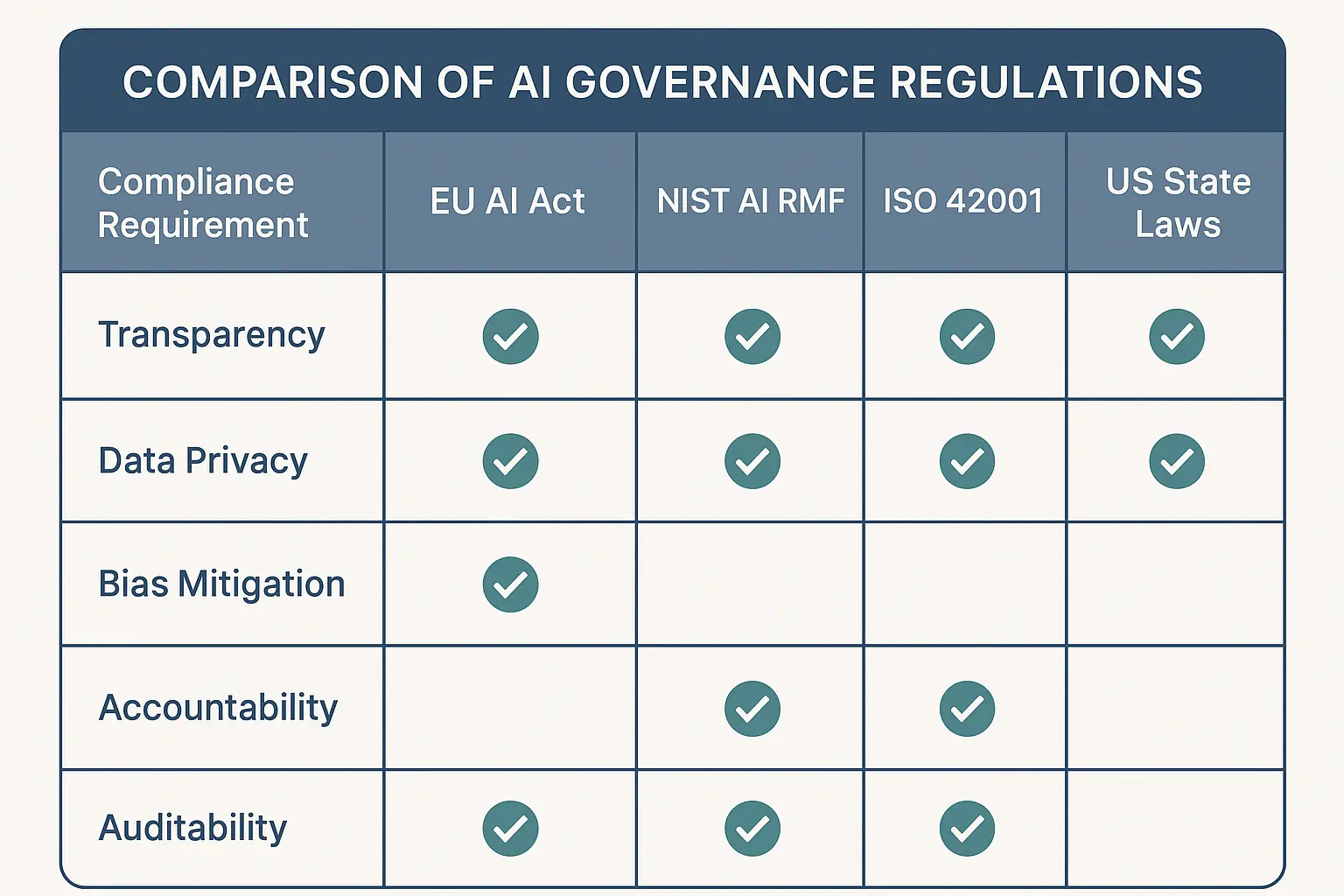
Governing AI agents isn’t just an ethical best practice; it’s increasingly a legal requirement. A complex web of regulations is emerging globally, and organizations must be prepared to demonstrate compliance.
Key frameworks to understand include:
- EU AI Act: A risk-based framework that classifies AI systems and imposes strict requirements for high-risk applications, including those involving autonomous agents.
- NIST AI Risk Management Framework (RMF): A voluntary framework from the U.S. that provides a structured process for managing risks associated with AI systems throughout their lifecycle.
- ISO/IEC 42001: An international standard that provides requirements for establishing, implementing, maintaining, and continually improving an AI management system.
While these frameworks have different scopes, they converge on common principles: risk management, data quality, transparency, human oversight, and accountability. A comprehensive AI governance solution should help you map your internal controls to these external standards, simplifying your compliance journey.
Our Approach: Building Trust in an Autonomous World
At Srinergy AI, we believe that ethical governance is the bedrock of innovation. We see the gaps in the market—the disconnect between academic theory and practical implementation, the siloed approaches to bias, ethics, and security.
Our methodology is different. We provide an integrated platform that weaves governance through the entire AI agent lifecycle. We help you move beyond checklists to create a dynamic, adaptive system for responsible AI development. We empower you to build agents that are not only powerful but also principled, transparent, and trustworthy.
Frequently Asked Questions (FAQ)
1. Where should we even start with AI agent governance?Begin with a cross-functional task force including representatives from legal, IT, data science, and the relevant business units. The first step is to conduct an inventory of your current and planned AI agent projects and perform a preliminary risk assessment using a framework like the NIST AI RMF.
2. Isn’t this level of governance too expensive and slow for a fast-moving field?The upfront investment in governance is far less than the potential cost of a major failure—which could include fines, lawsuits, loss of customers, and brand damage. A well-designed governance framework actually accelerates innovation by providing clear “rules of the road,” allowing development teams to build with confidence and speed.
3. How is AI agent governance different from our existing data governance policies?Data governance focuses on the quality, security, and privacy of data assets. AI agent governance builds on that foundation but adds a crucial new dimension: governing autonomous actions and decisions. It’s about managing the behavior of the system, not just the data it uses.
4. How can we prove the ROI of ethical AI governance to our leadership?Frame it in terms of risk mitigation and strategic advantage. Highlight the declining trust in AI companies (a 12% drop year-on-year, according to the World Economic Forum) and position robust governance as a key differentiator. It builds customer loyalty, attracts top AI talent, and future-proofs the organization against regulatory penalties.
5. What is the single most important element of a successful governance framework?While all elements are interconnected, establishing clear lines of accountability is paramount. When everyone knows who is responsible for what, it drives proactive behavior and ensures that ethical considerations are owned and addressed at every stage, rather than being delegated to an anonymous “system.”
Ready to build a governance framework that turns risk into a competitive advantage? Schedule a consultation with our experts to assess your organization’s AI governance maturity and map out your next steps.
