
The Pragmatist’s Guide: When to Adopt Quantum Machine Learning for Energy Optimization
You’re evaluating the next frontier of computational power for the energy sector. You’ve seen the headlines about quantum computing, but you’re faced with a critical question: Is Quantum Machine Learning (QML) a practical solution for today’s energy optimization challenges, or is it just theoretical hype?
Navigating this landscape is tough. On one side, you have dense academic papers filled with complex equations. On the other, high-level articles that promise a revolution without explaining the “how.” You need a clear, authoritative guide that bridges that gap—one that translates quantum potential into a practical business case.
This guide is designed for you. We’ll move beyond the theoretical to provide a pragmatic framework for evaluating QML. We’ll explore where it’s already delivering measurable value, what limitations you need to be aware of, and how you can build a strategy that leverages its power for a real competitive advantage.
The Unprecedented Data Challenge in Modern Energy
Today’s energy grid is no longer a simple, one-way system. It’s a dynamic, decentralized network overflowing with data. Smart meters, IoT sensors, intermittent renewable sources like wind and solar, and the surge in electric vehicle (EV) charging create a computational challenge that is pushing classical systems to their limits.
Traditional machine learning struggles with the sheer scale and complexity of this data. The number of variables involved in optimizing a modern grid grows exponentially, making it impossible for even the most powerful supercomputers to find the absolute best solution in real-time. This leads to:
- Inaccurate Forecasts: Difficulty in predicting the output of variable renewables, leading to grid instability and wasted energy.
- Inefficient Load Balancing: Suboptimal distribution of power, resulting in higher operational costs and increased risk of outages.
- Reactive Maintenance: An inability to predict component failures before they happen, causing costly downtime.
This is where the unique properties of quantum computing enter the picture, not as a replacement for classical methods, but as a powerful, specialized accelerator.
Quantum Machine Learning: A Practical Approach for Today
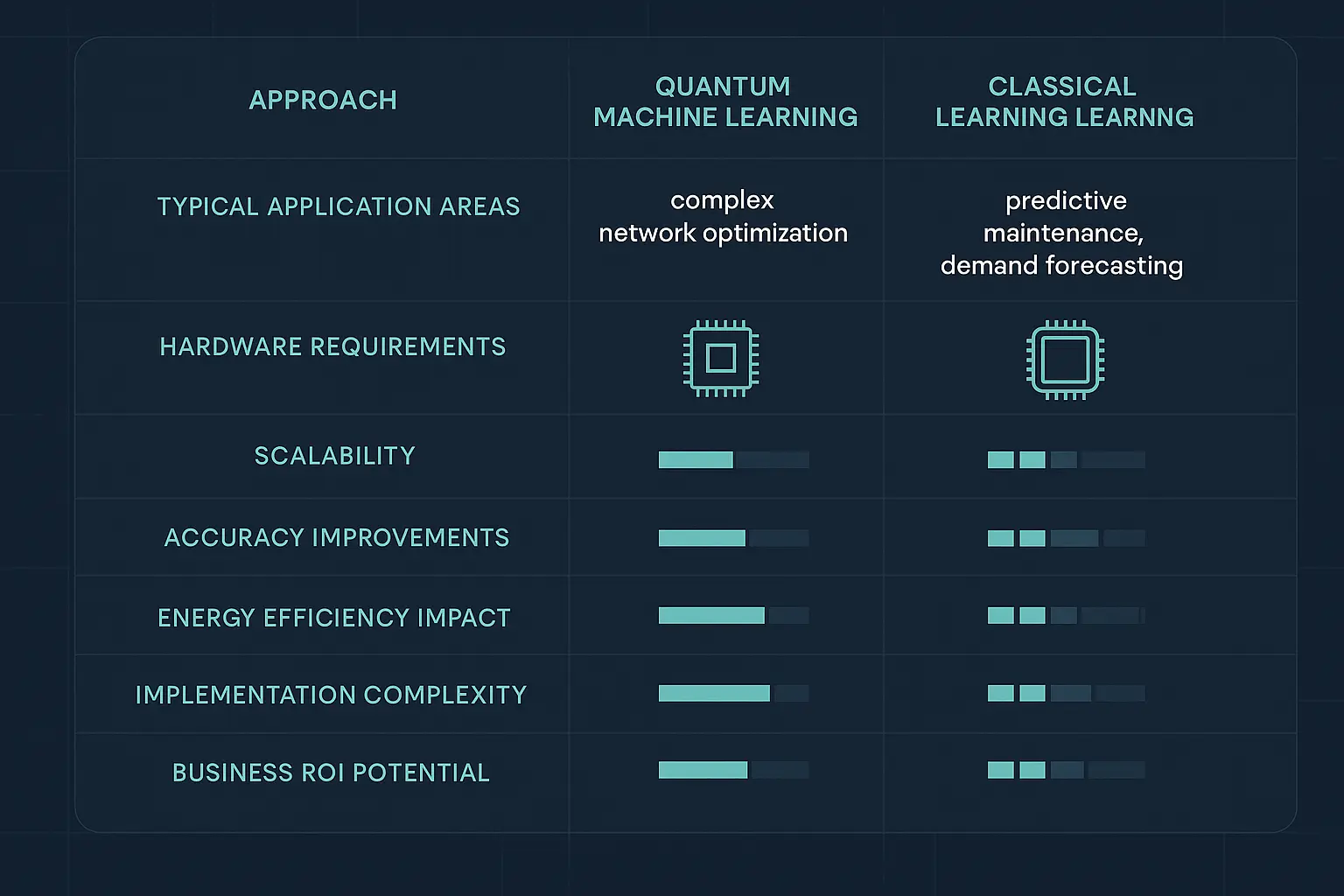
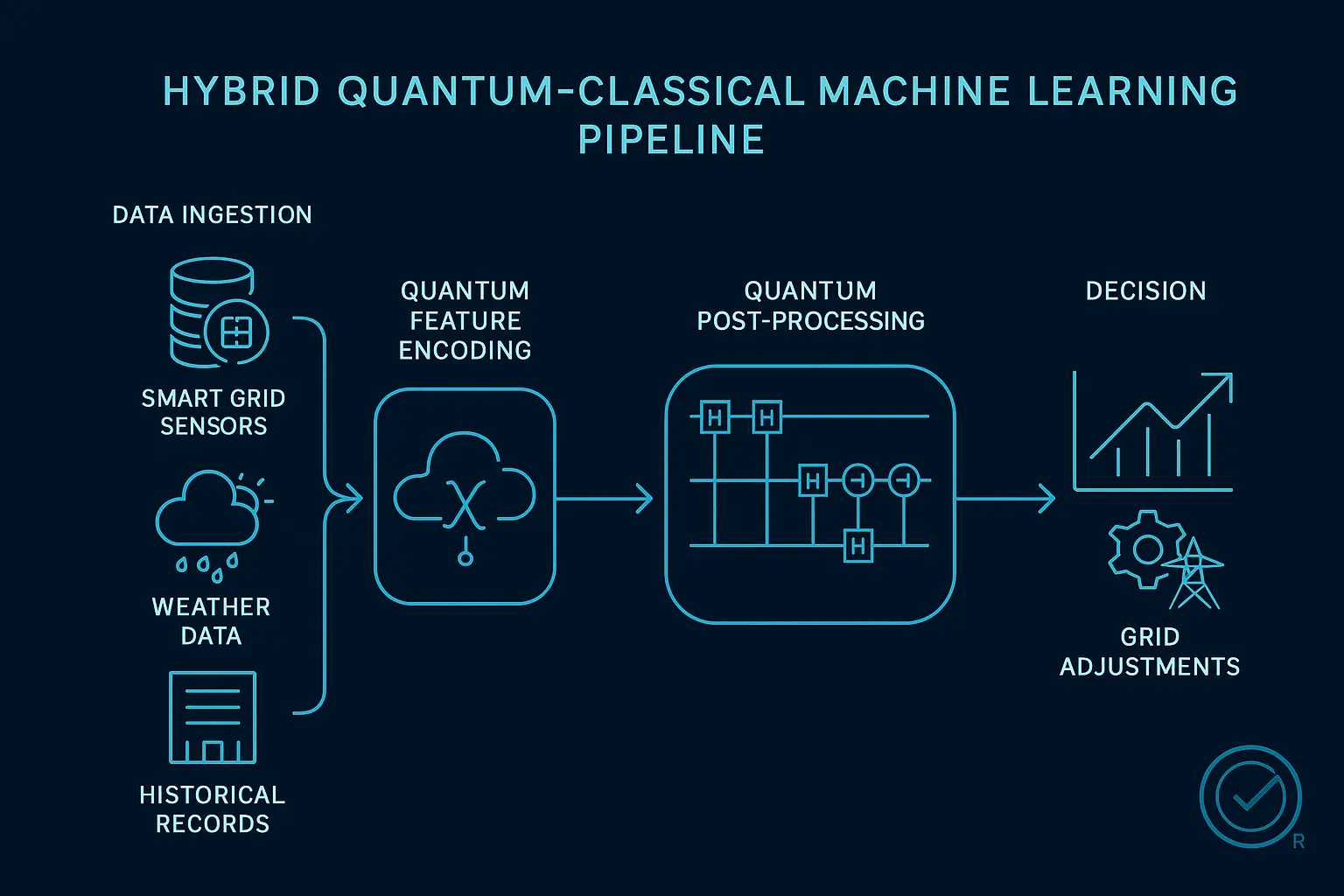
Forget the idea of a single, all-powerful quantum computer solving every problem. The most significant progress—and the most practical path forward—lies in Hybrid Quantum-Classical solutions.
This approach uses quantum processors for the specific tasks they excel at—like exploring vast possibility spaces or finding patterns in complex, high-dimensional data—while leaving the rest of the workflow (data pre-processing, for instance) to classical computers. It’s the best of both worlds, mitigating the limitations of current “Noisy Intermediate-Scale Quantum” (NISQ) era hardware while unlocking new computational capabilities.
The key techniques driving value in the energy sector include:
- Quantum Annealing: Ideal for solving complex optimization problems, such as finding the most efficient pathway for energy distribution across a grid.
- Variational Quantum Algorithms (VQAs): A powerful hybrid technique where a classical optimizer trains a quantum circuit, perfect for machine learning tasks like classification and regression.
- Quantum Neural Networks (QNNs): Quantum-enhanced versions of classical neural networks that can process information in fundamentally new ways, leading to more accurate and efficient models.
Transforming Energy Operations: Key QML Applications & Early Wins
The application of hybrid QML is already moving from research labs to real-world pilot projects, delivering quantifiable results that validate its potential. As leading industry publications and academic journals show, early adopters are gaining a significant edge.
Intelligent Grid Optimization and Stability
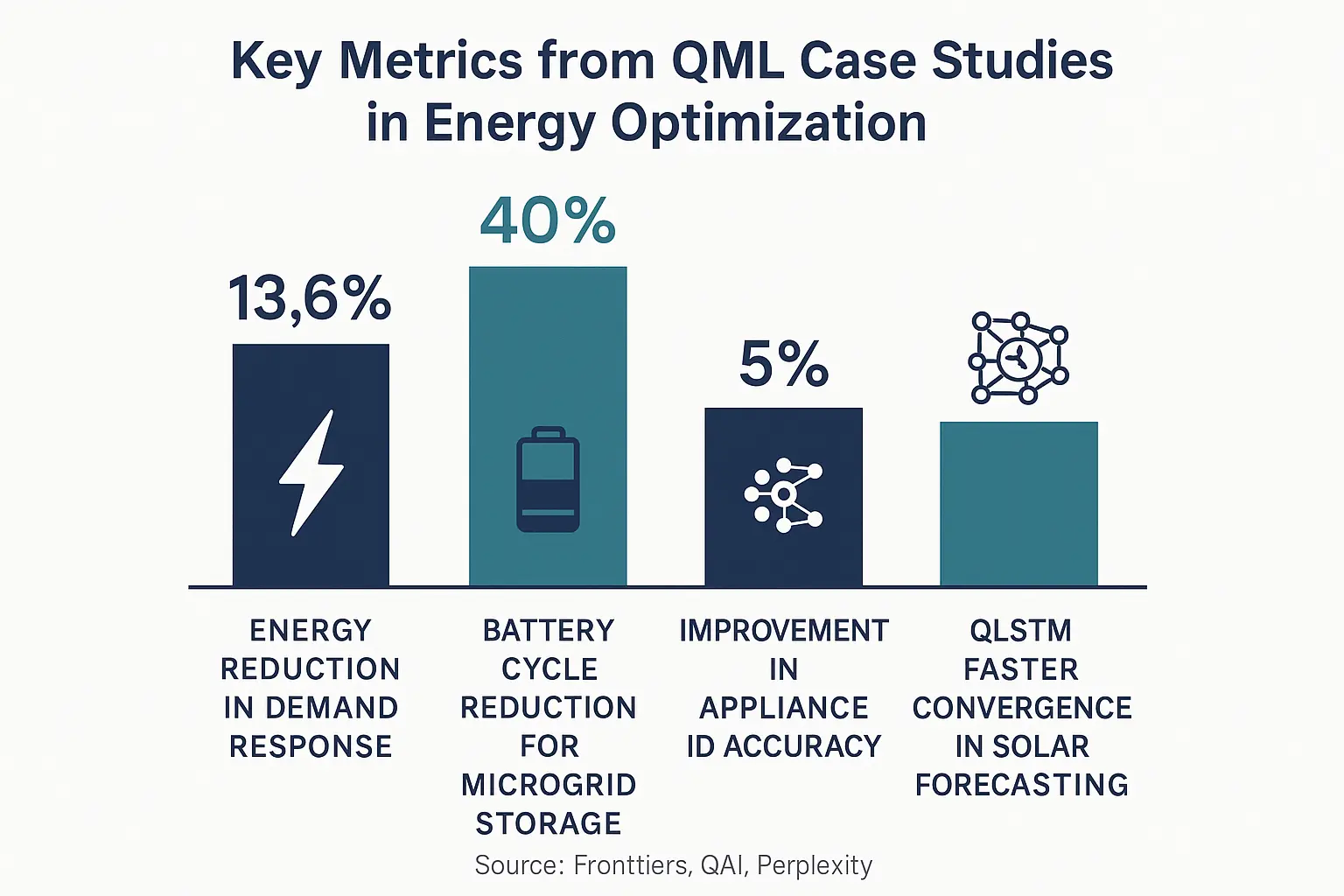
Quantum annealing is proving particularly effective for grid partitioning—a critical task for managing large, complex power networks. By breaking the grid into stable, manageable islands, operators can prevent cascading failures. A landmark partnership between D-Wave and E.ON demonstrated how this approach could optimize the grid for a more sustainable future, enhancing stability and improving efficiency. Similarly, a QuantyMize prototype for microgrid battery optimization reduced battery cycles by 40%, significantly extending asset life and boosting the use of renewables.
Hyper-Accurate Renewable Energy Forecasting
The unpredictable nature of wind and solar power is a major hurdle for grid stability. Hybrid models using Quantum Long Short-Term Memory (QLSTM) networks are showing remarkable promise. Research published in Frontiers in Quantum Science and Technology highlights that these models achieve faster convergence and higher accuracy than their classical counterparts, enabling utilities to better anticipate supply and reduce reliance on fossil fuel backups.
Smarter Demand Response and Consumption
Optimizing energy consumption across thousands or millions of endpoints is a massive combinatorial problem. QML excels here. A reinforcement learning framework for demand response demonstrated a 13.6% reduction in energy consumption, while another study showed QML improving appliance identification accuracy by 5% over classical methods. This allows for more granular and effective demand-side management, especially with the rise of smart homes and EV charging.
Navigating the Quantum Landscape: Challenges and Practical Considerations
To make a confident decision, you need a transparent view of the current landscape. Adopting QML is a strategic move that requires understanding its limitations as well as its strengths.
The Reality of the NISQ Era
We are in the Noisy Intermediate-Scale Quantum (NISQ) era. Today’s quantum processors have a limited number of qubits and are susceptible to environmental “noise,” which can introduce errors. This is precisely why hybrid quantum-classical approaches are critical. They are specifically designed to work within these constraints, providing a practical pathway to value long before large-scale, fault-tolerant quantum computers become available.
The Energy Paradox: A Nuanced View
A common concern is the energy consumption of quantum computers themselves, many of which require extensive cooling. This is a valid point, but it must be weighed against the massive, system-level savings QML can unlock. A small energy investment in a quantum processor that optimizes an entire national grid—preventing blackouts, maximizing renewable usage, and deferring costly infrastructure upgrades—delivers an overwhelmingly positive net energy ROI.
Your Roadmap to Quantum Advantage
Full-scale quantum advantage is a journey, not a switch-flip. The goal isn’t to wait for the “perfect” quantum computer. The goal is to identify high-value problems that can be solved with today’s hybrid systems and build institutional knowledge. Starting now with pilot projects allows you to develop a competitive edge as the technology matures.
Building Your Quantum Strategy: An Evaluation Framework for Energy Leaders
How do you determine if QML is right for your specific challenges? Instead of getting lost in technical details, focus on a strategic evaluation. Inspired by academic frameworks like the Assessment Model for Innovation Management (AMIM), this process helps you prioritize opportunities.
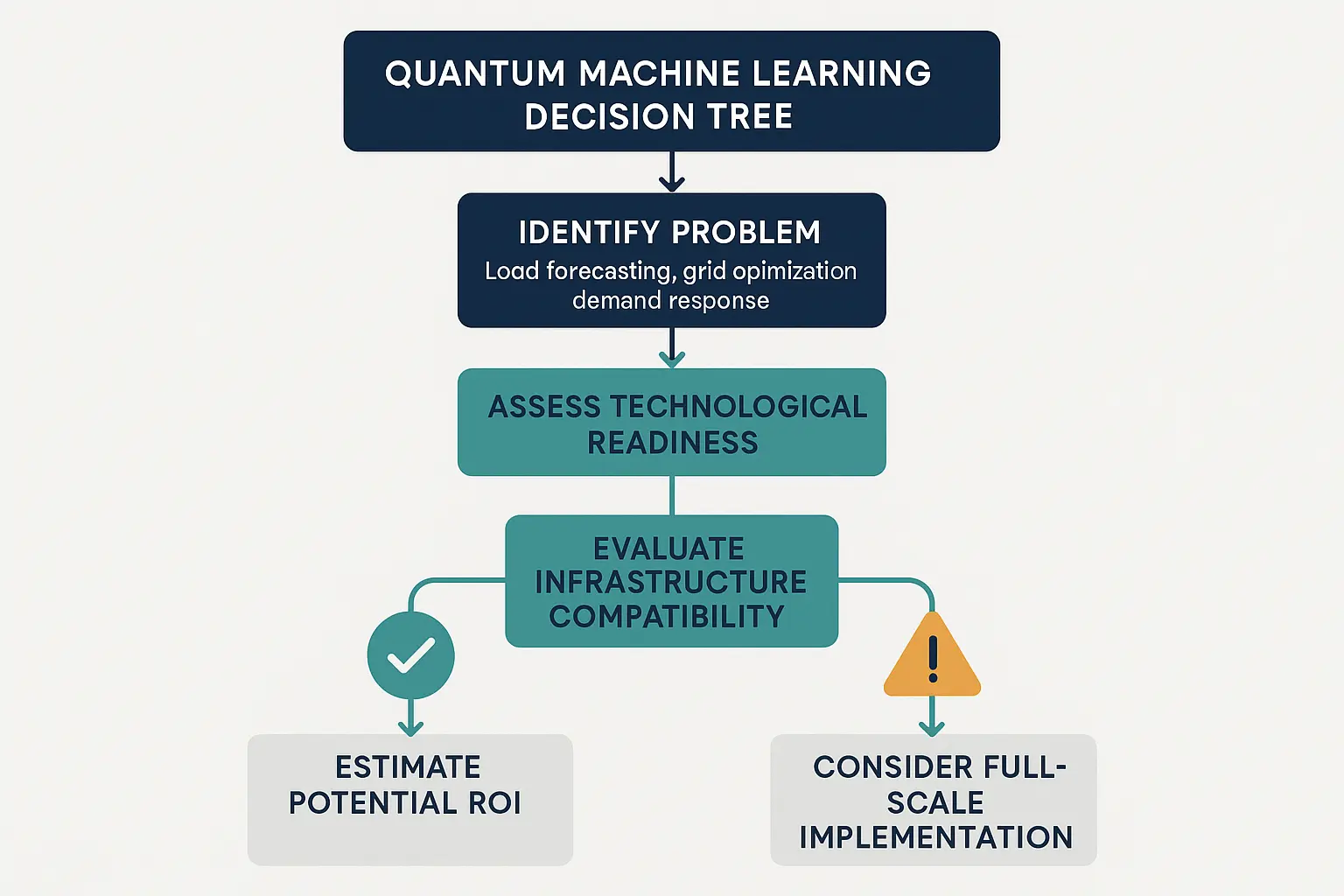
Step 1: Assess Problem Criticality
Identify your most pressing and computationally expensive optimization problems.
- Ask: Where are we hitting the limits of classical computing? Is it in real-time grid balancing, renewable forecasting, or asset management?
- Focus: Prioritize challenges where a better, faster solution would have a direct and significant impact on cost, reliability, or sustainability.
Step 2: Evaluate Technological Readiness
Match your problem to the maturity of current QML applications.
- Ask: Are there published studies or pilot projects (like the Pasqal/EDF collaboration) demonstrating success for our specific use case?
- Focus: Applications like grid optimization (quantum annealing) and forecasting (VQAs) are more mature than others. Start where the technology is most proven.
Step 3: Define Potential Impact and ROI
Quantify the expected benefits in business terms.
- Ask: What would a 10% improvement in forecasting accuracy or a 5% reduction in transmission losses mean for our bottom line?
- Focus: Model the financial, operational, and environmental returns. Use existing metrics—like the 13.6% energy reduction in demand response—as a benchmark.
Step 4: Compare Your Options
Understand where QML provides a true advantage over advanced classical methods.
- Ask: For this specific problem, does the exponential nature of the challenge justify a quantum approach, or could an advanced classical algorithm suffice?
- Focus: Use QML where the complexity is combinatorial and finding a “good enough” solution isn’t sufficient.
Frequently Asked Questions (FAQ)
1. Isn’t large-scale quantum computing still decades away?
Yes, a fully fault-tolerant quantum computer is a long-term goal. However, this misses the point. Hybrid Quantum-Classical systems are delivering value today by tackling specific parts of complex problems that are intractable for classical machines. The strategy is to gain an advantage now with NISQ-era hardware, not wait for a future breakthrough.
2. Do I need to hire a team of quantum physicists to get started?
No. The ecosystem is evolving to abstract away the deep quantum complexity. Leading platforms and solution providers (like us) offer hybrid frameworks and APIs that allow your existing data science and machine learning teams to leverage quantum resources without needing a PhD in quantum mechanics. The focus is on problem formulation, not building quantum circuits from scratch.
3. How does the cost of QML compare to classical solutions?
Direct cost comparisons can be misleading. While access to quantum hardware involves investment, it should be evaluated as a strategic capability, not a commodity. The right approach is to start with a well-defined proof-of-concept on a high-value problem. This allows you to demonstrate significant ROI and build a business case for further investment, mitigating financial risk. The growing QML market, projected to expand at a 24.5% CAGR, is creating more accessible pathways for entry.
4. When should I choose QML over a powerful classical algorithm like a deep neural network?
Choose QML when your problem has an underlying structure that is exponentially complex. For many pattern recognition or standard forecasting tasks, advanced classical ML is still the best tool. But for problems involving combinatorial optimization (like optimizing the charge schedule for a fleet of 10,000 EVs) or simulating complex molecular interactions (for new battery materials), QML offers a fundamentally more powerful approach. Our experts can help you [assess your specific use case] to determine the optimal path.
The Future is Hybrid: Your Path to Quantum-Powered Energy Systems
The energy transition demands a new class of computational tools. Quantum Machine Learning, applied pragmatically through hybrid models, is no longer a distant vision—it’s an emerging reality.
By focusing on high-impact problems, leveraging the power of hybrid architectures, and building a strategic roadmap, you can move from evaluation to implementation with confidence. The journey begins not with a massive overhaul, but with a single, strategic step.
Ready to explore how a hybrid quantum approach can solve your most critical optimization challenges? [Connect with our solutions architects] for a personalized assessment and discover your path to quantum advantage.
