
Fortifying the Factory Floor: A Guide to Secure Edge AI for Industrial Energy Monitoring
Imagine the control room of a large manufacturing plant. The hum of machinery is the facility’s heartbeat, and every watt of energy is a critical resource. Suddenly, a key piece of equipment fails without warning, causing a costly, cascading shutdown. The data showed everything was normal—or did it?
In today’s interconnected industrial world, this scenario is a growing concern. The systems monitoring our most critical infrastructure, from power grids to production lines, are facing unprecedented challenges. Traditional monitoring is often too slow, and sending massive amounts of operational data to the cloud for analysis introduces latency and significant security risks.
This is where Edge AI comes in—a transformative approach that brings artificial intelligence directly to the source of the data. But deploying AI in the sensitive world of Operational Technology (OT) isn’t as simple as plugging in a new device. It requires a security-first mindset that protects not just data, but the physical processes that power our world. This guide is your starting point for understanding how to do it right.
Foundation: Unpacking the Tech Trinity of Modern Industry
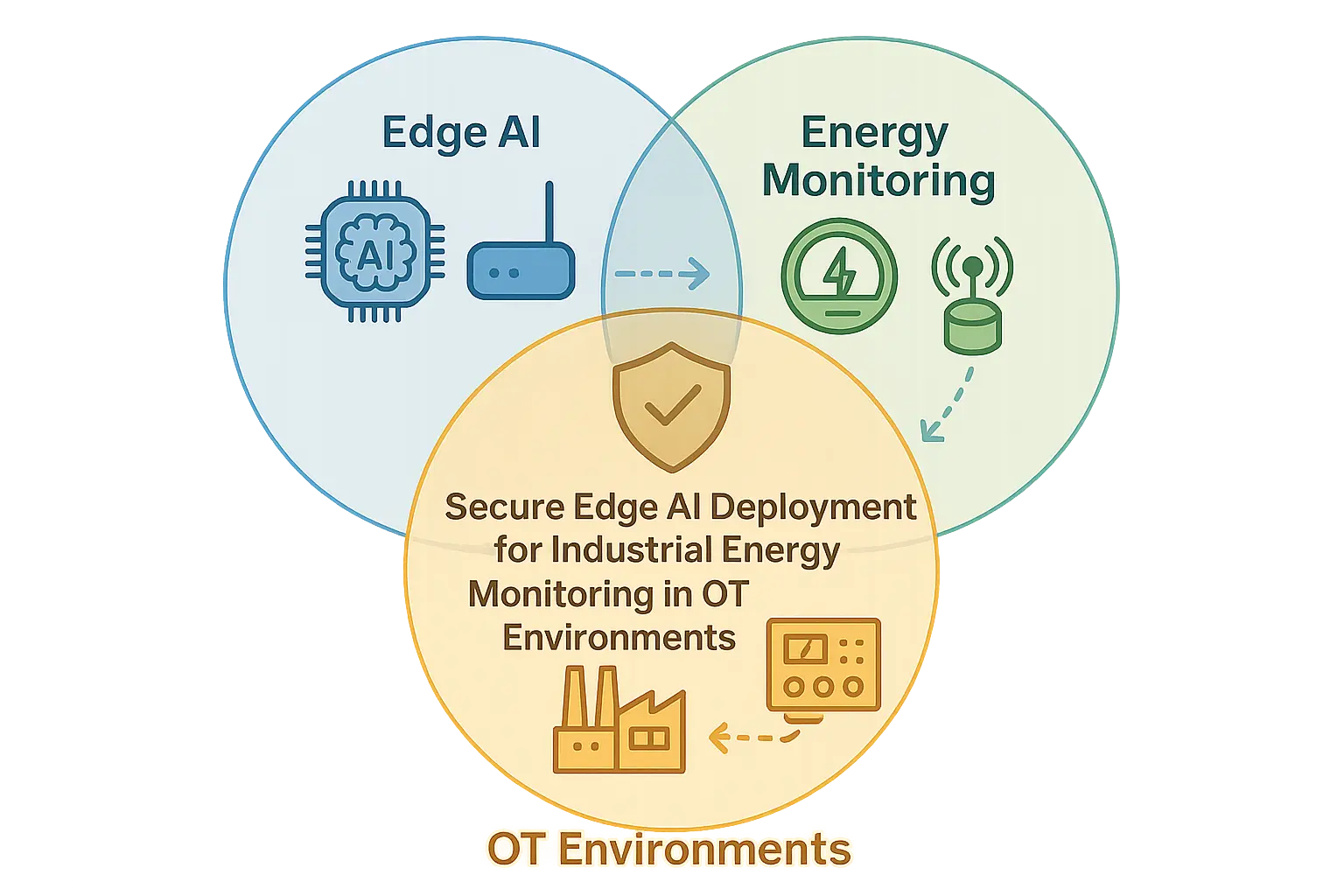
To build a secure system, we first need to understand the building blocks. At the heart of this revolution are three interconnected concepts: Edge AI, Operational Technology (OT), and Industrial Energy Monitoring. They are no longer separate fields but a powerful combination driving the future of industry.
- What is Edge AI? Think of it as putting a smart, local brain right next to your machines. Instead of sending raw data from a sensor to a distant cloud server for analysis, Edge AI processes it right there, on or near the device itself. This delivers real-time insights with lightning speed, reduces bandwidth costs, and keeps sensitive data from ever leaving your secure facility.
- What is an Operational Technology (OT) Environment? This is the world of industrial control systems (ICS), including everything from the programmable logic controllers (PLCs) on an assembly line to the SCADA systems managing a power grid. Unlike traditional IT networks that manage data, OT networks manage physical processes. Here, uptime is measured in years, and the consequences of a failure aren’t just lost data—they can be physical damage or safety incidents.
- What is Industrial Energy Monitoring? This is the application that ties it all together. It’s the practice of using data from sensors, meters, and industrial equipment to track energy consumption in real time. The goal is to improve efficiency, predict equipment failures before they happen (predictive maintenance), and ensure the stable, reliable operation of critical infrastructure.
When these three converge, you unlock the ability to make intelligent, split-second decisions about energy use and equipment health, right on the factory floor.
The New Frontier of Risk: Understanding the OT Edge AI Threat Landscape
Bringing the power of AI into an OT environment creates incredible opportunities, but it also introduces a new and complex set of security challenges. Your threat model is no longer just about protecting a server in a data center; it’s about protecting a smart device sitting right next to a multi-million-dollar turbine.
The risks are unique because they blend the digital with the physical:
- Physical Device Tampering: An edge device is physically accessible on the plant floor, making it a target for unauthorized access or hardware manipulation.
- Network Vulnerabilities: Connecting edge devices, even on an internal network, can create new entry points into historically “air-gapped” or isolated OT systems. Legacy OT equipment often lacks modern security protocols, making it vulnerable.
- AI-Specific Attacks: This is the most novel threat. Bad actors can target the AI model itself.
- Data Poisoning: An attacker could feed a sensor slightly altered but plausible data over time, slowly “retraining” your energy monitoring AI to ignore the signs of an impending critical failure.
- Adversarial Attacks: Malicious inputs, invisible to the human eye, can be crafted to trick an AI model into making a wrong decision, like classifying a dangerous power surge as normal operation.
- Supply Chain Compromise: The hardware and software for your edge device could be compromised before it ever arrives at your facility.
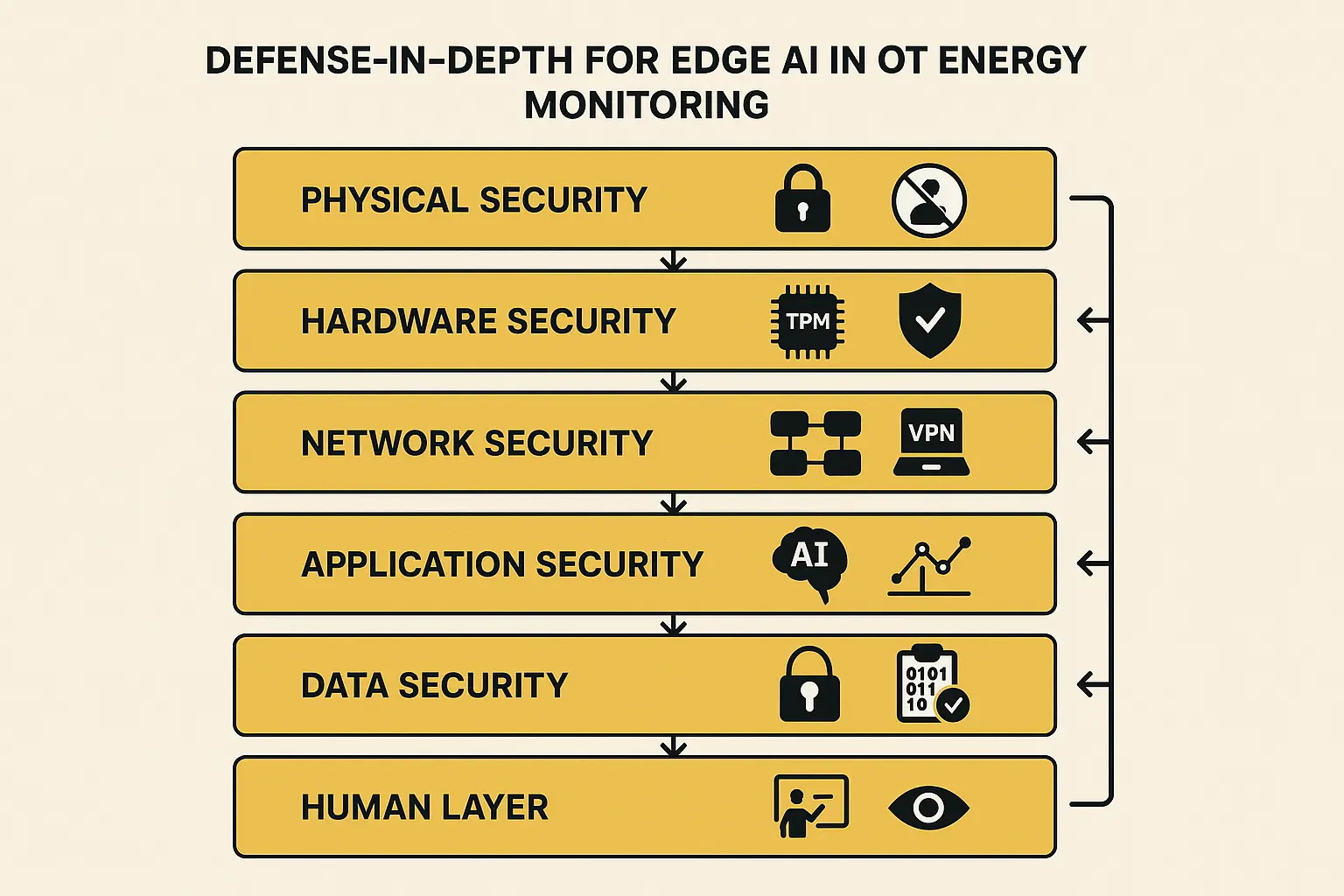
Securing this environment requires moving beyond a simple firewall. It demands a “Defense-in-Depth” strategy, where multiple layers of security work together to protect the entire system, from the physical hardware to the AI model itself.
From Theory to Practice: Implementing a Secure Edge AI Deployment
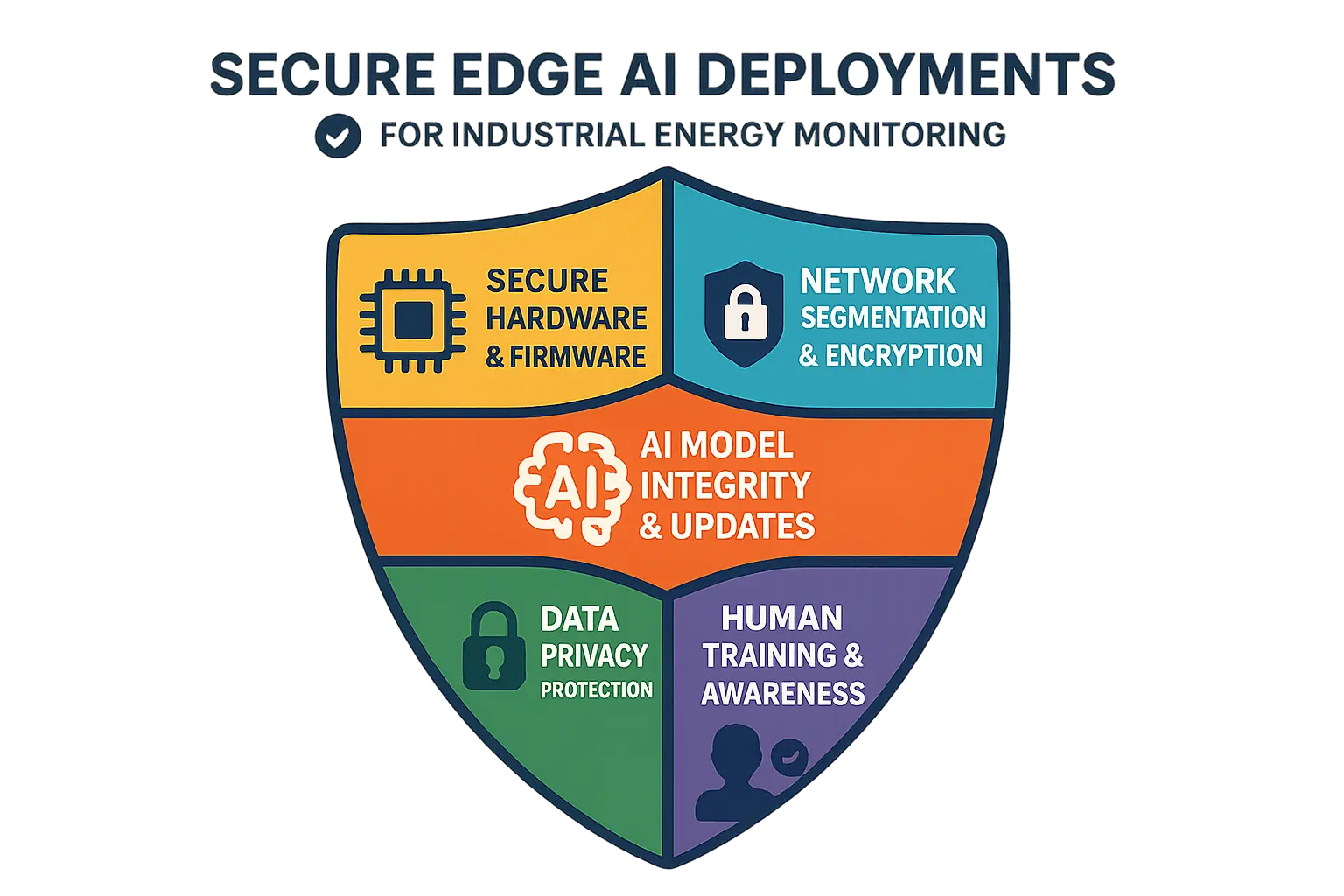
A secure deployment isn’t a single product; it’s a comprehensive strategy. Building this strategy requires thinking about security at every stage, creating a resilient framework that protects your critical operations.
Secure Hardware and Infrastructure
Your security starts with the physical device. You wouldn’t build a bank vault with flimsy walls, and you shouldn’t run critical AI on insecure hardware.
- Trusted Platform Module (TPM): This is a dedicated microchip designed to secure hardware by storing cryptographic keys. Think of it as a hardware vault that ensures the device hasn’t been tampered with.
- Secure Boot: This process ensures that the device only loads software that is trusted and signed by the manufacturer. It prevents malware from hijacking the device during startup.
- Ruggedization: OT environments are harsh. Devices must be built to withstand extreme temperatures, vibrations, and dust, ensuring physical reliability which is a core component of security.
Secure Network Design
How your edge device communicates is just as important as the device itself. The goal is to isolate it and limit its access to only what is absolutely necessary—a principle known as Zero Trust.
- Micro-segmentation: Instead of having one large, flat network, you create small, isolated zones. Your Edge AI device for energy monitoring should be in its own segment, unable to communicate with, for example, the control systems for a separate production line. This contains any potential breach.
- Secure Remote Access: If you need to access the device remotely for updates, use encrypted VPNs and multi-factor authentication. Unsecured remote access ports are one of the most common entry points for attackers.
AI Model Security and Integrity
This is where IT, OT, and data science security converge. An AI model is only as trustworthy as the data it’s trained on and the environment it runs in.
- Secure Model Updates: How do you update an AI model on a device in a highly restricted or air-gapped network? Techniques like federated learning allow models to be trained locally without sending raw, sensitive data out. Updates can be securely signed and delivered through a controlled process that aligns with strict OT change management protocols.
- Data Integrity Validation: Before data from a sensor is fed to the AI model, it should be validated. Implement checks to ensure the data is within expected ranges and formats. This helps guard against the data poisoning attacks mentioned earlier.
- Model Hardening: During development, AI models can be “hardened” by training them on noisy or intentionally manipulated data. This makes them more resilient to adversarial attacks in the real world.
Data Protection and Privacy
Finally, the energy data itself—which can reveal sensitive production schedules or operational weaknesses—must be protected at all times.
- End-to-End Encryption: Data must be encrypted from the moment it leaves the sensor, while it’s being processed on the edge device (“in use”), and when it’s stored (“at rest”).
- Anonymization: If data needs to be shared for broader analysis, techniques can be used to strip it of any information that could identify the specific machine or process it came from, protecting operational confidentiality.
Your Roadmap to a Secure and Trusted Deployment
Embarking on an Edge AI project in an OT environment can feel daunting, but a structured approach can pave the way for success. The key is to prioritize security from day one, not as an afterthought.
Focus on these core pillars as you begin your journey:
- Assess Your Environment: Understand your existing OT network, its vulnerabilities, and what physical and cyber-threats are most relevant.
- Start with a Secure Foundation: Choose hardware with built-in security features like TPM and secure boot.
- Design for Isolation: Implement network segmentation to protect your critical control systems.
- Validate Your AI: Establish a secure lifecycle for your AI models, from development and training to deployment and updating.
- Train Your People: The strongest lock is useless if someone leaves the door open. Your OT and IT teams need to understand the new security paradigm of Edge AI.
By integrating these practices, you can harness the incredible power of Edge AI to optimize energy consumption and predict failures, all while strengthening the security and resilience of the industrial operations that rely on it.
Frequently Asked Questions (FAQ)
What’s the main benefit of Edge AI over cloud AI for industrial energy monitoring?
The primary benefit is real-time response with enhanced security. By processing data locally on an edge device, you eliminate the latency of sending data to the cloud and back. This is critical for applications like predictive maintenance where a few seconds can mean the difference between a simple adjustment and a catastrophic failure. It also keeps sensitive operational data within the confines of your secure OT network, drastically reducing your attack surface.
What are the first steps to secure an edge device in an OT network?
- Physical Security: Ensure the device is in a locked cabinet or secure location to prevent unauthorized physical access.
- Network Segmentation: Place the device on an isolated network segment, separate from your critical control systems.
- Harden the Device: Disable all unused ports and services, change default passwords, and ensure the operating system is up to date with the latest security patches.
How does a standard like IEC 62443 apply to an AI model?
IEC 62443 is a series of standards for the security of industrial automation and control systems. While not written specifically for AI, its principles are directly applicable. For instance, the standard’s requirements for system integrity, data confidentiality, and restricted data flow apply to the AI model and its data pipelines. A secure AI model update process would fall under the patch and change management guidelines within the standard, ensuring that any changes are authorized, tested, and deployed in a way that doesn’t compromise the safety or reliability of the industrial process.
What is data poisoning and how can I prevent it?
Data poisoning is a type of attack where an adversary intentionally feeds malicious data to an AI system during its training or ongoing learning phase. In energy monitoring, this could mean an attacker slowly feeds false sensor readings to make the AI model learn that a dangerous state is “normal.” Prevention involves a layered approach:
- Data Integrity Checks: Use cryptographic signatures or checksums to verify that data hasn’t been tampered with between the sensor and the edge device.
- Anomaly Detection: Run basic statistical analysis on incoming data to flag inputs that are outside of expected norms before they reach the AI model.
- Controlled Retraining: Only retrain or update models using verified and trusted datasets in a secure environment. Avoid continuous online learning with unfiltered, live data in high-risk settings.
