
The Executive’s Guide to AI in Demand Response: A Framework for Evaluation & Monetization
Navigating the world of AI-driven demand response feels like trying to read a map in a hurricane. The market is exploding, projected to hit $110.1 billion by 2034, and every vendor promises a revolutionary platform. But amidst the buzzwords and bold claims, how do you separate genuine, game-changing technology from overhyped features? How do you build a business case that stands up to scrutiny?
You’re not looking for another sales pitch. You’re looking for a trusted advisor to help you cut through the noise, understand the core technology, and create a clear framework for evaluating your options. This guide is designed to be that resource—a comprehensive playbook for decision-makers tasked with unlocking the true value of grid flexibility.
The Untapped Potential of AI in Grid Flexibility
The shift to a decentralized, renewables-heavy grid has made traditional demand response programs slow and inefficient. AI is not just an upgrade; it’s a fundamental re-architecture of how we manage and monetize energy. The growth is undeniable, driven by critical needs for grid stability and new revenue streams.
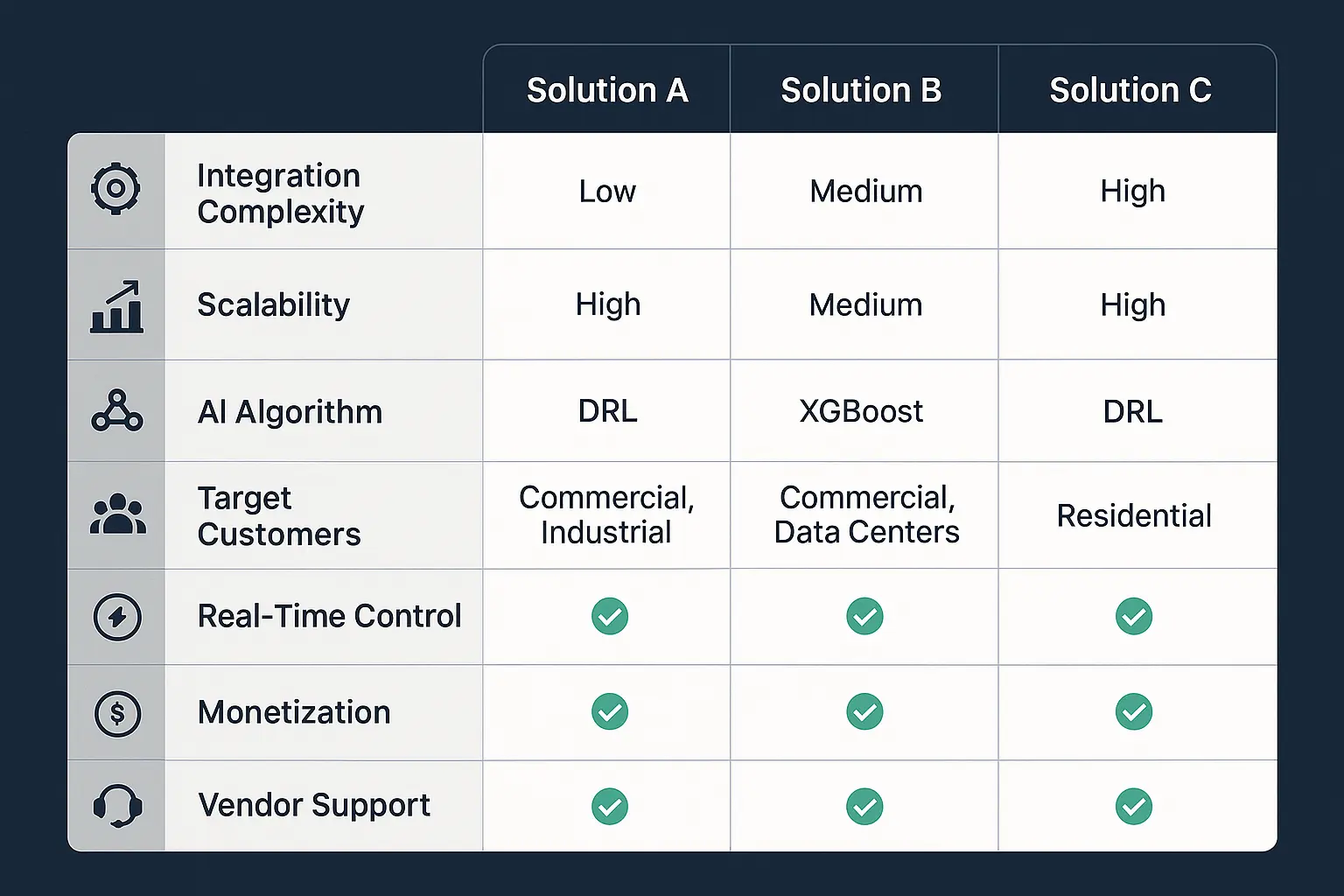
While the opportunity is massive, the path to implementation is littered with complexity. This guide provides the clarity you need to move forward with confidence.
Decoding Dynamic Demand Response: Beyond Simple Curtailment
Traditional demand response often involves blunt, pre-scheduled curtailment events. It works, but it’s disruptive and leaves significant value on the table.
Dynamic Demand Response (DDR), powered by AI, is different. It’s about creating a continuously optimized, flexible energy ecosystem. Instead of just shutting things down, AI enables:
- Intelligent Load Prediction: Accurately forecasting energy needs and grid conditions moments, hours, and days in advance.
- Real-Time Load Shaping: Subtly shifting non-critical loads to off-peak times or in response to price signals, without impacting core operations.
- Automated Market Participation: Dynamically bidding flexible capacity into energy markets to generate revenue from ancillary services.
The result is a system that can achieve 85-90% of the efficiency of traditional load shedding while reducing customer opt-out rates by an average of 25%. It’s a smarter, more surgical approach to grid management.
AI’s Core Impact: How It Delivers Precision and Profit
AI transforms demand response from a reactive measure into a proactive, value-generating asset. Two capabilities are central to this transformation:
1. Hyper-Accurate Load Prediction
AI algorithms analyze thousands of data points in real-time—historical consumption, weather patterns, market prices, and operational schedules—to generate incredibly precise demand forecasts. This allows you to anticipate peak demand surges and grid stress events before they happen, giving you the ability to act strategically rather than reactively.
2. Autonomous Real-Time Load Shaping
This is where AI truly shines. Instead of manual interventions, the system can automatically adjust energy consumption across a portfolio of assets. For a commercial building, this might mean slightly adjusting HVAC setpoints. For a data center, it could involve shifting non-critical compute workloads. These micro-adjustments, happening continuously, smooth out demand curves, lower energy costs, and create monetizable grid flexibility without anyone noticing.
The Engine Under the Hood: Advanced AI Algorithms for DR
Many vendors simply say they use “AI” or “ML.” A discerning buyer needs to understand what that actually means. While the math is complex, the business application of these algorithms is what matters. Here are the key technologies powering the most advanced platforms:
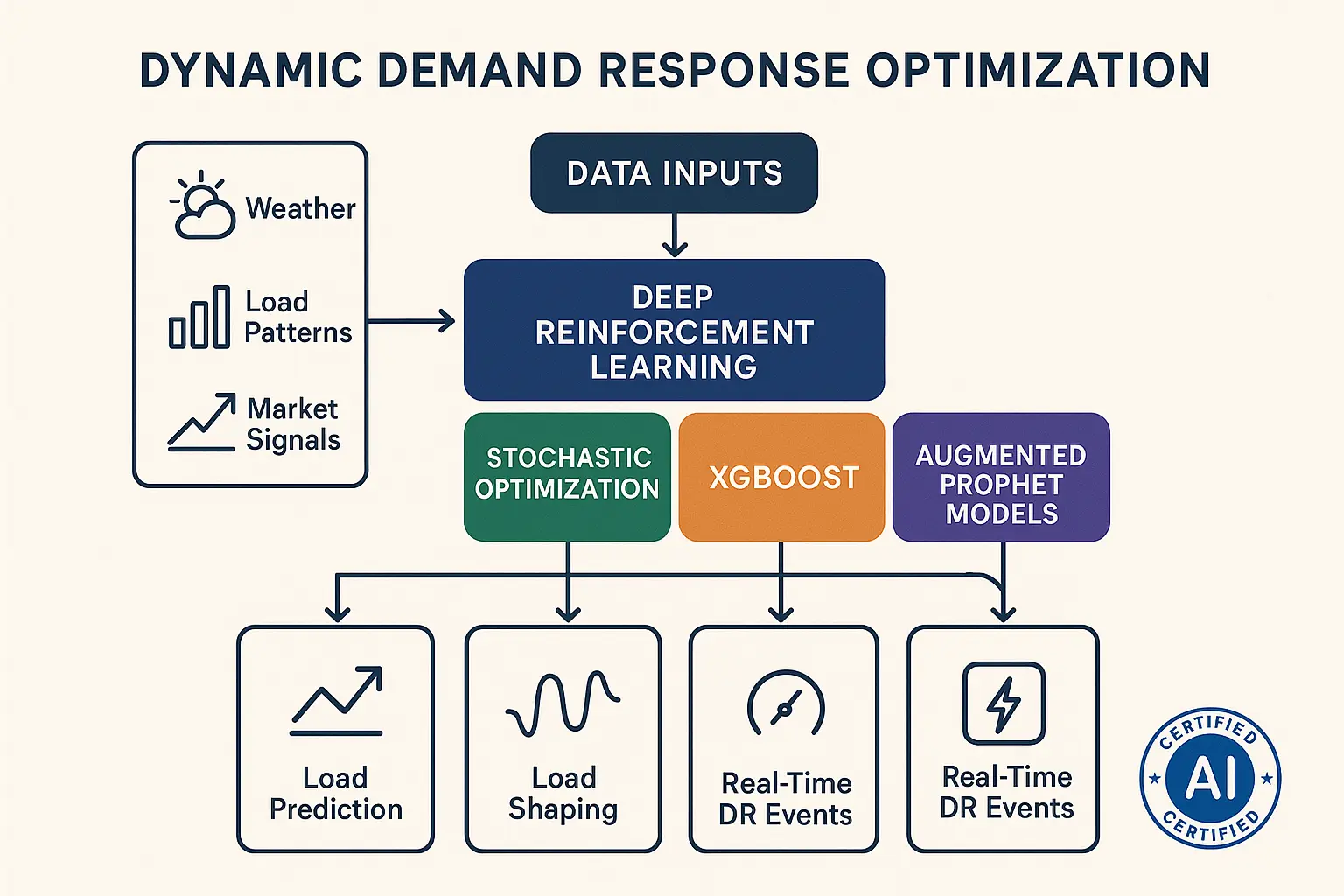
- Deep Reinforcement Learning (DRL): Think of this as a system that learns from experience. DRL is ideal for optimizing complex assets like battery storage or a fleet of EVs within a virtual power plant (VPP). It constantly runs simulations to find the most profitable charging and discharging strategy based on real-time market conditions.
- Stochastic Optimization: This method excels at making decisions under uncertainty. It models a range of possible future scenarios (e.g., a sudden heatwave, a drop in wind generation) and develops an optimal strategy that is robust across all of them, minimizing risk.
- XGBoost (Extreme Gradient Boosting): A powerhouse for prediction. This algorithm is exceptionally good at forecasting energy load because it can weigh the importance of hundreds of different variables simultaneously, leading to highly accurate and reliable predictions.
- Augmented Prophet Models: Developed for time-series forecasting, these models are excellent at identifying seasonality and trends in energy usage, making them a foundational tool for baselining and predicting load.
Understanding these concepts allows you to ask vendors more pointed questions about how their platform achieves its results, moving the conversation beyond marketing claims.
Monetizing Flexibility: AI-Driven Strategies for Every Segment
Flexibility is a valuable commodity. AI is the key to unlocking and monetizing it across different sectors. This isn’t just about saving on your energy bill; it’s about turning your energy assets into a new revenue stream.
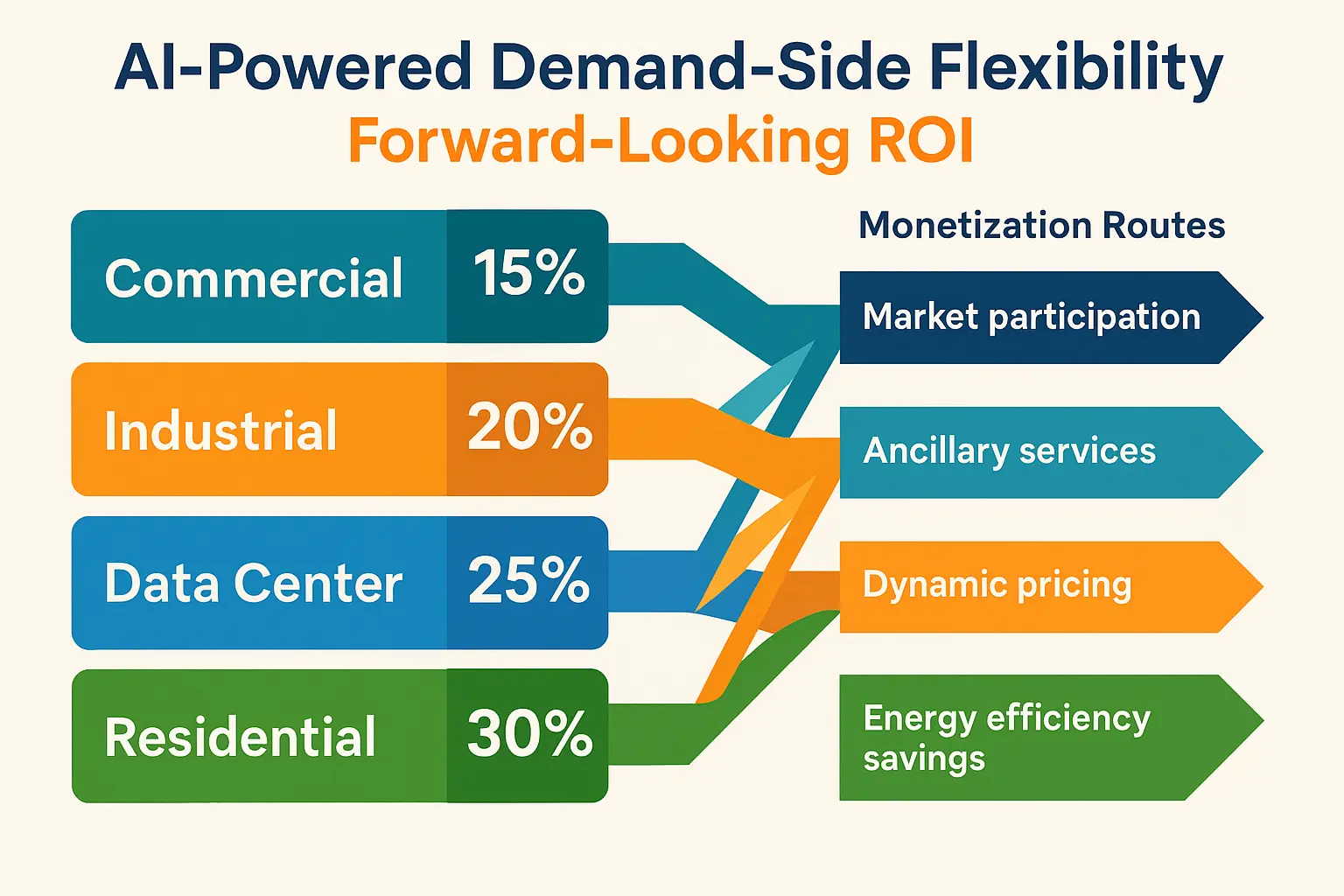
Commercial & Industrial (C&I)
- Ancillary Services: Participate in frequency regulation or spinning reserve markets. AI can automate the bidding and dispatch process to capture the most lucrative opportunities without manual oversight.
- Dynamic Pricing Optimization: Automatically shift energy-intensive processes to times when grid prices are lowest, directly impacting the bottom line.
- Capacity Markets: Aggregate flexible load to bid into capacity auctions, earning payments for being available to reduce demand during grid emergencies.
Data Centers: The Holy Grail of Flexibility
Data centers are a focal point for a reason. Their combination of high, constant energy use and schedulable workloads makes them ideal for DR. AI allows them to participate without compromising uptime. Research shows that leveraging data center flexibility can reduce grid investment and operational costs by 3-21%. Strategies include deferring non-critical batch processing, optimizing cooling systems, and dispatching on-site backup generation during high-price events.
Residential Aggregation
For utilities, AI can orchestrate thousands of residential devices—smart thermostats, EV chargers, water heaters—into a cohesive, dispatchable resource. By making tiny, unnoticeable adjustments across this network, AI creates a significant block of flexible load, improving grid stability and reducing reliance on peaker plants. Exploring options for demand response monetization is becoming a key strategy for grid operators.
Evaluating AI Demand Response Solutions: A Critical Framework
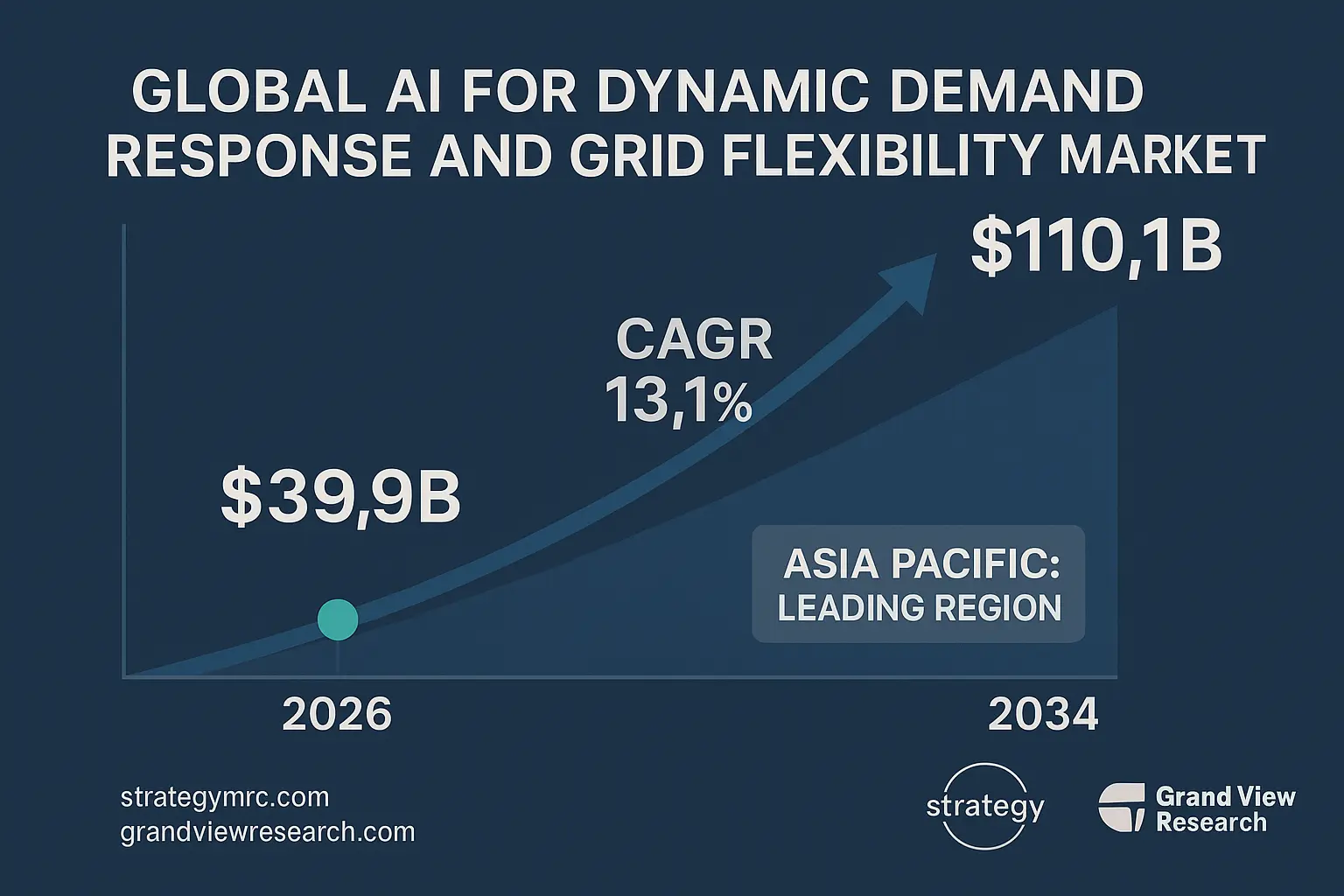
This is the most crucial step. To avoid investing in a “black box” solution, you need a robust evaluation framework. Go beyond the demo and ask vendors the tough questions inspired by industry watchdogs like EnergyHub, who caution against claims that defy physics.
Key Questions for Any Vendor:
-
Performance & Measurement:
- How do you measure load reduction? Is it based on a verifiable, transparent baseline methodology?
- Can you provide event data under different conditions? Ask for performance during extreme weather vs. mild days, and for short vs. long-duration events.
- What are your specific metrics for precooling/preheating efficiency? How much energy is shifted vs. added?
-
Technology & Algorithms:
- Which specific AI models do you use for forecasting vs. optimization? This shows if they have a sophisticated, multi-layered approach.
- How does your platform integrate with our existing BMS, SCADA, or EMS? Dig into the specifics of API availability and data protocols.
- What are the data requirements for your models to be effective? This uncovers potential hidden implementation hurdles.
-
Security & Reliability:
- What are your cybersecurity protocols for protecting operational assets from external threats?
- What is your system’s uptime, and what redundancies are in place?
- How do you ensure that DR events never compromise our core business operations? Look for configurable, hard-coded constraints.
Using a structured framework like the one above, you can compare solutions on an apples-to-apples basis, ensuring our AI platform or any other meets your specific operational and financial goals.
Frequently Asked Questions (FAQ)
1. What is the typical ROI for an AI-driven demand response system?ROI varies based on your industry, location, and asset flexibility, but it’s driven by three main factors: reduced capacity charges on utility bills, direct revenue from participating in energy markets, and lower overall energy consumption costs through load shifting. Many C&I customers see payback periods of 18-36 months.
2. How disruptive is the implementation process?Modern AI platforms are designed for light-touch integration. The process typically involves connecting to existing meters and control systems via secure APIs or on-site gateways. The goal is to leverage your existing infrastructure, not replace it. A typical implementation can take a few weeks to a few months, depending on complexity.
3. Is my operational data secure?This is a critical concern. Leading platforms use end-to-end encryption, adhere to strict cybersecurity standards (like SOC 2), and ensure that all control signals are authenticated and secure. Always ask a vendor to provide details on their security architecture.
4. Can this AI override our critical operational needs?No. A well-designed system operates within business constraints that you define. You set the parameters—temperature ranges, production quotas, uptime requirements—and the AI optimizes within those boundaries. Your core operations are always the top priority.
Building a Resilient, Flexible Grid with Intelligent AI
The transition to a cleaner, more dynamic energy future is happening now. AI-powered demand response is no longer a futuristic concept; it is a practical, powerful tool for reducing costs, generating revenue, and ensuring operational resilience.
The key to success is moving past the marketing hype and conducting a disciplined evaluation. By understanding the underlying technology, focusing on monetization strategies, and asking the right questions, you can select a partner and a platform that will deliver tangible value for years to come.
Ready to build a more intelligent energy strategy? Schedule a personalized consultation with our experts to see how these frameworks can be applied to your specific asset portfolio.
