
You’re evaluating the future of your organization’s energy strategy. You know the traditional grid is becoming increasingly fragile, costs are unpredictable, and sustainability goals are no longer optional. You’ve heard about decentralized energy and microgrids, but the information you find from traditional utilities feels surface-level, focused more on residential solar programs than on the sophisticated, resilient solutions required for commercial, industrial, or community-scale operations.
You’re past the “what” and firmly in the “how” and “why.” How do you move beyond basic backup power to create a truly intelligent, autonomous energy ecosystem? How do you quantify the return on investment, mitigate implementation risks, and choose a partner who understands the complexities of AI-driven control?
This guide is designed for you. We’ll cut through the noise and provide the authoritative insights you need to confidently evaluate and implement an AI-orchestrated microgrid, transforming your energy infrastructure from a liability into a strategic asset.
Decoding Microgrid Orchestration: The AI Advantage
A microgrid is a self-sufficient energy system that serves a discrete footprint, like a university campus, industrial park, or neighborhood. It can operate connected to the main utility grid or disconnect and run autonomously in “island mode” during an outage.
But simply having a microgrid isn’t enough. The real value is unlocked through orchestration—the intelligent, real-time management of all its components. This is where AI becomes indispensable. While basic control systems react to events, AI-driven orchestration anticipates them.
The impact is significant. By leveraging machine learning, deep learning, and reinforcement learning, an intelligent orchestration platform can:
- Optimize Energy Flow: Seamlessly balance energy from multiple sources—solar, battery storage, generators—against real-time demand, weather forecasts, and fluctuating energy prices. This level of optimization can reduce overall energy consumption by up to 20%.
- Improve Forecasting Accuracy: AI algorithms can predict energy production and consumption with up to 25% greater accuracy than traditional models, ensuring you have the right amount of power exactly when you need it.
- Boost Resilience: Predictive maintenance powered by AI can identify potential equipment failures before they happen, reducing the risk of unexpected outages by as much as 70%.
This isn’t just automation; it’s proactive intelligence that ensures maximum efficiency, resilience, and cost-effectiveness. As the market for decentralized energy systems is projected to surge from $285 billion in 2024 to over $720 billion by 2033, AI orchestration is the critical factor separating a simple backup system from a future-proof energy platform.
Advanced AI Algorithms in Microgrids: A Technical Deep Dive
To truly appreciate the power of AI orchestration, it’s helpful to understand the specific algorithms at work. While traditional providers may talk vaguely about “smart” systems, a sophisticated platform leverages a portfolio of advanced models to manage the inherent uncertainty and complexity of a microgrid.
- Stochastic Optimization & Markov Decision Processes (MDPs): These are essential for decision-making under uncertainty. A microgrid constantly faces variables: Will a cloud bank reduce solar output? Will a factory line suddenly draw more power? MDPs model these probabilities, allowing the system to make the optimal decision (e.g., charge batteries now, sell excess power to the grid) to achieve the best long-term outcome, not just the best immediate one.
- Multi-Fidelity Surrogate Models: It’s computationally expensive to run complex physics-based simulations of every component in real-time. Surrogate models act as highly accurate, lightweight digital twins. They can emulate the behavior of assets like inverters or batteries, allowing the AI to run thousands of “what-if” scenarios in seconds to find the most efficient operational strategy.
- Reinforcement Learning (RL): This is where the system truly learns and adapts. Much like a chess program that learns by playing millions of games, an RL agent in a microgrid learns from experience. It experiments with different energy dispatch and storage strategies, receives feedback (e.g., cost savings, grid stability), and continuously refines its approach to improve performance over time, adapting to new assets or changing consumption patterns without needing to be reprogrammed.
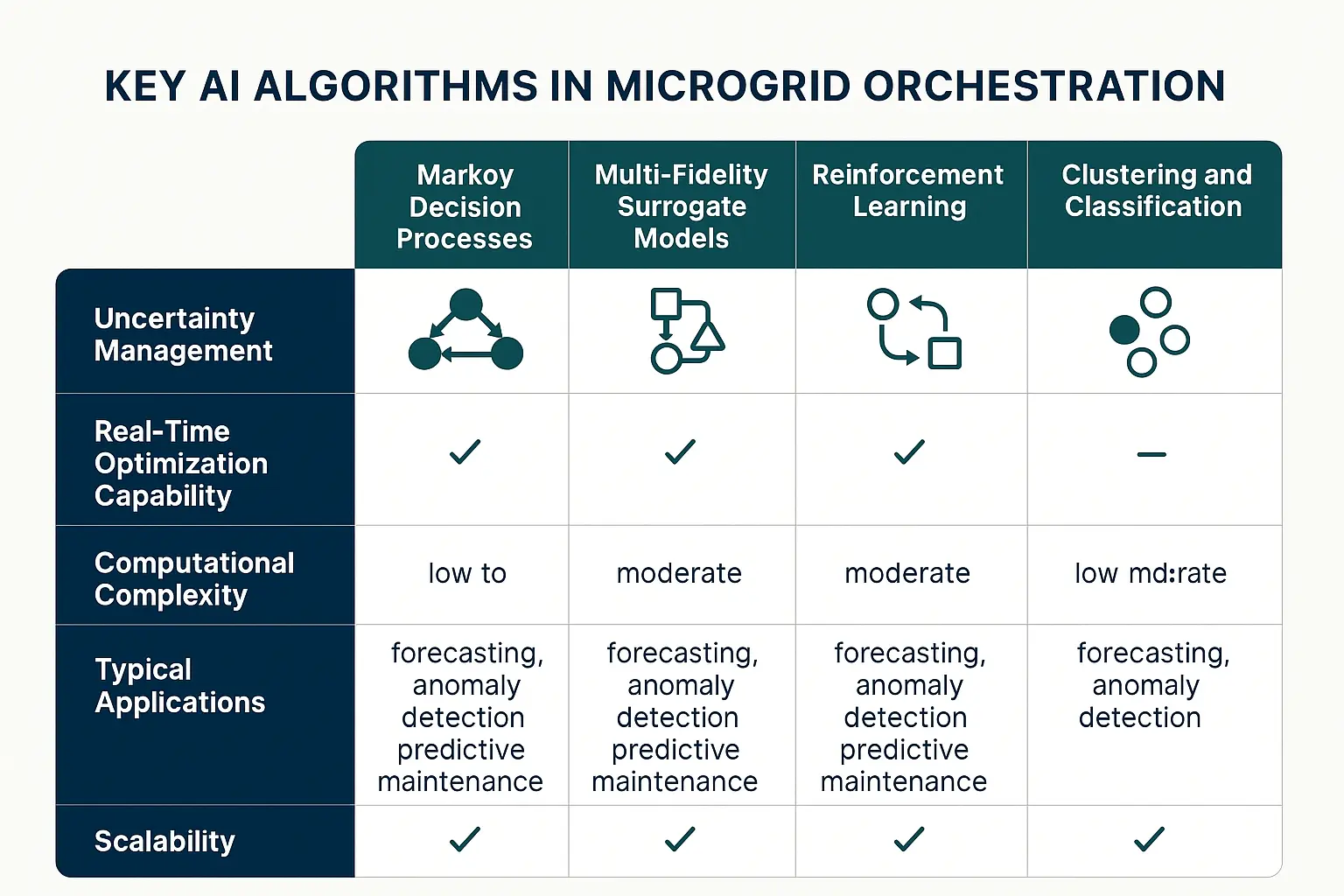
Understanding these underlying technologies is crucial when evaluating providers. A partner who can articulate how their AI works is one who has moved beyond buzzwords to build a genuinely intelligent and reliable system.
The Overlooked Realities: Overcoming Microgrid Implementation Challenges
Any provider can promise resilience and savings. A true expert, however, will be transparent about the challenges and have proven strategies to solve them. The content you find on utility websites often glosses over these critical details, but they are central to a successful deployment.
Here are the practical hurdles you must consider and how a robust AI platform addresses them:
- Scaling & Cost Complexity: A microgrid for a data center has vastly different requirements than one for a residential community. A sophisticated partner will use modular software design and those multi-fidelity surrogate models to accurately simulate performance at scale, ensuring you don’t over-invest in hardware or face unexpected performance gaps.
- Real-Time Data Integration: A microgrid is a network of IoT devices—solar inverters, battery management systems, smart meters, weather stations. AI orchestration depends on clean, high-velocity data from all of them. This requires deep expertise in communication protocols and integration to create a single, coherent operational view.
- Human-Error Proofing: The transition from grid-connected to island mode is a critical moment. Manual switching introduces risk. An AI-driven system automates this process, ensuring a “bumpless” transition that protects sensitive equipment and maintains continuous power without human intervention.
- Renewable Intermittency: Renewables, which make up over 67% of decentralized power generation, are inherently variable. By combining superior weather forecasting with predictive load models, an AI orchestrator can proactively store energy ahead of a cloud front or reschedule non-critical loads to align with peak solar production, smoothing out volatility.
- Cybersecurity: A connected microgrid is a potential target. Security cannot be an afterthought. Modern orchestration platforms are built on zero-trust principles, using AI-powered anomaly detection to identify and isolate threats before they can disrupt operations. When considering solutions, it’s essential to understand the strategies for
overcoming microgrid implementation challenges.
Unlocking New Value: Peer-to-Peer Energy Trading with AI & Blockchain
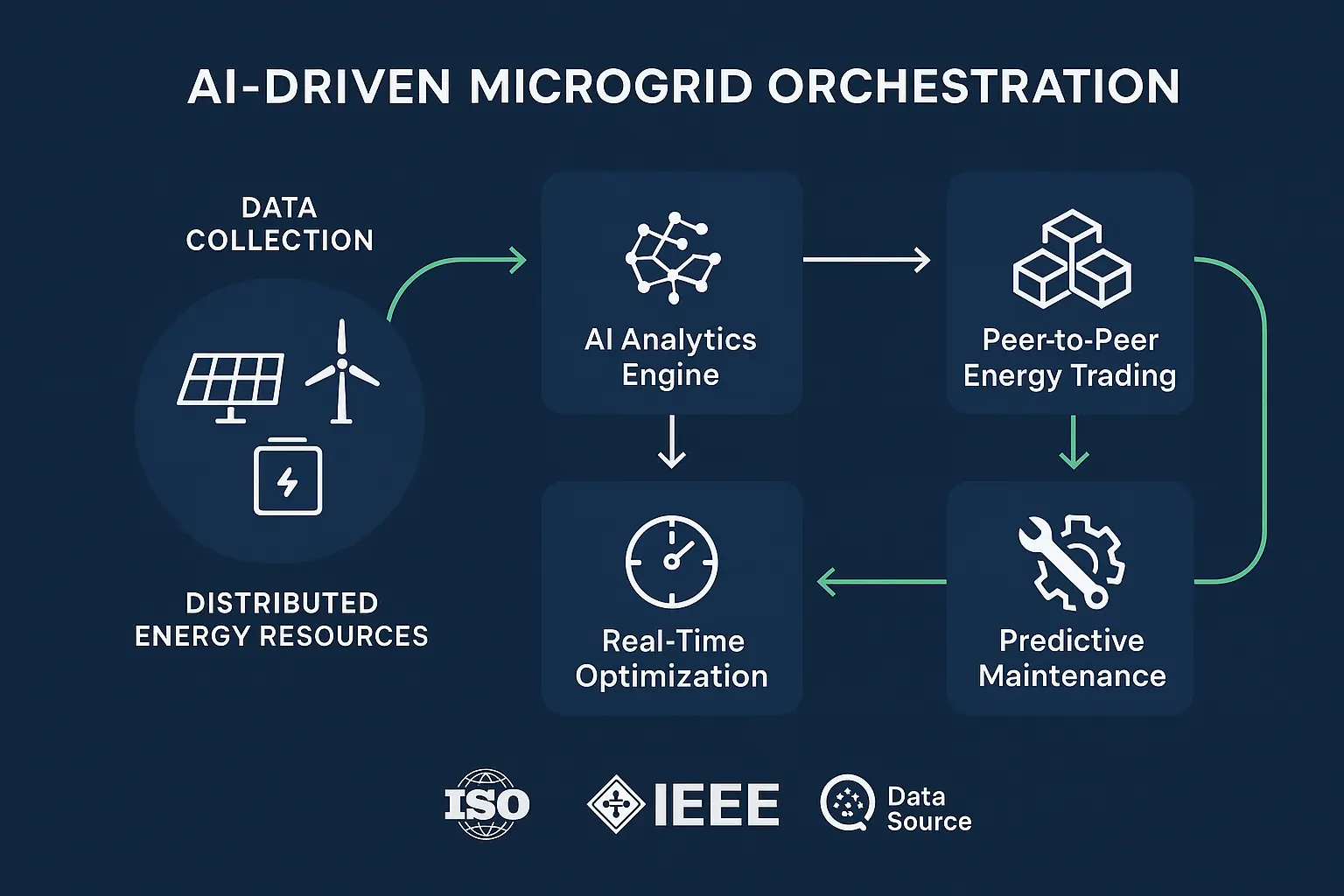
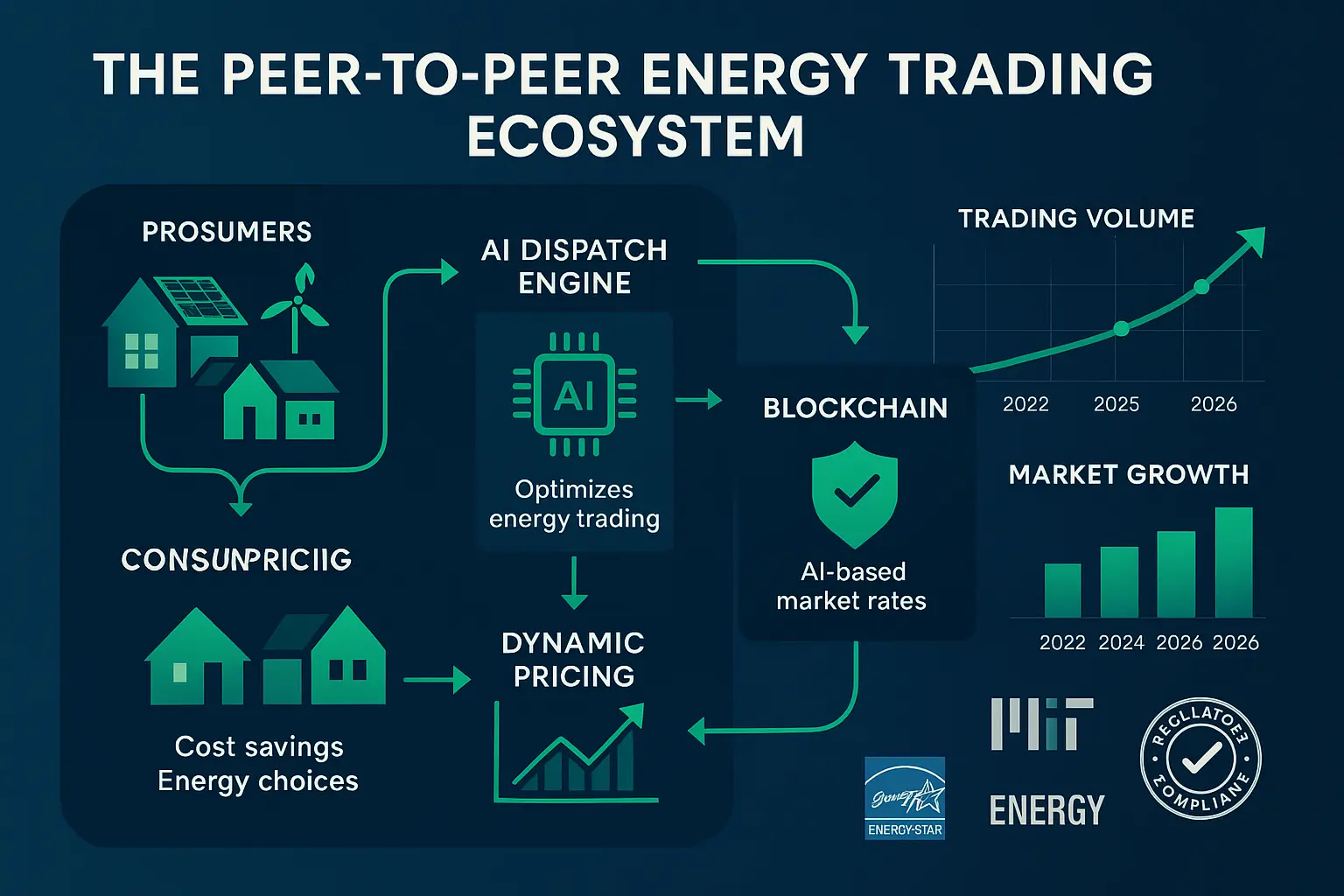
True energy independence isn’t just about resilience; it’s about transforming your energy assets from a cost center into a revenue source. The next frontier is peer-to-peer (P2P) energy trading, where microgrid owners can sell excess stored or generated energy directly to other users in the network.
This creates a dynamic, localized energy market, but it requires an incredible level of intelligence to participate effectively. This is where AI and blockchain converge:
- AI for Market Optimization: The AI acts as an automated energy trader. It analyzes market prices, predicts network demand, and determines the most profitable times to sell excess energy from your batteries or solar panels, maximizing your return on investment.
- Blockchain for Secure Transactions: To ensure trust and transparency in a decentralized market, transactions are recorded on a secure, immutable ledger using blockchain technology. This eliminates the need for a central intermediary, reducing costs and ensuring every kilowatt-hour traded is accurately accounted for and verified.
This isn’t a distant future. The technology exists today to create hyper-local energy markets that enhance community resilience and provide new economic opportunities for participants in peer-to-peer energy trading solutions.
Case Studies & Real-World Applications
Theory is important, but proof is essential. AI-driven microgrids are already delivering significant value across various sectors.
- For the University Campus: A campus with dozens of buildings, fluctuating class schedules, and large event venues has a complex energy profile. An AI-orchestrated microgrid can reduce peak demand charges from the utility by intelligently discharging batteries during high-cost periods. During a grid outage, it can automatically shed non-essential loads (like decorative lighting) to prioritize power for critical research labs and dormitories, ensuring safety and continuity.
- For the Industrial Manufacturer: A manufacturing plant cannot afford a moment of downtime. An AI platform uses predictive maintenance to prevent costly equipment failures. It also optimizes energy use by aligning the charging of an EV fleet with periods of high solar generation, drastically reducing electricity costs and carbon footprint without impacting production schedules.
- For the Remote Community: For a town at the end of a long, vulnerable transmission line, a community microgrid provides life-saving resilience. The AI orchestrator ensures the optimal use of shared solar and battery resources, keeping the lights on at the local clinic and grocery store during storms that would have previously caused multi-day outages.
Choosing Your Microgrid Partner: Evaluation Criteria & Future Outlook
As the microgrid market grows toward a projected $101 billion by 2031, selecting the right technology partner is the most critical decision you’ll make. Generic energy providers and hardware installers often lack the deep software and AI expertise needed for true orchestration.
Use this checklist during your evaluation:
- AI Expertise: Do they talk about specific algorithms (like RL or MDPs), or do they just use the term “AI” as a buzzword? Ask for a demonstration of their platform’s predictive and adaptive capabilities.
- Integration Capability: Can they provide evidence of successful integrations with a wide variety of hardware (inverters, batteries, generators) from different manufacturers? A hardware-agnostic platform offers you the most flexibility.
- Proven Track Record: Ask for case studies and performance data from real-world deployments that are similar in scale and complexity to your own.
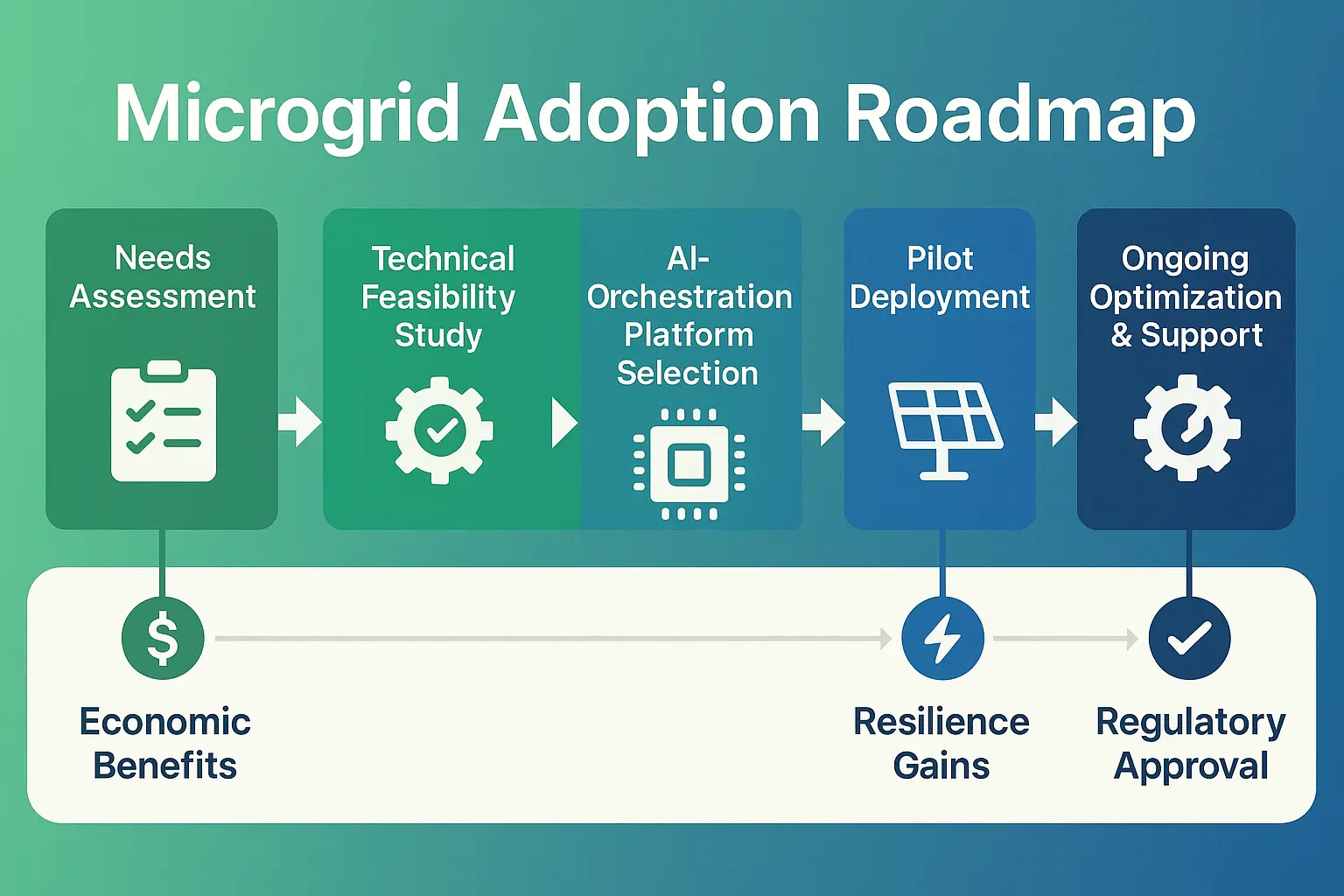
- A Clear Roadmap: How will they guide you from initial feasibility and design to deployment and ongoing optimization? A transparent process is key to building trust and ensuring success.
The future of energy is not centralized; it is a distributed network of intelligent, resilient, and interconnected microgrids. By embracing AI-driven orchestration, you are not just investing in a new piece of infrastructure—you are adopting a fundamentally smarter way to power your future.
***
Frequently Asked Questions
1. Isn’t a microgrid just a more complex version of a backup generator?Not at all. A backup generator is a simple reactive solution that only provides power during an outage. An AI-orchestrated microgrid is a proactive, 24/7 energy management system. It actively works to reduce your energy costs, optimize your use of renewables, and enhance sustainability every day, while also providing seamless, intelligent backup power when needed.
2. Is this technology mature enough for my organization’s critical operations?Absolutely. The core AI technologies, such as machine learning and predictive analytics, have been proven for years in other mission-critical industries like finance and aerospace. Their application in energy is a mature and rapidly growing field. Leading providers have years of real-world operational data demonstrating the reliability and performance of their platforms in critical environments like hospitals, data centers, and military bases.
3. How does an AI orchestration platform integrate with my existing Building Management System (BMS)?A sophisticated orchestration platform is designed for interoperability. It uses standard communication protocols to connect with your existing BMS, HVAC systems, and other facility controls. This allows the AI to not only manage energy generation and storage but also intelligently influence demand by, for example, slightly adjusting thermostat setpoints or pre-cooling a building ahead of a peak price period, all without impacting occupant comfort.
4. What is the typical ROI for an AI-driven microgrid?The ROI depends on several factors, including local utility rates, available incentives, and your specific energy load profile. However, the return is calculated from multiple value streams:
- Energy Bill Savings: From reducing peak demand charges and optimizing energy use.
- Operational Resilience: The avoided cost of downtime, which can be millions of dollars per hour for some industries.
- Revenue Generation: From participating in grid services or P2P energy trading.
- Sustainability Goals: Achieving ESG targets, which can enhance brand value and attract investment.
A thorough feasibility study from a qualified partner can provide a detailed financial model tailored to your specific situation.
Take the Next Step Toward Energy Independence
You’re now equipped with the framework to evaluate decentralized energy solutions beyond the surface-level claims. The path to a resilient, cost-effective, and sustainable energy future is powered by intelligent orchestration.
If you’re ready to explore how an AI-driven microgrid can transform your organization’s energy strategy, our team of experts is here to help. Schedule a complimentary consultation to discuss your specific needs and begin building your customized AI-enabled microgrid deployment roadmap.
