
You understand the promise of an Intelligent Energy Management System (iEMS). You’ve seen the high-level benefits: reduced costs, enhanced sustainability, and greater operational resilience. But now you’re facing the real challenge—moving from the “what” to the “how.” How do you design an architecture that scales? How do you manage the flood of data? And how do you deploy it successfully without disrupting your entire operation?
This is where most iEMS initiatives stall. The landscape is crowded with high-level sales pitches and dense academic papers, but there’s a gap where practical, actionable guidance should be. You need more than a concept; you need a blueprint.
This guide is designed to be that blueprint. We’ll walk through the critical architectural decisions, data pipeline strategies, and deployment frameworks that turn an iEMS vision into a high-performing reality. We’ll translate complex engineering principles into a clear roadmap, empowering you to make confident decisions at every stage.
Beyond Smart: Defining a Truly Intelligent EMS
First, let’s clarify the distinction. A Smart Energy Management System (SEMS) automates and provides visibility. It follows pre-set rules. An Intelligent Energy Management System learns, predicts, and optimizes autonomously. It uses AI to move beyond simple automation to genuine optimization, which is crucial as the global iEMS market is projected to grow at a staggering 15-16% CAGR, reaching over $150 billion by 2030. This growth isn’t just about saving energy; it’s about building future-proof, resilient operations.
The move to iEMS is driven by:
- Cost & Volatility: Increasing energy prices and market fluctuations demand predictive, not just reactive, management.
- Sustainability & Compliance: Meeting aggressive ESG goals and regulatory requirements requires sophisticated optimization.
- Grid Complexity: The rise of renewable energy and distributed energy resources (DERs) necessitates intelligent coordination.
For engineers and facility managers, this means building a system that doesn’t just report data but actively improves performance. For decision-makers, it means securing a tangible return on investment through operational excellence.
The Core Components of a Modern iEMS
A successful iEMS is built on four interconnected layers. Understanding how they work together is the first step in designing a robust system.
Hardware Layer
This is the physical foundation that senses and acts. It includes everything from smart meters and IoT sensors capturing real-time data to controllers, actuators, and Distributed Energy Resources (DERs) like solar PV, battery storage, and EV chargers.
Software & Connectivity Layer
This layer is the central nervous system. It handles data acquisition from the hardware, using communication protocols like Modbus, BACnet, and MQTT. It includes the monitoring platforms, control algorithms, and user interfaces that allow you to visualize and manage your energy ecosystem.
AI/ML Layer
This is the brain. This is what makes the system intelligent. It’s where raw data is transformed into actionable insights through:
- Predictive Analytics: Forecasting energy consumption, generation, and pricing.
- Optimization Engines: Autonomously making decisions to balance loads, dispatch storage, and minimize costs.
- Anomaly Detection: Identifying equipment malfunctions or inefficiencies before they become critical failures.
Architectural Frameworks for iEMS: Centralized, Distributed, and Hybrid Models
Choosing the right architecture is the single most important decision you’ll make. It impacts scalability, latency, resilience, and cost. There is no one-size-fits-all answer, but understanding the trade-offs is key.
-
Centralized Architecture: All data is sent to a central server or cloud for processing and analysis. Decisions are made centrally and pushed back out to devices.
- Pros: Simpler to manage for smaller deployments, consolidates data for easier high-level analysis.
- Cons: Creates a single point of failure, introduces latency that’s unacceptable for real-time control, and can lead to high data transmission costs.
-
Distributed/Edge Architecture: Intelligence is pushed to the edge of the network, closer to the devices themselves. Edge devices can process data and make autonomous decisions locally.
- Pros: Enables millisecond-level real-time control, enhances system resilience (continues to operate if cloud connection is lost), reduces network bandwidth, and improves data privacy.
- Cons: Can be more complex to deploy and manage across many sites.
-
Hybrid Architecture: This model offers the best of both worlds and is rapidly becoming the industry standard. It uses the edge for real-time control and data pre-processing, while the cloud is used for heavy-duty analytics, AI model training, and long-term data storage.
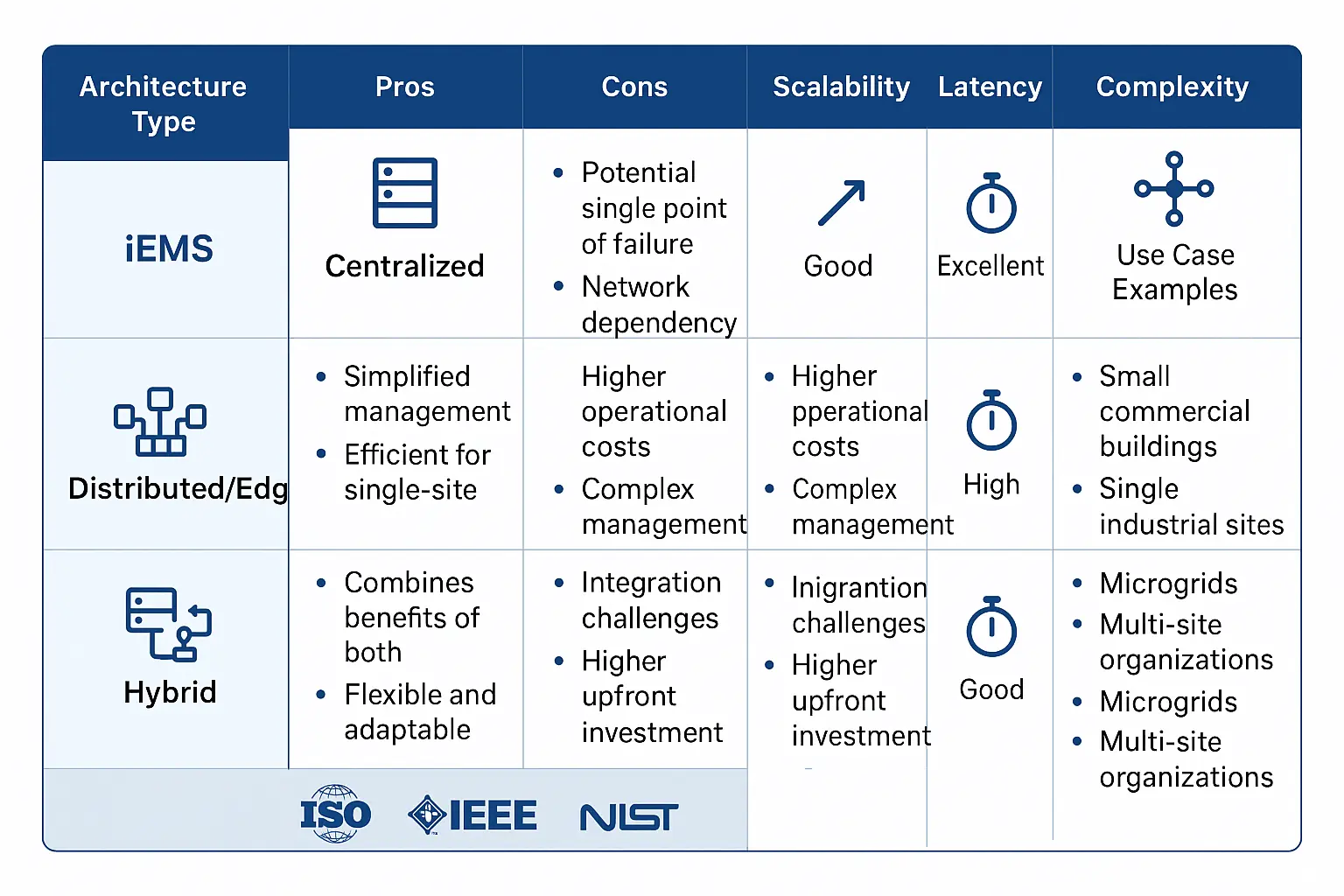 Compare core architectural frameworks with this matrix to understand which iEMS model best fits your project’s scale, latency requirements, and infrastructure.
Decision Framework: Choose a centralized model for simple, single-site monitoring. Opt for a distributed/edge model when real-time control, resilience, and low latency are critical (e.g., microgrid management, industrial process control). For most modern, scalable applications, a hybrid architecture provides the optimal balance of power and flexibility.
Mastering Data Pipeline Optimization for iEMS
An iEMS is only as good as its data. However, iEMS deployments face unique data integration challenges, including massive data volumes, the need for real-time processing, and highly diverse data sources (operational, device, weather, market data). A poorly designed data pipeline will cripple your system.
Building a scalable and reliable data pipeline requires focusing on four key stages:
- Ingestion: You need strategies for both real-time and historical data. Use streaming platforms like Kafka for sub-second data from sensors and meters, and batch processing for ingesting historical utility bills or weather data.
- Transformation & Normalization: Your system will receive data in dozens of different formats. Implementing a middleware layer or a unified data schema (like Brick or Haystack) is essential to normalize this data so your analytics engine can understand it.
- Storage: The right database is critical. Time-series databases (e.g., InfluxDB, TimescaleDB) are purpose-built for the high-volume, timestamped data common in iEMS, offering superior performance over traditional relational databases. For massive historical datasets, a cloud data lake is a cost-effective solution.
- Data Quality & Governance: Your pipeline must include robust data validation, error handling, and monitoring. Without it, you’ll be making critical optimization decisions based on faulty data. Trust in your system starts here.
Edge Computing Applications & Deployment in iEMS
Edge computing isn’t just a trend; it’s a fundamental enabler for advanced iEMS capabilities. As highlighted by research from MIT and the U.S. Department of Energy, moving AI processing closer to the data source is crucial for reducing latency and improving reliability.
Why is Edge Critical for iEMS?
- Real-Time Control: For applications like fast-frequency response or on-site load balancing, the round-trip to the cloud is too slow. Edge devices can execute decisions in milliseconds.
- Resilience: If the internet connection to your facility goes down, an edge-powered iEMS continues to operate, optimize, and protect your assets locally.
- Predictive Maintenance: Edge AI can analyze high-frequency vibration or thermal data directly on a piece of equipment to predict failures without sending terabytes of raw data to the cloud.
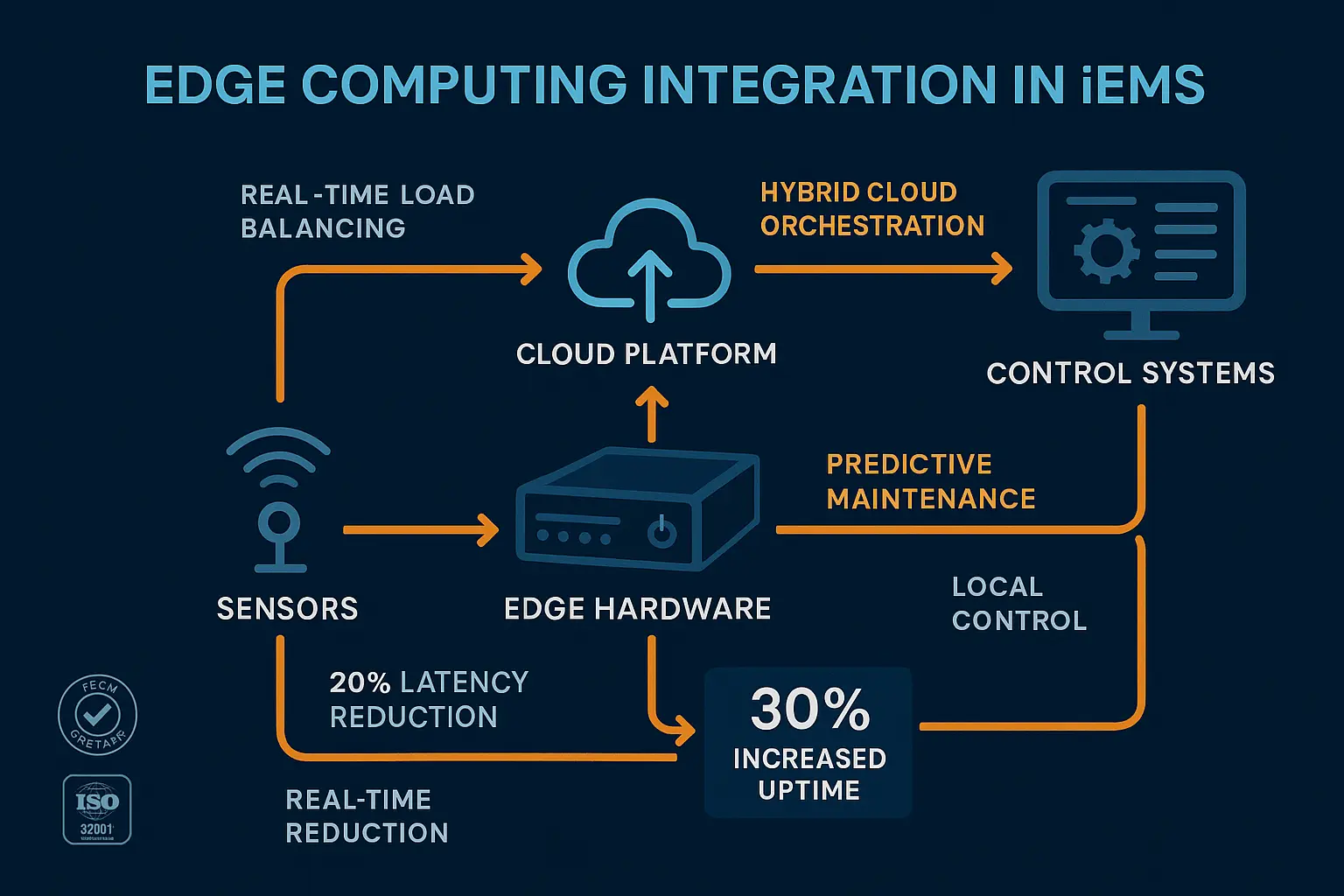 Visualize how edge computing enhances iEMS with real-time actions and resilience, backed by measurable performance improvements and trusted partnerships.
Key Deployment Considerations:
- Hardware Selection: Choose industrial-grade edge gateways with sufficient processing power for your AI models.
- Software Stack: Utilize lightweight containerization technologies like Docker to manage and deploy applications consistently across your edge fleet.
- Cloud-Edge Integration: Your architecture must include a robust orchestration platform for deploying AI models to the edge, synchronizing critical data, and managing the lifecycle of your edge devices.
Integrating iEMS with Existing Infrastructure & Overcoming Complexity
Few iEMS deployments start with a blank slate. The biggest challenge is often integrating with a complex web of existing systems like Building Management Systems (BMS), SCADA, and various legacy controllers. This is where many projects fail due to complexity and cost overruns.
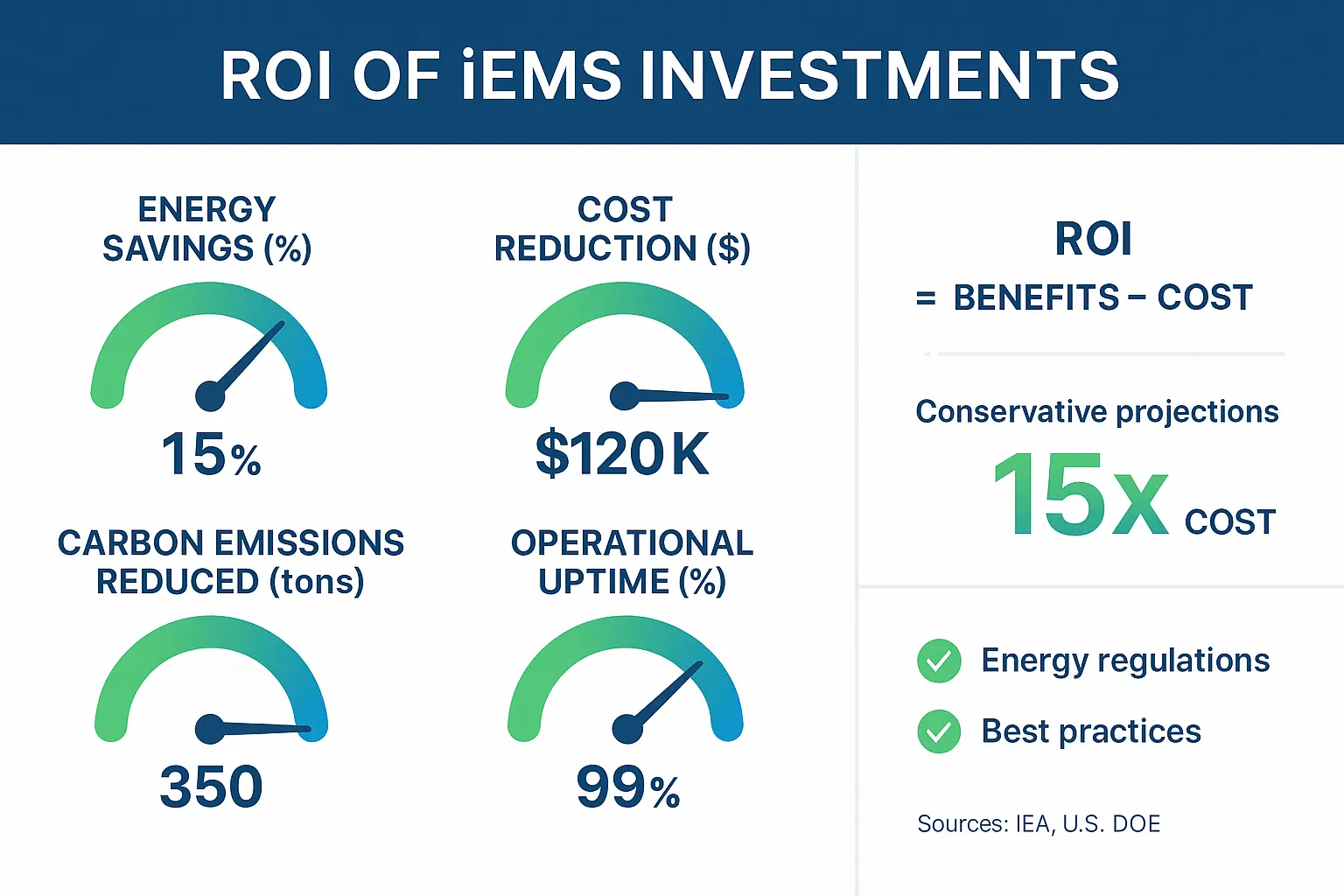 Understand how iEMS integrates smoothly with your existing infrastructure while managing complexity through proven frameworks and cybersecurity standards.
A successful integration strategy includes:
- Phased Rollout: Don’t try to boil the ocean. Start with a pilot program on a single critical asset or system. Prove the value and troubleshoot integration issues on a small scale before expanding.
- Interoperability Layers: Use solutions that support a wide range of industry-standard protocols (Modbus, BACnet, OPC-UA) out of the box. For proprietary systems, leverage a flexible API gateway to build custom connectors.
- Data Security by Design: From the start, build your integration plan around robust security principles. This includes encrypting data both in transit and at rest, implementing strict access controls, and ensuring your solution helps you meet your regulatory compliance obligations.
Measuring iEMS ROI and Performance
An iEMS is a significant investment, and you need to prove its value to stakeholders. Success isn’t just about a lower utility bill; it’s a combination of financial, operational, and sustainability gains.
A comprehensive ROI framework for iEMS should include:
- Energy Cost Savings: The most direct metric, achieved through peak shaving, load shifting, and optimized DER dispatch.
- Operational Efficiency: Reduced maintenance costs from predictive analytics and lower labor costs from automated operations.
- Revenue Generation: Participation in demand response programs or grid services.
- Sustainability Impact: Quantifiable reductions in carbon emissions to meet ESG targets.
- Resilience & Risk Mitigation: The financial value of avoiding downtime during grid outages or equipment failures.
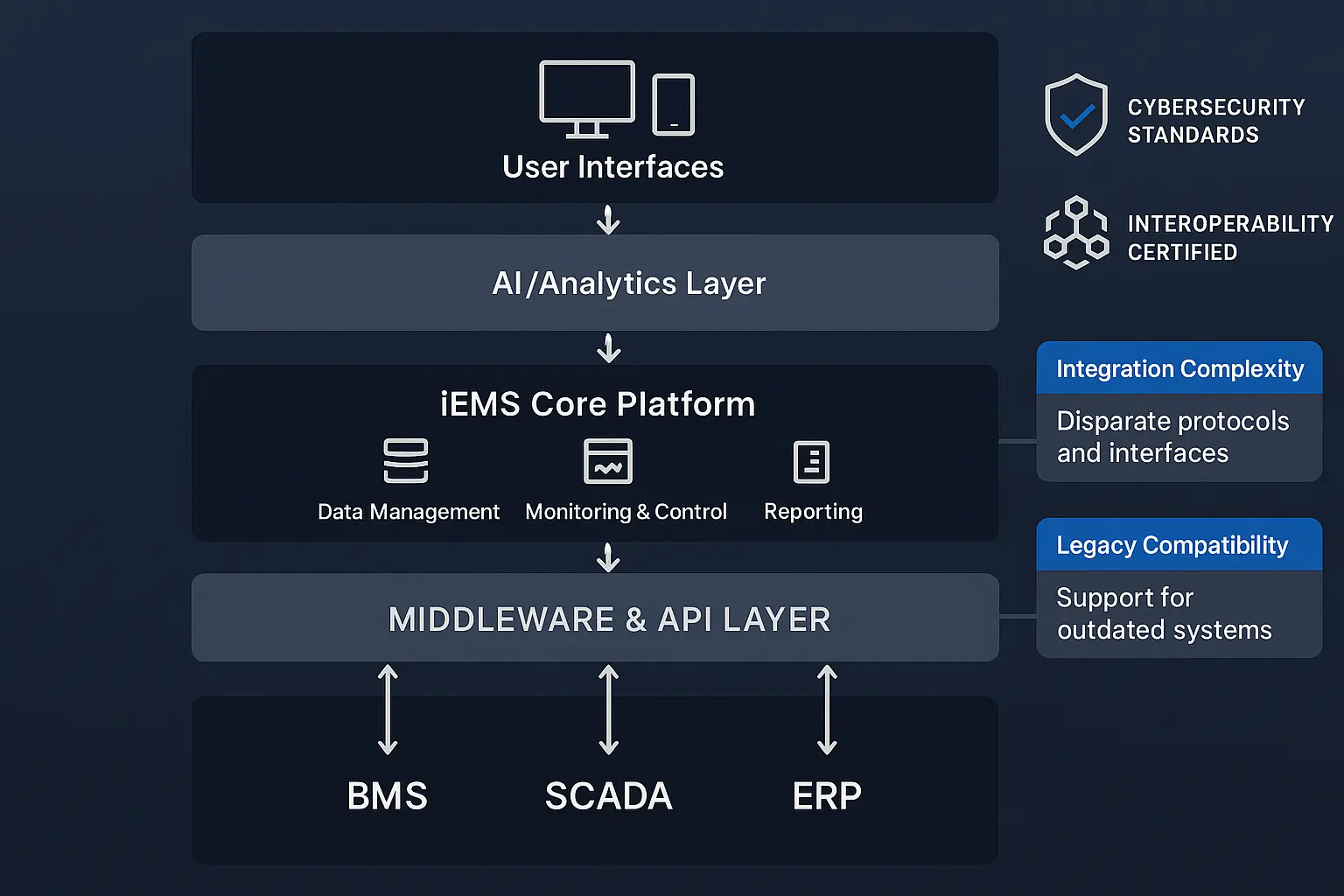 Assess your iEMS investment confidently with this dashboard, illustrating realistic savings and sustainability impacts essential for stakeholder buy-in.
Frequently Asked Questions
Q: How do we handle security for a system connected to our most critical operations?A: Security must be architected in, not bolted on. A robust iEMS employs a defense-in-depth strategy, including end-to-end data encryption, role-based access control, secure edge device provisioning, and continuous network monitoring. Look for partners who adhere to international cybersecurity standards like IEC 62443.
Q: Our facility has a mix of very old and very new equipment. Can an iEMS truly integrate with everything?A: Yes, but it requires a flexible integration platform. Modern iEMS solutions use a combination of native protocol support for new equipment and custom-developed connectors or protocol converters for legacy systems. A phased integration approach, starting with your highest-value assets, is the best way to manage this complexity.
Q: Is an edge-heavy architecture more expensive to deploy and maintain?A: While there is an upfront hardware cost for edge devices, a hybrid architecture often leads to a lower Total Cost of Ownership (TCO). By processing data locally, you significantly reduce ongoing cloud data transmission and storage costs. Furthermore, the increased resilience and real-time performance can unlock operational savings that far outweigh the initial hardware investment.
Q: How much customization will our iEMS require?A: The best iEMS platforms are built on a flexible, configurable foundation that minimizes the need for extensive custom code. While some tailoring for specific business logic or legacy system integration may be necessary, the core platform should provide 80-90% of the required functionality out of the box through configurable AI models, dashboards, and control algorithms. When you’re ready, you can explore the benefits of a [fully customized iEMS solution].
Your Next Step: From Blueprint to Action
Designing and deploying a successful iEMS is a complex journey, but it doesn’t have to be an uncertain one. By focusing on a flexible hybrid architecture, a robust data pipeline, and a strategic use of edge computing, you can build a system that delivers tangible value from day one and scales with you into the future.
The key is to move from theory to a practical plan tailored to your specific operational needs. If you’re ready to translate these architectural principles into a concrete strategy for your facility, let’s talk. Our experts can help you assess your current infrastructure and design a deployment roadmap that aligns with your business goals.
