
You’re facing an increasingly complex energy landscape. Rising utility costs, the threat of grid instability, and mounting pressure to meet sustainability goals are no longer abstract concerns—they are daily operational challenges. You know that simply having a backup generator isn’t a strategy; it’s a stopgap. You’re evaluating advanced solutions, and the concept of an AI-powered microgrid has emerged as a powerful contender.
But how do you cut through the noise? How do you move from understanding the “what” to confidently grasping the “how” and “why” for your specific commercial building or campus?
This guide is designed for you. We’re moving past the high-level benefits to provide the detailed, comparative insights you need at this critical evaluation stage. We’ll explore the financial models, the specific AI technologies at play, and the practical frameworks for making a decision that delivers true energy independence and economic advantage.
The New Standard: What is an AI-Powered Commercial Microgrid?
Let’s establish a clear foundation. A commercial microgrid is a self-contained energy system that can serve a specific building or campus. It integrates various Distributed Energy Resources (DERs)—like solar panels, battery storage, and co-generation units—and can operate either connected to the main utility grid or independently in “island mode.”
The game-changer is the AI management layer. Instead of relying on simple, pre-programmed logic, an AI-powered system acts as an intelligent, predictive brain. It continuously analyzes thousands of data points—from weather forecasts and real-time energy prices to your building’s occupancy patterns and equipment performance—to make optimal decisions every second. This isn’t just automation; it’s orchestration.
This shift is driving incredible growth, with the microgrid market projected to more than double from USD 43.47 billion in 2025 to USD 95.16 billion by 2030. For commercial and industrial facilities, which already represent the largest segment of the market (32.9%), this technology is quickly becoming the new standard for energy management.
The Economic Imperative: Quantifiable Benefits & ROI of AI-Driven Energy
For any major investment, the discussion ultimately comes down to the numbers. An AI-powered microgrid delivers returns that go far beyond a simple utility bill reduction. The financial case is built on multiple, compounding value streams that traditional energy systems can’t match.
A Framework for Total ROI
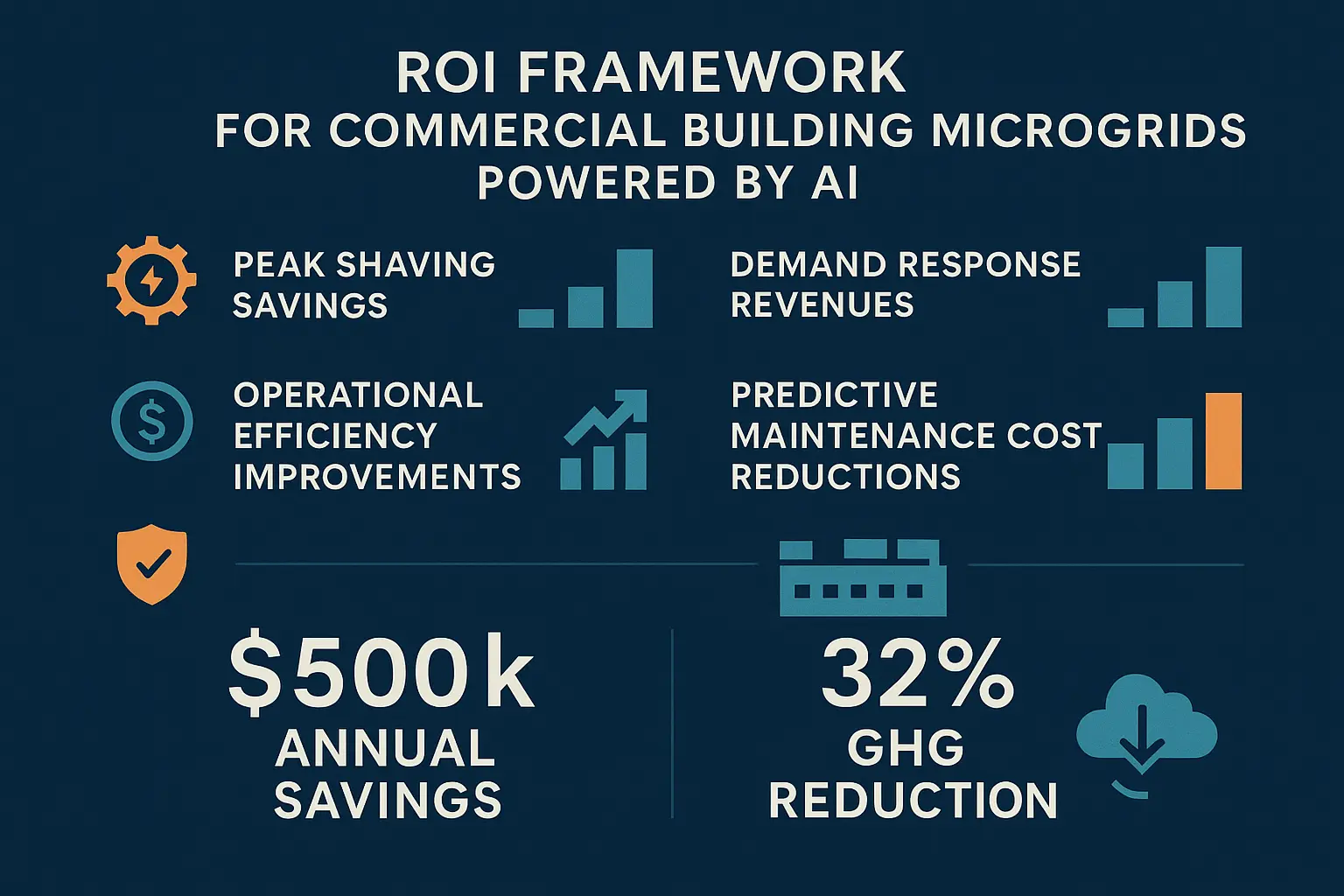
Think of the economic benefits in four key areas:
- Drastic Cost Reduction: AI algorithms excel at a strategy called “economic dispatch.” They automatically shift energy consumption to avoid peak demand charges, draw from stored battery power when grid prices are high, and sell excess energy back to the utility when it’s most profitable. The results are significant—one real-world implementation by Schneider Electric helped a client save approximately $500,000 per year on power bills.
- New Revenue Generation: Your energy assets can become revenue centers. AI-driven platforms can seamlessly enroll your microgrid in demand response programs and other grid services, earning payments from utilities for helping to stabilize the grid during peak times.
- Operational Efficiency: AI-powered predictive maintenance analyzes sensor data from your DERs to identify potential failures before they happen. This minimizes downtime for critical assets like HVAC systems or co-generation units, reducing costly emergency repairs and extending equipment lifespan.
- Enhanced Sustainability & Brand Value: By maximizing the use of renewable energy and optimizing overall consumption, these systems deliver measurable ESG (Environmental, Social, and Governance) improvements. An AI-managed microgrid can reduce greenhouse gas emissions by 32% or more, a powerful metric for stakeholders, investors, and customers.
For a deeper dive into financial modeling, explore the core Economic Benefits of Commercial Microgrids and how they apply to your facility.
Beyond Backup: True Energy Resilience & Grid Independence with AI
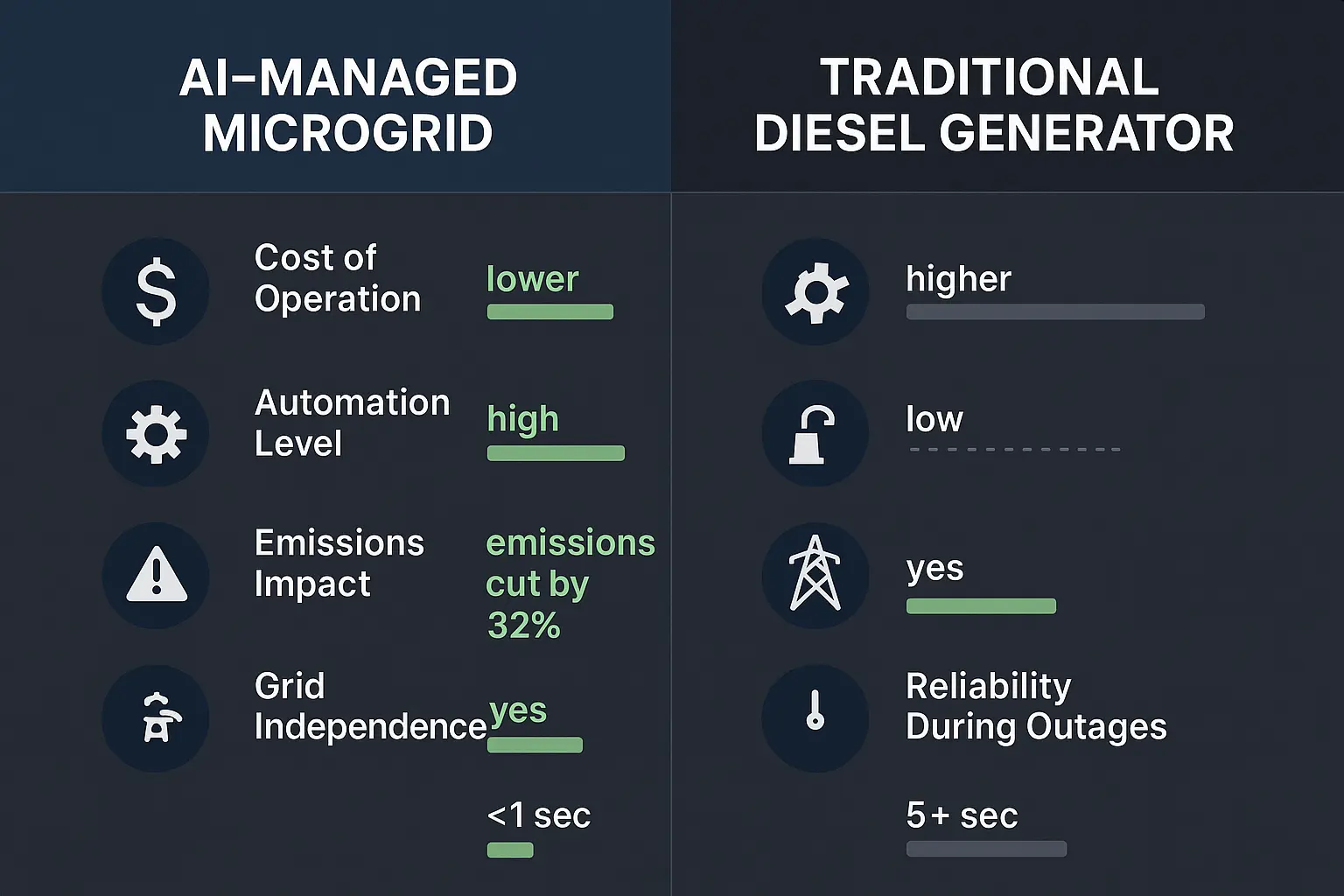
A traditional diesel backup generator is a blunt instrument. It’s loud, polluting, expensive to run, and only activates after a failure has occurred, leading to a disruptive power gap. An AI-powered microgrid offers a fundamentally superior approach to resilience.
The system’s AI controller can predict potential grid instability based on weather data or utility alerts. Before an outage hits, it can preemptively disconnect from the grid—a process called “islanding”—and transition to its own power sources with zero interruption to your operations.
During an outage, the AI doesn’t just keep the lights on; it intelligently manages critical loads. It prioritizes power for essential systems (like data servers, life-safety equipment, or manufacturing lines) while scaling back non-critical loads to extend the microgrid’s duration and optimize fuel or battery usage. Research from Rutgers University confirms that these AI-based strategies are not only more reliable but also save money and reduce emissions compared to a heavy reliance on diesel generators.
This intelligent management is the key to achieving true Grid Independence Strategies for Large Commercial Campuses, ensuring your business remains productive and secure no matter what happens on the main grid.
The Brain of the Grid: Deep Dive into AI Algorithms for Optimal Dispatch & Control
Many providers talk about “AI,” but true expertise lies in applying the right algorithms to the right problems. The effectiveness of a microgrid’s “brain” depends entirely on the sophistication of its underlying models. For commercial decision-makers, understanding these differences is key to choosing a truly intelligent system.
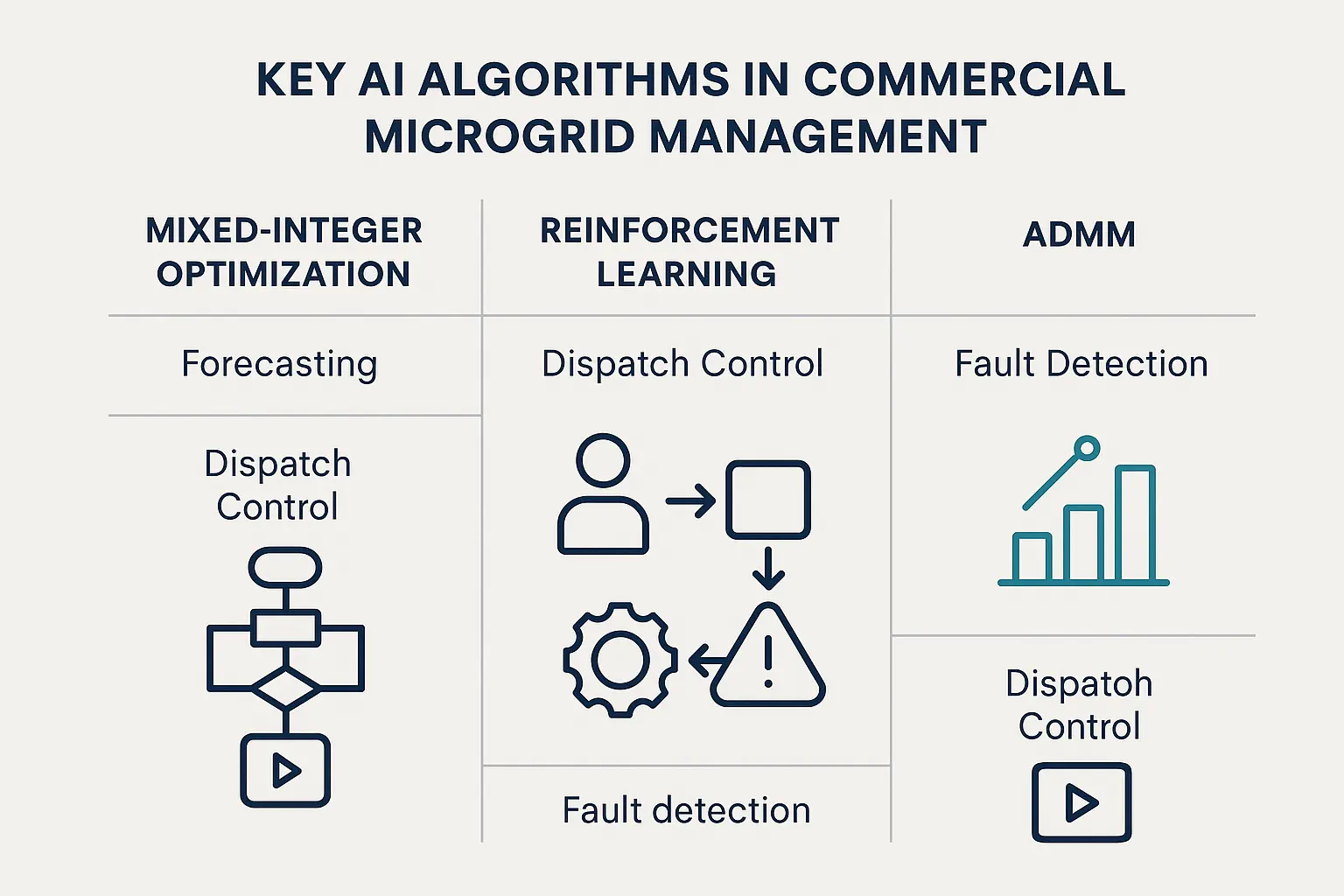
Here’s a simplified look at the AI engine powering a modern microgrid:
- Predictive Forecasting (Machine Learning): Using models like LSTMs (Long Short-Term Memory networks), the AI analyzes historical data and external factors (weather, events) to produce highly accurate forecasts of your building’s energy demand and the output from renewable sources like solar. This is rated as one of the highest impact areas for AI in microgrids, scoring a 9/10 for effectiveness according to MarketsandMarkets.
- Optimal Dispatch (Reinforcement Learning & Optimization): This is where the magic happens. Reinforcement Learning (RL) agents learn the best energy dispatch strategy through trial and error in a simulated environment of your facility. They figure out the perfect moments to charge or discharge batteries, when to use on-site generation, and when to buy from the grid. This continuous learning adapts to your building’s unique patterns far better than static rules.
- System Stability (Distributed Control Algorithms): For complex campuses with multiple buildings and DERs, algorithms like ADMM (Alternating Direction Method of Multipliers) ensure all assets work together seamlessly. This prevents instability and ensures power is routed efficiently across the entire site without a single point of failure.
Understanding the technology behind AI Control Systems for Commercial DER Optimization is crucial for selecting a partner who can deliver a truly intelligent and adaptive solution.
From Strategy to Reality: Navigating Implementation Challenges
A successful microgrid project requires more than just advanced technology; it demands expertise in navigating practical implementation hurdles. Proactively addressing these challenges is a hallmark of an experienced partner.
- Challenge: Interoperability: Your facility likely has a mix of legacy equipment and modern DERs from various manufacturers.
- AI-Powered Solution: An OEM-agnostic control platform is essential. It uses standardized communication protocols and data integration layers to create a unified view and control over all assets, regardless of vendor.
- Challenge: Data Quality & Cybersecurity: The AI is only as good as the data it receives. Poor data quality or cyber threats can compromise the entire system.
- AI-Powered Solution: The system should include built-in anomaly detection algorithms that flag faulty sensor data or unusual network activity, alerting operators to potential issues and ensuring the integrity of the control system.
- Challenge: Regulatory Complexity: Navigating utility interconnection agreements, incentives, and local permitting can be a significant bottleneck.
- AI-Powered Solution: Advanced energy management platforms can help by modeling the financial impact of different utility tariffs and incentive programs, ensuring the final design is optimized not just for engineering performance but also for regulatory and financial advantage.
A well-structured approach to Designing Resilient Commercial Microgrids with AI turns these potential obstacles into manageable steps in a clear project plan.
Choosing Your Path: A Decision Framework for Commercial Building Stakeholders
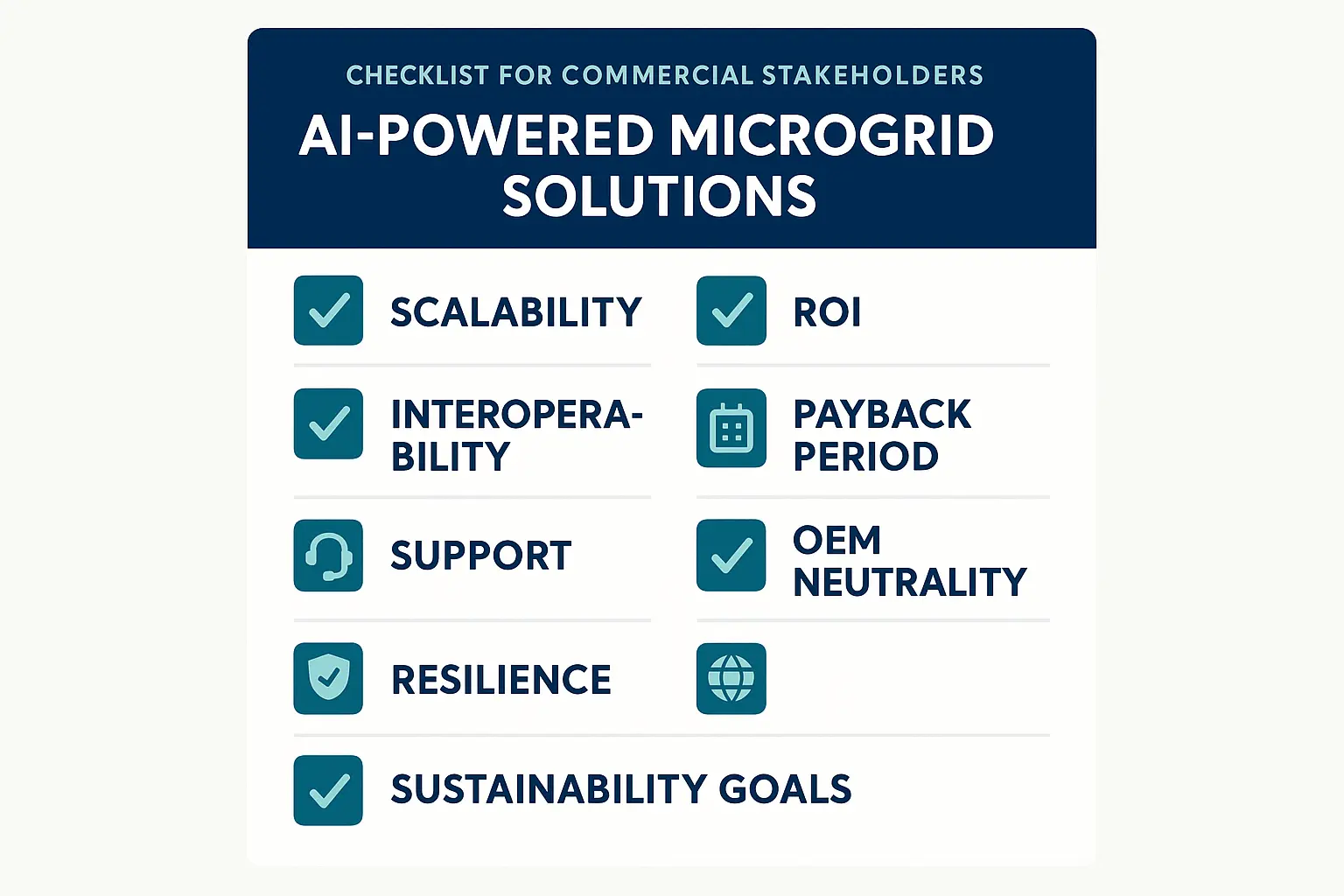
As you evaluate potential solutions and vendors, it’s crucial to have a structured framework. This ensures you’re comparing options on the factors that truly matter for long-term success. Use this checklist to guide your internal discussions and vendor interviews.
Frequently Asked Questions
1. What is the typical payback period for an AI-powered commercial microgrid?While this varies based on local utility rates, available incentives, and the specific mix of DERs, many commercial projects see a payback period of 5-8 years. When factoring in the financial costs of downtime prevented by enhanced resilience, the ROI becomes even more compelling.
2. Can this technology integrate with our existing Building Management System (BMS)?Absolutely. A key feature of a modern microgrid control system is its ability to integrate seamlessly with existing BMS platforms. This allows the AI to not only manage energy generation and storage but also optimize major loads like HVAC and lighting for a whole-building approach to efficiency.
3. How secure is an AI-controlled energy system from cyberattacks?Cybersecurity is a paramount design consideration. Leading solutions employ a multi-layered defense strategy, including network segmentation, encrypted communications, and AI-driven threat detection that actively monitors for and isolates anomalous behavior.
4. Do we need a dedicated data scientist on staff to manage the system?No. The goal of these platforms is to translate complex AI into an intuitive, actionable user interface. The system should operate autonomously based on your high-level goals (e.g., “minimize cost” or “maximize resilience”), while providing clear dashboards and reports for facility managers.
5. Is this only for new construction projects?Not at all. While ideal for new builds, AI-powered microgrids are frequently retrofitted into existing commercial buildings and campuses. A thorough site assessment is the first step to determine the best way to integrate DERs and controls with your current infrastructure.
Your Next Step Toward Energy Certainty
You are at a pivotal moment in defining your facility’s energy future. Moving beyond traditional systems to an intelligent, self-sufficient microgrid is a strategic decision that pays dividends in cost savings, operational continuity, and sustainability.
The key is to partner with a team that combines deep expertise in AI with a practical understanding of the commercial and industrial landscape.
If you’re ready to explore a detailed financial and resilience analysis for your facility, connect with one of our energy strategists. We can help you build a data-driven business case and a clear roadmap for achieving true energy independence.
