
If you manage a commercial property, you’ve likely felt the frustration of staring at a utility bill that feels more like a ransom note than a data report. It tells you what you spent, but not why or, more importantly, where. It’s a black box, leaving you to guess at the source of rising costs, whether it’s an inefficient HVAC unit, after-hours lighting, or tenant-specific consumption. You know there are savings to be found, but you can’t manage what you can’t measure.
This is the critical evaluation point where most energy strategies fail. They either stop at surface-level data or invest in complex software without the right foundational data to make it work. The solution isn’t just more data; it’s the right data, fed into a system smart enough to use it.
This guide moves beyond the basics. We’ll explore how Advanced Metering Infrastructure (AMI) and submetering are not just billing tools but the essential data backbone for AI-driven energy management. By the end, you’ll have a clear framework for transforming your building from a reactive cost center into a predictive, hyper-efficient asset.
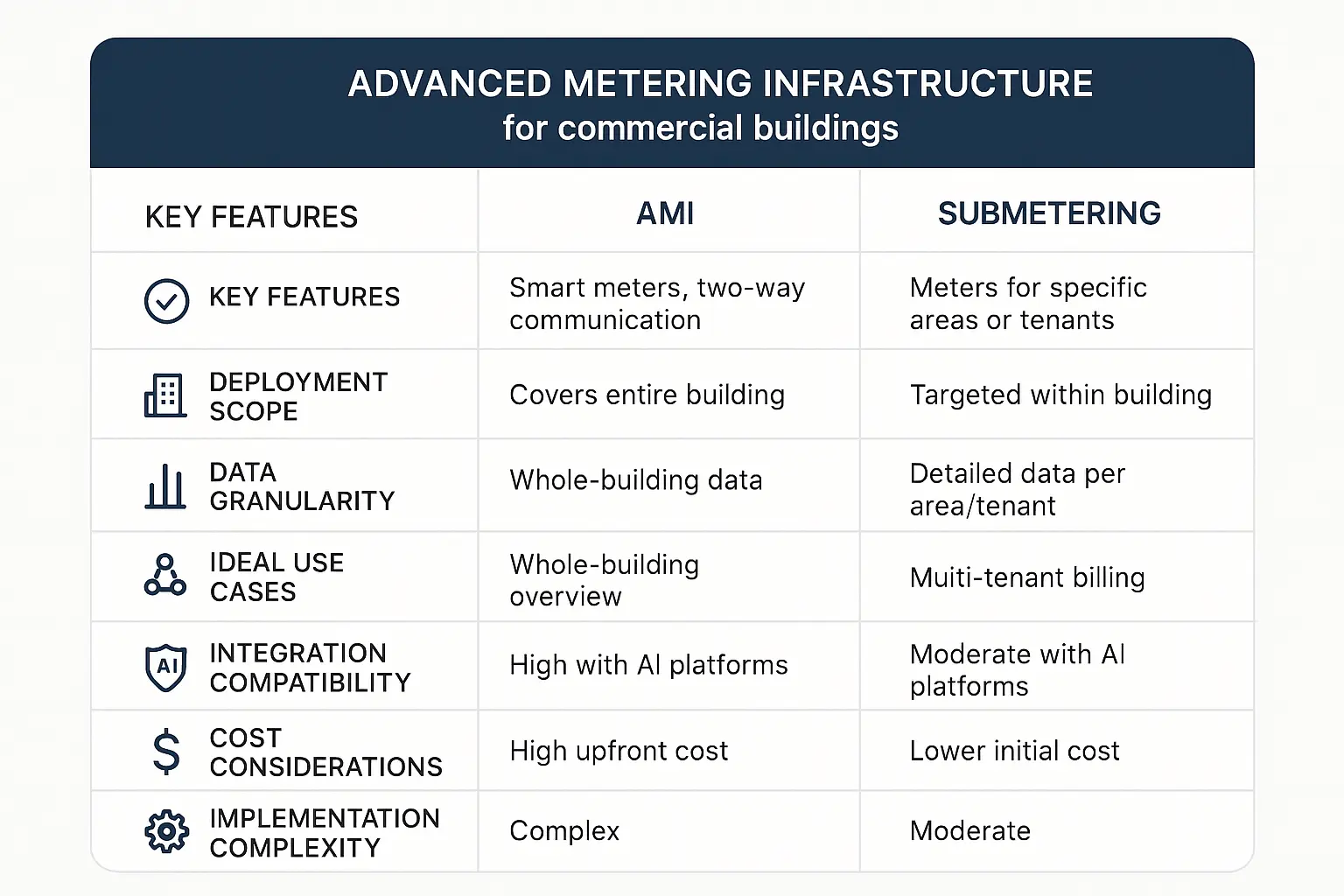
Unpacking the Foundation: What are AMI and Submetering?
While often used interchangeably, AMI and submetering play distinct yet complementary roles in a modern energy management strategy. Understanding the difference is the first step toward building a powerful data infrastructure.
Advanced Metering Infrastructure (AMI)
Think of AMI as the two-way conversation between your building and the utility company. It’s an integrated system of smart meters, communication networks, and data management systems. The utility uses it to get accurate, remote readings and manage the grid more effectively. For you, the building owner, its primary benefit is providing access to high-resolution interval data—often in 15 or 30-minute increments—replacing the single data point of a monthly bill. This is the starting point for understanding your building’s energy pulse.
Submetering
If AMI is the conversation with the utility, submetering is the internal conversation within your building’s walls. It involves installing additional meters downstream from the main utility meter to isolate the energy consumption of specific areas, equipment, or tenants.
- By Area: Metering individual floors, common areas, or leased spaces.
- By Equipment: Isolating high-draw systems like HVAC chillers, lighting panels, or data center racks.
- By Tenant: Enabling precise, fair billing and promoting energy accountability.
Submetering shatters the “black box” of the main utility bill, revealing exactly who, what, and where energy is being consumed.
The real power emerges when you combine them. AMI provides the macro view of your building’s relationship with the grid, while submetering delivers the micro-level granularity needed for an AI platform to perform truly transformative optimizations.
The Brain of the Building: How AMI/Submetering Empowers AI Energy Management
Granular data from advanced metering is the fuel, but an AI-powered energy management system is the engine that converts that fuel into savings and control. While competitors might talk about “building analytics,” they often miss the deep, synergistic connection between the data source and the AI’s capabilities. Here’s how raw meter data becomes actionable intelligence.
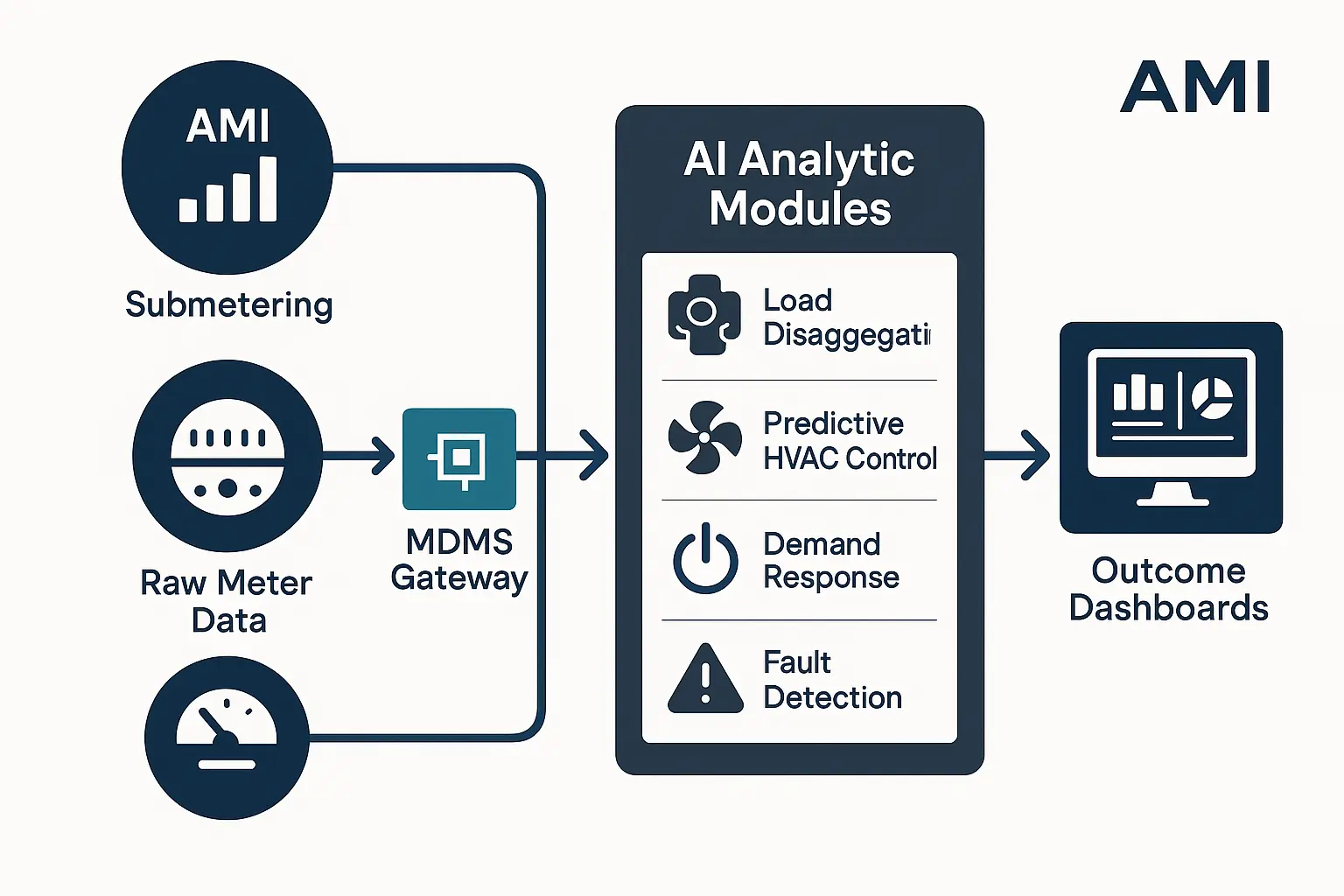
An AI platform ingests the high-frequency data streams from your AMI and submeters to perform functions that are impossible with manual analysis or basic software:
- Predictive HVAC Optimization: Instead of running on a fixed schedule, AI uses metering data combined with weather forecasts, occupancy patterns, and thermal modeling to pre-cool or pre-heat spaces with maximum efficiency, drastically reducing one of the largest energy expenses in any commercial building.
- Granular Load Disaggregation: AI algorithms can analyze the energy signature from a main meter and accurately break down consumption by end-use (HVAC, lighting, plug loads) even without extensive submetering, helping you pinpoint waste from “ghost loads” left on overnight.
- Automated Demand Response: With real-time AMI data, the AI can react instantly to price signals from the utility. When prices spike, it can automatically curtail non-essential loads, shifting consumption to cheaper periods without impacting occupant comfort, a key strategy in deregulated markets.
- Predictive Fault Detection: A failing motor or clogged air filter changes its energy consumption profile long before it breaks down completely. AI detects these subtle anomalies in submeter data, flagging equipment for maintenance to prevent costly failures and prolonged inefficient operation.
This moves you from simply reviewing past performance to letting your building autonomously optimize its future performance, 24/7. This is the core of a successful AMI Integration with AI Energy Platforms.
Strategic Deployment: Designing Your Metering Infrastructure for AI Success
Implementing an advanced metering system isn’t just about installing hardware; it’s about designing a data collection architecture that’s scalable, reliable, and tailored to your AI strategy.
Key Considerations for Your Metering Architecture
- Network & Connectivity: Will you use wired (Modbus, BACnet) or wireless (LoRaWAN, Zigbee) meters? Wireless offers flexibility for retrofits, while wired provides robust reliability. Your choice impacts installation cost and data transmission stability.
- Scalability: Your system should grow with your needs. A well-designed architecture allows you to start with critical systems or a single building and expand across a portfolio without a complete overhaul.
- Utility Integration: Accessing your AMI data can be a significant hurdle. Solutions range from connecting via standardized protocols like Green Button to more complex integrations with legacy utility systems. Planning this integration early is crucial.
For facilities with unique challenges, a tailored approach is essential. Developing Smart Metering Strategies for Multi-Tenant Properties, for instance, requires careful planning around cost allocation, tenant privacy, and common area management. Similarly, a data center’s metering strategy will prioritize PUE (Power Usage Effectiveness) and server rack-level monitoring, which differs greatly from a standard office building.
Ensuring Data Integrity: The Cornerstone of AI-Driven Energy Insights
Your AI platform is only as good as the data it receives. Inaccurate, incomplete, or inconsistent data leads to flawed analysis and poor optimization decisions. While many solutions mention data accuracy as a challenge, few provide a clear path to solving it.
A robust Meter Data Management System (MDMS) is the critical bridge between your meters and your AI platform. Its primary role is to ensure the quality and reliability of your energy data through a continuous workflow.
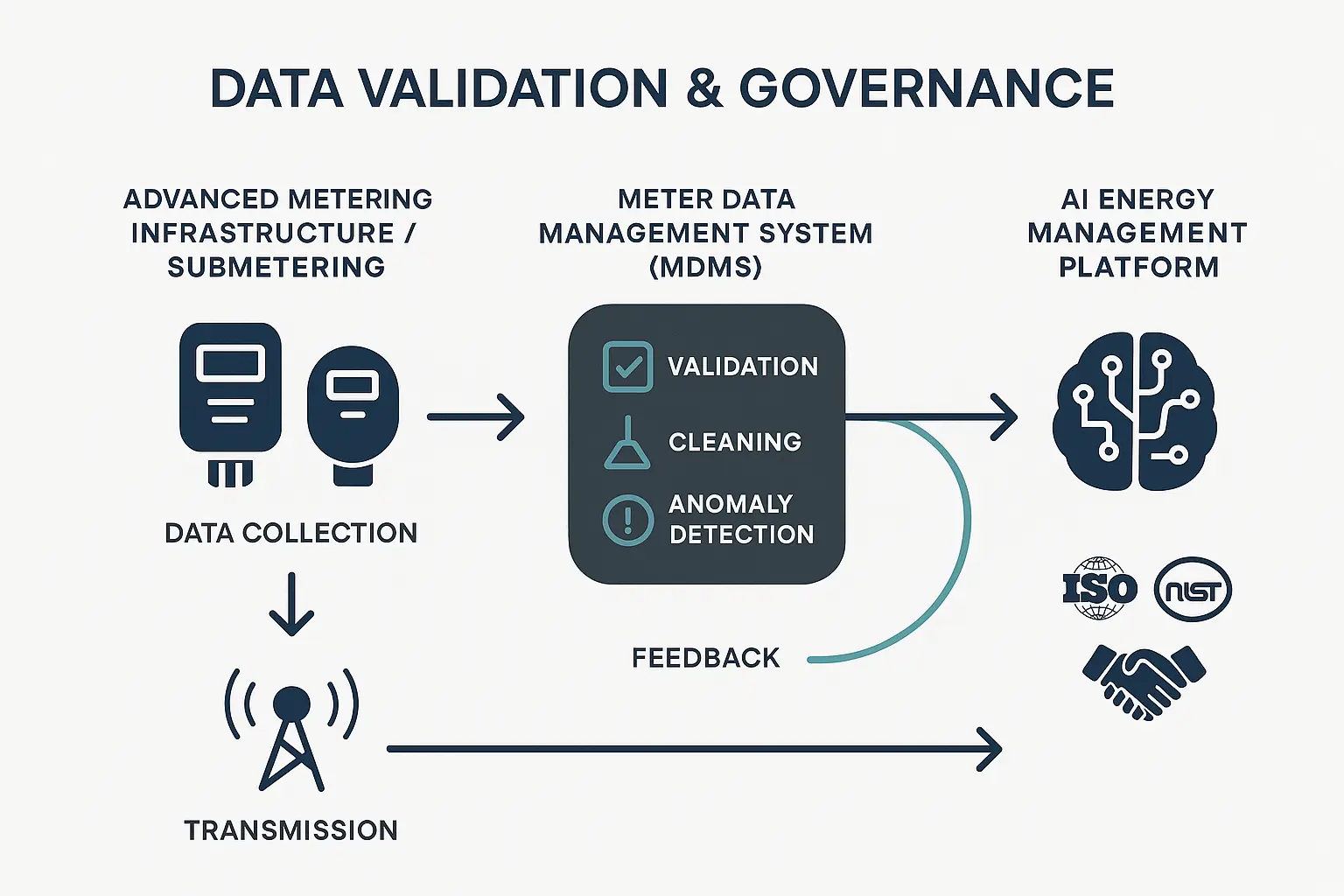
The Three Pillars of Data Integrity:
- Validation: The system automatically checks incoming data for errors. Are there missing intervals from a communication drop? Is a meter’s clock drifting? Is a reading so far outside the norm that it suggests a meter malfunction?
- Estimation & Editing (VEE): When errors are found, the system uses validated historical data and algorithms to estimate the missing values, creating a complete, clean dataset. This prevents gaps that could derail AI analysis.
- Governance: The platform maintains a secure, auditable record of all data and any changes made. This is essential for accurate billing, ESG reporting, and regulatory compliance.
Prioritizing a system that excels at Ensuring Data Accuracy in Commercial Energy Metering de-risks your investment and provides the confidence needed to trust the automated decisions your AI platform makes.
Realizing the ROI: Quantifiable Benefits of AI with Advanced Metering
An investment in advanced metering and AI isn’t an expense; it’s a high-return investment in operational efficiency. The benefits are clear, measurable, and compound over time.
Research from sources like NYSERDA and the Institute for Market Transformation (IMT) provides a strong baseline. Buildings that implement submetering see average first-year savings of around 6% in whole-building electricity consumption. As operators learn to use this data, those savings grow to an average of 10-12% in years two through five, with highly optimized buildings achieving 20% or more.
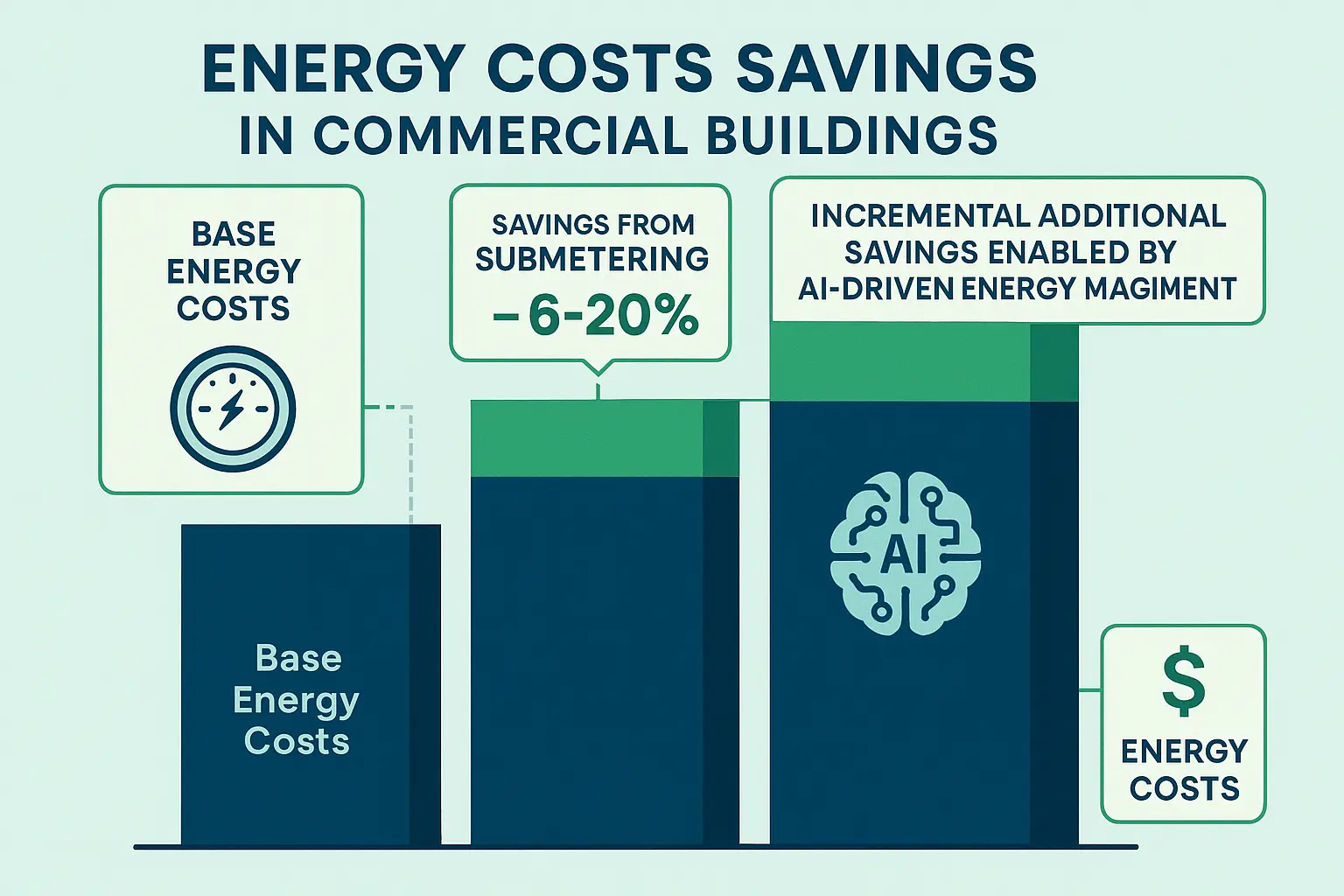
AI acts as a powerful multiplier on this baseline. While submetering shows you where to save, AI automates the savings by:
- Slashing Peak Demand Charges: By intelligently shifting loads, AI can reduce your monthly peak demand, which can account for 30-70% of a commercial utility bill.
- Eliminating Energy Waste: AI identifies and eliminates persistent energy waste from incorrectly scheduled equipment and ghost loads, often capturing an additional 5-15% in savings.
- Optimizing Operations: Predictive maintenance and optimized equipment run-times not only save energy but also reduce labor costs and extend asset lifespan.
The combined impact is a powerful financial case that typically delivers a payback period of under three years, while generating savings for the entire life of the building.
Beyond Savings: Strategic Advantages for Property Owners
The benefits of an AI-driven energy strategy extend far beyond the utility bill, enhancing asset value and competitive positioning.
- Enhanced Property Value & Tenant Satisfaction: Green-certified, energy-efficient buildings command higher rents and sale prices. For tenants, the transparency and fairness of submetering are significant advantages, improving satisfaction and retention.
- Streamlined ESG Reporting: Automated data collection and analysis make reporting for frameworks like GRESB, LEED, and other sustainability mandates simple and accurate, eliminating weeks of manual effort.
- Future-Proofing Your Asset: The energy landscape is evolving. A building with advanced metering and AI is prepared for the future of smart grids, demand response programs, and seamless integration of renewables and EV charging infrastructure.
Choosing Your Path: A Decision Framework for AMI & Submetering Solutions
As you evaluate solutions, it’s crucial to look beyond hardware specifications and assess how a system will deliver on the promise of intelligent, autonomous management.
Use this framework to guide your decision-making process:
- Define Your Primary Goal: Are you focused on tenant billing, whole-building optimization, or equipment-level performance? Your goal dictates whether to start with AMI data, comprehensive submetering, or a hybrid approach.
- Assess the AI Platform: Don’t just ask if a vendor uses AI. Ask how. Can they demonstrate specific use cases like predictive HVAC control and fault detection? How do they ensure data integrity before it reaches the AI models?
- Evaluate Integration Capabilities: How seamlessly does the system integrate with your existing Building Automation System (BAS), utility data sources, and other property management software? A truly intelligent building requires open, flexible communication between systems.
- Consider the Partnership: Are you buying a box of hardware or partnering with an expert who can provide strategic guidance, implementation support, and ongoing optimization services? The right partner will help you navigate the complexities and maximize your return.
Frequently Asked Questions
What if my building is old? Can it be retrofitted?
Absolutely. One of the biggest advantages of modern wireless submetering technology is its suitability for retrofits. Installation is minimally disruptive and avoids the high cost of running new wires, making it a viable solution for buildings of any age.
How secure is my energy data?
Data security is paramount. A reputable provider will use end-to-end encryption for data transmission and storage, adhere to industry-best security protocols, and ensure clear data ownership policies that protect your sensitive operational information.
What is the typical implementation timeline?
A pilot project focusing on a single building or critical system can often be deployed in a matter of weeks. A full portfolio rollout is a phased process, typically planned over several months to ensure a smooth transition and immediate value capture at each stage.
Do I need to replace my existing Building Automation System (BAS)?
No. A modern AI platform is designed to integrate with and enhance your existing BAS. It acts as an intelligent layer on top, taking data from your BAS and meters to make smarter control decisions than the BAS could on its own.
Take Control of Your Energy Future
Moving beyond the traditional utility bill is no longer a luxury—it’s a competitive necessity. By establishing a foundation of granular data with AMI and submetering and activating it with a powerful AI engine, you can unlock a new era of efficiency, control, and asset value. You can stop guessing where your energy dollars are going and start directing them with precision.
The intelligent building of tomorrow is not defined by futuristic architecture, but by its ability to learn, adapt, and optimize itself. That journey starts today, with the decision to finally see what’s happening inside the black box.
