
You’re past the initial “what is AI?” stage. You understand that predictive intelligence is no longer a futuristic concept but a strategic imperative in the energy sector. The real challenge now is cutting through the noise. How do you evaluate solutions and choose a partner who can translate complex data models into tangible business outcomes—like lower operating costs, enhanced grid stability, and a measurable return on investment?
Many platforms promise transformation, but few deliver a clear roadmap from data to decision. This guide is different. We’re moving beyond high-level promises to give you the practical evaluation framework you need. We’ll explore the methodologies that separate standard analytics from truly advanced intelligence, quantify the real-world ROI you should expect, and highlight the critical questions you need to ask to ensure you’re investing in a future-proof solution, not just another dashboard.
The New Energy Reality: Navigating a Data-Driven Battleground
The energy landscape is more volatile and complex than ever. Intermittent renewables, unpredictable market prices, aging infrastructure, and intense regulatory pressure create a perfect storm of uncertainty. At the same time, you’re facing a deluge of data from smart meters, IoT sensors, SCADA systems, and weather feeds.
This isn’t just a challenge; it’s a multi-trillion-dollar opportunity. McKinsey estimates that data and AI will unlock $5 trillion in value for the energy sector over the next decade. The winners won’t be those who simply collect data, but those who can model its complexities to predict the future with confidence.
Beyond Basic Forecasting: What “Advanced” Really Means
Traditional forecasting often relies on historical averages and simple linear models. It’s a bit like driving while looking only in the rearview mirror. Advanced energy intelligence, powered by machine learning (ML) and AI, is like having a sophisticated GPS that analyzes real-time traffic, weather, and road conditions to predict the best route forward.
The key difference lies in the ability to model non-linear, dynamic relationships within your data. Here’s what that looks like in practice:
- Machine Learning for Precision: Instead of basic regression, advanced models like XGBoost and Recurrent Neural Networks (RNNs) can identify subtle patterns in consumption, asset performance, and market behavior that older methods miss entirely.
- Deep Learning for Complexity: For challenges like forecasting renewable generation from satellite imagery or detecting microscopic faults in equipment, deep learning models can analyze vast, unstructured datasets to deliver insights that were previously impossible to uncover.
- Optimization for Action: It’s not enough to predict an outcome; you need to know the best action to take. Optimization algorithms use these predictions to recommend the most cost-effective dispatch schedule, the ideal time for maintenance, or the optimal battery charging strategy.
This leap in methodological sophistication is what allows leading organizations to forecast power generation fluctuations up to 36 hours in advance, increasing the value of that power by 20%.
Quantifying the Edge: The ROI of Predictive Energy Intelligence
Investing in predictive intelligence isn’t a cost center; it’s a powerful engine for value creation. While every scenario is unique, industry data reveals a clear and compelling financial case. Organizations that successfully deploy these solutions typically see a positive return on investment within 12 to 18 months.
The returns aren’t just theoretical. They manifest across your operations in concrete, measurable ways:
- Drastic Cost Reduction: ML models have been shown to deliver energy cost reductions of 15-20% by optimizing consumption and procurement. For industrial and commercial facilities, taming peak demand charges alone—which can account for up to 50% of an electricity bill—is a game-changing value driver.
- Enhanced Operational Efficiency: By improving the accuracy of load and demand forecasts, you can optimize resource allocation and procurement, increasing the cost-effectiveness of energy efficiency programs by as much as 21%.
- Maximized Asset Uptime: Predictive maintenance is one of the fastest ways to see returns. By predicting equipment failure before it happens, you eliminate unplanned downtime. For critical, high-downtime assets, the payback period can be as short as 6 to 9 months.
- Increased Market Value: For generators, especially in renewables, accurately predicting output allows for more profitable participation in energy markets and ancillary services.
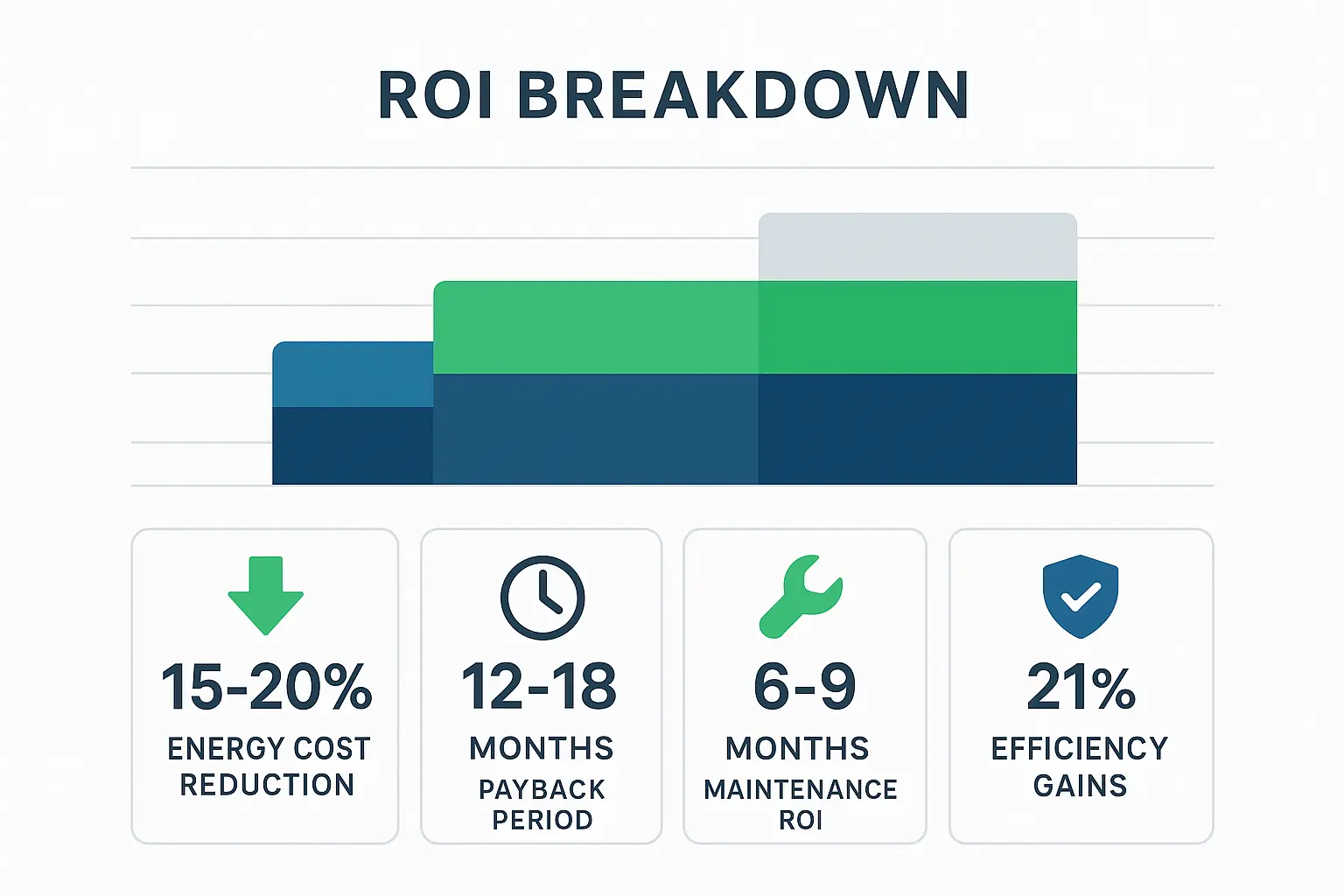 Visualizing the tangible business impact: Breakdown of predictive energy intelligence ROI components to inform investment justification.
Decoding the DNA of Success: Key Components of a Winning Energy Data Model
A powerful algorithm is useless without a rock-solid data foundation. High-performing predictive models are not built on algorithms alone; they are the result of a rigorous, multi-stage process that transforms raw data into strategic intelligence. When evaluating potential solutions, you need to look under the hood.
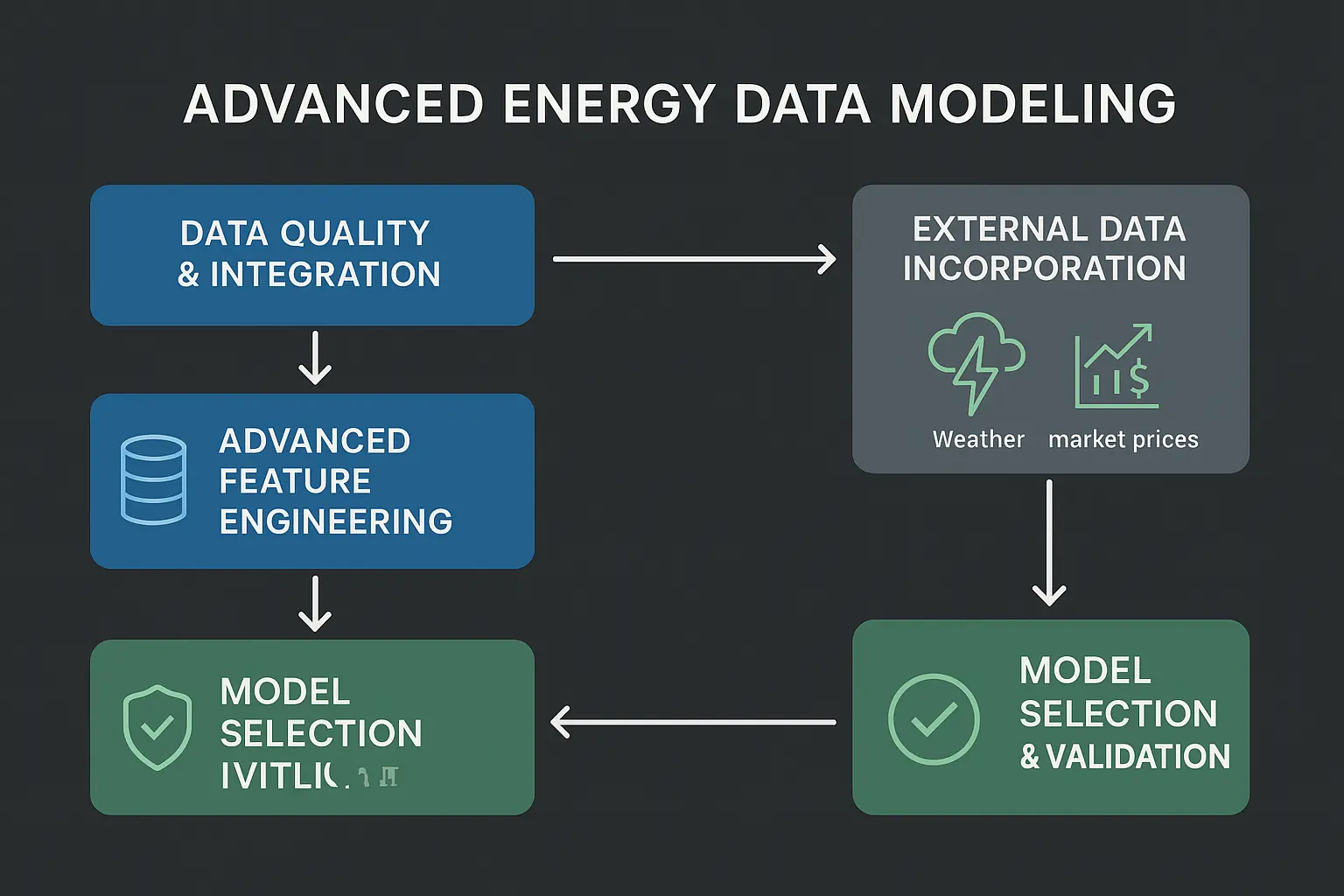 A transparent visualization of the rigorous process behind reliable energy data models, demonstrating our expertise and commitment to quality analytics.
Here are the non-negotiable components:
1. The Data Foundation: Taming the Sprawl
Energy data is notoriously fragmented, living in different systems with different formats. A winning strategy begins with robust data integration capabilities that can unify everything from utility bills and meter data to real-time SCADA feeds and building management systems. This is the first and most critical step to solving the “data sprawl” that paralyzes so many analytics initiatives.
2. Feature Engineering: The Unsung Hero
This is where true data science expertise shines and where many generic platforms fall short. Feature engineering is the art of creating new, relevant input signals for a model from existing raw data. For energy, this is paramount. It means transforming raw data into high-value features like:
- Lag Features: What was the energy consumption at this exact time yesterday, or last Tuesday?
- Rolling Statistics: What is the 7-day rolling average temperature or peak demand?
- Cyclical Features: Encoding the time of day, day of the week, or season to capture cyclical patterns.
- Interaction Features: Combining weather data with operational schedules to understand their combined impact on consumption.
Without sophisticated feature engineering tailored to energy, even the best algorithm will underperform. If you’re looking for ways to improve your Energy Demand Forecasting Solutions, this is where the biggest gains are often found.
3. Intelligent Model Selection
There is no “one-size-fits-all” model. The right choice depends entirely on the problem. Is it predicting a single value like next hour’s load (a regression problem)? Or classifying an event like an imminent equipment failure (a classification problem)? A knowledgeable partner will guide you on when to use models like ARIMA for simple time-series, XGBoost for complex tabular data, or LSTMs for deep temporal dependencies.
4. Integration of External Data
Your internal data only tells half the story. The most accurate models enrich internal data with external sources. Integrating real-time weather forecasts, grid carbon intensity data, and fluctuating market prices is essential for making truly optimized decisions. This is especially critical when developing models for Our Predictive Maintenance Platform, where ambient temperature can be a key predictor of asset stress.
Navigating the Minefield: Overlooked Challenges & How to Overcome Them
Any provider promising a seamless, “plug-and-play” implementation of advanced AI is not giving you the full picture. The path to success has potential pitfalls, but an experienced partner helps you anticipate and navigate them.
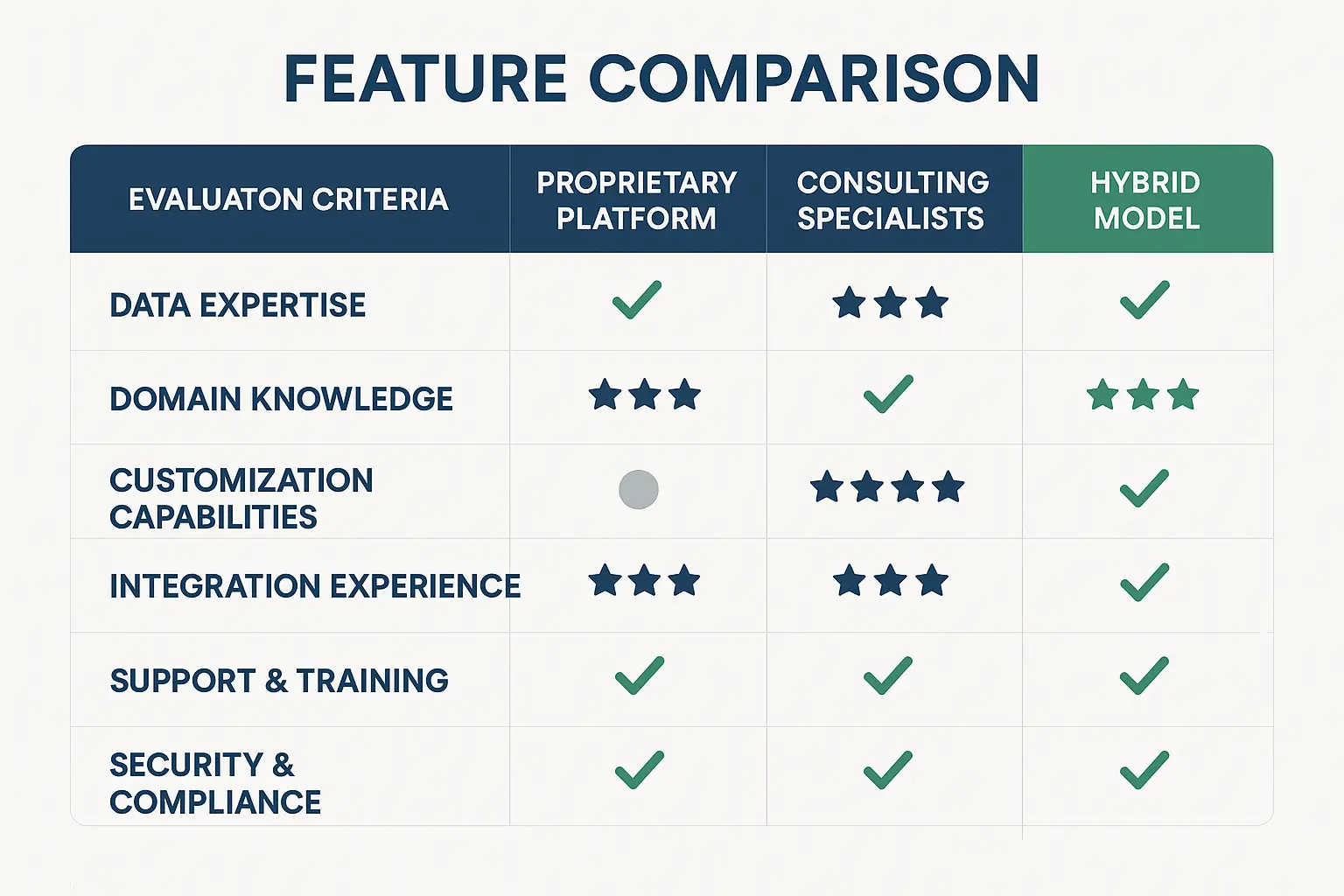 Understanding and addressing key challenges ensures smoother implementations and sustainable energy data modeling success.
-
Challenge: Data Quality & Standardization.
- Reality: Missing values, incorrect timestamps, and inconsistent units can corrupt your model’s accuracy.
- Solution: A rigorous data cleansing and validation process is non-negotiable. Your partner should have a clear methodology for identifying and rectifying these issues before modeling even begins.
-
Challenge: Computational Cost & Scalability.
- Reality: Training complex deep learning models can be computationally expensive and time-consuming.
- Solution: A scalable architecture is key. This involves choosing the right cloud infrastructure and optimizing models for efficiency, ensuring your solution can grow with your data and operational needs.
-
Challenge: Continuous Maintenance & Model Drift.
- Reality: A model’s accuracy can degrade over time as real-world conditions change. This “model drift” is a silent killer of ROI.
- Solution: The system must include robust MLOps (Machine Learning Operations) practices for continuous monitoring, automatic retraining, and redeployment to ensure sustained peak performance.
-
Challenge: The “Black Box” Problem & Trust.
- Reality: If operators don’t understand or trust a model’s recommendations, they won’t act on them.
- Solution: Prioritize solutions that offer model explainability (XAI) features. These tools provide insight into why a model made a specific prediction, building the trust necessary for adoption.
Choosing Your Partner: A MOFU Evaluation Framework
As you compare solutions, move beyond the feature list. The right partner offers a combination of technological prowess, deep domain expertise, and a transparent implementation process. Use this framework to guide your evaluation.
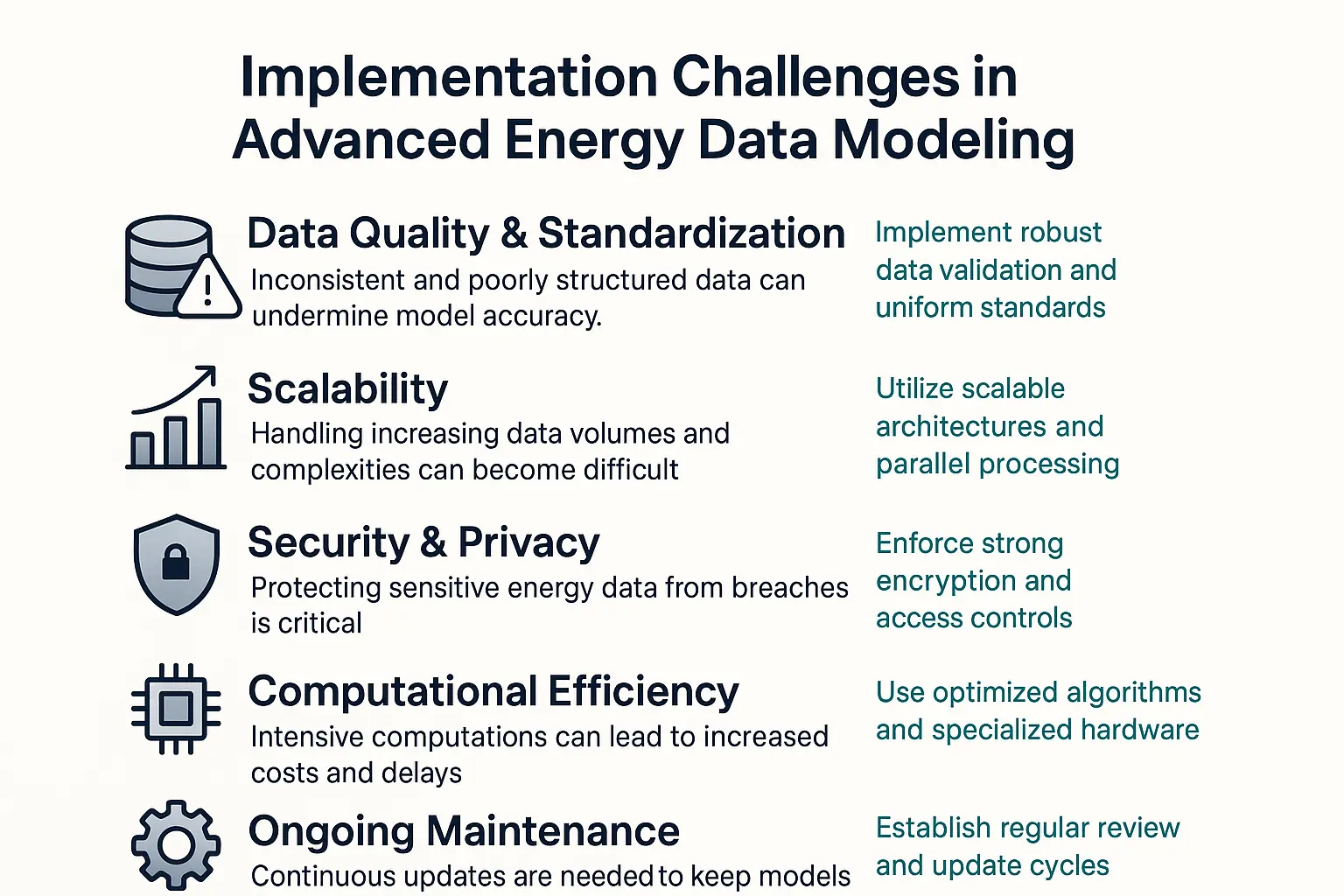 Essential evaluation criteria matrix to simplify your partner selection process and ensure alignment with your energy modeling needs.
Key Questions to Ask Potential Partners:
- On Domain Expertise: Can you share examples of how you’ve handled unique energy datasets, like intermittent solar generation or industrial process loads?
- On Data Science Rigor: Walk me through your feature engineering process. How do you select, create, and validate features for a use case like ours?
- On Technology: How does your platform handle model monitoring and retraining to combat model drift over time?
- On Implementation: What does your data onboarding and validation process look like? What resources will we need to provide?
- On Partnership & ROI: How will you work with us to define success metrics and quantify the business value of the solution post-deployment?
Answering Your Key Evaluation Questions (FAQ)
Q: Is our data “good enough” for advanced modeling?A: This is one of the most common concerns. A skilled partner doesn’t expect perfect data. The initial phase of any project should be a data readiness assessment. This involves identifying gaps, outlining a cleansing strategy, and determining which business problems can be solved with your current data versus what might require additional sources. It’s about starting with what you have to deliver initial value quickly.
Q: We don’t have a team of data scientists. Can we still leverage this technology?A: Absolutely. This addresses the “talent gap” many organizations face. The best solutions are designed to augment your existing team, not replace them. They should provide intuitive user interfaces for your operations experts while handling the complex data science in the background. Look for a partner who offers a managed service or acts as an extension of your team.
Q: How is this different from the analytics modules in our existing BMS or SCADA system?A: Most built-in analytics tools are excellent for historical reporting and basic threshold-based alerts. They answer “what happened?”. Advanced predictive intelligence platforms are built to answer “what will happen next?” and “what is the best thing we can do about it?”. They use more sophisticated machine learning models and integrate a much wider array of data sources (like weather and market prices) to provide true foresight.
Q: What is a realistic timeline for implementation and seeing initial results?A: This depends on data complexity, but a well-defined project should deliver initial insights within a few months, not years. A common approach is to start with a specific, high-impact use case—like predicting peak demand for a single facility. A successful pilot can often be completed in 12-16 weeks, demonstrating tangible value and building momentum for a wider rollout.
Your Next Step Toward Intelligent Energy Management
You are at a critical junction in your evaluation process. The choice you make will determine whether you are simply managing energy costs reactively or strategically leveraging energy intelligence as a competitive advantage.
The path forward requires a partner who combines deep energy sector knowledge with elite data science expertise. It requires a platform built not just on powerful algorithms, but on a rigorous methodology that ensures reliable, actionable, and quantifiable results.
If you’re ready to see how a tailored predictive intelligence strategy can transform your operations, let’s talk.
[Schedule a complimentary Data Strategy Session with our experts today.]
