
Navigating the Labyrinth: A Practical Guide to AI Agent Data Privacy, Security, and Compliance
Deploying AI agents feels like unlocking a new level of business capability. They promise unprecedented efficiency, personalization, and insight. But this power comes with a critical responsibility. As these agents interact with your most sensitive data, a nagging question keeps decision-makers up at night: Are we navigating the complex world of data privacy, security, and compliance correctly, or are we walking into a minefield?
You’re not just looking for a list of regulations. You’re evaluating how to build a program that enables innovation while creating an unbreakable foundation of trust. You need a blueprint that connects legal obligations to technical reality. This guide provides exactly that—a clear, actionable framework for deploying AI agents responsibly, turning compliance from a hurdle into a competitive advantage.
The AI Agent Data Challenge: Understanding the Unique Risks
AI agents are not just another software tool. Their autonomy, continuous learning, and deep interaction with data create unique privacy and security challenges that generic AI policies often miss. The stakes are incredibly high. A staggering 40% of companies have already experienced an AI-related privacy breach, and data leaks from generative AI are the top security concern for organizations.
Let’s break down the specific risks:
- Autonomous Data Collection: Unlike traditional software, agents can proactively seek and process information. Without strict controls, they can ingest sensitive PII or confidential business data from unintended sources, violating the core principle of data minimization.
- Inference and Derived Data: Agents can infer new, often highly sensitive, information about individuals by connecting disparate data points. This “derived data” falls under regulations like GDPR, yet it’s created in a black box that is difficult to audit.
- Shadow AI Proliferation: The ease of deploying third-party AI agents means employees often use them without official approval. This “shadow AI” creates massive security holes, with 20% of organizations reporting breaches from unsanctioned AI use, adding an average of $670,00c0 to breach costs. In fact, nearly half of all organizations admit that employees are inputting sensitive company data into external generative AI tools.
- Sophisticated Security Threats: Beyond simple data leaks, AI agents are targets for new attack vectors like model poisoning (corrupting training data to produce malicious outcomes) and prompt injection (tricking an agent into bypassing its security protocols).
Failing to address these agent-specific risks isn’t just a compliance issue; it’s a direct threat to customer trust. With 70% of U.S. adults lacking confidence in companies’ responsible AI use, a proactive and transparent approach is the only way forward.
The Regulatory Maze: GDPR, CCPA, EU AI Act, and Beyond for AI Agents
Navigating the global regulatory landscape is one of the biggest challenges in deploying AI agents. You’re not just dealing with one set of rules but a patchwork of evolving legislation. Understanding how GDPR, CCPA, and the new EU AI Act apply specifically to agent-driven processes is crucial.
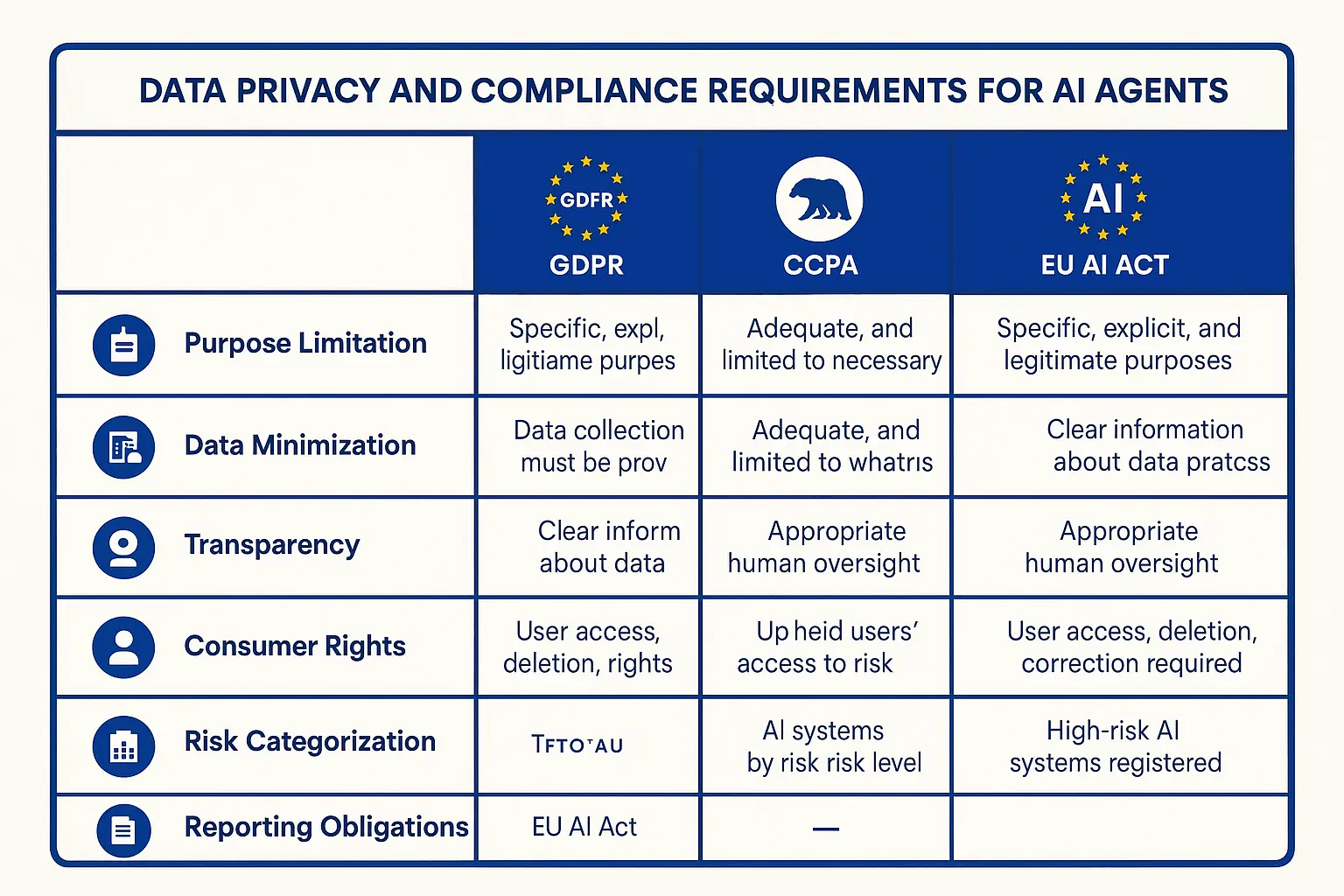
Key Regulatory Considerations for AI Agents:
-
GDPR (General Data Protection Regulation):
- Legal Basis for Processing: You must have a valid legal basis (like consent or legitimate interest) for every piece of data your agent processes. For agents that continuously learn, managing and documenting consent becomes a dynamic, ongoing task.
- Data Minimization: Agents must only collect and process data that is strictly necessary for their defined purpose. This directly conflicts with the “data-hungry” nature of many AI models.
- Right to Explanation (Article 22): If an agent makes an automated decision with a significant impact on an individual (e.g., a credit scoring or hiring recommendation agent), you must be able to explain the logic behind that decision. This requires a deep focus on model explainability.
-
CCPA (California Consumer Privacy Act):
- Right to Know & Delete: Consumers have the right to know what personal information your agent has collected about them and to request its deletion. You need robust systems to trace and delete a specific user’s data from complex AI models and their training sets without compromising the model’s integrity.
- Opt-Out of Sale/Sharing: You must provide clear mechanisms for users to opt-out of their data being shared or sold, which includes sharing data with third-party AI tool providers.
-
EU AI Act:
- Risk-Based Categorization: The Act classifies AI systems into risk categories (from minimal to unacceptable). Many business-critical AI agents (e.g., in hiring, finance, or critical infrastructure) will likely be classified as “high-risk,” imposing strict requirements for data quality, technical documentation, human oversight, and cybersecurity.
- Transparency Obligations: Even for lower-risk agents like chatbots, you must clearly disclose that the user is interacting with an AI system.
- Human Oversight: For high-risk systems, you must design your agents so that humans can intervene or oversee their operation at any time.
The key takeaway is that you need an agile governance strategy. A static, check-the-box approach is no longer sufficient. Your compliance framework must be as dynamic as the technology it governs.
Architecting Trust: Secure Data Pipelines for AI Agents
Responsible AI doesn’t happen by accident; it’s architected from the ground up. Building a secure data pipeline is the technical foundation for privacy, security, and compliance. This isn’t just about encrypting data at rest; it’s about embedding safeguards at every stage of the agent’s data lifecycle.
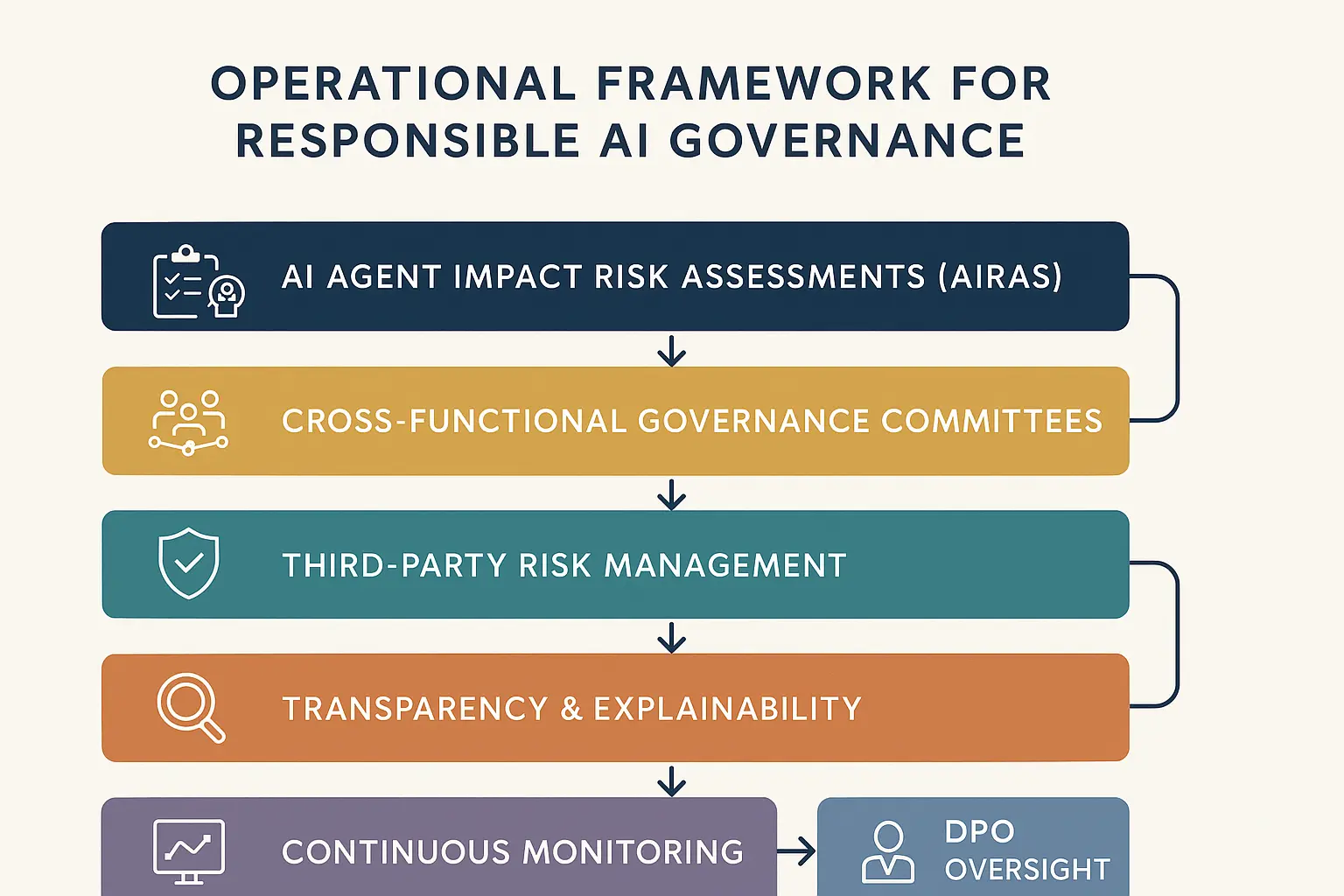
A secure pipeline for AI agents consists of four key stages:
- Secure Ingestion & Analysis: Before any data enters your system, it must be scanned. Use technologies like Data Loss Prevention (DLP) to detect and flag PII, PHI, or other sensitive information. Named Entity Recognition (NER) can automatically identify and tag entities like names, locations, and social security numbers for subsequent treatment.
- Data Transformation & Anonymization: This is where raw data is made safe for AI. Implement robust anonymization or pseudonymization techniques before the data is used for training or inference. This could involve masking, tokenization, or generating synthetic data. The goal is to strip identifying information while preserving the data’s utility for the AI model.
- Secure Processing & Storage: Here, a Zero Trust security model is paramount. Access to data should be granted on a strict, need-to-know basis, even for internal systems and agents. Utilize secure token vaults to store sensitive data, swapping it with a non-sensitive token for processing. For ultimate security, explore advanced techniques like homomorphic encryption, which allows agents to perform computations on data while it remains fully encrypted.
- Auditable Output & Logging: Every action your agent takes and every piece of data it accesses must be logged. This creates an immutable audit trail essential for demonstrating compliance, debugging issues, and explaining automated decisions. It’s your evidence that the agent is operating within its designated boundaries.
Demystifying Anonymization: Techniques for Privacy-Preserving AI Agents
Anonymization is the cornerstone of privacy-preserving AI, but it’s not a one-size-fits-all solution. Choosing the right technique depends on your agent’s function, the sensitivity of the data, and your regulatory requirements. The goal is to strike the right balance between protecting privacy and maintaining data utility.
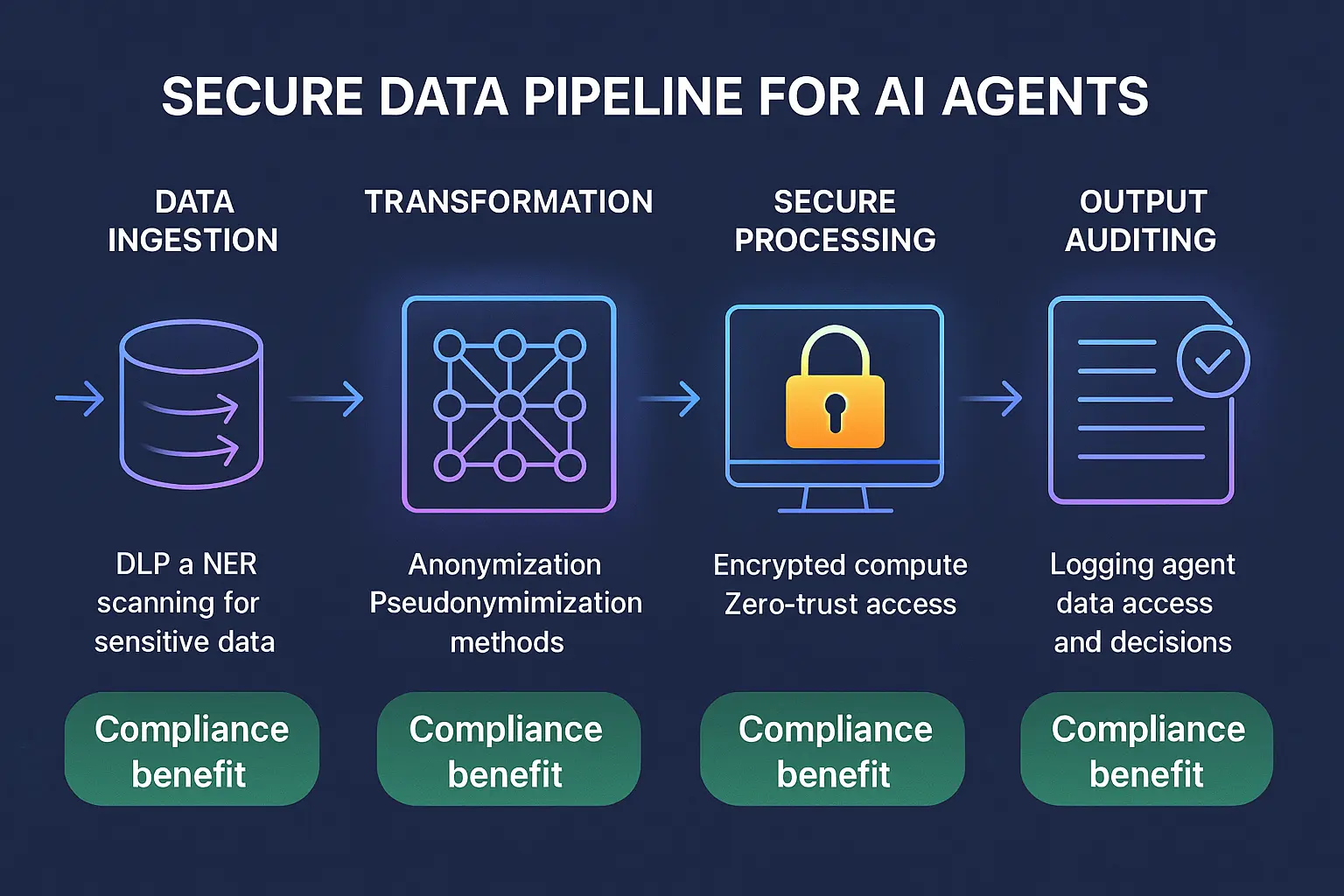
Here’s a breakdown of common techniques and their best-fit use cases for AI agents:
- Data Masking & Redaction: The simplest form. It involves replacing sensitive data with placeholder characters (e.g., “John Doe” becomes “[REDACTED]”).
- Best for: Agents that need to process unstructured text but don’t need the specific PII for their core function, like a customer support agent analyzing sentiment from chat logs.
- Tokenization & Pseudonymization: Replaces sensitive data with a non-sensitive equivalent, or “token.” The original data is stored securely elsewhere.
- Best for: Agents that need to track a user’s activity across sessions without knowing their real identity, such as a personalization agent that tailors content based on a user’s tokenized ID.
- Synthetic Data Generation: Creates artificial but statistically realistic data to train AI models. This avoids using any real PII whatsoever in the training process.
- Best for: Training robust agents for fraud detection or product recommendations without ever exposing sensitive customer financial or behavioral data.
- Differential Privacy: Adds statistical “noise” to data before it’s analyzed. This allows for querying datasets to get aggregate insights without revealing information about any single individual.
- Best for: Agents that perform large-scale analytics or research, where trends are more important than individual data points.
- Homomorphic Encryption: The “holy grail” of privacy. It allows agents to perform calculations directly on encrypted data, which is only decrypted after the processing is complete.
- Best for: Agents handling extremely sensitive data in untrusted environments, such as medical AI agents analyzing patient records in the cloud.
Operationalizing Responsible AI Governance for Agents
Technology alone isn’t enough. A successful AI agent program requires a robust governance framework that integrates people, processes, and policies. This is how you move from theory to practice and build a defensible, responsible AI ecosystem. Since 78% of companies lag in basic data and AI security practices, establishing this framework is a critical differentiator.
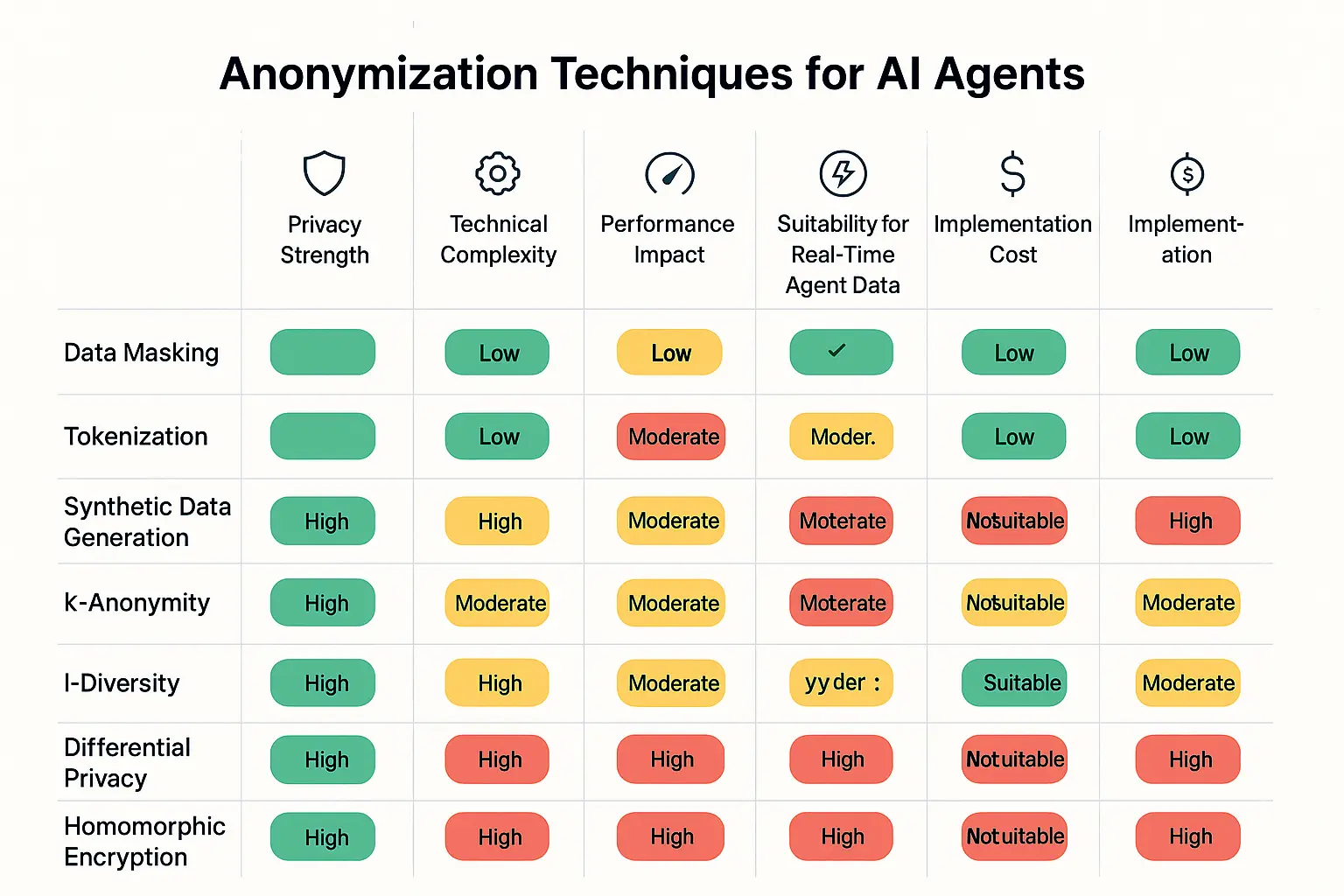
Here are the essential steps to operationalize your governance program:
- Conduct AI Impact Assessments (AIAs): Before deploying any new agent, conduct a thorough risk assessment, similar to a Data Protection Impact Assessment (DPIA) for GDPR. This process should identify potential privacy, security, ethical, and bias-related risks and establish mitigation strategies upfront.
- Establish a Cross-Functional AI Governance Committee: AI governance is a team sport. Your committee should include representatives from legal, compliance, IT/security, data science, and the relevant business units. This group is responsible for setting AI policies, reviewing new agent deployments, and overseeing ongoing compliance.
- Implement Strict Vendor Risk Management: If you use third-party AI agents, their risk is your risk. Your procurement process must include rigorous security and privacy due diligence. Scrutinize their data handling practices, security certifications, and contractual obligations.
- Prioritize Transparency and Explainability: Document every agent’s purpose, the data it uses, and the basic logic of its decision-making. This documentation is not only crucial for compliance (like GDPR’s “Right to Explanation”) but also for building internal and external trust.
- Enable Continuous Monitoring and Auditing: Deploy tools and processes to continuously monitor your agents’ behavior, data access patterns, and decision outputs. Regular audits ensure that agents are operating as intended and haven’t drifted into non-compliant or biased behavior over time.
Building Unshakeable Trust: Beyond Compliance for AI Agents
Meeting regulatory requirements is the baseline, not the destination. The true goal is to build unshakeable trust with your customers. In a world where users are increasingly skeptical of AI, demonstrating a genuine commitment to responsible practices is a powerful differentiator.
- Communicate Proactively with “AI Nutrition Labels”: Be transparent about how your agents work. Consider creating simple, easy-to-understand summaries—like a nutrition label—that explain what data an agent uses, what its purpose is, and what controls the user has.
- Empower Users with Granular Control: Go beyond basic consent checkboxes. Give users meaningful control over how your agents use their data. Allow them to easily access, correct, and delete their information or opt-out of specific agent-driven features.
- Embed Ethics into the Design: Proactively work to identify and mitigate bias in your training data and algorithms. An ethical AI by design approach ensures your agents make fair and equitable decisions, protecting both your customers and your brand reputation.
Ultimately, investing in robust data privacy, security, and governance for your AI agents isn’t a cost center—it’s an investment in resilience, customer loyalty, and sustainable innovation.
***
Frequently Asked Questions
1. We’re a small company. Do we really need such a comprehensive AI governance program?Yes. Data privacy regulations like GDPR and CCPA apply to companies based on their data processing activities, not just their size. More importantly, a data breach or loss of customer trust can be far more devastating for a small business than a large enterprise. Starting with a scalable, right-sized governance framework early on is much easier and more cost-effective than retrofitting it later.
2. What is the single most important first step we should take?Start with discovery and risk assessment. You can’t protect what you don’t know you have. Identify all AI agents currently in use (including potential “shadow AI”) and conduct an AI Impact Assessment (AIA) for each one, starting with the one that handles the most sensitive data or has the biggest impact on users. This will give you a clear, prioritized roadmap for action.
3. How can we ensure our agents’ decisions aren’t biased?Mitigating bias is an ongoing process. It starts with carefully curating and cleaning your training data to ensure it is representative of the population. During development, use fairness metrics and bias detection tools to test your models. After deployment, continuously monitor agent outputs for discriminatory patterns and establish a clear process for human review and intervention when potential bias is detected.
4. Our data science team says anonymization hurts model performance. What’s the trade-off?There can be a trade-off, but it’s often manageable. The key is to choose the right anonymization technique for the job. Advanced methods like synthetic data generation or tokenization can preserve a high degree of data utility while providing strong privacy protection. The conversation shouldn’t be “if” you anonymize, but “how” you do it smartly to meet both your performance goals and your compliance obligations.
5. How do we keep up with all the changing regulations?This is a significant challenge, which is why an agile governance framework is essential. Designate a person or team (like your governance committee) to be responsible for monitoring the regulatory landscape. Subscribe to updates from regulatory bodies and legal experts. Most importantly, build your AI systems on flexible, principles-based foundations—like data minimization and privacy-by-design—which will remain relevant even as specific laws evolve.
Your Next Step to Confident AI Deployment
The journey to responsible AI is complex, but it doesn’t have to be overwhelming. By focusing on a foundation of secure data architecture, practical anonymization, and operational governance, you can unlock the immense potential of AI agents while building lasting trust.
If you are ready to move from understanding the risks to implementing the solutions, the next step is to assess your organization’s specific needs and map out a clear path forward.
