
AI Agents for the Autonomous Enterprise: Your Definitive Evaluation Guide
You’ve moved past the initial hype. You understand that Robotic Process Automation (RPA) was just the beginning and that generative AI assistants, while useful, are still waiting for your command. Now, you’re evaluating the next frontier: autonomous AI agents that don’t just respond, but anticipate, plan, and execute complex tasks across your enterprise.
But this evaluation stage is complex. How do you move from concept to confident deployment? How do you cut through the noise to find a solution that integrates with your legacy systems, delivers measurable ROI, and empowers your team instead of creating chaos?
This isn’t another high-level overview. This is your practical guide to making an informed decision. We’ll walk through the essential frameworks, integration challenges, and evaluation criteria you need to select and scale AI agents successfully. By the end, you’ll have a clear roadmap for transforming your operations, backed by the data you need to build a compelling business case. With 85% of enterprises already using AI agents, the time for evaluation is now.
Decoding the DNA of Enterprise AI Agents
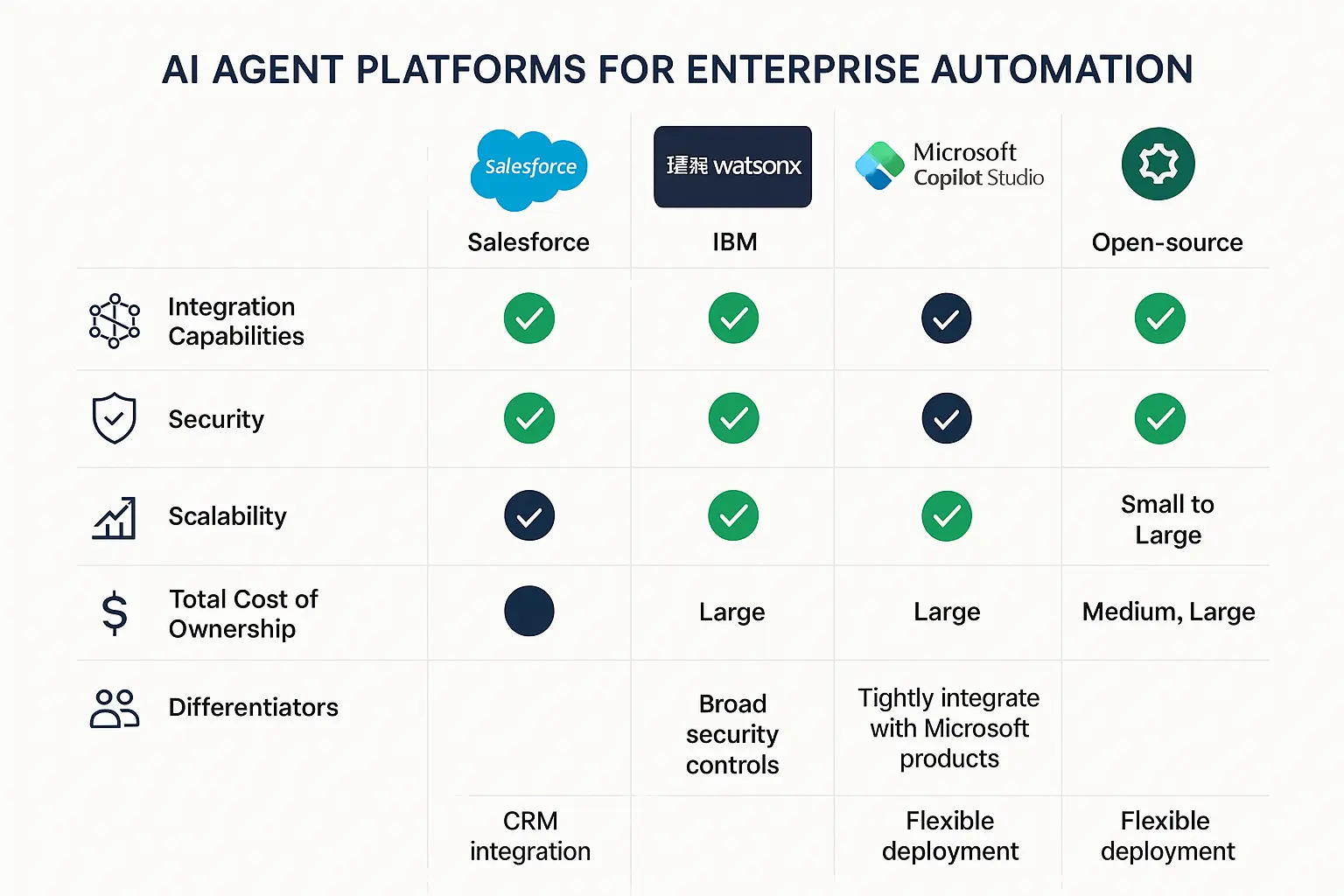
Before you can compare solutions, you need a clear, shared understanding of what an enterprise-grade AI agent truly is. It’s more than a chatbot with API access. A true agent operates on a continuous cycle: it perceives its environment, reasons to form a plan, and acts on that plan to achieve a goal.
This sets it apart from other forms of automation:
- vs. RPA: RPA bots follow rigid, pre-defined scripts. AI agents can adapt their plans based on new information and unexpected events.
- vs. GenAI Assistants/Chatbots: Assistants are reactive; they wait for a human prompt. Agents are proactive; they can initiate tasks autonomously based on triggers or goals.
The most effective enterprise agents are built on a sophisticated architecture that includes perception, reasoning, execution, memory, and orchestration components.
Types and Key Features for Enterprise Success
In an enterprise context, agents evolve from simple reactive systems to complex, learning entities. You’ll encounter Goal-Based agents that work to achieve a specific outcome (e.g., “reduce customer support tickets by 15%”) and Learning agents that analyze their own performance to improve over time.
The most transformative trend is the rise of Multi-Agent Systems, where specialized agents collaborate on complex workflows. Imagine a “Sales Prospecting” team of agents: one scours LinkedIn for new leads, another enriches that data in your CRM, and a third drafts personalized outreach emails for human review. This is where a 327% surge in multi-agent workflows is coming from—they tackle challenges too complex for a single agent.
When evaluating platforms, these are the non-negotiable features:
- Autonomy & Proactivity: The ability to operate with minimal human intervention.
- Contextual Awareness: Deep understanding of the specific task, user history, and business process.
- Robust Tool Integration: Seamless API connectivity to your entire tech stack—CRMs, ERPs, databases, and custom applications.
- Reasoning & Planning: The capacity to break down a complex goal into a sequence of executable steps.
- Learning & Adaptation: The ability to improve performance based on feedback and outcomes.
- Enterprise-Grade Security & Governance: Granular controls, audit logs, and data protection are paramount.
The Transformative Impact: Quantifying ROI Across Functions
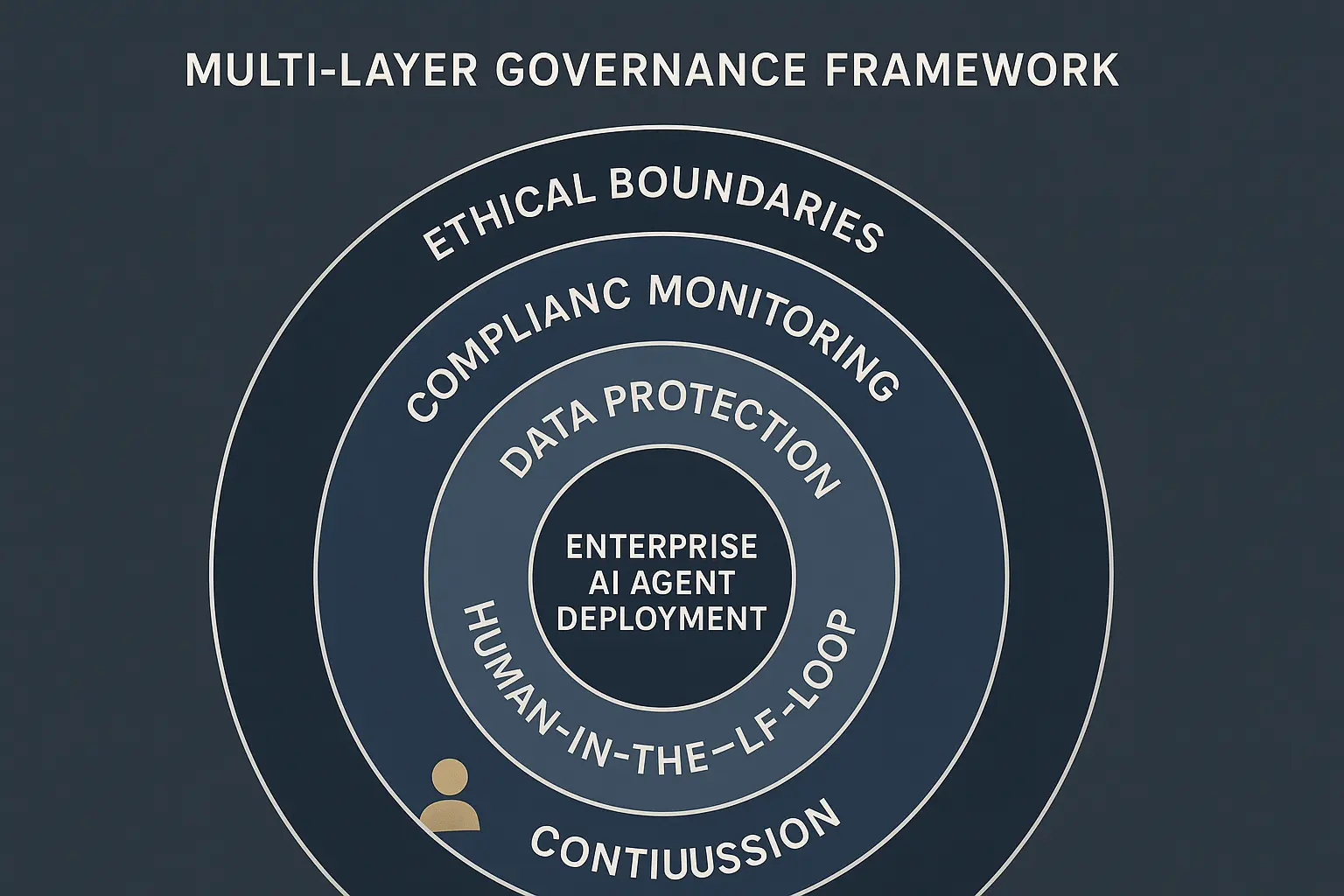
The strategic goal of deploying AI agents isn’t just automation; it’s optimization. The results are tangible, with companies achieving an average of 55% higher operational efficiency and 35% cost reductions. With 88% of senior executives planning to increase AI budgets specifically because of agentic AI, the pressure is on to demonstrate clear returns.
Let’s break down the impact where it matters most.
Departmental Deep Dives & Use Cases
Here’s how AI agents are already delivering value across the enterprise, moving beyond the generic examples to solve specific, high-impact problems.
-
Sales & Marketing:
- Autonomous Lead Qualification: An agent monitors inbound channels (forms, emails, chatbots), enriches lead data using tools like Clearbit, scores the lead based on your ideal customer profile, and assigns it to the correct sales rep in Salesforce—all without human touch.
- Proactive CRM Hygiene: An agent constantly scans your CRM for duplicate records, outdated contact information, or deals that have stalled, then automatically merges records or flags tasks for follow-up. This solves a massive data integrity headache.
-
HR & Talent Management:
- Intelligent Employee Onboarding: A new hire triggers a multi-agent workflow. One agent provisions accounts in Active Directory and Slack, another enrolls them in benefits, and a third schedules their first-week orientation meetings, delivering a consistent and efficient Day 1 experience.
- 24/7 Policy Support: An agent trained on your internal knowledge base and HR policies can answer complex employee questions about PTO, expense reports, or career development, freeing up HR professionals for more strategic work.
-
Supply Chain & Operations:
- Predictive Maintenance Agent: An agent monitors real-time data from factory floor sensors. When it detects an anomaly that predicts a machine failure, it automatically creates a maintenance ticket in your ERP system, orders the necessary parts, and schedules a technician.
- Dynamic Inventory Optimization: An agent analyzes sales data, supplier lead times, and even external factors like weather forecasts to proactively adjust inventory levels, preventing stockouts and reducing carrying costs.
-
Finance & Accounting:
- Automated Invoice Reconciliation: An agent extracts data from incoming invoices (regardless of format), matches it against purchase orders in your accounting system, flags discrepancies for human review, and routes approved invoices for payment. BCG reported a case with a 10x cost reduction in a similar banking use case.
Navigating the Complexities: Integration, Deployment & Governance
This is where most AI agent initiatives stall. The promise is enormous, but the reality is that 90% of enterprises struggle to scale their projects. Early gains often fall short because of unforeseen integration and governance hurdles. A successful strategy requires a clear plan for navigating this complexity.
Integration with Your Enterprise Ecosystem
Your business runs on a complex web of systems: legacy ERPs, cloud-based CRMs, data warehouses, and custom-built applications. An AI agent is only as effective as its ability to communicate with this ecosystem.
Key challenges to address with any potential vendor are:
- Legacy Systems: How does the platform connect to on-premise systems that may not have modern APIs?
- Data Transformation: How does it handle data quality issues and ensure data is in the correct format before acting on it?
- Real-Time Synchronization: How does it ensure the agent is always working with the most up-to-date information from all connected systems?
The Pillars of Responsible AI Agent Governance
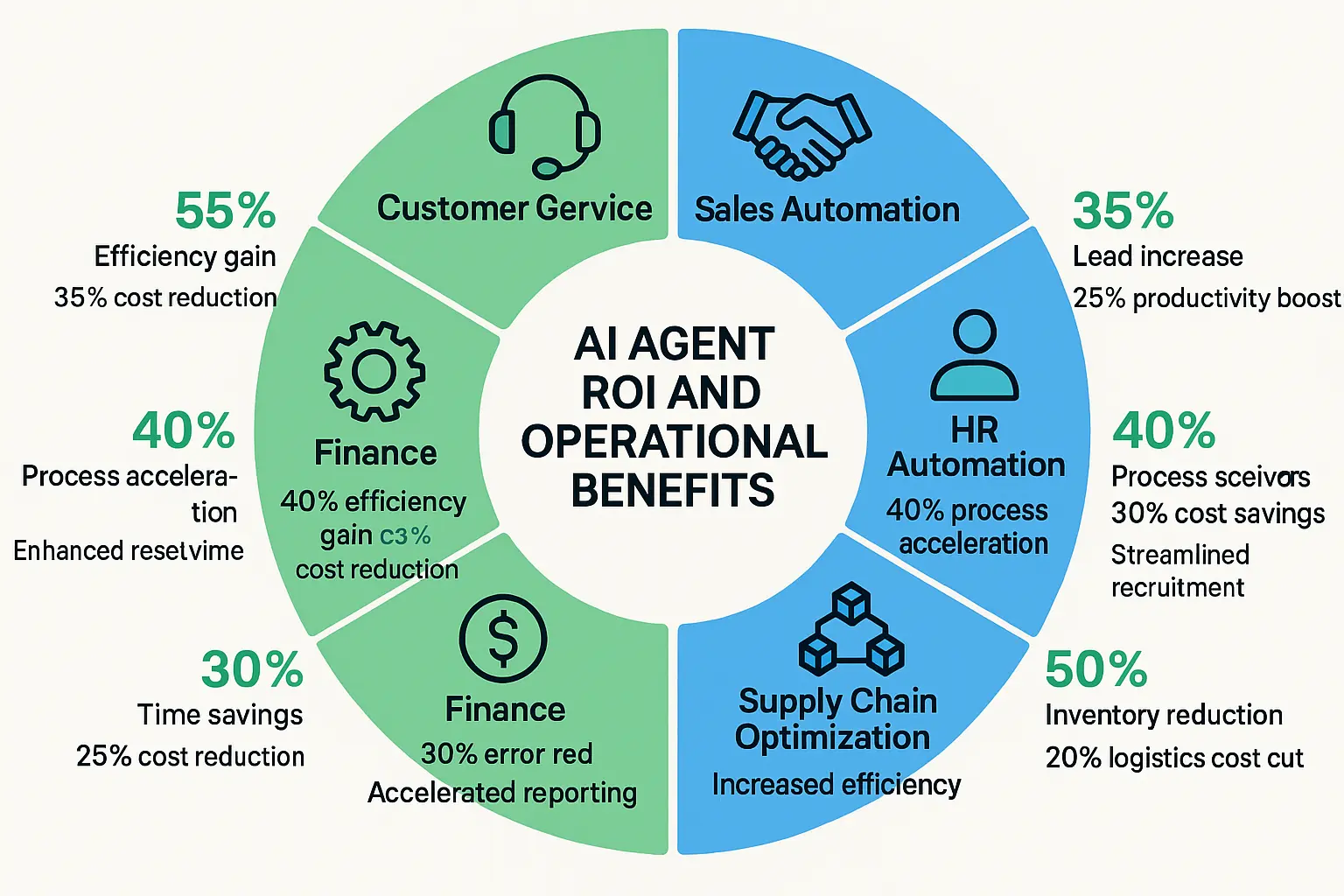
Trust is the currency of automation. Before you grant an agent autonomy over critical business processes, you need a robust governance framework. This is non-negotiable for enterprise buyers and a key differentiator between consumer-grade tools and true enterprise platforms.
Your governance model must include:
- Granular Policy Controls: The ability to define exactly what an agent can and cannot do, which tools it can use, and what data it can access.
- Human-in-the-Loop (HITL) Workflows: For sensitive tasks, the agent should complete its analysis and then present its recommended actions for human approval before execution.
- Comprehensive Audit Logs: A clear, unalterable record of every action and decision the agent makes for compliance and troubleshooting.
- Accountability & Error Handling: A clear plan for what happens when an agent fails or makes a mistake. How do you diagnose the issue, roll back the action, and ensure it learns from the error?
Choosing Your AI Agent Strategy: Build vs. Buy vs. Partner
With a clear understanding of your needs and the technical requirements, you can now evaluate the market. The fundamental decision is whether to build a custom solution, buy an off-the-shelf platform, or partner with a provider.
Evaluation Criteria for Enterprise AI Agent Solutions
Use this checklist to systematically compare your options:
- Use Case Alignment: How well does the solution address your specific, high-priority business problems out of the box?
- Tech Stack Compatibility: How easily does it integrate with your existing CRM, ERP, and data infrastructure?
- Implementation Complexity: What level of internal expertise and resources are required for deployment and maintenance?
- Total Cost of Ownership (TCO): Look beyond licensing fees to include implementation, training, and ongoing management costs.
- Scalability & Performance: Can the solution grow from a single departmental pilot to an enterprise-wide deployment without performance degradation?
- Vendor Trust & Support: What is the vendor’s reputation, what level of support do they offer, and what is their long-term product roadmap?
- Security & Compliance: Does the platform meet your industry’s specific security and data privacy requirements (e.g., GDPR, HIPAA)?
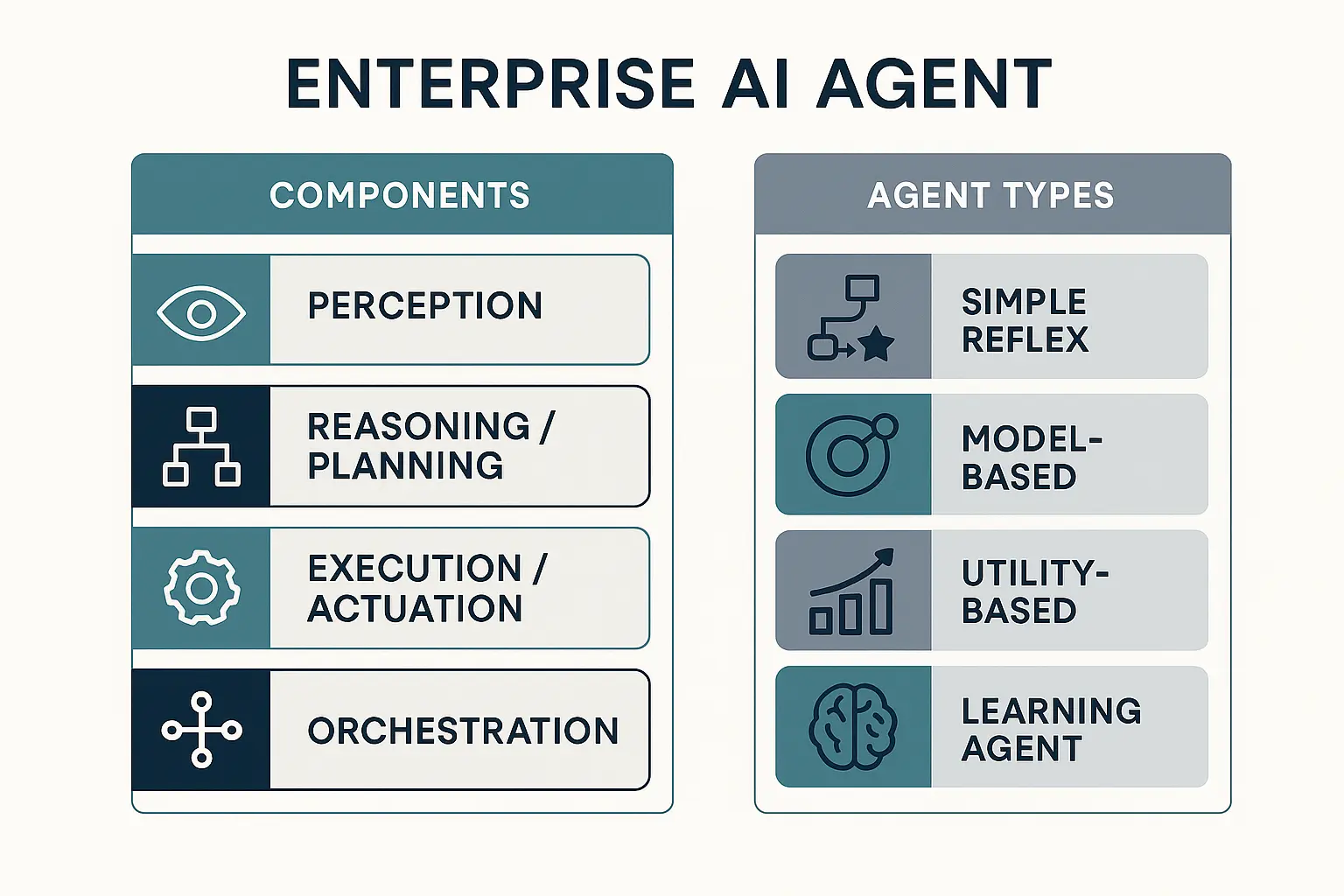
Comprehensive AI Agent Platform Comparison Matrix
To aid your evaluation, we’ve compiled a comparison of leading approaches and platforms. This is designed to be a starting point for your own deep-dive analysis.
| Approach / Platform | Core Strength | Best Suited For | Key Considerations |
|---|---|---|---|
| Build (Open-Source) | Maximum customization & control | Tech-forward companies with strong in-house AI/ML talent and unique process requirements. | High upfront investment, long development time, ongoing maintenance burden, requires deep expertise. |
| Embedded CRM Agents | Deep integration with sales/service data | Companies heavily invested in a single ecosystem (e.g., Salesforce, HubSpot) looking to automate core CRM tasks. | Can be a walled garden, limited ability to orchestrate processes outside the core platform. |
| Broad AI Platforms | Comprehensive toolsets & scalability | Large enterprises needing a unified platform for diverse AI initiatives, often with consulting support. | Can be complex and expensive; may require significant configuration to meet specific needs. |
| Specialized Automation | Turnkey solutions for specific functions | Departments needing to solve a targeted problem quickly (e.g., invoice processing, IT support ticketing). | May not scale easily to other use cases; risk of creating fragmented “point solution” silos. |
| Srinergy AI | Balanced integration, governance, and rapid deployment | Mid-to-large enterprises seeking a flexible platform to automate and optimize cross-departmental workflows without requiring a large in-house AI team. | Designed for complex enterprise ecosystems, balancing power with ease of use. |
The Human Element: Leading Organizational Change
Technology is only half the equation. The most successful AI agent deployments are as much about people as they are about platforms. Gartner forecasts that by 2028, we’ll see a 33-fold increase in agentic AI applications, fundamentally changing how work gets done.
Focus on creating a human-AI teaming model. Agents should handle the repetitive, data-intensive tasks, freeing up your employees to focus on strategic thinking, complex problem-solving, and building customer relationships. This requires a proactive approach to:
- Reskilling and Upskilling: Invest in training programs that teach employees how to manage, supervise, and collaborate with AI agents.
- Defining New Roles: Create roles like “AI Agent Orchestrator” or “Automation Ethicist” to manage and govern your new digital workforce.
- Fostering Trust: Be transparent about the goals of your automation initiatives, focusing on how they will augment human capabilities, not replace them.
FAQ: Addressing Your Core Concerns
1. What is the real Total Cost of Ownership (TCO) for an AI agent solution?TCO includes more than the software license. Factor in costs for implementation (which can be significant if you have many complex integrations), employee training, data preparation, and ongoing governance and maintenance. A good vendor will be transparent about these costs upfront.
2. How do we ensure our proprietary data remains secure?This is a critical evaluation point. Look for platforms that offer robust data encryption, granular access controls, and clear data residency policies. Ask vendors specifically how they isolate your data and whether their AI models are trained on customer data (the answer should be no for enterprise-grade solutions).
3. What happens when an AI agent makes a mistake?Failure is inevitable in any complex system. A mature platform will have strong error handling, detailed audit logs to trace the source of the error, and straightforward “human-in-the-loop” workflows that allow a person to intervene and correct the agent’s course of action.
4. Will AI agents replace jobs in our company?History shows that technology tends to transform jobs rather than eliminate them entirely. While agents will automate tasks—by some estimates, between 15-50% of them by 2027—they also create a need for new skills in managing, directing, and optimizing these systems. The key is to invest in reskilling your workforce to collaborate with this new technology.
5. How do we start? Should we go for a big bang launch or a small pilot?Always start with a phased approach.
- Phase 1: Identify a single, high-impact, low-risk use case.
- Phase 2: Run a pilot project to prove the technology and calculate the ROI.
- Phase 3: Use the learnings and success from the pilot to build a business case for a wider, strategic rollout.
From Automation to True Transformation
You are at a critical juncture in your evaluation process. Moving beyond basic automation to an autonomous enterprise requires a solution that is not only technologically powerful but also secure, governable, and designed to integrate seamlessly into your existing operational fabric.
By focusing on a clear ROI, addressing integration complexities head-on, and choosing a partner who prioritizes both technology and the human element, you can confidently deploy AI agents that deliver transformative results.
Ready to see how a dedicated enterprise automation solution can address your specific challenges? Explore our platform to understand how we balance powerful autonomy with the governance and control your business demands.
