
You’re tasked with a monumental goal: guiding your organization through the energy transition. You know artificial intelligence is a critical lever, but you’re caught in a paradox. On one hand, headlines from the World Economic Forum and KPMG herald AI as the “greatest accelerator” of climate progress. On the other, reports from the International Energy Agency (IEA) raise alarms about AI-driven data centers becoming colossal energy consumers.
How do you move forward confidently? How do you separate the transformative potential from the energy-intensive hype?
This is the central challenge for decision-makers today. You need more than high-level strategies or generic use cases. You need a clear framework for evaluating AI solutions that not only promise decarbonization but can prove they deliver a net-positive impact. This guide provides that framework, moving beyond the surface to explore the advanced AI methodologies that are truly accelerating the path to a sustainable future.
Decoding the AI Energy Paradox: How to Ensure a Net-Positive Impact
The “AI energy paradox” isn’t just a talking point; it’s a material risk. The IEA projects that AI and data centers could drive 20% of global electricity demand growth through 2030, consuming more electricity than Japan does today. Choosing an AI partner without a clear strategy to manage this footprint is like trying to bail out a boat with a leaky bucket—the effort may not outweigh the damage.
A true decarbonization partner must address this challenge head-on. The goal isn’t just to apply AI to climate problems; it’s to ensure the AI solution itself is part of a sustainable ecosystem. This means prioritizing computational efficiency, powering operations with clean energy, and transparently measuring the total carbon equation. At Srinergy AI, we call this the Net-Positive Mandate: for every unit of energy our models consume, they must enable an exponentially greater reduction in emissions for our partners.
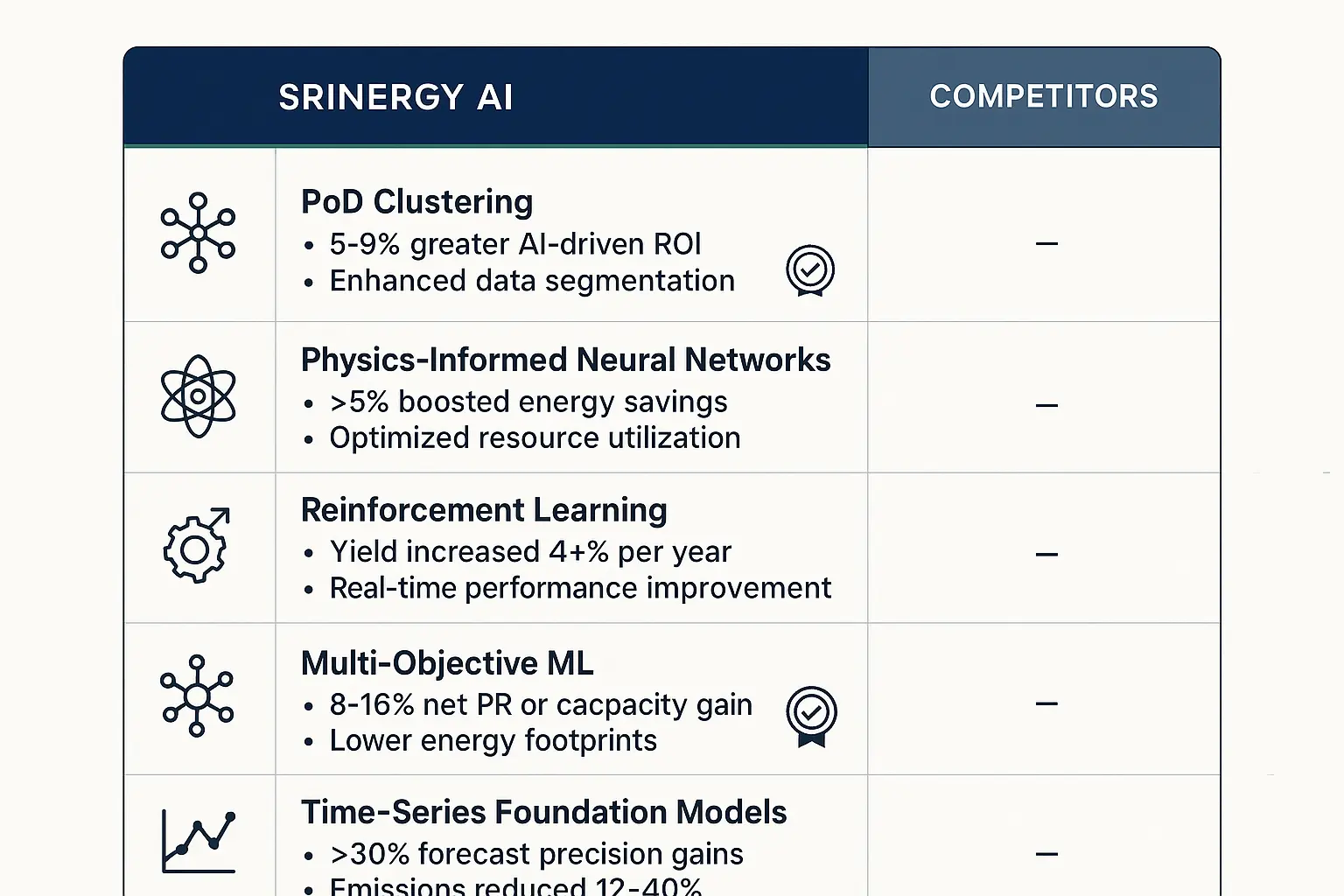
This isn’t just a philosophical stance; it’s a core design principle. By focusing on advanced, efficient models, we help you avoid the trap of solving one emissions problem while creating another.
The Strategic Playbook: Advanced AI for Precision Decarbonization
Many AI solutions for energy rely on standard machine learning models. While useful, they often lack the nuance required to solve complex, dynamic energy challenges. To truly accelerate the energy transition, you need a more specialized toolkit. This is where Srinergy AI focuses, moving beyond the basics to deploy advanced AI methodologies that deliver superior results.
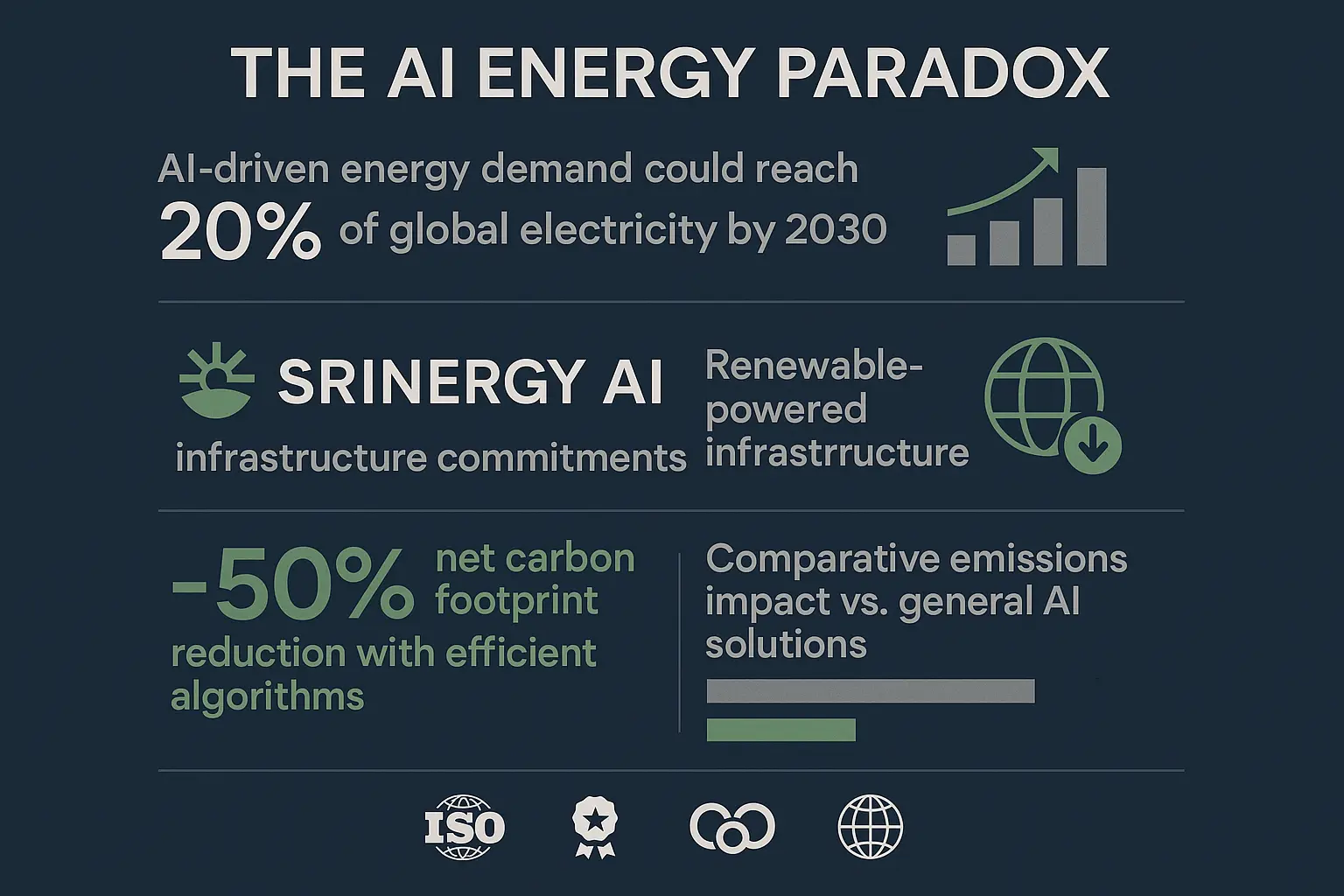
Here’s a look at the key techniques that separate a standard approach from a strategic one:
1. Beyond the Forecast: Granular Point-of-Delivery (PoD) Prediction
Standard energy forecasting provides a general overview. Srinergy AI goes deeper with granular PoD prediction, forecasting electricity needs every 15 minutes for specific delivery points. This precision is a game-changer for grid operators and utilities, enabling them to reduce discarded load curves to below 5% and cut analysis efforts by 40%, according to research from BIP Consulting. It’s the difference between knowing it might rain and knowing exactly when and where to place the buckets.
2. Solving the “Cold Start” Problem: Physics-Informed Neural Networks (PINNs)
What happens when you lack historical data for a new building or a retrofitted wind turbine? Standard AI models struggle. Srinergy AI leverages Physics-Informed Neural Networks, which integrate the laws of physics (like thermodynamics or fluid dynamics) directly into the model. This allows for highly accurate predictions even in “cold start” scenarios with limited data. Research in Buildings & Cities has shown this approach can lead to 22% chiller plant savings in complex environments like hospitals.
3. Real-Time Optimization: Reinforcement Learning (RL)
The energy grid isn’t static. Demand fluctuates, renewable generation is variable, and market prices change by the minute. Reinforcement Learning is perfectly suited for this dynamic environment. Instead of just making predictions, RL agents learn through trial and error to make optimal decisions in real-time. By deploying RL for dynamic controls in HVAC systems or industrial processes, organizations can achieve 25-30% energy savings, turning passive assets into active, intelligent participants in the grid.
4. Balancing Competing Goals: Multi-Objective Optimization
Decarbonization doesn’t happen in a vacuum. You must balance emissions reduction with cost, grid reliability, and social equity. Srinergy AI’s multi-objective models are designed to find the optimal balance between these competing priorities, providing a holistic plan for sustainable energy systems that is both effective and viable.
Srinergy AI in Action: Real-World Use Cases & Measurable Impact
Strategy is important, but results are what matter. The true test of any AI solution lies in its ability to deliver measurable improvements in real-world scenarios. Srinergy AI’s advanced methodologies are engineered to create a tangible impact on your carbon footprint and operational efficiency.
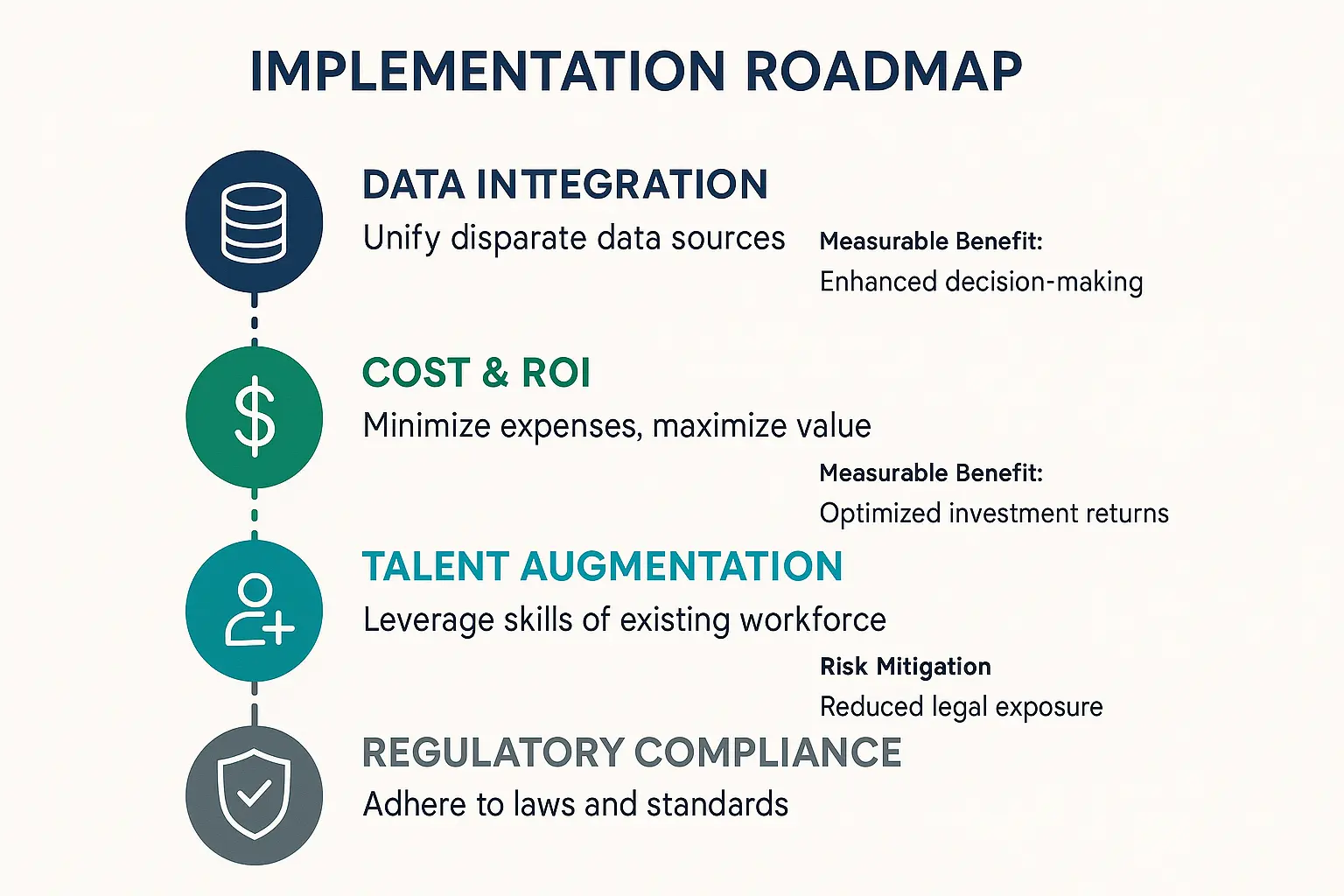
Here’s how our approach translates into practical outcomes:
- Optimizing Low-Carbon Energy Infrastructure: For a wind farm operator, our physics-informed models predict component failures with greater accuracy than traditional systems, reducing downtime and maximizing the output of clean energy. This moves beyond simple predictive maintenance to proactive asset performance management.
- Reducing Industrial Emissions: In a manufacturing facility, our reinforcement learning agents dynamically adjust energy consumption based on real-time grid carbon intensity data, shifting heavy processes to times when renewable energy is most abundant. This strategy can reduce a building’s energy use by up to 30%, as noted by the ACEEE.
- Enhancing Grid Stability with Renewables: For a utility integrating large-scale solar, our granular PoD forecasting allows for precise demand-response management, ensuring grid stability without relying on fossil-fuel peaker plants. With over 90% of new U.S. utility-scale capacity in 2024 coming from renewables, this capability is no longer a luxury—it’s a necessity.
Overcoming Hurdles: Your Practical Path to Implementation
Adopting advanced AI can feel daunting. Decision-makers often face challenges with data quality, integration complexity, and demonstrating a clear return on investment. A true partner doesn’t just provide an algorithm; they provide a clear path to success.
Our AI implementation roadmap is designed to de-risk your investment and accelerate time-to-value by systematically addressing the most common hurdles.
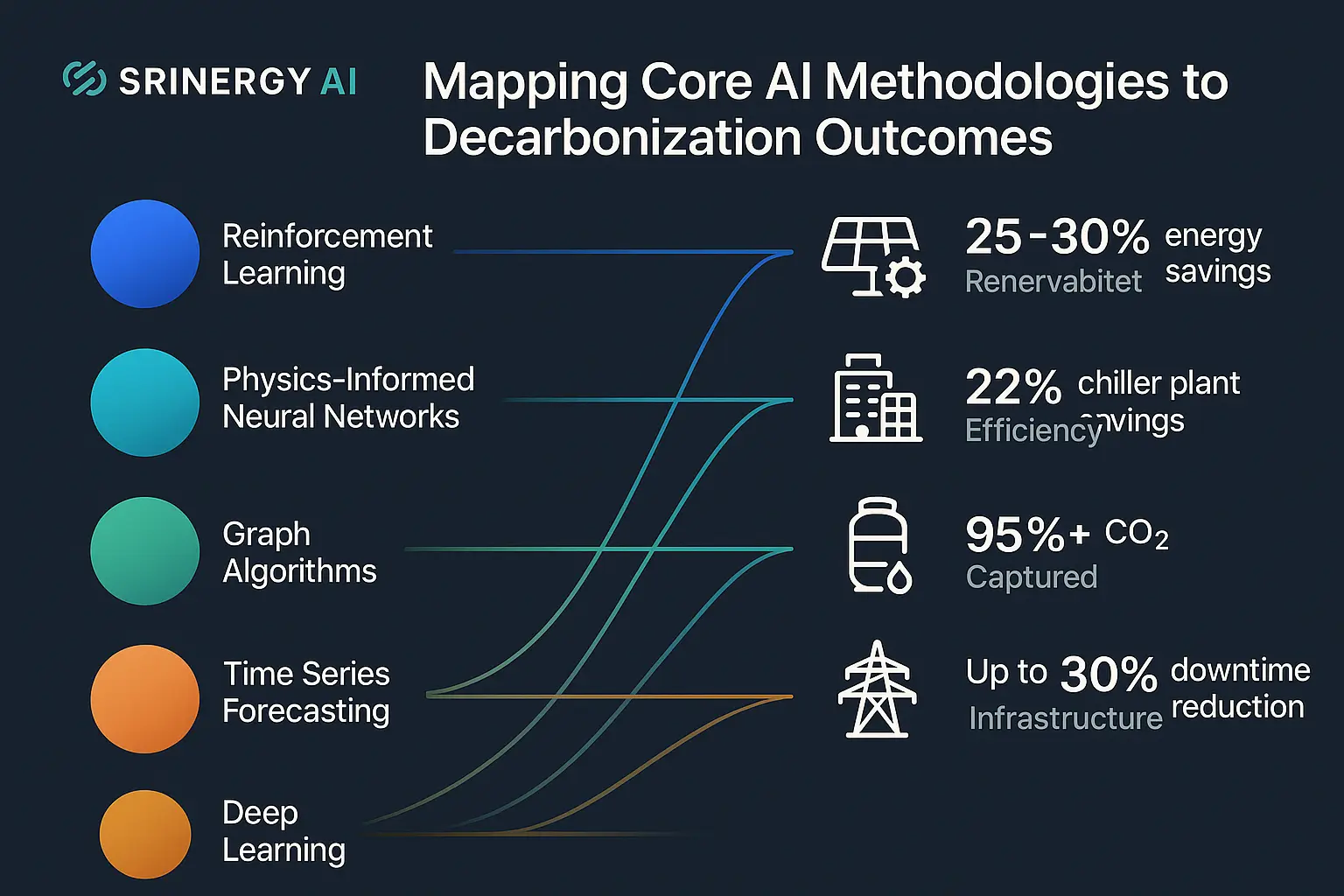
- Data Readiness: We start with a data maturity assessment, using AI-powered tools to identify gaps and unify fragmented data sources, ensuring a solid foundation for our models.
- Seamless Integration: Our solutions are built on flexible architecture designed to integrate with your existing SCADA, ERP, and building management systems, augmenting your current infrastructure rather than replacing it.
- Transparent ROI: We work with you to build a robust business case, modeling the projected energy savings, operational efficiencies, and carbon credit opportunities to provide a clear financial justification for your investment.
- Empowering Your Team: We don’t just hand over a black box. Our platform is designed to augment your internal experts, providing intuitive dashboards and actionable insights that empower them to make smarter, data-driven decisions.
Frequently Asked Questions
1. Is our existing data good enough for advanced AI?This is a common and valid concern. Our process begins with a data discovery phase where we use automated tools to assess quality and completeness. Our models, particularly Physics-Informed Neural Networks, are specifically designed to perform well even with imperfect or incomplete datasets, a significant advantage over standard AI approaches.
2. How do you calculate the “net-positive” impact?We use a transparent methodology. We calculate the carbon footprint of our model’s training and operational energy consumption (factoring in the use of renewable-powered data centers) and weigh it against the emissions reductions our solution generates for your operations. This includes direct energy savings, optimized renewable energy usage, and avoided emissions from fossil fuels. We provide a clear report on this net impact.
3. How does Srinergy AI integrate with our legacy control systems?Our platform is designed for interoperability. We use secure APIs and industry-standard protocols to connect with a wide range of operational technology (OT) and information technology (IT) systems. The goal is to provide an intelligence layer that enhances your existing infrastructure without requiring a costly and disruptive “rip-and-replace” project.
4. What is the typical timeline and ROI for a project?While this varies by scope, pilot projects are often launched within 3-6 months. We focus on identifying “quick wins” that can demonstrate value early. ROI is typically realized within 12-24 months, driven by direct energy cost savings, reduced maintenance expenses, and improved operational uptime.
Take the Next Step Toward a Smarter, Greener Future
The energy transition requires more than good intentions; it requires intelligent action. By moving beyond generic AI and embracing specialized, advanced methodologies, you can solve the AI energy paradox and turn your decarbonization strategy into a measurable reality.
If you’re ready to see how precision AI can accelerate your journey to net-zero, let’s talk. Schedule a complimentary strategy session with one of our decarbonization experts today. We’ll help you map out a practical, data-driven roadmap to achieve your sustainability goals.
