
Meeting aggressive net-zero targets is no longer a distant goal for commercial property owners and facility managers—it’s an urgent operational imperative. You’ve likely moved past the ‘why’ and are now grappling with the complex ‘how.’ How do you transform intermittent renewable sources like solar and wind into a reliable, 24/7 power solution? How do you select and deploy energy storage that doesn’t just store power, but actively generates value?
The standard approach of simply installing solar panels and batteries is failing to deliver. It creates isolated assets rather than an intelligent, unified energy ecosystem. This guide is for leaders like you who are evaluating the next step: a strategic framework that uses Artificial Intelligence to master the intricate dance between on-site generation, energy storage, and the grid. We’ll move beyond high-level benefits and provide the detailed evaluation criteria you need to make a confident, future-proof investment in your property’s energy infrastructure.
The Net-Zero Challenge: Turning Intermittency into an Asset
The commercial sector is at a crossroads. Escalating energy costs, stringent regulatory mandates like city-wide benchmarking with penalties up to $100 per day, and mounting pressure from stakeholders demand decisive action. The market is responding, with investments in net-zero energy buildings projected to surge from $52.64 billion in 2026 to over $103 billion by 2030.
But this transition comes with a fundamental challenge: intermittency. Solar panels only generate power when the sun shines, and wind turbines only when the wind blows. For a commercial property with constant, critical loads, this variability is a significant operational risk. This is where most net-zero strategies fall short. They fail to bridge the gap between variable supply and constant demand, leaving cost savings and carbon reductions on the table.
The solution isn’t just more hardware; it’s superior intelligence. By integrating on-site renewables with a Battery Energy Storage System (BESS) managed by a predictive AI core, you can transform intermittency from a liability into a strategic asset.
Deep Dive: AI’s Role in Optimizing Renewable Energy Integration
An AI-driven Energy Management System (EMS) acts as the brain of your building’s energy ecosystem. It goes far beyond the simple automation of legacy Building Management Systems (BMS). Instead, it uses sophisticated algorithms to forecast, optimize, and dispatch energy in real-time, ensuring every kilowatt is used to its maximum potential.
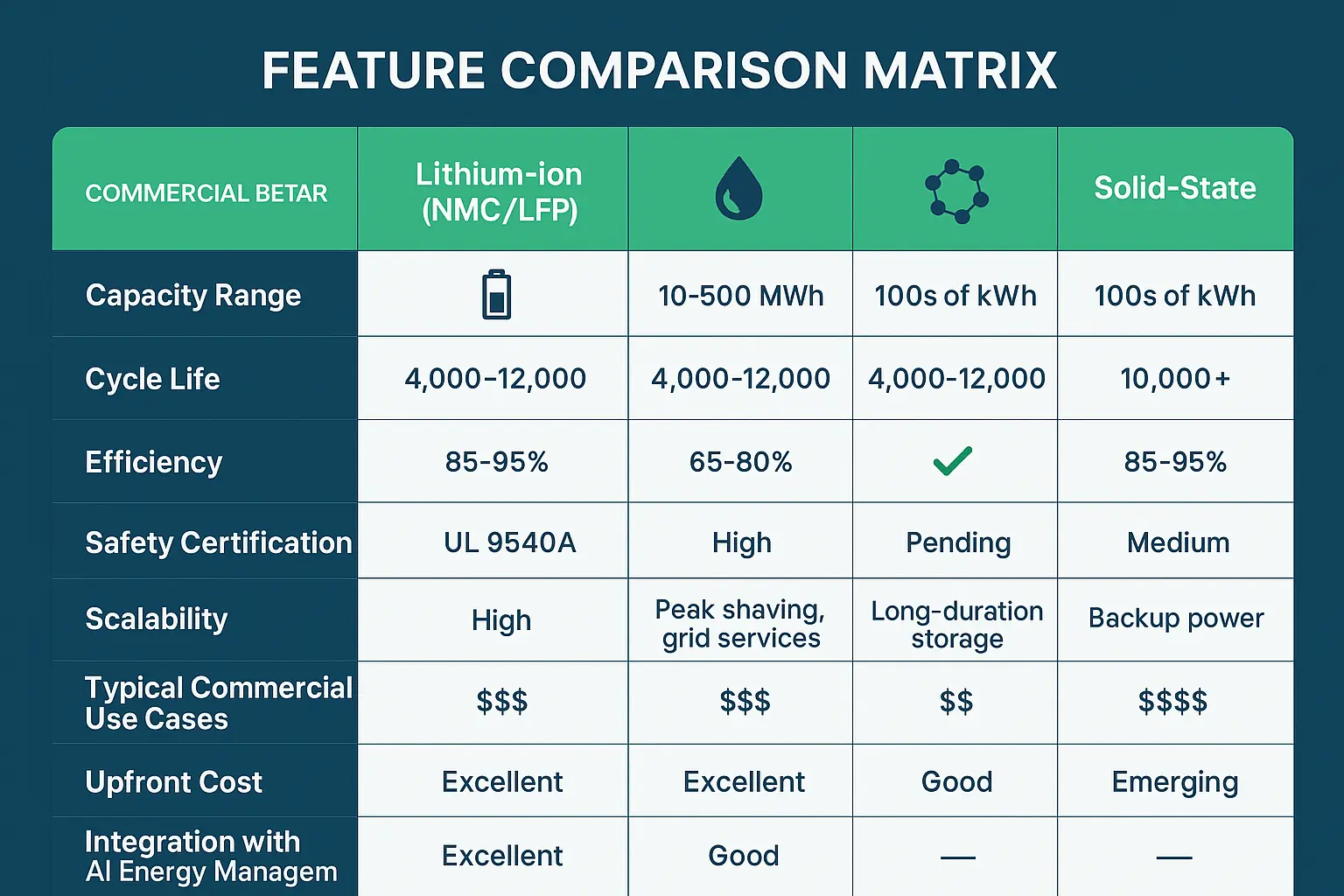
Predictive Forecasting with 95% Accuracy
Your building’s energy needs aren’t random. They follow patterns based on occupancy, time of day, weather, and operational schedules. AI models analyze these historical data streams alongside external inputs like weather forecasts to predict both your energy consumption and your renewable generation with up to 95% accuracy. This foresight is critical for making intelligent decisions before they need to happen.
Dynamic Energy Dispatch and Load Balancing
With accurate forecasts in hand, the AI can orchestrate your energy assets. Using reinforcement learning models, it continuously answers critical questions:
- Is it more cost-effective to use solar power now, charge the battery, or export to the grid?
- Can we pre-cool the building using low-cost renewable energy before a predicted afternoon peak?
- Based on forecasted cloud cover, should the battery reserve more power to cover the dip in solar generation?
This dynamic dispatch ensures you’re always using the most economical and sustainable energy source available, a core component of [AI for commercial solar PV optimization].
Maximizing Self-Consumption and Demand Charge Reduction
For most commercial properties, demand charges—fees based on your highest peak electricity usage—can constitute 30-70% of your bill. AI directly targets these charges through two key strategies:
- Peak Shaving: When the AI predicts a surge in demand that would set a new peak, it automatically dispatches energy from your BESS to keep usage below the peak threshold.
- Load Shifting: The system intelligently shifts non-essential energy use (like EV charging or running certain HVAC cycles) to periods when renewable energy is abundant or grid prices are lowest.
These strategies alone can lead to energy cost reductions of 20-40%, delivering a powerful and immediate return on investment.
Strategic BESS Selection & Deployment for Commercial Targets
Choosing the right Battery Energy Storage System (BESS) is one of the most critical decisions in your net-zero journey. The optimal choice depends not just on capacity, but on chemistry, safety, scalability, and how it integrates with an AI management platform. A disconnected battery is a passive asset; an AI-integrated battery is an active revenue and resilience engine.
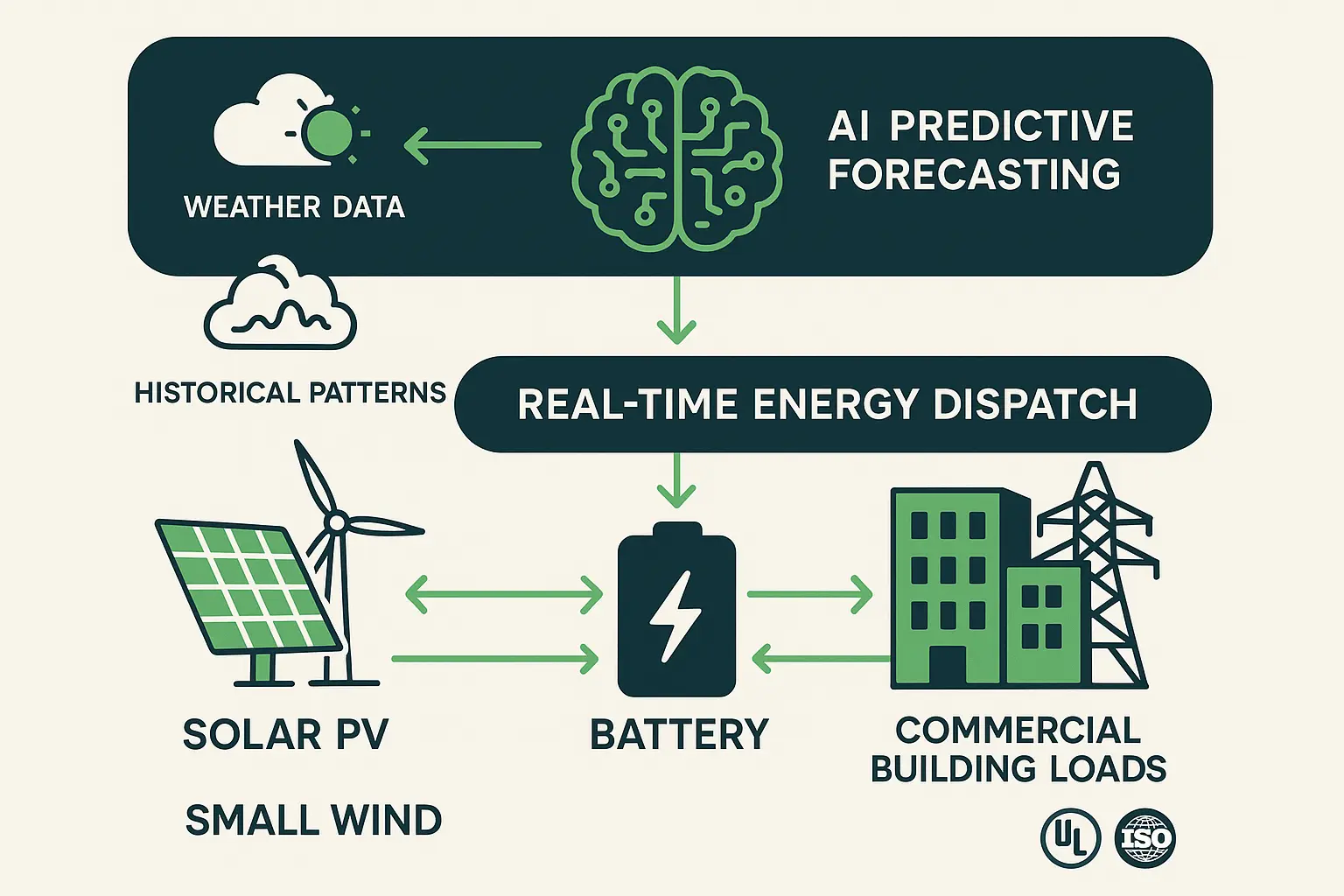
Key Evaluation Criteria for Commercial BESS
When [selecting and deploying commercial battery energy storage systems], move beyond simple datasheets. Consider these factors through the lens of long-term value:
- Battery Chemistry:
- Lithium Iron Phosphate (LFP): The dominant choice for commercial applications due to its high safety profile, long cycle life, and thermal stability. It’s ideal for daily cycling applications like peak shaving and self-consumption.
- Nickel Manganese Cobalt (NMC): Offers higher energy density (more power in less space) but has a more volatile thermal profile, requiring more robust safety and thermal management systems.
- Flow Batteries: An emerging option excellent for long-duration storage (6+ hours). They offer a very long lifespan with no degradation but have a larger footprint and lower round-trip efficiency than lithium-ion options.
- Safety and Certification: This is non-negotiable. Look for systems compliant with rigorous standards like UL 9540 (Standard for Energy Storage Systems and Equipment). This certification validates that the battery, inverter, and control systems have been tested to work together safely.
- Round-Trip Efficiency: How much energy you get back for every unit you put in. Look for efficiencies of 85% or higher. A few percentage points can translate into significant savings over the system’s 10-15 year lifespan.
- Scalability: Your energy needs will change. Choose a modular BESS that allows you to add capacity over time without needing to replace the entire system.
Microgrids for Net-Zero Commercial Campuses: An AI-Enhanced Approach
For large commercial campuses, data centers, or industrial facilities, achieving true energy resilience and independence requires a microgrid. A microgrid is a self-contained energy system that can connect to and disconnect from the main utility grid, an ability known as “islanding.”
While traditional microgrids provide backup power, an AI-enhanced microgrid delivers so much more. The AI acts as the central controller, managing all distributed energy resources (solar, storage, generators) to ensure seamless operation whether grid-connected or islanded. This intelligent control is essential for [optimizing microgrids for commercial campuses] by:
- Enhancing Resilience: In the event of a grid outage, the AI can autonomously island the campus in milliseconds, ensuring uninterrupted power for critical operations.
- Optimizing Economics: The AI continuously optimizes the microgrid’s interaction with the utility, participating in demand response programs and selling ancillary services back to the grid to create new revenue streams.
- Ensuring Power Quality: For sensitive operations like data centers or manufacturing, the AI maintains stable voltage and frequency, protecting equipment and preventing costly downtime.
Implementation Roadmap: From Strategy to Net-Zero Operation
Deploying an integrated energy solution is a significant undertaking, but it can be managed through a clear, phased approach. This ensures all technical, financial, and operational stakeholders are aligned at every step.
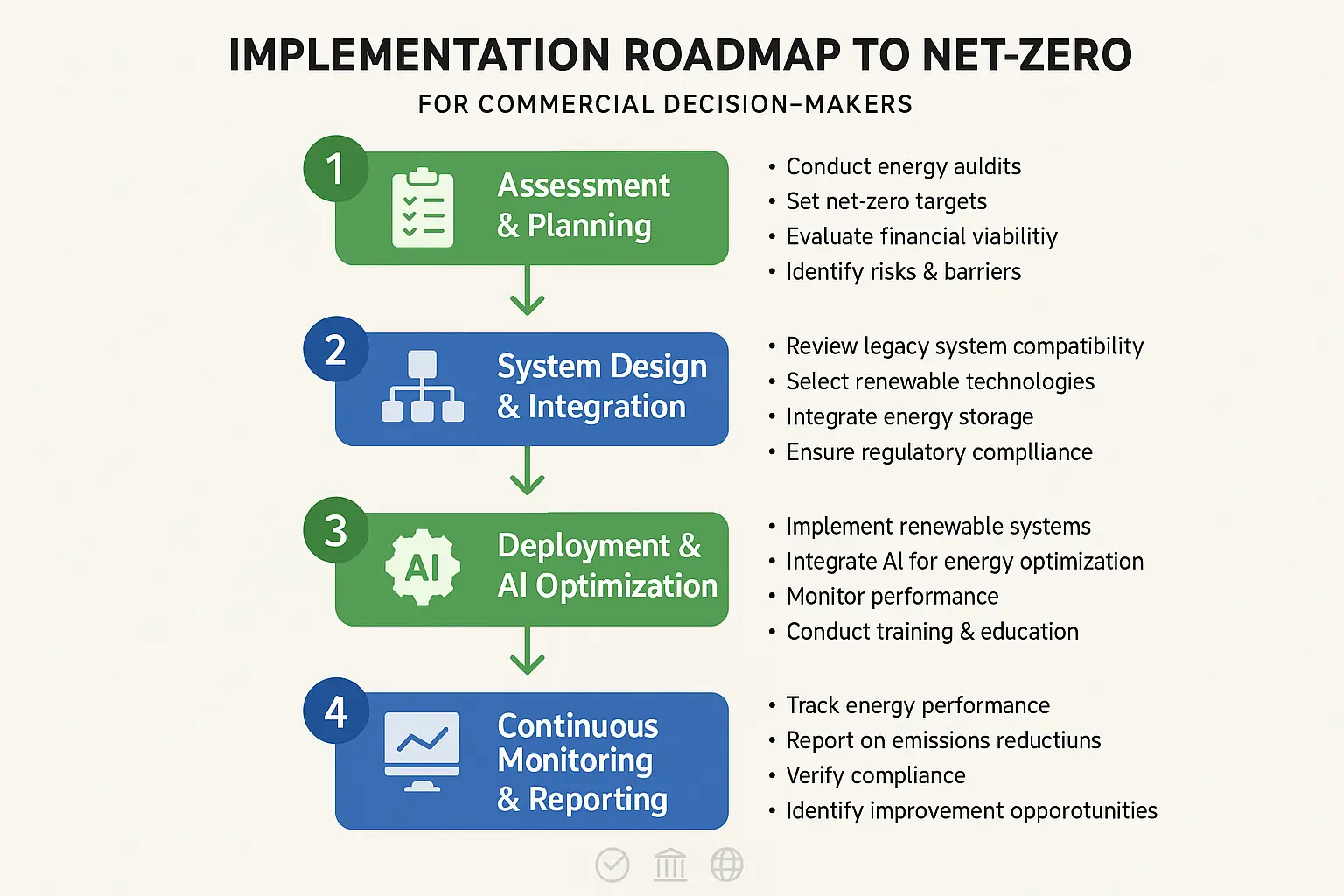
Phase 1: Assessment & Planning
- Energy Audit & Goal Definition: Conduct a comprehensive analysis of your current energy usage, define clear net-zero timelines, and set key performance indicators (KPIs).
- Feasibility Study: Model the technical and financial viability of different combinations of solar, wind, and BESS capacities.
- Stakeholder Alignment: Secure buy-in from finance, operations, and leadership by presenting a clear business case focused on ROI and risk reduction.
Phase 2: System Design & Integration
- Technology Selection: Choose the right AI platform, BESS, and renewable generation components based on the criteria established in your feasibility study.
- Integration with Legacy Systems: This is a critical step. Develop a clear plan for how the new AI-driven EMS will interface with your existing Building Management System (BMS). A modern, API-first platform is essential for seamless data exchange.
- Engineering & Permitting: Finalize system designs, navigating utility interconnection agreements and local building codes.
Phase 3: Deployment & Continuous Optimization
- Installation & Commissioning: Physical installation of hardware followed by rigorous testing to ensure all components communicate and function as a single, cohesive system.
- AI Model Training: The AI platform begins learning the unique energy patterns of your building, continuously refining its predictive models over the first 30-90 days.
- Monitoring & Reporting: Track performance against your KPIs with transparent dashboards that show energy savings, carbon reduction, and system health in real-time.
Quantifying the Impact: ROI & Decarbonization Benefits
An investment in an AI-driven renewable energy ecosystem is not an expense; it is a value-generating asset with a multi-faceted return. Over 80% of early adopters in commercial real estate are already using AI for energy optimization and predictive maintenance because the business case is undeniable.
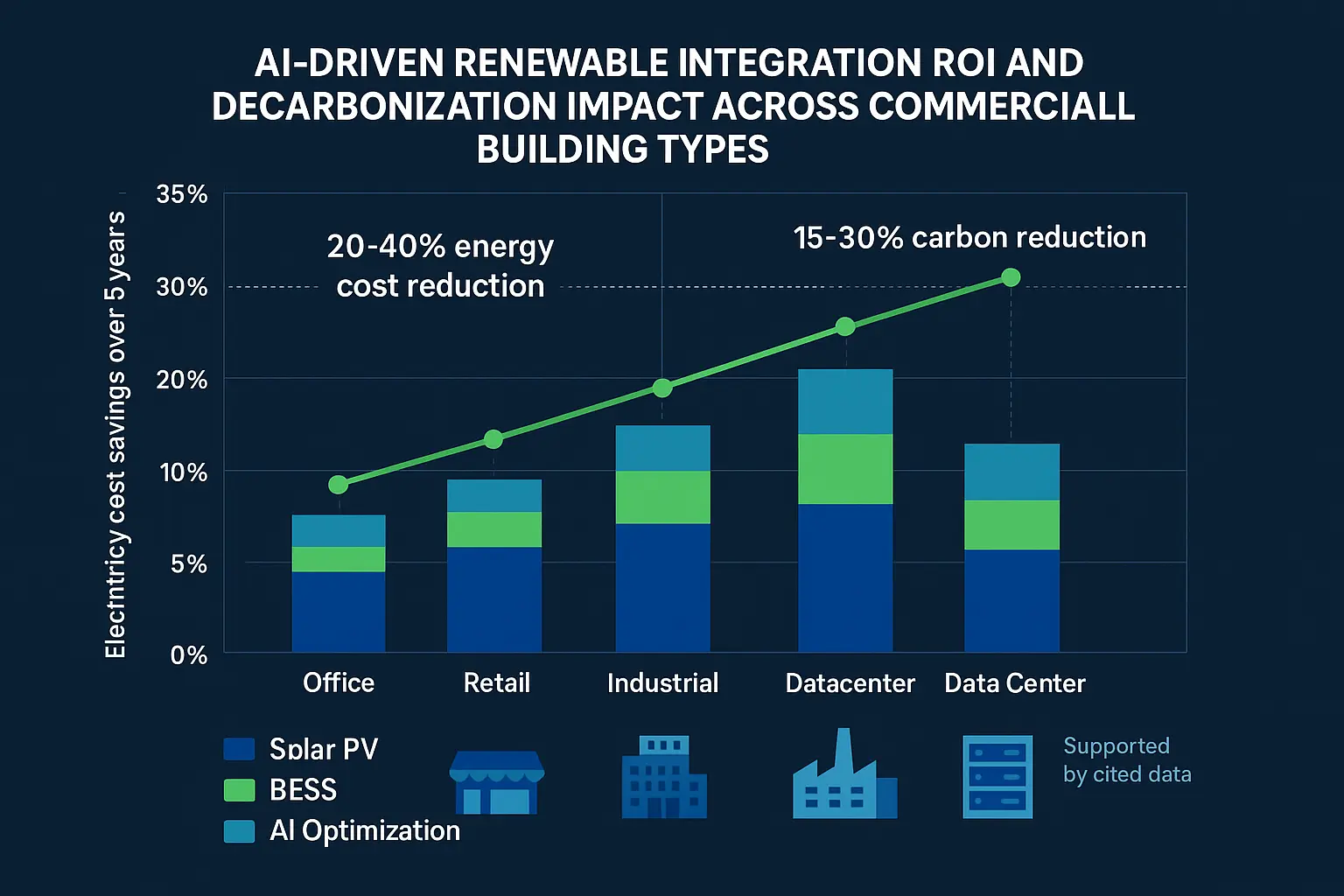
- Financial ROI:
- Energy Cost Reduction (20-40%): Achieved through demand charge management, time-of-use optimization, and maximizing renewable self-consumption.
- Predictive Maintenance Savings: AI can identify potential equipment failures weeks in advance, avoiding costly emergency repairs and downtime.
- Increased Asset Value: Net-zero-ready buildings attract premium tenants, command higher rents, and are increasingly valued by institutional investors.
- Decarbonization & ESG:
- Carbon Emission Reduction (15-30%): Directly reduce your property’s carbon footprint, providing verifiable data for sustainability reports and compliance.
- Enhanced Brand Reputation: Demonstrate clear leadership on climate action, strengthening your brand with customers, employees, and the community.
Frequently Asked Questions (FAQ)
Q: Isn’t integrating AI with our legacy BMS too complex and expensive?
A: This is a common concern. The key is to choose an AI platform designed with open APIs for flexible integration. Instead of a costly “rip and replace” approach, the AI system can act as an intelligent overlay, pulling data from your existing BMS and pushing back optimized control commands. The integration cost is often marginal compared to the long-term energy savings.
Q: How can we trust the safety of large-scale battery storage systems?
A: Safety is paramount. The most effective way to mitigate risk is to exclusively specify BESS units that have received third-party certification to rigorous safety standards like UL 9540. This ensures the entire system—not just individual components—has been tested for thermal runaway prevention, fire suppression, and electrical safety.
Q: What kind of data security measures are in place for AI energy management?
A: A robust AI platform uses end-to-end encryption for all data in transit and at rest. It should operate on a secure, cloud-based infrastructure and adhere to leading cybersecurity protocols. Ensure any potential partner can speak to their data governance, privacy policies, and security architecture in detail.
Q: How does this scale as our property portfolio grows?
A: Scalability is a core benefit of a software-centric approach. A cloud-based AI platform can manage a single building or a global portfolio of properties from a single interface. As you add new buildings, they can be onboarded to the platform, allowing you to centralize control, compare performance across sites, and implement portfolio-wide optimization strategies.
Your Partner for a Net-Zero Future
Achieving your net-zero targets requires more than just hardware; it demands an intelligent, integrated strategy. By harnessing the predictive power of AI to orchestrate your renewable generation and energy storage, you can unlock unparalleled efficiency, resilience, and financial returns. You can move from simply managing energy costs to creating a building that is an active, optimized participant in the clean energy transition.
If you’re ready to move beyond evaluation and design a concrete action plan for your commercial property, our team of energy strategists is here to help. Let’s build a smarter, more sustainable energy future together.
