
You know the landscape is shifting. Rising energy costs are squeezing margins, new regulations like NYC’s Local Law 97 are non-negotiable, and the term “AI” is everywhere. You’re past the initial “what is it?” stage and now face the critical question: How do you strategically implement an AI-powered Energy Management System (EMS) and, more importantly, prove its return on investment to your stakeholders?
You’re not looking for a sales pitch. You need a playbook—a clear, data-driven framework to evaluate solutions, plan a successful deployment, and build a bulletproof business case. This is that guide. We’ll walk you through the entire process, from calculating a precise AI-specific ROI to selecting the right technology partner, transforming a complex decision into a confident strategic move.
The Market Imperatives Driving AI EMS Adoption
The move toward intelligent building management isn’t just a trend; it’s a response to powerful market forces. Commercial properties are at the center of this transformation, with the sector projected to command nearly 59% of the EMS market by 2035. Understanding these drivers is the first step in building your business case.
- Intense Financial Pressure: With advanced systems proven to slash commercial utility spending by 25–40%, energy management has moved from a maintenance task to a core financial strategy. In a market where every dollar of operational expenditure counts, ignoring this potential is no longer an option.
- Unavoidable Regulatory Mandates: Jurisdictions are getting serious about building emissions. Mandates like NYC Local Law 97, which requires a 40% emissions cut by 2030 for buildings over 25,000 square feet, are creating urgent, compliance-driven demand for sophisticated energy solutions.
- The AI & IoT Revolution: The automation segment of the EMS market, powered by AI and IoT, is exploding with a projected 24.35% CAGR. These technologies are no longer futuristic; they are proven tools that enable predictive control, autonomous optimization, and insights that were previously impossible to uncover.
Decoding ROI: A Financial Playbook for AI-Powered EMS Projects
A generic ROI calculation won’t cut it. To secure buy-in, you need to quantify the specific advantages AI brings to the table. The traditional formula is a good start, but the real power is in the details of the “Net Savings” component.
Core ROI Formula: (Net Savings – Implementation Costs) / Implementation Costs × 100%
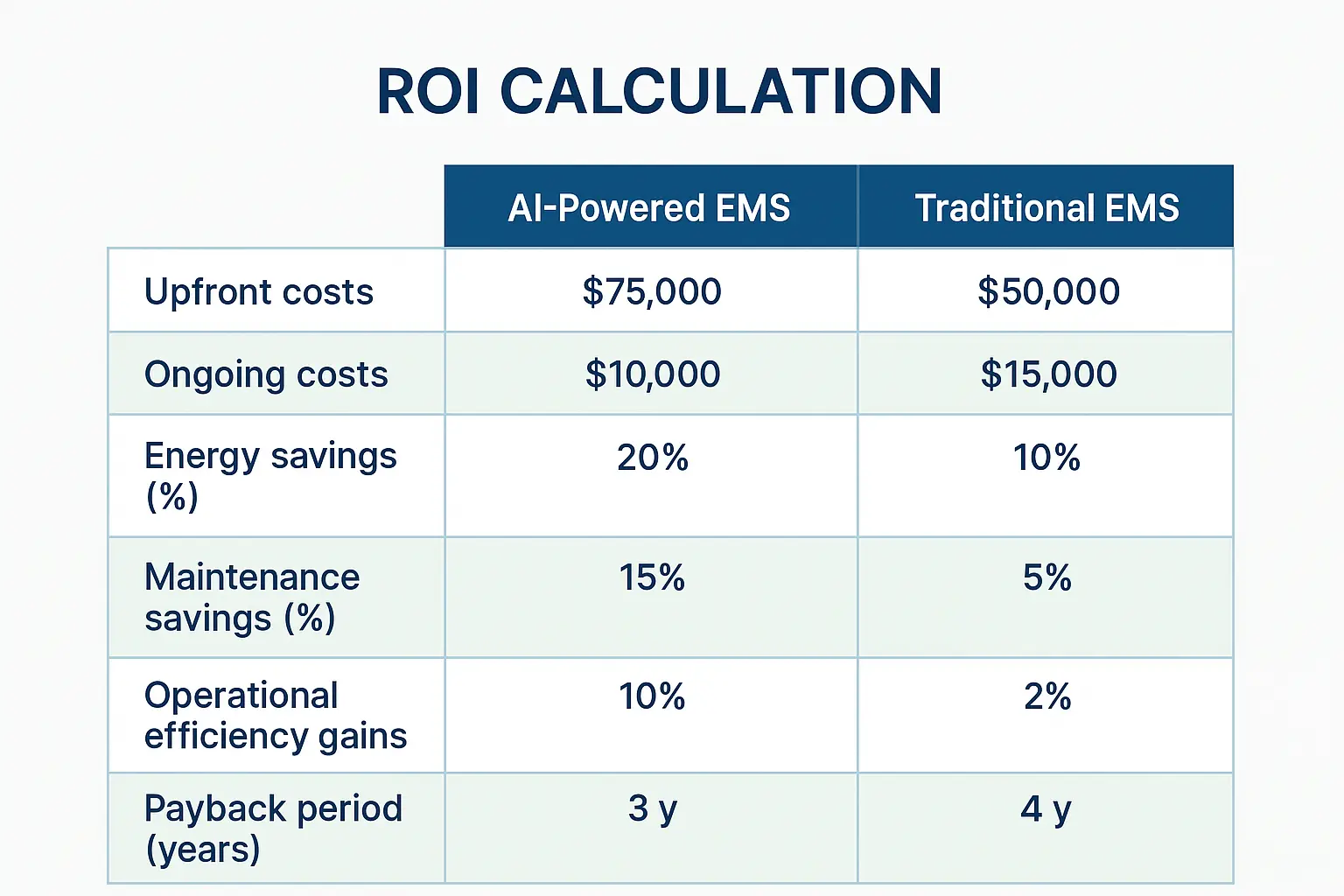
Comparing ROI metrics side-by-side lets commercial property decision-makers quickly discern the financial advantages of AI-powered energy management systems over traditional alternatives.
Cost Breakdown
- Initial Investment: This includes software licensing, sensor hardware, professional integration with your existing Building Management System (BMS), and initial team training.
- Ongoing Costs: Factor in software-as-a-service (SaaS) subscription fees, data plans, and any ongoing support or maintenance contracts.
Quantifying AI-Specific Savings
This is where your business case becomes compelling. An AI-powered EMS goes far beyond simple scheduling. For a deeper dive, explore our detailed guide to calculating ROI for AI EMS projects.
- Dynamic Energy Optimization: Unlike static systems, AI continuously analyzes live data (occupancy, weather, utility rates) to make real-time adjustments. This leads to energy cost reductions of 10-40%, with AI-powered HVAC optimization alone capable of cutting energy costs by 20%.
- Predictive Maintenance Savings: This is a game-changer. AI algorithms detect subtle anomalies in equipment performance, predicting failures before they happen. The result is a staggering 40% reduction in maintenance costs and up to 90% fewer unexpected equipment failures, preventing costly emergency repairs and operational downtime.
- Operational Efficiency: AI automates complex tasks like demand-response events and peak load shedding, freeing up facility management teams for higher-value work. This also leads to an 80% reduction in setpoint deviations and a 90% drop in tenant comfort complaints, improving both staff productivity and occupant experience.
Beyond direct savings, AI EMS significantly boosts your property’s Net Operating Income (NOI)—often by €5-15 per square meter—and enhances its overall asset value. With typical payback periods between one to three years, the investment quickly translates to bottom-line performance.
Strategic Implementation Roadmap: From Planning to Performance
A successful deployment isn’t just about technology; it’s about process and people. A phased approach ensures you mitigate risks, align stakeholders, and achieve the results you’ve projected.
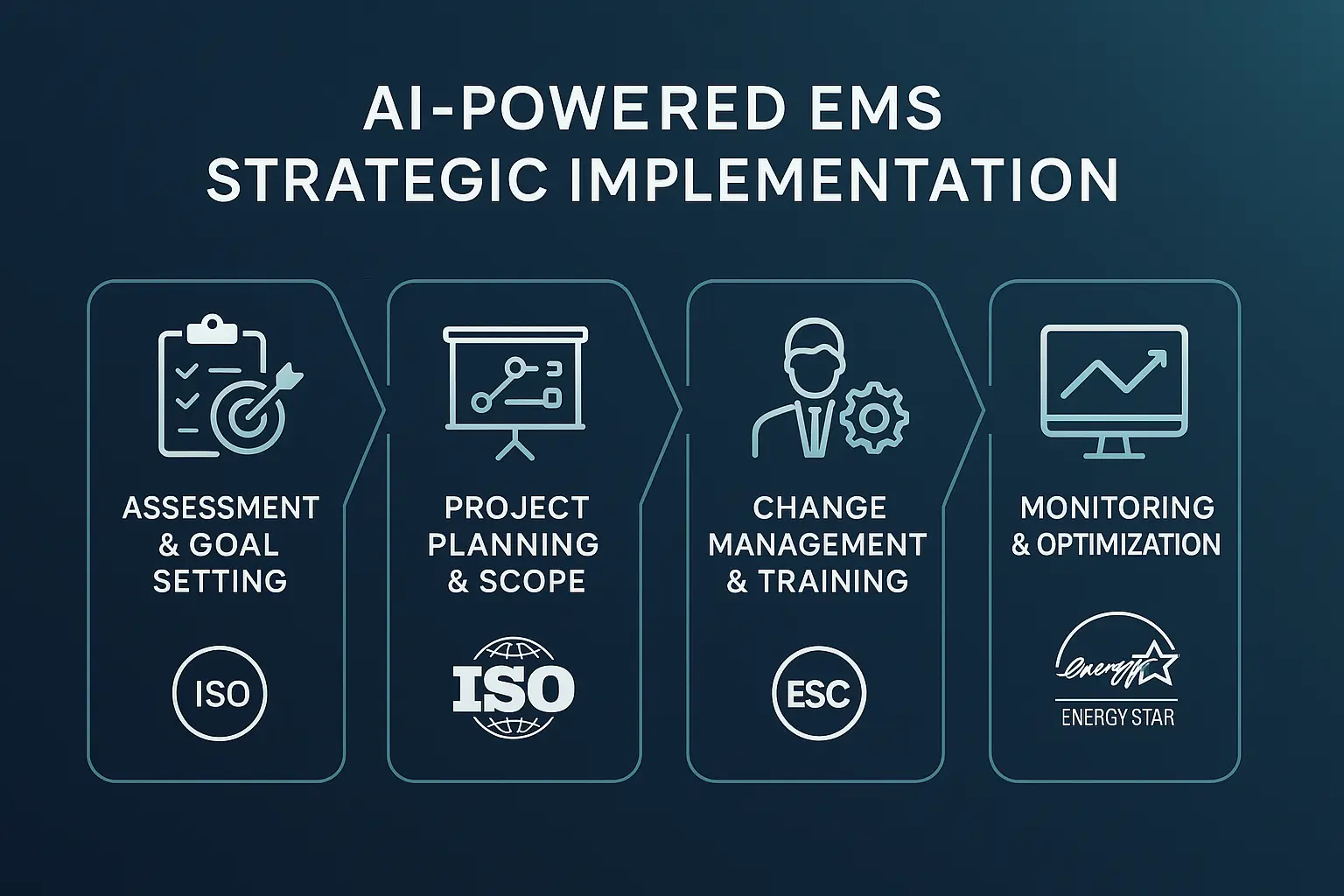
A clear strategic roadmap builds trust by demonstrating a proven, expert process for successful AI EMS deployment and continuous value realization.
Phase 1: Assessment & Goal Setting
Before you look at any vendor, look at your own portfolio. Conduct thorough energy audits to establish a clear baseline. Define what success looks like. Is it a 20% reduction in energy spend? Compliance with a specific law? Reduced maintenance tickets? Your goals will dictate your entire strategy.
Phase 2: Project Planning & Scope
Map out the technical requirements. How will the new system integrate with your existing BMS? What data points are needed? Define the scope for a pilot project or a full portfolio rollout. A detailed plan prevents scope creep and budget overruns.
Phase 3: Change Management & Training
Technology is only as good as the people who use it. This is the most overlooked—and most critical—phase. Develop a plan to train your facility teams, not just on how to use the software, but on how to trust and interpret its AI-driven recommendations. Overcoming resistance to change is key to unlocking the system’s full potential.
Phase 4: Monitoring, Verification & Optimization
The work isn’t done at “go-live.” Use the system’s AI capabilities to continuously monitor performance against your baseline. Generate regular reports for stakeholders to demonstrate the realized ROI. The system’s machine learning algorithms will continue to learn and find new efficiencies over time, making optimization an ongoing process.
Navigating the Landscape: Best Practices for AI-Powered EMS Vendor Selection
Choosing the right partner is paramount. The market is crowded, and many providers make similar claims. Your job is to cut through the noise and evaluate vendors on the criteria that truly matter for an AI-powered system. For a comprehensive tool, review our complete checklist for vendor selection.
First, a quick clarification: when searching, be sure to specify “Energy Management System.” The acronym “EMS” is often used for “Electronics Manufacturing Services,” leading to irrelevant results.
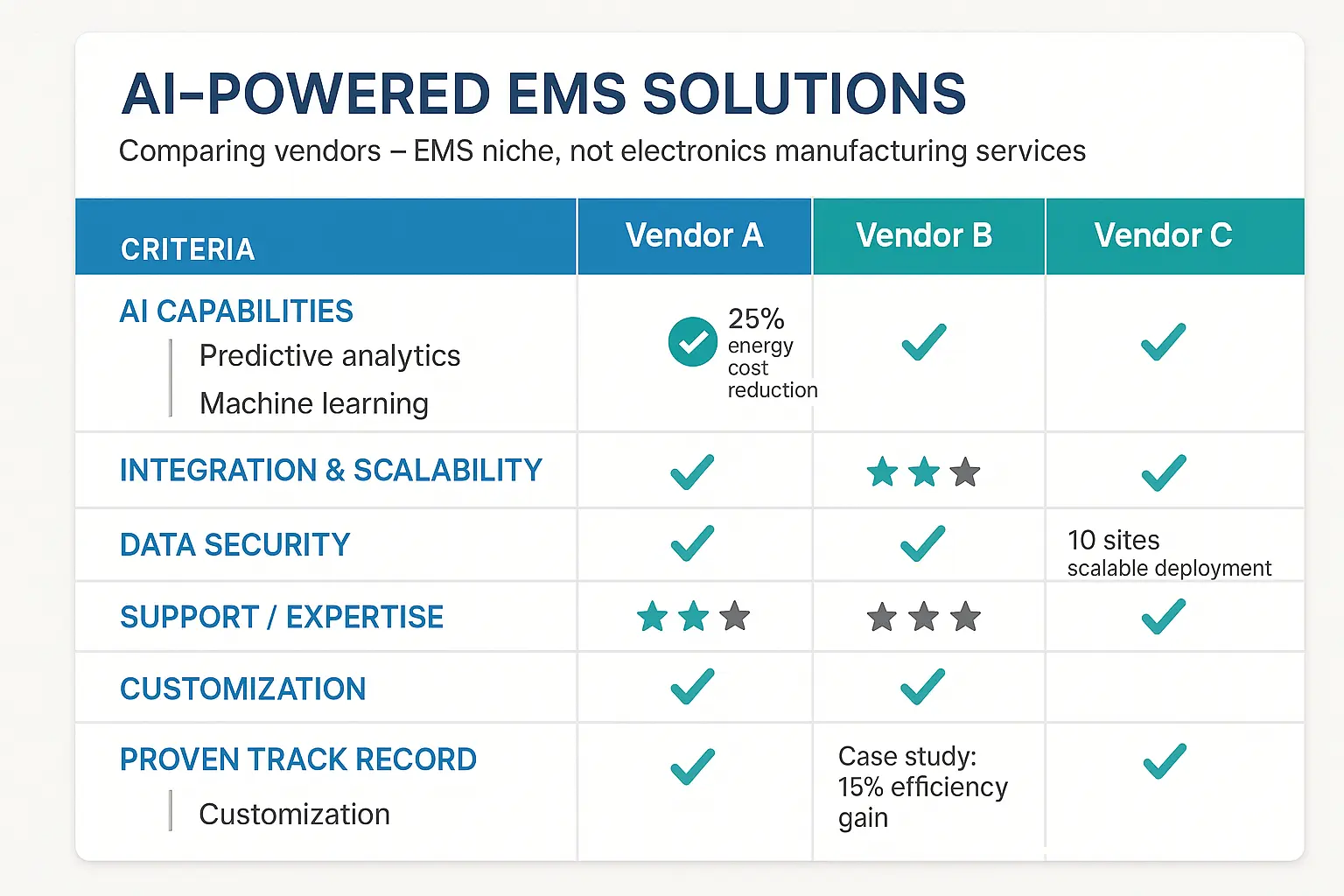
This side-by-side vendor comparison equips commercial real estate decision-makers to objectively evaluate AI EMS providers based on key AI-specific features and business needs.
Key AI-Centric Evaluation Criteria
- AI Capabilities: Go beyond the buzzwords. Ask how their AI works. Is it truly predictive and autonomous, or just a set of glorified rules? Can they demonstrate specific algorithms for predictive maintenance or dynamic load optimization?
- Integration & Scalability: A great AI platform is useless if it can’t talk to your existing infrastructure. Insist on a solution with open APIs and a proven track record of integrating with a wide range of BMS, utility, and IoT data sources.
- Data Security: You are trusting the vendor with sensitive operational data. Verify their data security protocols, privacy policies, and any relevant certifications (e.g., SOC 2).
- Support & Expertise: You’re not just buying software; you’re buying a partnership. Does the vendor’s team include data scientists and energy engineers who can help you interpret the insights and maximize value?
- Proven Track Record: Ask for case studies specific to your property type (e.g., commercial office, retail, hospitality). A vendor should be able to provide hard data on the results they’ve achieved for clients similar to you.
Fueling Your Project: Comprehensive Financing & Incentive Strategies
Even with a strong ROI, the initial capital outlay can be a hurdle. Fortunately, a wide range of financing options and incentives exist to make these projects more accessible. Overcoming this barrier often comes down to knowing where to look and how to present your case.
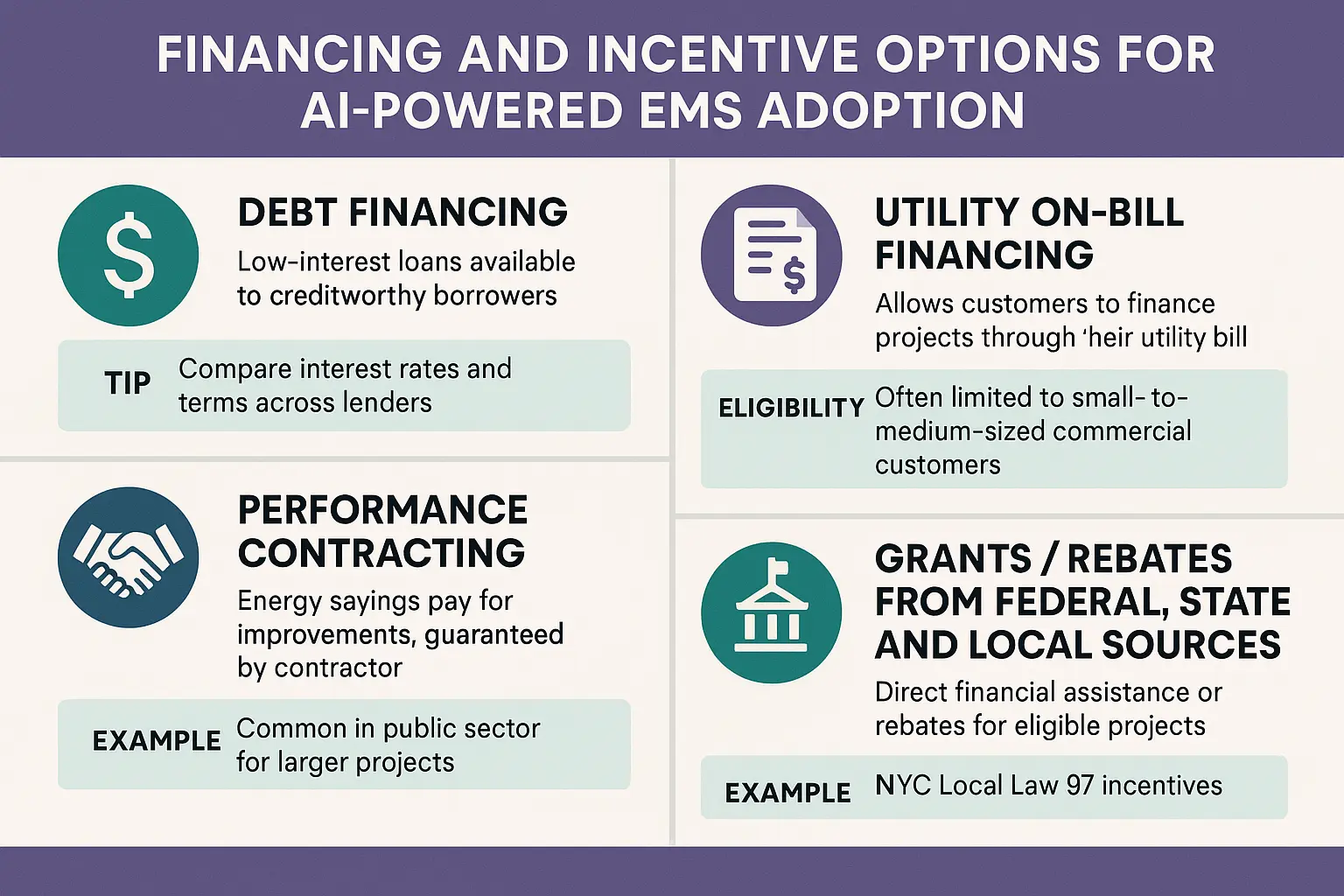
Understanding and accessing diverse funding sources empowers decision-makers to confidently finance AI EMS projects and overcome budget barriers.
- Performance Contracting (ESPCs): An Energy Service Company (ESCO) arranges financing and implements the project. The cost savings from the project are guaranteed to cover the debt payments, making it a low-risk option.
- Property Assessed Clean Energy (PACE) Loans: Available in many states, PACE financing is tied to the property, not the owner, and is paid back through an assessment on the property tax bill. This allows for long-term financing that can transfer with the sale of the building.
- Utility Rebates and On-Bill Financing: Many utility companies offer significant rebates for efficiency upgrades or allow you to finance the project through a monthly charge on your utility bill, often structured so the payment is less than the monthly savings.
- Federal & State Grants: Government agencies like the Department of Energy and state energy offices frequently offer grants and tax incentives for projects that reduce energy consumption and carbon emissions.
Exploring the full range of financing options for energy efficiency upgrades can often turn a project that seems out of reach into a financially sound and immediately beneficial investment.
Conclusion: Make Your Next Move a Strategic One
Implementing an AI-powered Energy Management System is one of the most impactful investments you can make in your commercial property portfolio. It’s a direct path to reducing operational costs, ensuring regulatory compliance, increasing asset value, and meeting ambitious ESG goals.
The key is to move beyond the hype and approach it with a clear strategy. By building a detailed, data-driven business case, following a structured implementation plan, and selecting a technology partner with proven AI expertise, you can confidently navigate the evaluation process and unlock the future of building performance.
Frequently Asked Questions
Is my building too old to benefit from an AI EMS?
Not at all. While newer buildings with modern BMS systems are easier to integrate, many AI EMS solutions are designed to overlay on top of older, less sophisticated systems. By adding a layer of smart sensors and a powerful analytics platform, you can bring intelligent, predictive control to almost any building.
How much technical expertise does my team need to operate an AI EMS?
This is a key vendor selection question. The best platforms are designed to be intuitive for facility managers, not just data scientists. They translate complex data into clear, actionable insights and automate many of the day-to-day adjustments, reducing the burden on your team.
How do we prove the savings to our CFO after implementation?
A credible AI EMS platform should have robust Measurement and Verification (M&V) capabilities. It will track performance against the pre-implementation baseline you established, adjusting for variables like weather and occupancy to isolate the savings generated directly by the system. This provides the auditable, third-party-validated reports that financial stakeholders require.
What’s the difference between a BMS and an AI EMS?
A Building Management System (BMS) is the foundational control system for your building’s hardware (HVAC, lighting, etc.). It typically operates on pre-set schedules and rules. An AI EMS is a layer of intelligence that sits on top of the BMS. It uses AI to analyze massive amounts of data and sends commands to the BMS to make smarter, more dynamic decisions that go far beyond what a static BMS can do on its own.
