
You’re facing a familiar challenge. On one hand, you have aggressive energy efficiency targets and rising operational costs. On the other, you have a building full of diverse occupants, each with their own idea of the “perfect” temperature, leading to a constant stream of hot and cold calls. For years, the conventional wisdom has been that you must choose one over the other: save energy or satisfy occupants.
What if that choice was a false one?
Modern AI-powered Energy Management Systems (EMS) are rewriting the rules of building operations. They move beyond the limitations of static schedules and zone-based controls to create environments that are simultaneously hyper-efficient and deeply personalized. This isn’t about finding a middle ground; it’s about using intelligence to elevate both sides of the equation.
For decision-makers like you, this shift presents a critical evaluation point. You need to understand not just what these systems do, but how they achieve this dual promise and what it means for your assets and the people within them. This guide provides the authoritative insights you need to move from evaluation to confident decision-making.
Redefining Comfort in the AI Era
For decades, “occupant comfort” in commercial buildings meant maintaining a single temperature setpoint across a large zone, a one-size-fits-all approach doomed to fail. True personalized comfort is far more nuanced. It’s a dynamic state influenced by temperature, humidity, air quality, light, and even individual metabolic rates.
AI-powered systems are the first technology capable of managing this complexity at scale. They shift the goal from maintaining a static temperature to achieving optimal thermal comfort for each individual. By continuously learning and adapting, leading platforms have demonstrated the ability to enhance thermal comfort by as much as 60%, a figure that translates directly into fewer complaints and a more positive occupant experience. This is achieved not by simply reacting to manual adjustments, but by proactively creating an environment where adjustments are rarely needed in the first place.
The AI-Powered EMS: How Intelligence Elevates Occupant Experience
An AI EMS acts as the intelligent brain of your building, orchestrating a symphony of systems to create an environment that is responsive, efficient, and human-centric. It goes far beyond the capabilities of a traditional Building Management System (BMS) by adding a layer of predictive and adaptive intelligence.
Personalized Climate Controls & Smart Scheduling
The core of an AI EMS is its ability to learn from vast amounts of data—historical temperature trends, weather forecasts, building occupancy patterns, and even direct occupant feedback. Instead of rigid schedules, the AI develops a predictive model of your building’s thermal behavior, understanding how long it takes to heat or cool specific zones.
This allows for incredibly precise and proactive control. The system knows to pre-cool a south-facing conference room before a 2 p.m. meeting on a sunny day, ensuring it’s comfortable right on time without wasting energy. With 84% of commercial building decision-makers planning to increase AI use for energy management and operations, this predictive capability is moving from a novelty to a necessity.
AI running on edge controllers can even optimize individual rooms or micro-zones, learning from occupant feedback to meet standards like ASHRAE 55 while minimizing energy use.
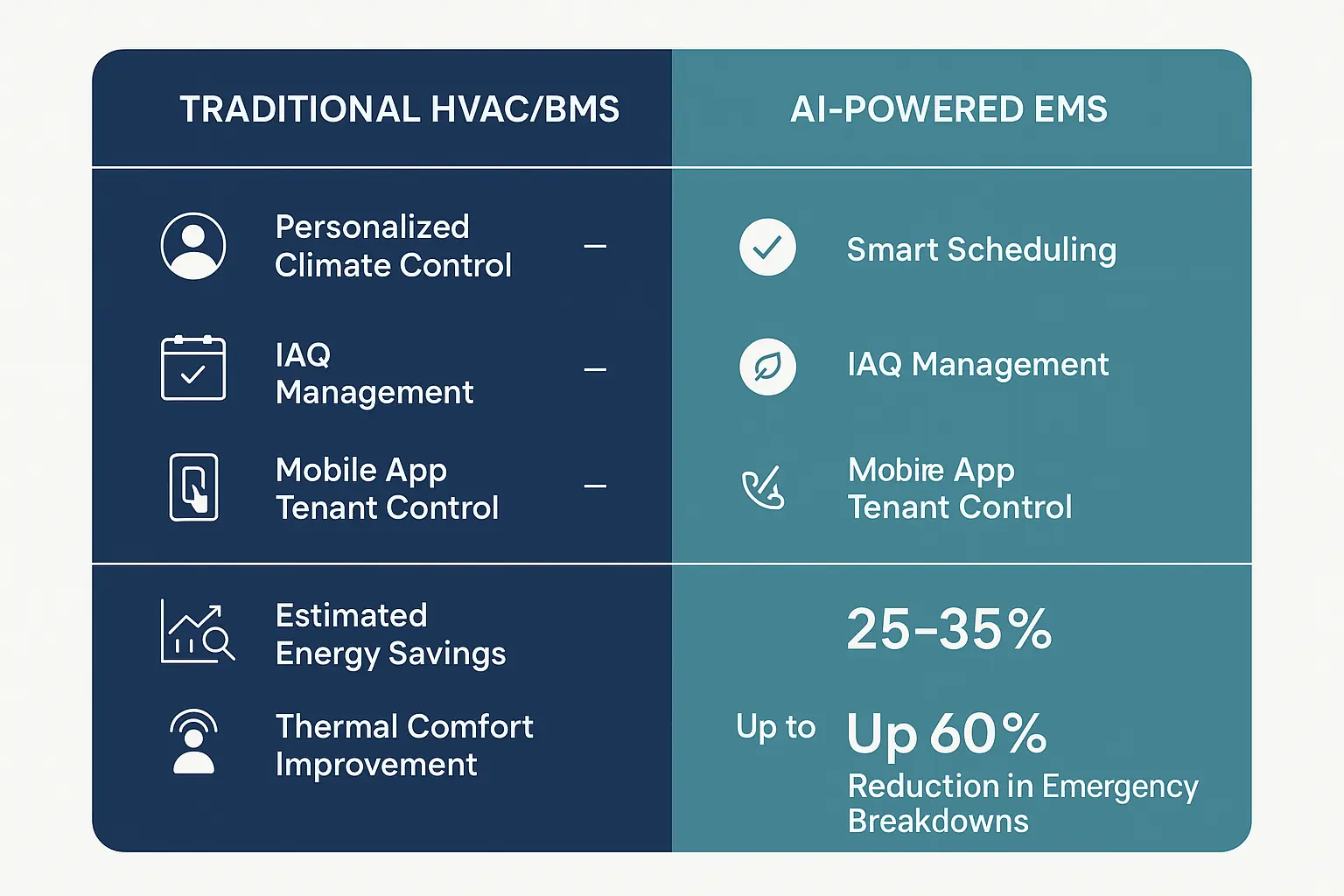 Caption: Comparison of Traditional HVAC and AI-Powered EMS Features: Clear differentiation of advanced occupant comfort capabilities and energy savings benefits aids informed decision-making.
Indoor Air Quality (IAQ) Management
Comfort isn’t just about temperature. An AI EMS continuously monitors key IAQ indicators like CO2, VOCs (Volatile Organic Compounds), and humidity. When it detects CO2 levels rising in a populated meeting room, it can intelligently increase fresh air ventilation to that specific zone, boosting cognitive function and well-being without over-ventilating the entire building. This targeted approach is a key driver behind the 25-35% energy savings achievable with AI-driven systems.
Responsive Building Environments
A truly intelligent building adapts in more ways than one. An AI EMS can integrate with lighting and automated shading systems, adjusting them based on occupancy, time of day, and natural light levels to create a consistently comfortable and productive visual environment. This holistic approach ensures all aspects of the physical space contribute to the overall occupant experience.
Mobile App Integration & Tenant Control
Empowering occupants is a cornerstone of the modern smart building. Integrating the AI EMS with a user-friendly mobile app gives tenants a direct line of communication and control. They can provide real-time feedback (“a little warmer,” “a bit cooler”), which the AI uses as a valuable data point to refine its learning models. This feedback loop not only improves individual comfort but also dramatically reduces the volume of service calls to facility managers, turning a reactive process into a proactive partnership.
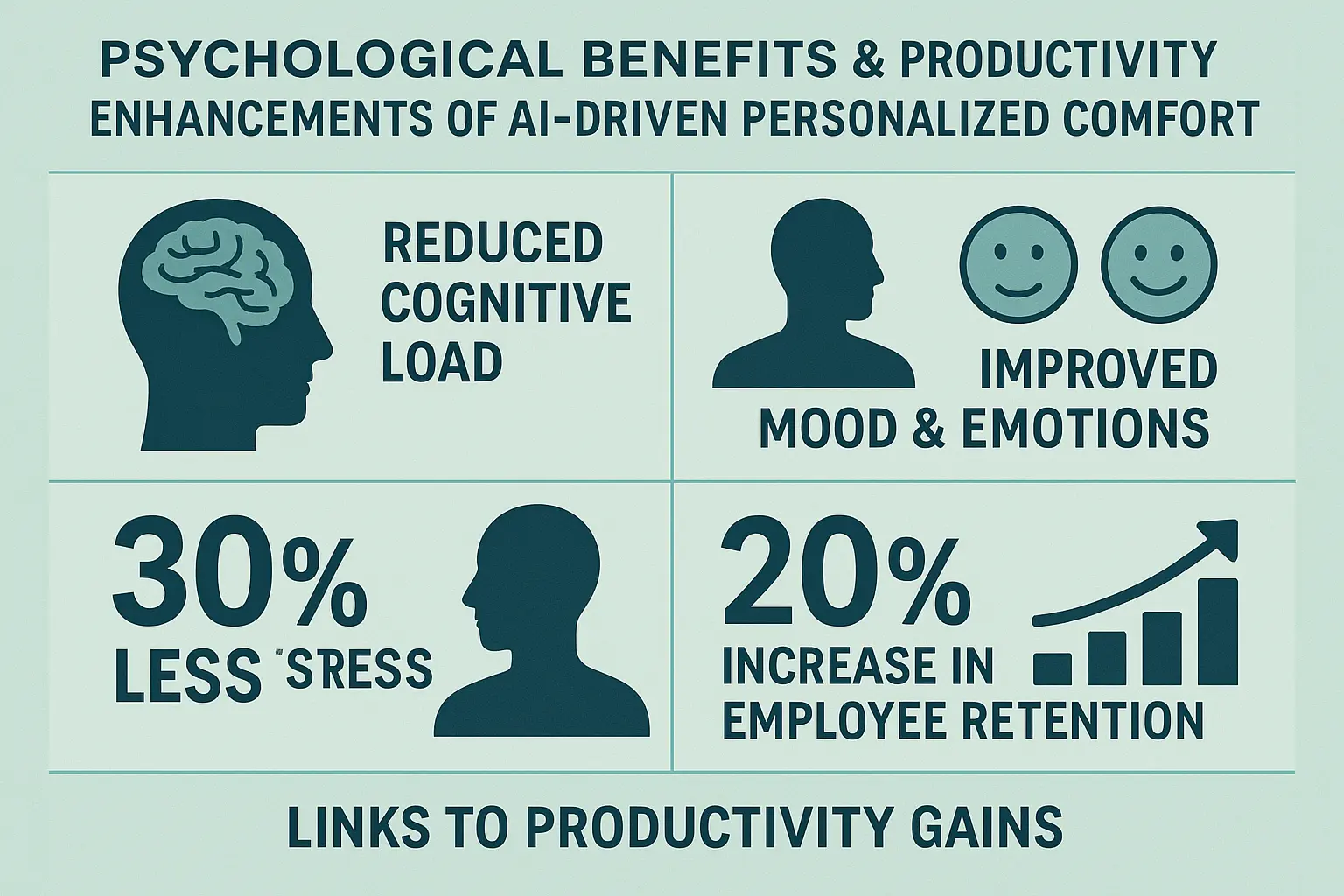 Caption: Tenant-Centric AI Interaction: Visual proof of seamless mobile app integration supports trust in technology usability and data security for personalized occupant comfort.
The Unseen Impact: Psychological and Productivity Benefits of Smart Buildings
Focusing solely on energy savings misses half the story. The most significant ROI from an AI-powered environment is often found in its impact on your most valuable asset: people. A human-centric building is a strategic investment in human capital.
When the environment is intelligently managed, occupants experience:
- Reduced Cognitive Load: They aren’t constantly distracted by being too hot or too cold, allowing for deeper focus on their work.
- A Sense of Control: The ability to provide feedback and influence their environment fosters a sense of psychological comfort and agency.
- Improved Well-being: Better air quality and thermal comfort have been directly linked to fewer sick days, higher cognitive performance, and improved mood.
These aren’t just soft benefits; they are measurable outcomes that impact tenant retention, employee productivity, and a company’s ability to attract top talent. By investing in a responsive and personalized environment, you are creating a workplace that actively supports the people within it.
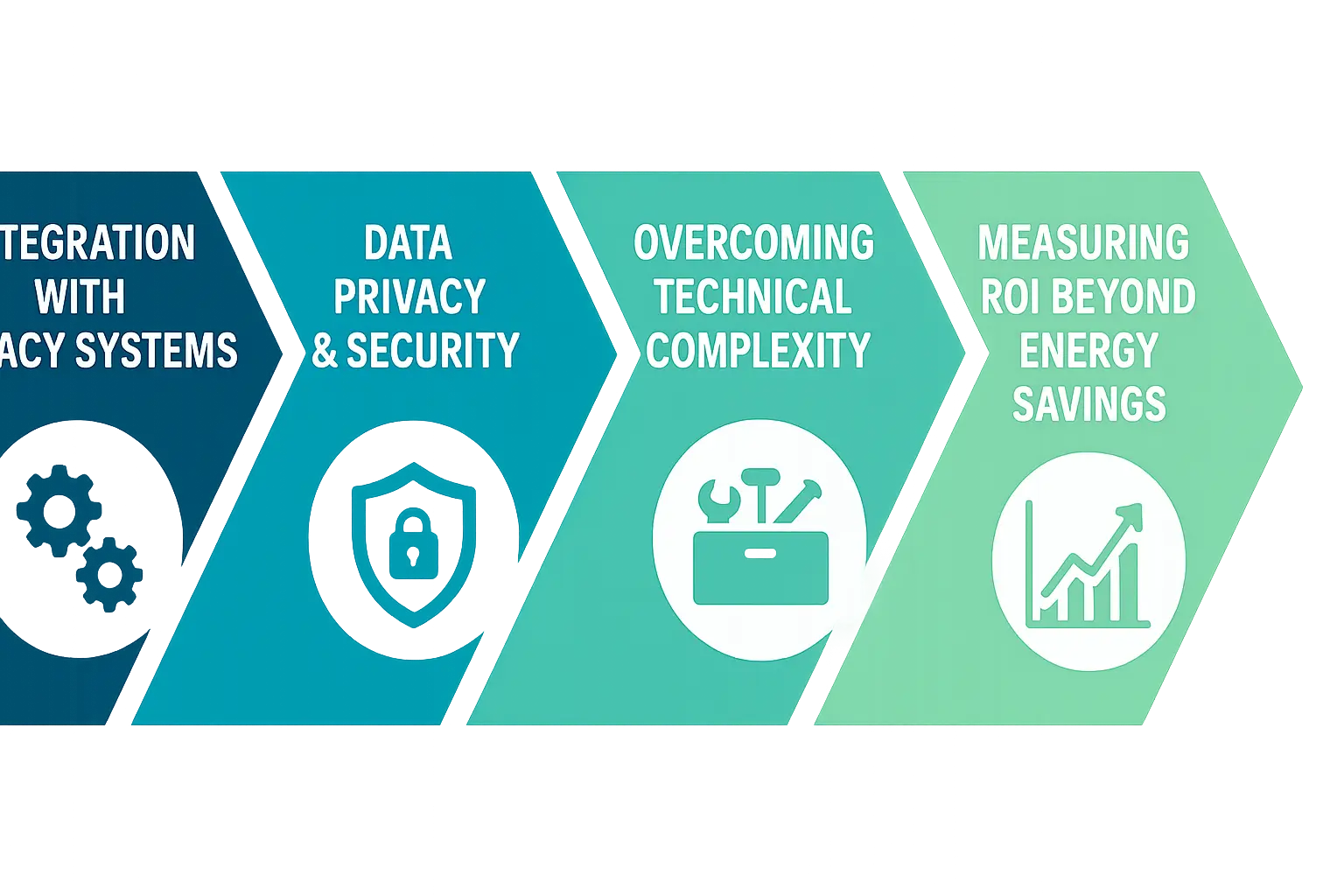 Caption: Visualizing Human-Centric AI Benefits: Demonstrating how personalized comfort elevates occupant well-being and productivity builds emotional confidence in investing in AI EMS.
Navigating Implementation: Challenges and Best Practices for AI EMS Adoption
Adopting an AI EMS is a transformative step, and a clear implementation strategy is key to success. Understanding the common challenges and best practices will help you navigate the process with confidence.
While competitors often highlight challenges like infrastructure compatibility and data quality, they rarely offer a clear path forward. Here is a practical framework for a smooth transition.
A Phased Approach to Adoption
- Assess & Connect: The first step is to audit your existing infrastructure (BMS, HVAC, sensors). Modern AI platforms are designed to be vendor-agnostic, connecting to existing systems through standard protocols like BACnet or cloud APIs. This minimizes upfront investment by leveraging what you already have.
- Learn & Model: Once connected, the AI begins a crucial learning phase. It silently collects data for several weeks to build a “digital twin” or a highly accurate predictive model of your building’s unique thermal dynamics and occupancy patterns.
- Optimize & Deploy: With a confident model, the AI transitions from learning to active control. It begins sending optimized commands to your HVAC system, continuously refining its strategy based on real-time data and feedback.
- Measure & Refine: The process doesn’t stop at deployment. The system provides transparent reporting on energy savings, comfort improvements, and operational efficiency, allowing for continuous refinement and validation of your investment.
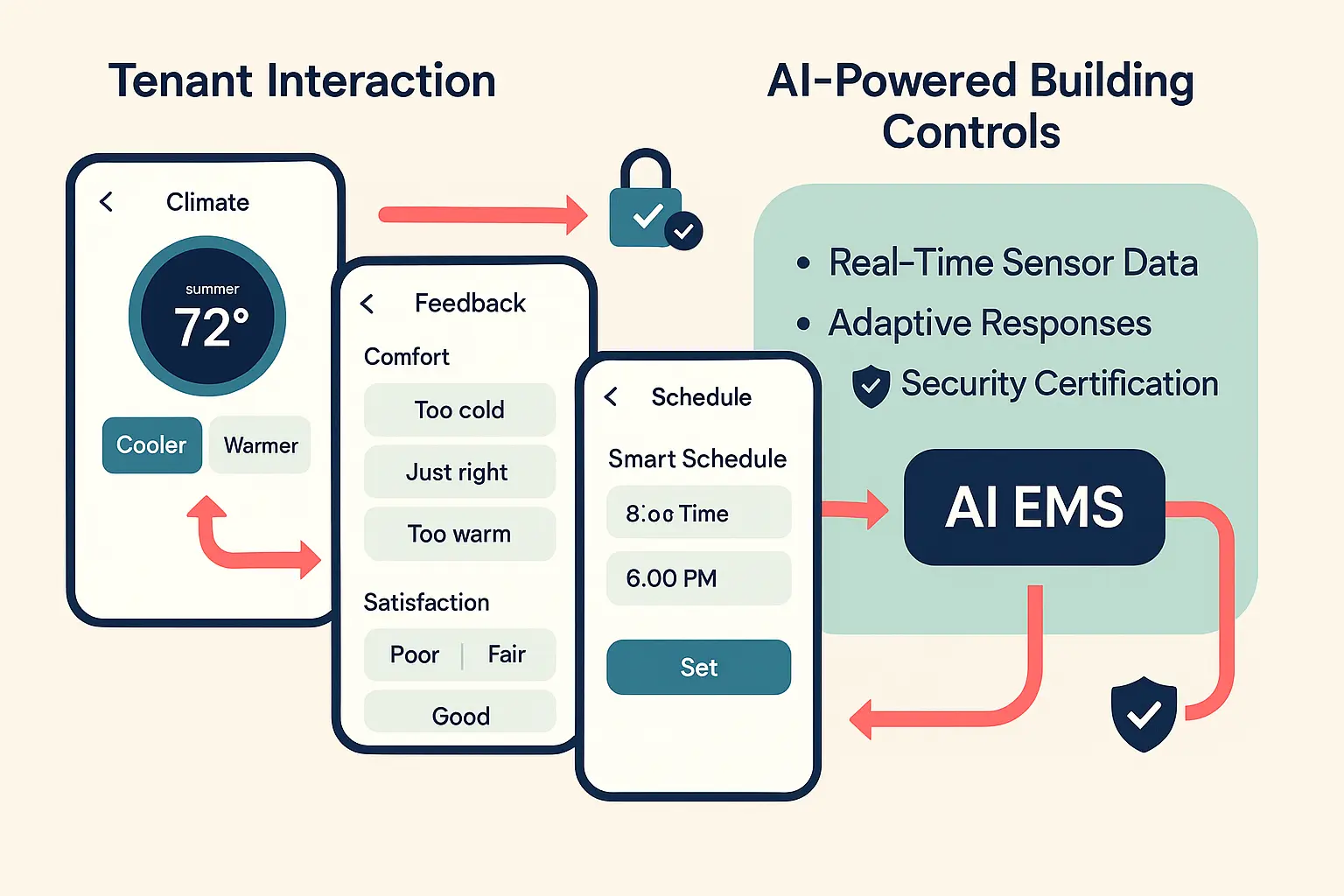 Caption: AI EMS Implementation Roadmap: A practical visual guide that simplifies complex adoption considerations into actionable steps fosters buyer confidence and reduces perceived risk.
Measuring ROI Beyond Energy Savings
A comprehensive ROI analysis includes both hard and soft returns:
- Hard ROI: Track direct energy cost reductions (often 8-19% in carbon emissions and up to 35% in cost), and savings from [predictive maintenance], which can reduce emergency HVAC breakdowns by up to 90%.
- Soft ROI: Quantify the value of an improved occupant experience. Measure metrics like the reduction in hot/cold complaints, improvements in tenant satisfaction surveys, and potential impacts on lease renewal rates.
Frequently Asked Questions
1. Will an AI EMS replace my existing Building Management System (BMS)?Not usually. An AI EMS is typically an intelligence layer that integrates with and enhances your existing BMS. It leverages your current infrastructure, sending smarter, more optimized commands to the equipment your BMS already controls.
2. How does the system handle a space with widely different comfort preferences?This is where AI excels. By analyzing long-term data and direct feedback (via a mobile app), the AI learns the unique preferences of occupants in different zones. It can then make micro-adjustments to airflow and temperature to create a balanced environment that satisfies the most people possible, moving beyond a single setpoint for an entire area.
3. Is our building’s data secure?Data security is paramount. Leading AI EMS providers use robust, enterprise-grade security protocols, including end-to-end encryption for all data in transit and at rest. Ensure any vendor you evaluate can provide detailed information on their security architecture and compliance with standards like SOC 2.
4. What kind of ongoing support is required from my facilities team?The goal of AI is to automate and simplify, not add complexity. Once deployed, the system operates autonomously 24/7. Your team’s role shifts from reactive troubleshooting to strategic oversight, using the system’s analytics and predictive maintenance alerts to stay ahead of issues and manage the building more effectively.
The Future is Responsive, Efficient, and Human-Centric
The debate between energy efficiency and occupant comfort is over. AI-powered building systems have proven that you can achieve outstanding results in both areas simultaneously. By investing in this technology, you are not just upgrading your building’s infrastructure; you are investing in a more sustainable, productive, and desirable environment for the people who use it every day.
Ready to see how an AI-powered EMS can transform your building’s performance and occupant experience? Explore our [smart building technology] solutions or schedule a personalized assessment with one of our experts today.
