
You understand the critical role of energy storage. You’ve seen the projections, you know the stakes, and you’re now facing the pivotal question: how do you move beyond simple battery management to unlock the full economic and operational value of your assets? The answer is AI, but navigating the options—from basic automation to advanced reinforcement learning—can feel like a high-stakes decision with incomplete information.
This guide is designed for you. It’s not a surface-level overview; it’s a comprehensive framework for evaluating and implementing AI in Energy Storage Systems (ESS). We’ll move past the marketing buzzwords to give you the data-backed insights and technical clarity needed to make a confident, future-proof decision.
The Tipping Point: Why AI in Energy Storage Is No Longer Optional
The energy landscape is undergoing a seismic shift. The global market for AI in energy storage is set to explode, projected to reach $16.63 billion by 2030. This isn’t speculative growth; it’s a direct response to a set of undeniable pressures that traditional, rule-based ESS management simply cannot handle.
- The Data Center Demand Surge: The proliferation of AI is creating a voracious appetite for power. U.S. data center electricity consumption is expected to quadruple between 2023 and 2030, making uninterruptible, efficiently managed power not just a goal, but a structural necessity. With 52% of serious data center outages originating from power events, the reliability of your ESS is paramount.
- Renewable Intermittency: As grids lean more heavily on solar and wind, the challenge of intermittency grows. Traditional systems struggle to predict and react to a fluctuating supply, leading to grid instability and missed revenue opportunities.
- Asset Depreciation: Every charge and discharge cycle degrades your battery assets. Without intelligent management, you could be shortening the lifespan of multi-million dollar investments and facing premature replacement costs.
- Market Complexity: Energy markets are becoming more dynamic. Participating in ancillary services, capacity markets, and real-time energy arbitrage requires predictive capabilities and split-second decision-making that is impossible for human operators or rigid, pre-programmed logic.
Simply put, managing a modern ESS with yesterday’s tools is like trying to navigate a superhighway in a horse-drawn carriage. It’s inefficient, risky, and leaves immense value on the table.
Decoding AI in ESS: From Core Functions to Advanced Algorithms
“AI” is a broad term. For an ESS operator, it translates into specific, value-driven capabilities. Let’s break down the three core pillars of an intelligent ESS and explore the technologies that power them.
Charge/Discharge Optimization: From Guesswork to Guaranteed Gains
This is the heart of ESS profitability. An intelligent system doesn’t just charge when power is cheap and discharge when it’s expensive; it builds a sophisticated, predictive model of the future.
- Predictive Forecasting: The system ingests vast datasets—historical market prices, weather forecasts, grid load predictions, and your own facility’s consumption patterns—to accurately predict future energy prices and demand.
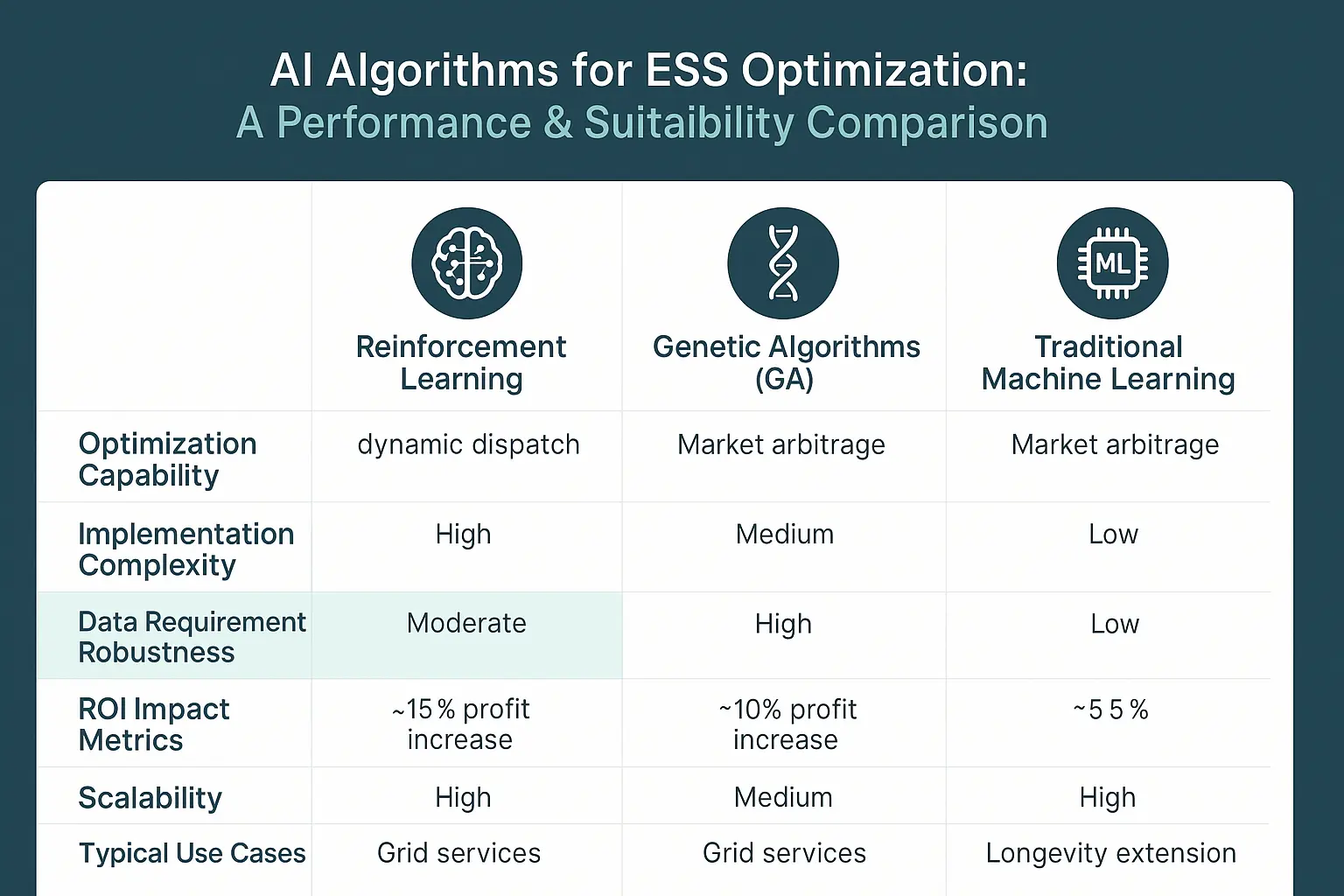
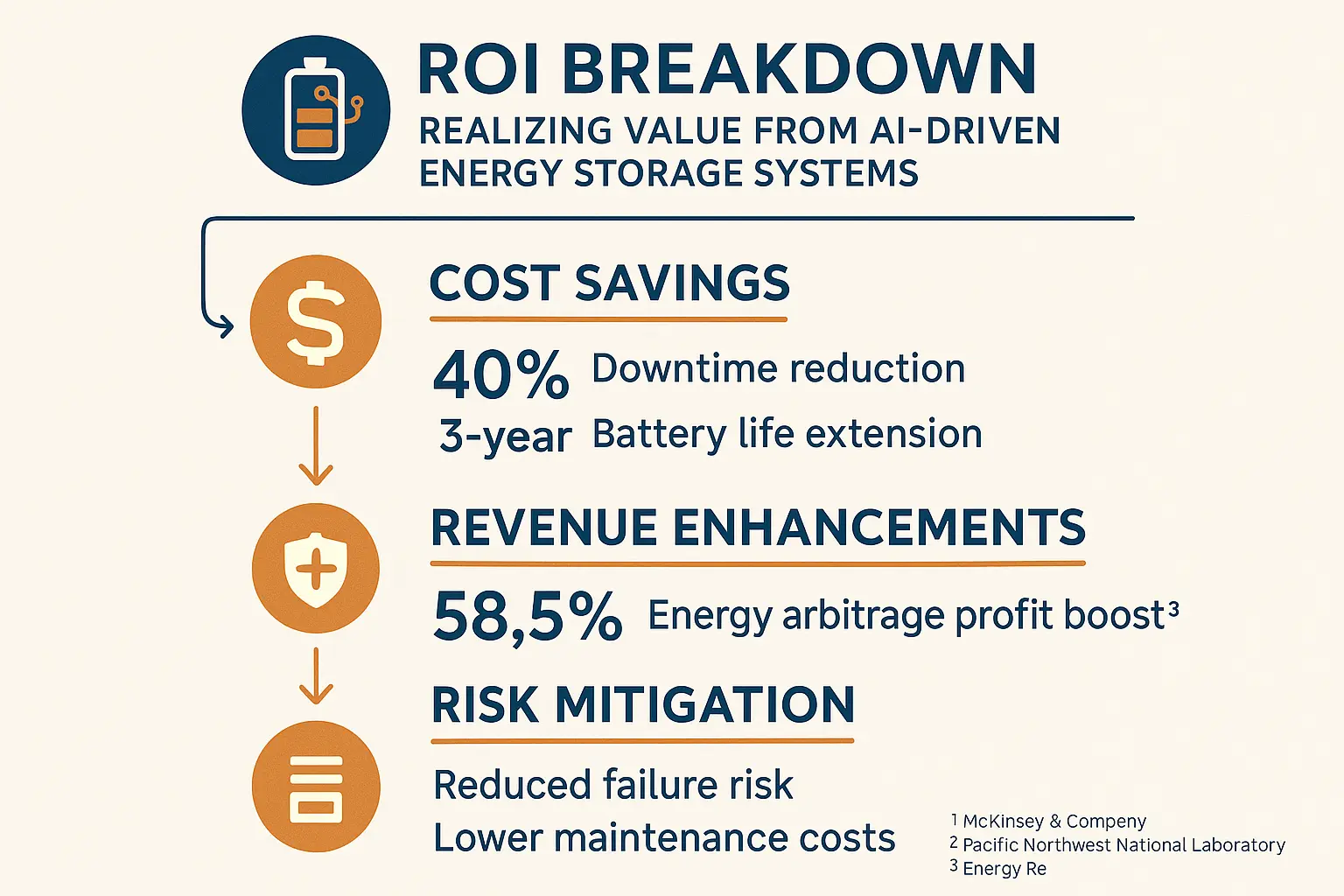
- Dynamic Dispatch & Arbitrage: This is where advanced AI truly shines. While basic systems use linear programming, cutting-edge platforms leverage Reinforcement Learning (RL). An RL agent learns through trial and error in a simulated environment (a digital twin of your system and the market), discovering complex strategies that a human would never find. The result? Studies show RL can boost energy arbitrage profits by as much as 58.5% over traditional methods.
- Revenue Stacking: An AI platform can simultaneously evaluate and act on multiple revenue streams. It might use 90% of your BESS capacity for peak shaving to reduce demand charges, while dedicating the other 10% to participate in high-value frequency regulation markets—a level of multi-objective optimization that is impossible to program with static rules.
Decoding AI in ESS: Charge/Discharge Optimization and AI Algorithm Comparison
Predictive Maintenance & Lifespan Extension
An intelligent ESS doesn’t just manage energy; it manages its own health. By analyzing thousands of data points—from cell-level temperatures and voltage to cycling history—machine learning models can identify subtle anomalies that signal impending issues.
This shifts your maintenance strategy from reactive (fixing what’s broken) to predictive (preventing failures before they happen). The impact is profound. Leading AI platforms have demonstrated the ability to:
- Reduce BESS downtime by up to 40%.
- Extend battery asset life by up to three years.
- Improve State of Health (SoH) and State of Charge (SoC) estimation to <1% accuracy, preventing overcharging or deep discharging that accelerates degradation.
By optimizing charging protocols and thermal management based on real-time health diagnostics, the AI acts as a 24/7 guardian for your most valuable energy assets. If you want to dive deeper, you can [learn more about our BESS predictive maintenance models].
Grid Integration & Stability
For utility-scale deployments or microgrids, AI is the key to seamless integration. It acts as the central nervous system, balancing the unpredictable nature of renewables with grid demand. It can instantaneously dispatch energy to stabilize frequency, manage voltage, and ensure the reliable delivery of power, turning your ESS into a valuable, flexible grid resource.
Overcoming the Hurdles: Data Quality, Integration & Cybersecurity
Implementing an AI layer isn’t just about algorithms; it’s about navigating real-world operational challenges. Competitors often gloss over these complexities, but a credible partner will address them head-on.
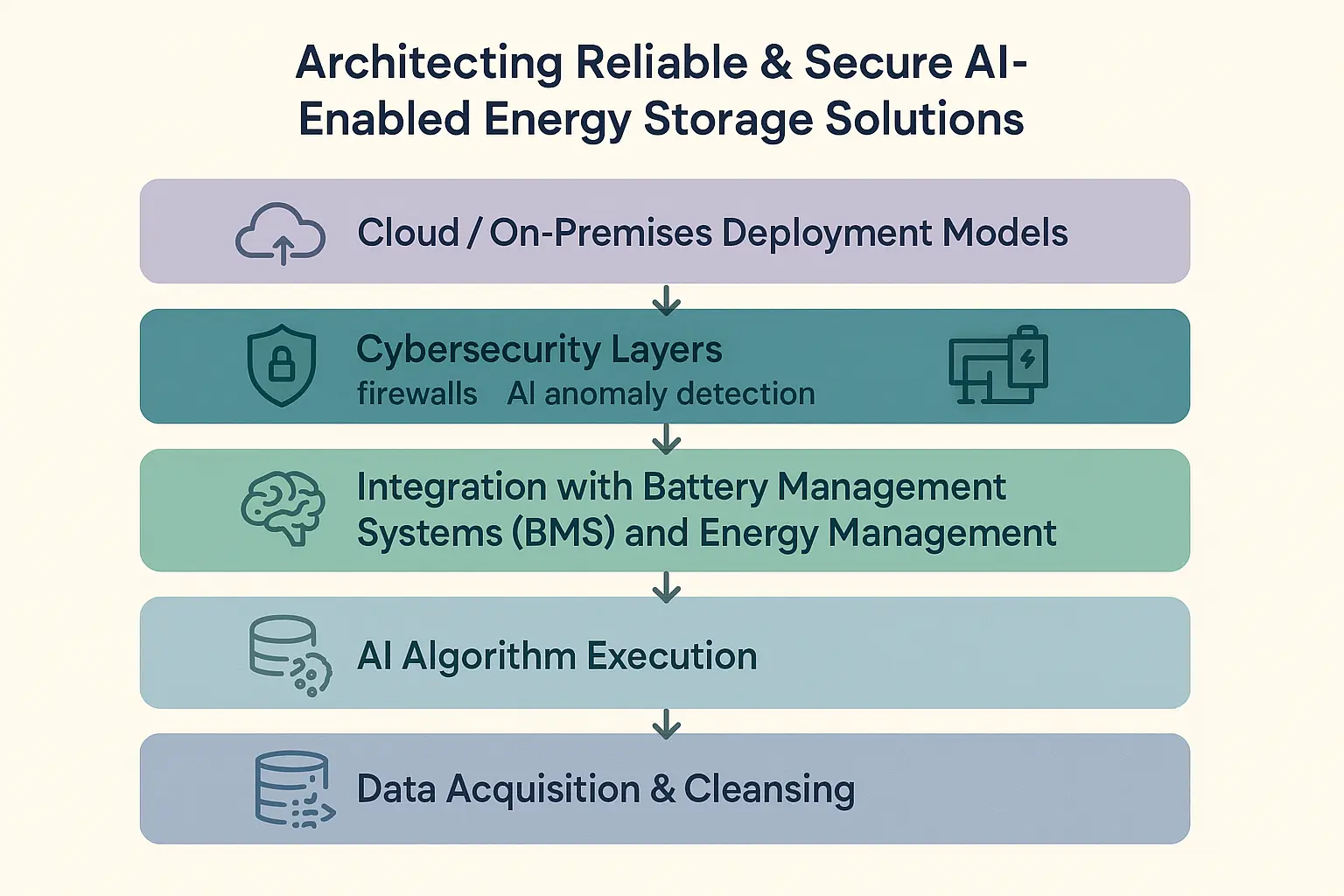
- The Data Quality Problem: AI is only as smart as the data it learns from. A robust platform must have built-in data ingestion and cleansing protocols to handle inconsistent or missing data from various sources (BMS, EMS, weather APIs, market data feeds).
- Integrating with Legacy Systems: You don’t need to rip and replace your existing infrastructure. A well-architected AI solution should offer flexible APIs and adapters to integrate seamlessly with your current Battery Management System (BMS) and Energy Management System (EMS), unifying siloed data into a single source of truth.
- Cybersecurity in an Interconnected Grid: Connecting your assets to an AI platform introduces new potential vulnerabilities. Look for partners who prioritize security with features like end-to-end encryption, anomaly detection for network traffic, and adherence to industry security standards.
Overcoming the Hurdles: Data Quality, Integration & Cybersecurity
The ROI of Intelligent ESS: Quantifying Your Investment
Ultimately, the decision to invest in AI comes down to the business case. An advanced AI-powered management system delivers value across two primary fronts: cost savings and new revenue generation, contributing to an average ROI of 143% for early adopters.
Cost Savings (OPEX Reduction):
- Extended Asset Life: Deferring capital-intensive battery replacement by up to three years has a massive impact on your total cost of ownership.
- Reduced Maintenance Costs: Predictive maintenance allows for more efficient scheduling of technician time and reduces emergency repair expenses.
- Lower Demand Charges: For C&I users, intelligent peak shaving directly reduces monthly electricity bills.
Revenue Generation (Increased Revenue):
- Enhanced Arbitrage Profits: As noted, RL-powered strategies can significantly outperform simpler models.
- Optimized Market Participation: AI unlocks the ability to participate in lucrative ancillary service markets that require rapid, automated responses.
- Increased Uptime: With downtime reduced by up to 40%, your assets are available to generate revenue more often.
The ROI of Intelligent ESS: Quantifying Your Investment
Choosing Your AI ESS Partner: Key Evaluation Criteria
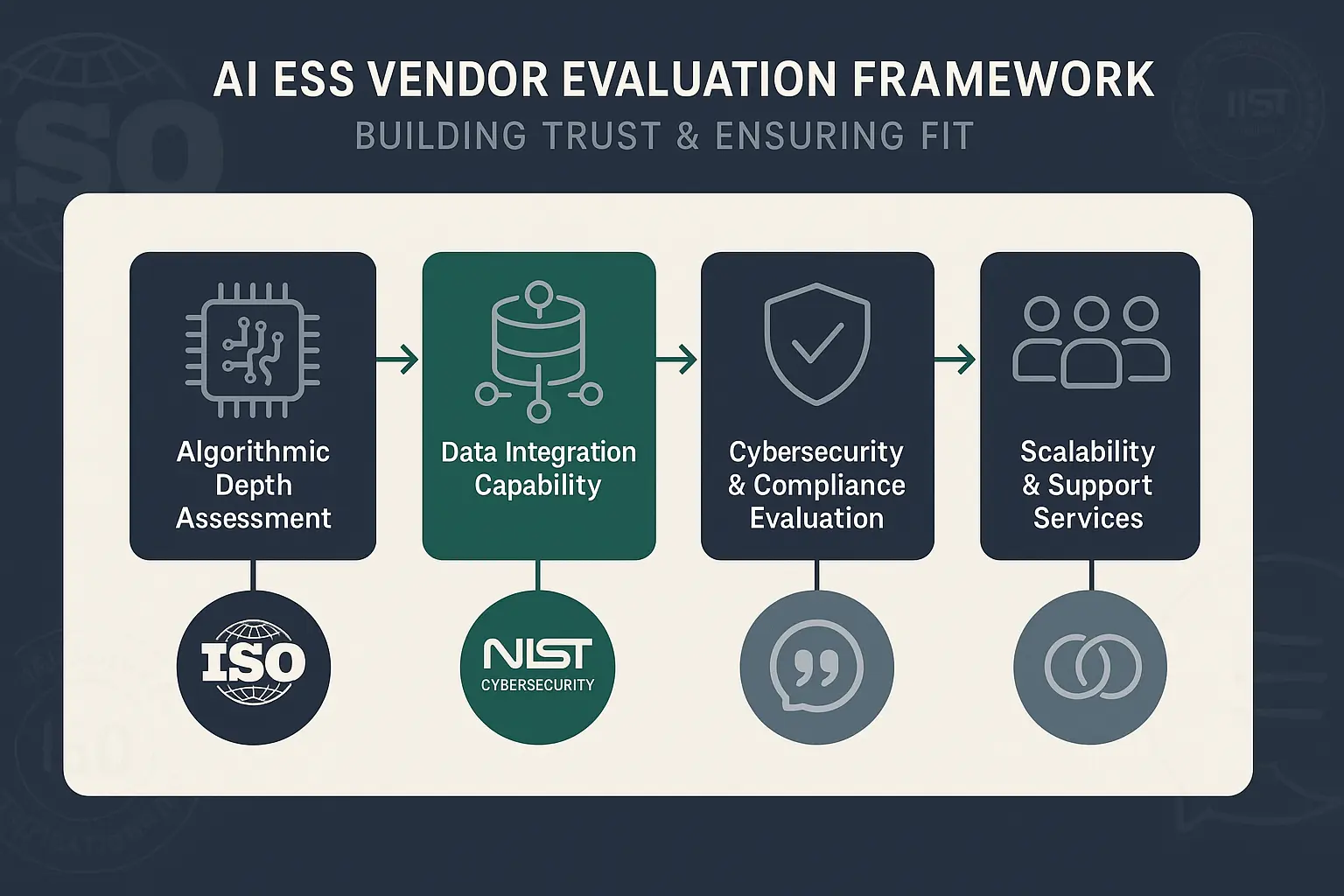
As you evaluate potential vendors, move beyond the feature list. The right partner provides not just software, but deep domain expertise. Here are the critical questions to ask:
- Algorithmic Depth: Do they explain how their AI works? Can they articulate why they chose a specific approach (e.g., Deep Reinforcement Learning vs. Genetic Algorithms) for your use case?
- Data Integration Capabilities: How easily can their platform connect to your specific BMS, SCADA systems, and external data sources? Ask for a [demonstration of their integration framework].
- Model Customization & Scalability: Is the platform a rigid “black box,” or can the AI models be tuned to your unique assets, market conditions, and business goals? How does the solution scale from a single site to an entire fleet?
- Proven Expertise & Support: Does their team consist of data scientists, energy market experts, and power systems engineers? What level of ongoing support and model monitoring do they provide?
Choosing Your AI ESS Partner: Key Evaluation Criteria
Frequently Asked Questions (FAQ)
1. How much historical data do I need to get started?While more data is always better, a good AI platform can often start delivering value with as little as 6-12 months of operational and market data. Advanced techniques, like transfer learning, can even leverage models trained on similar assets to accelerate your deployment.
2. Is the AI a “black box”? Will I lose control over my assets?A well-designed system provides transparency and control. You should be able to see why the AI is making a particular dispatch decision and be able to set operational guardrails and constraints to ensure it always operates within your desired safety and business parameters.
3. What is the typical implementation timeline?This varies depending on the complexity of your operations, but a typical pilot project can often go from data ingestion to live, optimized dispatch within 2-4 months.
4. How does the AI adapt to market changes or battery degradation?The system should be designed for continuous learning. The AI models retrain themselves periodically on new data, ensuring that the strategies adapt to evolving market dynamics, regulatory changes, and the natural degradation of your battery assets over time.
Your Next Step Toward Intelligent Energy Management
The transition from basic BESS control to AI-powered optimization is the single most important step you can take to maximize the value and lifespan of your energy storage assets. It’s the difference between owning a passive energy reservoir and commanding a dynamic, revenue-generating grid resource.
The key is to choose a partner who understands the nuances of both artificial intelligence and energy systems. If you’re ready to see what a truly intelligent ESS can do for your operations, the next logical step is a personalized assessment.
[Request a Customized ROI Analysis and Technical Deep-Dive]
