
You’re staring at the dashboard for your building management system (BMS). It’s a sea of data points, trend logs, and the occasional, cryptic alarm. You know there are inefficiencies hiding in that data—energy waste, equipment strain, and pending failures that will inevitably disrupt operations. But sifting through the noise to find the signal feels like an impossible task. This is the core challenge for facilities and energy managers today: you have more data than ever, but not necessarily more insight.
You’re not just looking for another alarm. You’re looking for answers. You need a system that doesn’t just tell you that something is wrong, but tells you what is wrong, why it’s wrong, and what to do about it. This is the critical leap from simple fault detection to true, AI-driven fault detection and diagnostics (FDD). This guide provides the comparative framework you need to evaluate FDD solutions and make a decision that delivers measurable returns.
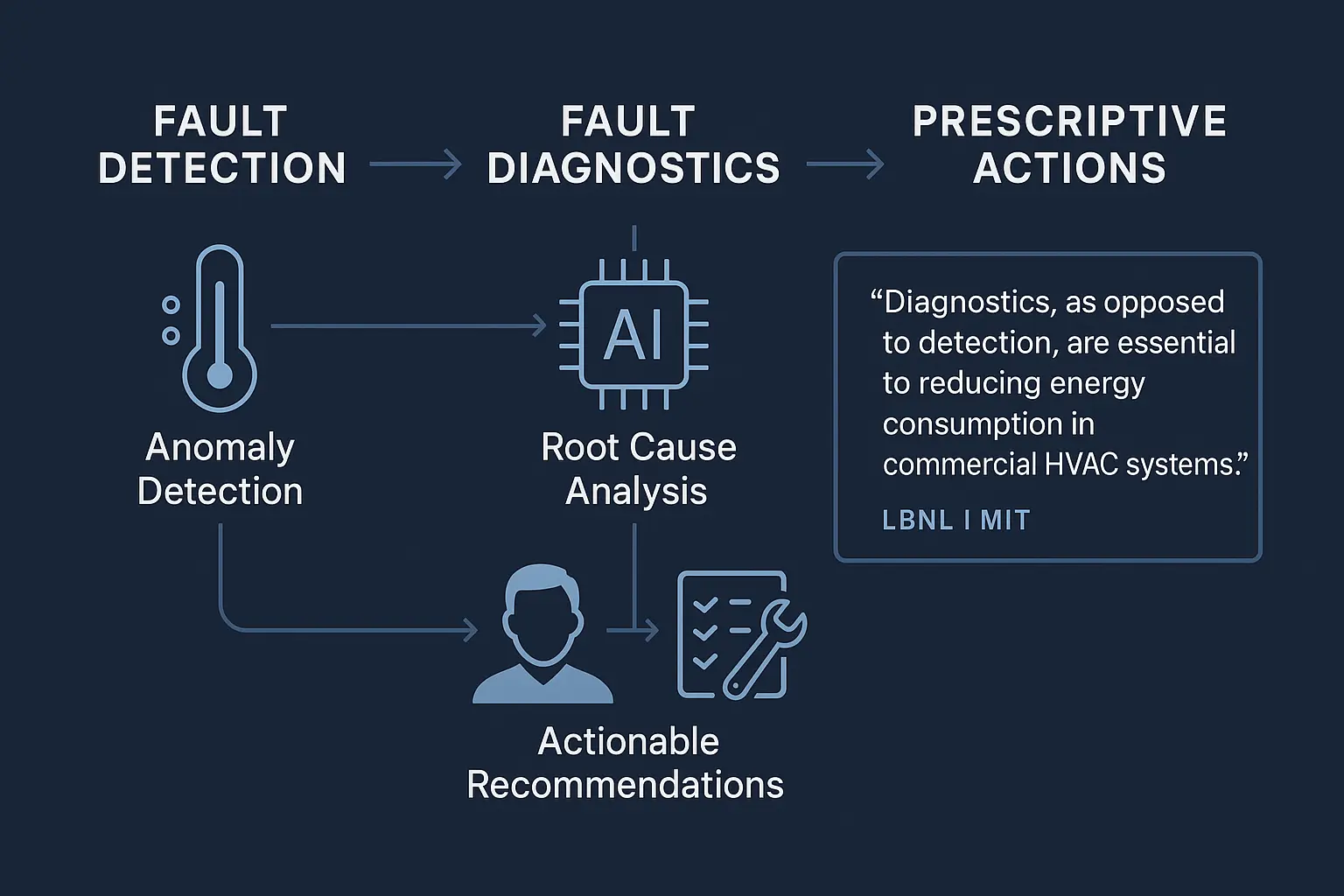
The FDD Difference: Detection vs. Diagnosis – Why the “Second D” Matters Most
Most building analytics platforms are good at the first “D”—Detection. They can tell you when a sensor reading is outside its expected range. This is the equivalent of a smoke alarm going off. It’s a crucial first step, but it often creates more questions than answers and can lead to a flood of low-priority alerts that get ignored. Is it a real fire, or just burnt toast?
True diagnostics—the second “D”—is what separates a noisy alarm system from an intelligent operational tool.
- Detection identifies an anomaly: “Air Handling Unit 3’s discharge air temperature is too high.”
- Diagnosis provides the root cause and context: “The cooling coil valve on AHU-3 is stuck in a partially open position, causing a constant reheat cycle that is wasting energy and preventing the unit from meeting its setpoint.”
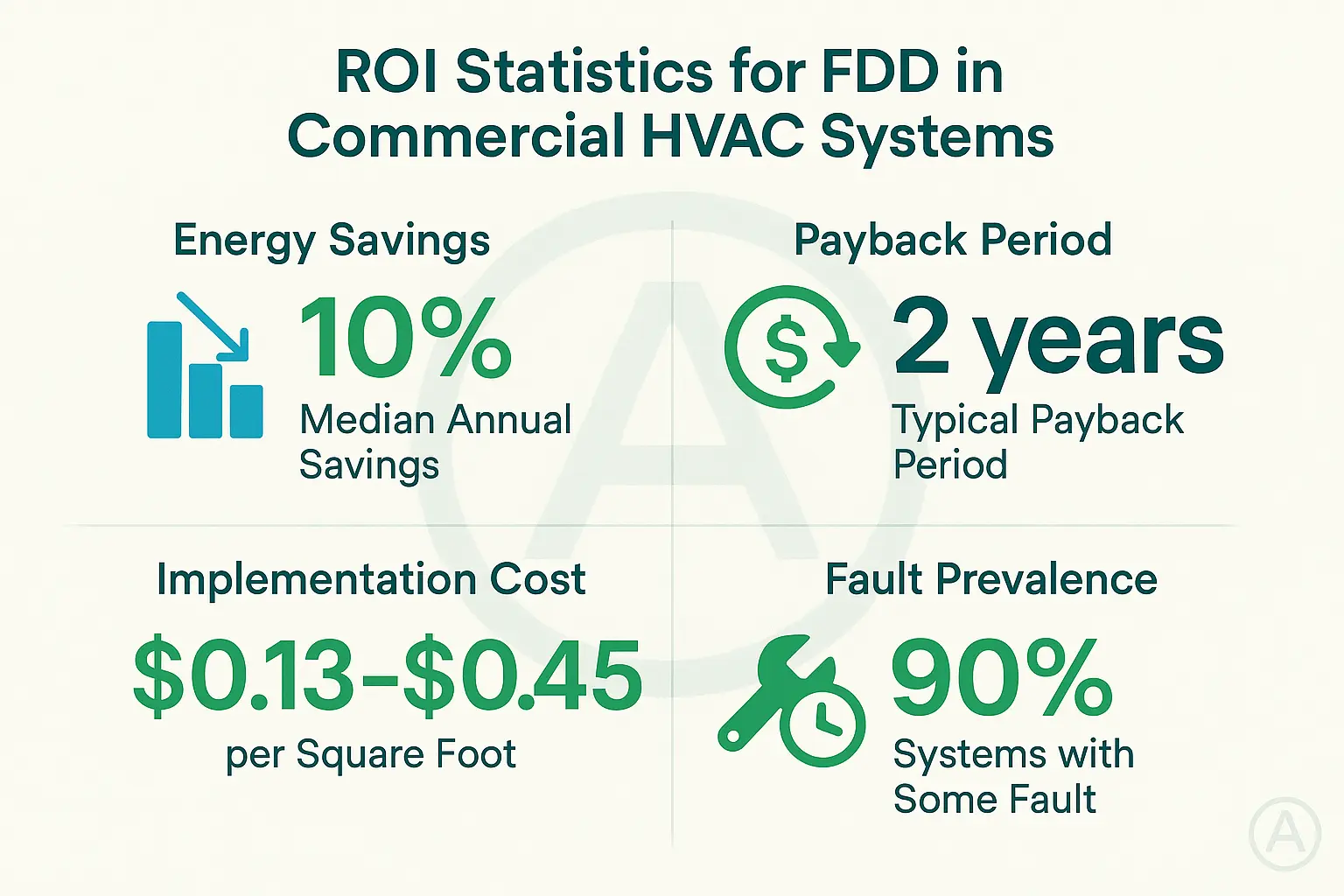
This distinction is everything. While basic detection can flag issues, research from Lawrence Berkeley National Laboratory (LBNL) shows that up to 90% of installed HVAC systems operate with some kind of fault, leading to significant waste. AI-powered diagnostics cut through this complexity by automatically analyzing the relationships between hundreds of data points to pinpoint the root cause, prioritize issues by impact, and recommend specific corrective actions. It’s the difference between knowing there’s a problem and having a clear path to resolution.
A Deeper Look at FDD Technologies
When evaluating FDD solutions, it’s crucial to understand the engine running under the hood. The sophistication of the diagnostic algorithms directly impacts the accuracy, reliability, and actionability of the insights you receive.
- Rule-Based FDD: This is the traditional approach. Engineers write explicit rules (e.g., “IF discharge air temp > setpoint AND cooling valve is 100% open THEN flag ‘cooling fault'”). It’s effective for common, predictable issues but can be brittle, time-consuming to set up, and often generates false alarms when encountering unexpected operating conditions.
- Model-Based FDD: These systems use physics-based or statistical models of how your equipment should perform and flag deviations. They are more robust than simple rule-based systems but can be complex to calibrate and maintain as equipment ages.
- AI & Machine Learning (Data-Driven) FDD: This is the cutting edge. Instead of relying on pre-written rules, AI-driven FDD platforms learn the unique operational patterns of your building and its equipment directly from your BAS data. They use advanced algorithms—like deep recurrent neural networks (DRNNs) or convolutional neural networks (CNNs)—to detect subtle, complex fault patterns that are invisible to other methods. This approach is highly adaptable, requires less manual setup, and is incredibly effective at identifying the root causes of efficiency loss and impending failures. By learning the normal operating behavior, these systems can spot the earliest signs of drift before they become costly problems.
The most powerful solutions often use a hybrid approach, combining the precision of AI with the reliability of physics-based models to deliver the most accurate and trustworthy diagnostics.
Quantifying the Impact: FDD ROI & Business Case Builder
Investing in FDD isn’t an operational expense; it’s a strategic investment in efficiency and resilience. The data consistently shows a compelling financial return.
Operational faults and control errors are a silent drain on your budget, with studies showing they cause 5% to 30% of a commercial building’s total energy to be wasted. In HVAC systems specifically, over 20% of units operate with early-stage faults that increase energy consumption by more than 15%.
An effective FDD program directly recaptures that loss. Research from the MIT Center for Energy and Environmental Policy Research found that buildings implementing FDD achieve a median annual energy savings of 10%, with a typical simple payback period of just two years.
Understanding the Investment
To build a credible business case, you need to understand both the potential savings and the costs. Based on market analysis from industry experts at Nexus Labs, FDD implementation costs typically fall in these ranges:
- Implementation/Setup: $0.03 – $0.10 per square foot
- Annual Software Subscription: $0.02 – $0.12 per square foot per year
When you compare these costs to a 10% reduction in your annual energy spend, the business case often makes itself. This doesn’t even account for the significant cost avoidance from reduced emergency repairs, extended equipment lifespan, and improved tenant comfort. A robust FDD platform provides all the data you need for building a compelling business case internally.
Navigating the FDD Marketplace: A Feature-Focused Comparison Guide
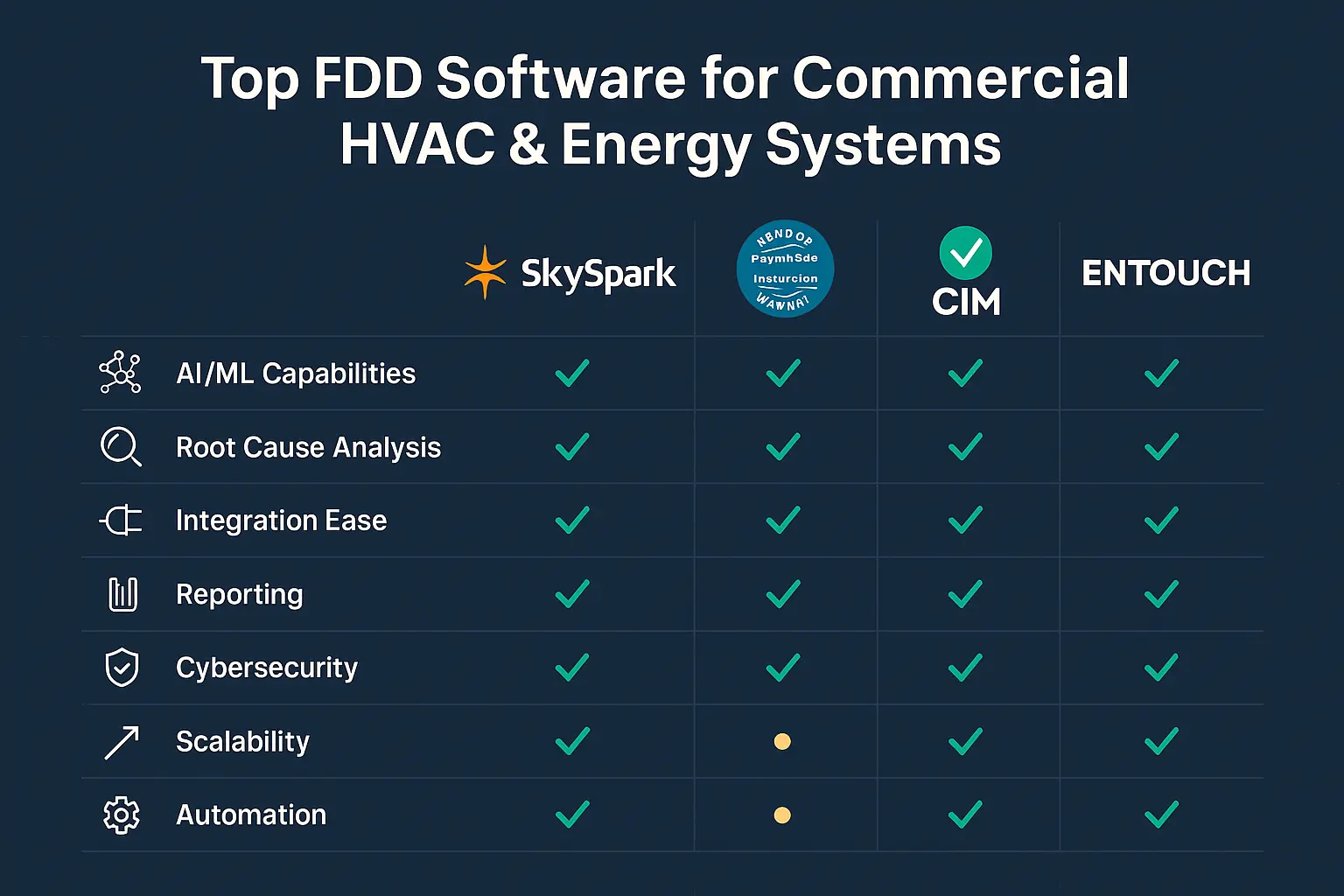
Choosing the right FDD partner is critical. As you evaluate solutions, move beyond marketing claims and focus on the core capabilities that drive real-world value. Use this framework to compare providers and find the best fit for your portfolio.
Key Evaluation Criteria for FDD Software
- Diagnostic Depth & Accuracy: How sophisticated are the AI/ML algorithms? Do they go beyond simple rules to perform automated root cause analysis? Ask for examples of how they diagnose complex, multi-system faults.
- Actionability & Prioritization: Does the platform prioritize faults by cost impact, energy waste, or comfort risk? Does it provide clear, prescriptive recommendations for your technicians?
- Scalability & Interoperability: Can the system easily connect with your existing BMS, sensors, and CMMS? How does it handle a portfolio of diverse buildings with different equipment and control systems? Proper integration with your BMS is non-negotiable.
- Data Quality Management: Dirty or missing data is a common challenge. How does the provider handle data gaps, mislabeled points, and sensor drift to ensure diagnostic accuracy?
- User Experience & Workflow: Is the interface intuitive for your entire team, from engineers to technicians? Does it streamline the process from fault identification to work order generation and verification?
- Vendor Expertise & Support: Does the vendor have deep domain expertise in both HVAC systems and data science? What level of ongoing support, training, and analysis do they provide?
Implementation Success: A Programmatic Approach to FDD Adoption
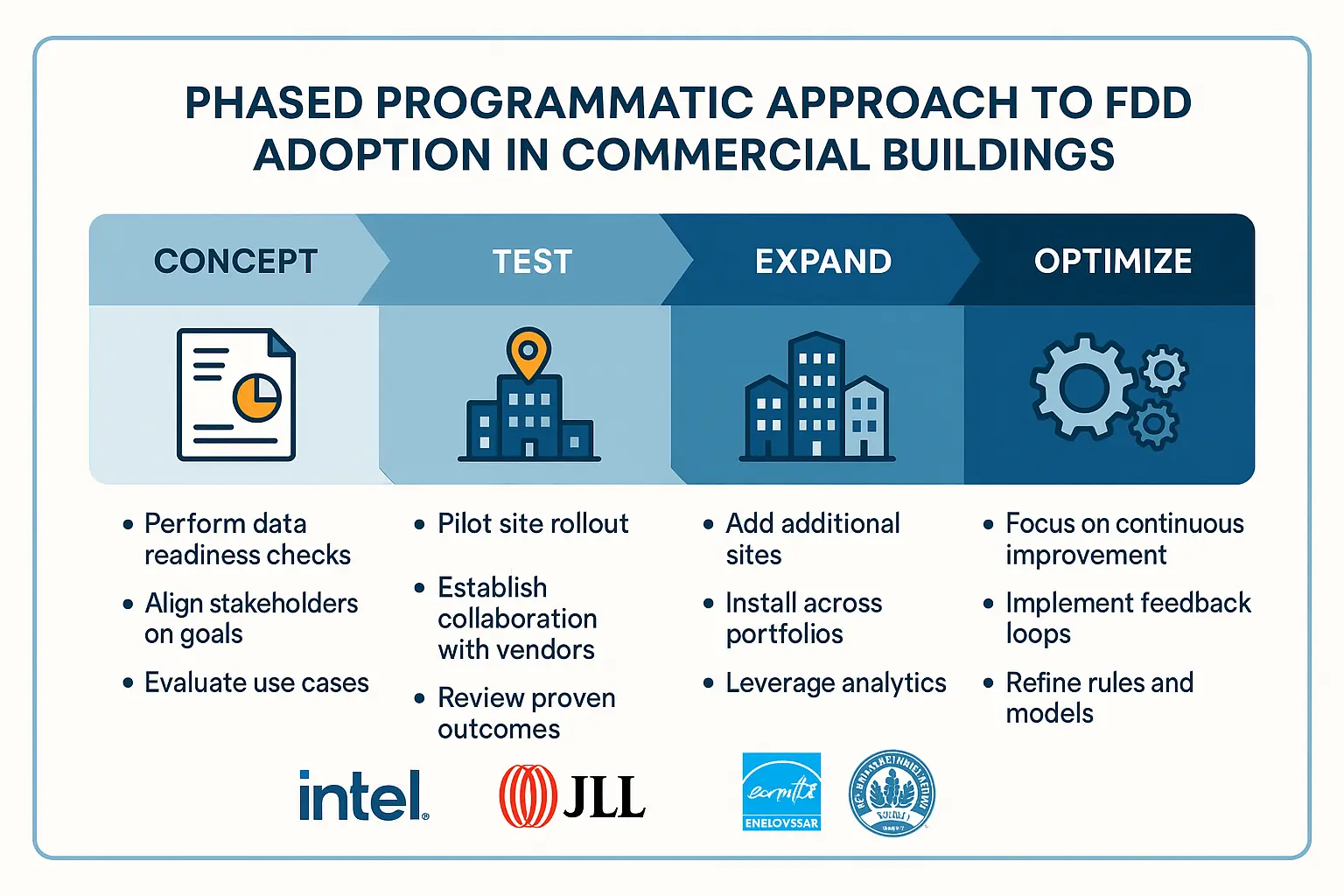
The most successful FDD deployments treat it not as a one-time software installation, but as an ongoing operational program. Technology is only one piece of the puzzle; process and people are just as important. Adopting a programmatic mindset ensures you realize the full value of your investment.
A best-practice implementation follows a clear, phased approach:
- Concept & Planning: Define your goals. Are you focused on energy reduction, maintenance efficiency, or capital planning? Identify key stakeholders from facilities, IT, and finance.
- Pilot & Test: Start with one or two high-value buildings to validate the technology, refine your workflow, and demonstrate early wins.
- Expand & Scale: Use the lessons learned from the pilot to roll out the FDD solution across your portfolio. Standardize processes for fault resolution and verification.
- Optimize & Sustain: Continuously use the insights from the FDD platform to inform your maintenance strategies, capital planning, and energy management programs. This creates a virtuous cycle of improvement.
Overcoming challenges like data readiness and change management is key. Partner with a vendor who acts as an extension of your team, providing guidance not just on the software, but on how to integrate it effectively into your daily operations.
Frequently Asked Questions about FDD
Is my building too old or my BMS too basic for FDD?
Not necessarily. Modern FDD platforms are designed to be hardware-agnostic. As long as your BMS can provide access to core data points (like setpoints, temperatures, valve/damper positions, and energy consumption), an AI-driven FDD solution can generate powerful insights. Even older buildings can see immense benefits.
How is this different from the analytics module in my BMS?
Most built-in BMS analytics are rule-based detection systems. They are good at flagging obvious excursions from setpoints but typically lack the automated root cause analysis, impact prioritization, and prescriptive recommendations of a dedicated, AI-powered FDD platform. Think of it as the difference between a basic spell-checker and a sophisticated grammar and style editor.
How much work is this for my team?
A primary goal of FDD is to reduce your team’s workload, not add to it. By automating the tedious work of data analysis and pinpointing the exact root cause of issues, FDD allows your technicians to spend less time troubleshooting and more time fixing. It transforms your maintenance posture from reactive to proactive and data-driven.
What is the future of FDD?
The future is about deeper integration and automation. FDD platforms are increasingly connecting directly with Computerized Maintenance Management Systems (CMMS) to auto-generate detailed work orders. They are also becoming a foundational data layer for “digital twins,” providing real-time operational intelligence to virtual models of your buildings. This enables even more sophisticated predictive maintenance and capital planning.
Your Blueprint for Smarter Operations
The choice is no longer whether to adopt analytics, but which analytics partner will provide the diagnostic depth to turn your building data into your most valuable operational asset. Moving beyond simple fault detection to embrace AI-powered diagnostics is the most effective step you can take to reduce energy waste, minimize unscheduled downtime, and extend the life of your critical systems.
By focusing on the “second D,” you empower your team to solve problems at their source, creating a more efficient, resilient, and sustainable portfolio.
Ready to see what true diagnostics can uncover in your buildings? Explore our AI-driven FDD platform to understand how we turn complex HVAC data into clear, actionable insights.
