
You’re facing an unprecedented challenge. Your grid, the reliable backbone of our economy, is being strained by volatile renewable energy sources, the surge in electric vehicles, and increasingly sophisticated cyber threats. You know the old playbook of reactive maintenance and manual forecasting is no longer enough. The question isn’t if you need a smarter grid, but how to confidently invest in the right intelligence to make it resilient, efficient, and future-proof.
This guide moves beyond the buzzwords. We’ll break down exactly how specific AI applications are transforming grid management, backed by real-world performance data. We’ll give you the framework to evaluate solutions, understand the technology, and make the confident decisions necessary to lead the energy transition.
Why Now? The Unstoppable Forces Driving AI in Grid Management
The shift toward intelligent grids isn’t just a trend; it’s a market-wide imperative. The global smart grid industry is projected to hit $161.15 billion by 2029, growing at a rapid 16.9% CAGR. This explosive growth is fueled by critical, converging pressures:
- Renewable Energy Integration: The intermittent nature of solar and wind power creates massive forecasting and balancing challenges that traditional systems can’t handle.
- Grid Resilience & Reliability: Aging infrastructure and extreme weather events demand a proactive, not reactive, approach to maintenance and fault detection.
- Escalating Cyber Threats: As grids become more connected, their vulnerability increases. The market for AI-driven intrusion detection is expected to more than double to $4.3 billion by 2029 because it’s the only viable defense against next-generation threats.
- Demand-Side Disruption: The rise of EVs, smart homes, and distributed energy resources (DERs) requires a dynamic, two-way conversation between utilities and consumers—a conversation orchestrated by AI.
The AI Toolkit: Algorithms & Applications for Smart Grid Management
Saying “we use AI” is no longer enough. Decision-makers need to understand which AI tools are being used and for what specific purpose. Different algorithms excel at different tasks, and knowing the difference is key to evaluating any solution.
Demand-Side Management (DSM) & Dynamic Pricing
The goal here is to influence consumption patterns to better match supply. Instead of just building more power plants, AI helps use existing capacity more intelligently.
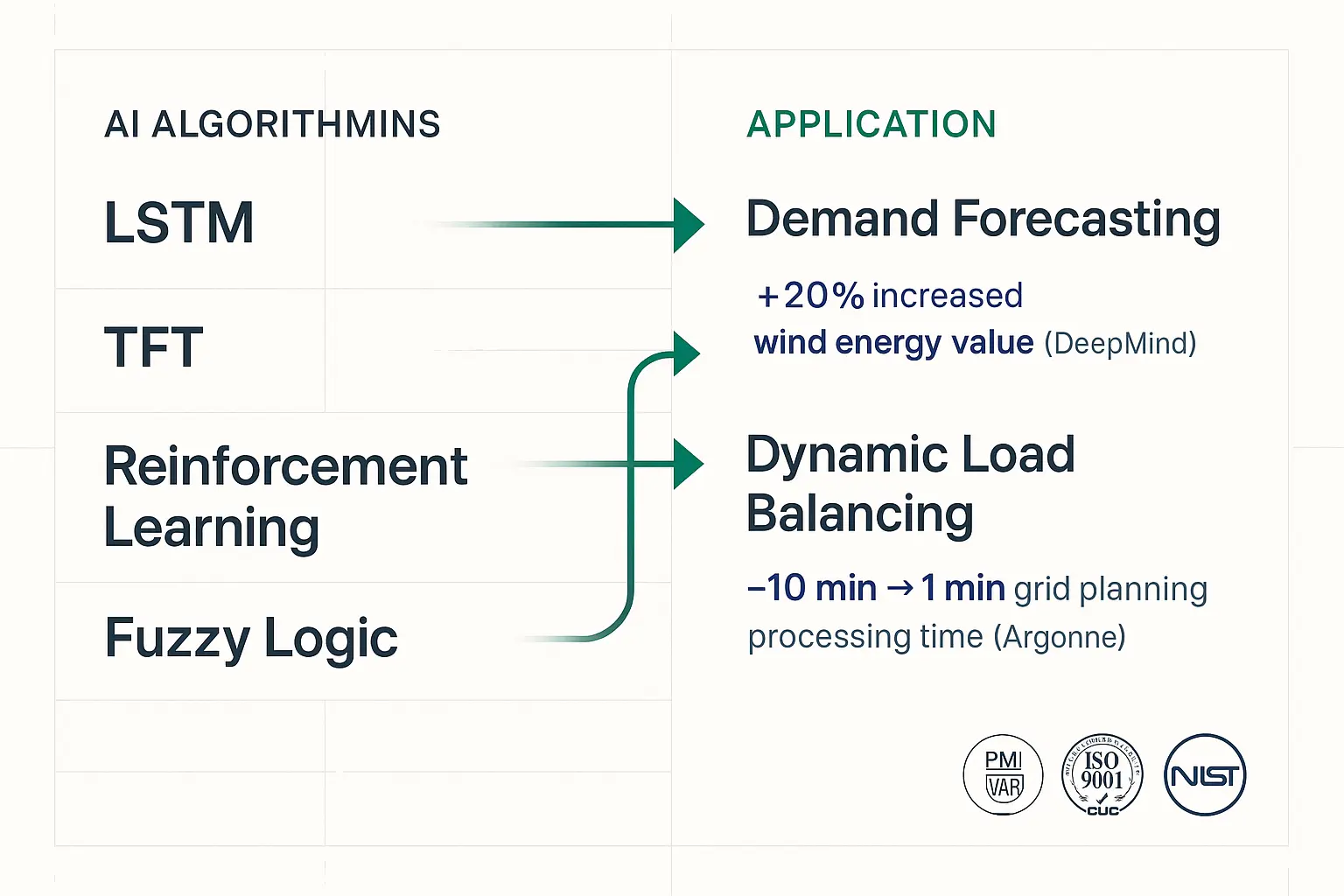
- How AI Helps: Reinforcement Learning agents can learn the optimal pricing strategies in real-time, sending signals to smart thermostats and EV chargers to shift demand away from peak hours. This creates a more stable, efficient, and cost-effective grid for everyone.
Dynamic Load Balancing & Forecasting
This is about predicting the future with unprecedented accuracy. For renewables, accurate forecasting is the difference between profit and loss.
- How AI Helps: Advanced neural networks like Long Short-Term Memory (LSTM) and Temporal Fusion Transformers (TFT) analyze vast datasets—including weather patterns, historical demand, and market signals—to create hyper-accurate forecasts. Google’s DeepMind famously used this approach to increase the financial value of wind energy by approximately 20% by predicting output 36 hours in advance.
Grid Stability & Proactive Fault Detection
A modern grid doesn’t just fail; it anticipates and heals itself. This is where AI moves from an analytical tool to an autonomous operator.
- How AI Helps: Machine learning models analyze data from thousands of sensors across the network. By detecting subtle anomalies in voltage, frequency, or equipment temperature, these models can predict a potential failure days or weeks before it happens. Leading European utility E.ON used this strategy to reduce grid outages by up to 30%. Similarly, Enel leveraged an IoT-sensor and AI combination to cut power outages by 15%.
Cybersecurity & Intrusion Detection
An intelligent grid’s greatest strength—its interconnectedness—is also its greatest vulnerability. AI is the only security solution fast and smart enough to defend it.
- How AI Helps: AI algorithms establish a baseline of normal network activity. They can then instantly detect any deviation from this pattern—a hallmark of a sophisticated cyberattack—and isolate the threat before it can spread, protecting critical infrastructure in milliseconds.
Real-World Impact: Quantifiable Success Stories
The benefits of AI in grid management aren’t theoretical. They are measured in reduced outages, faster processing, and tangible financial gains. Forward-thinking organizations are already reaping the rewards.
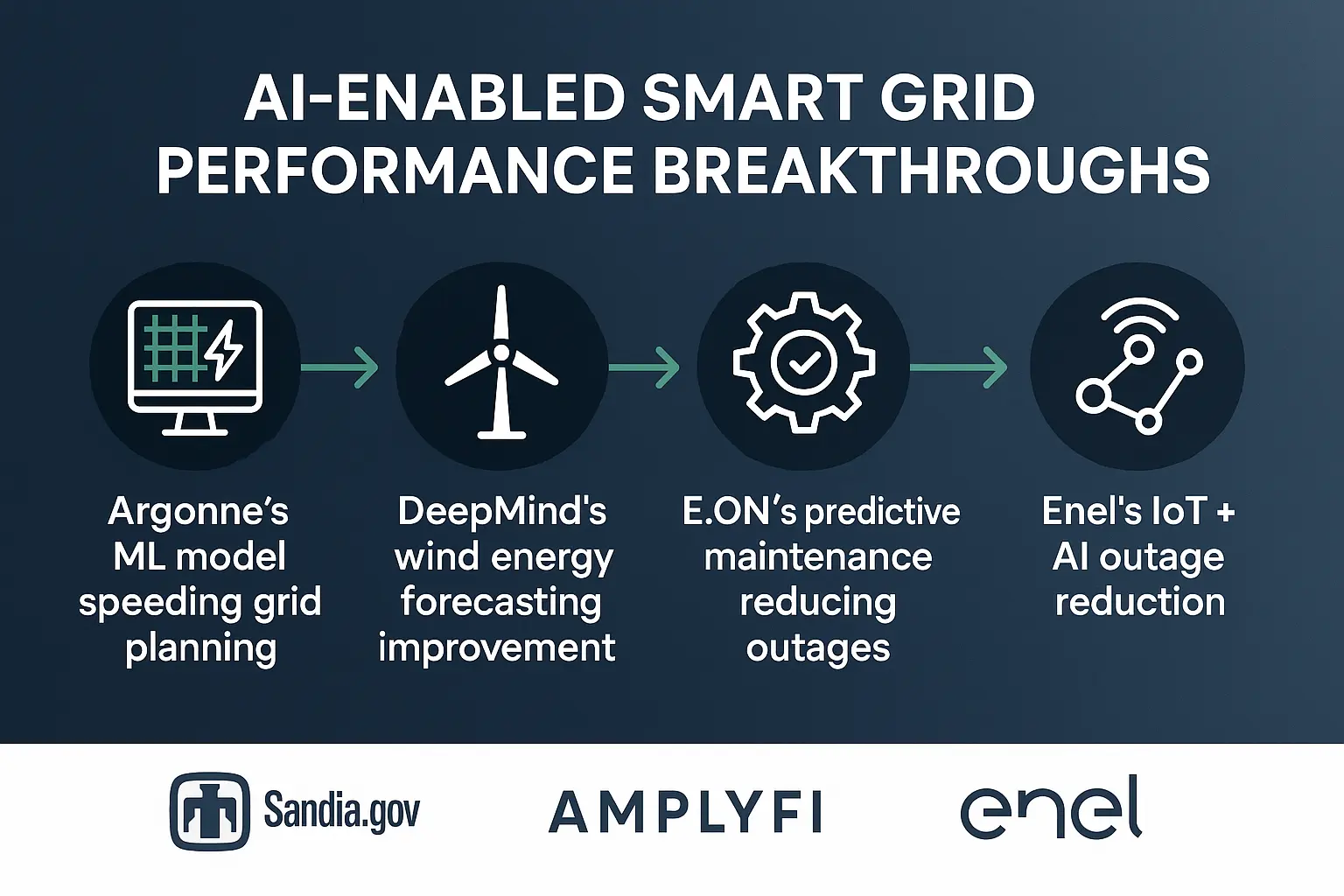
- Operational Speed: At Argonne National Laboratory, a machine learning model tasked with complex grid planning simulations reduced processing time from 10 minutes to just 60 seconds—a 90% improvement that allows for faster, more agile grid management.
- Renewable Value: As mentioned, DeepMind’s AI-powered wind forecasting increased the value of wind energy by ~20%, turning a variable resource into a predictable, highly profitable asset.
- Reliability & Resilience: E.ON and Enel have demonstrated that AI-driven predictive maintenance directly leads to significant reductions in power outages (up to 30% and ~15% respectively), improving customer satisfaction and grid stability.
- Consumer Savings: Even at the consumer level, the data is clear. A European Commission report cited by Enel found that smart meters alone—the foundational data source for grid AI—can lead to electricity savings of up to 8.9% for customers.
These figures prove that investing in AI is not a cost center; it’s a direct driver of efficiency, reliability, and financial performance. This is the kind of data that builds a compelling business case for [our integrated grid management platform].
Addressing the Elephant in the Room: AI’s Energy Footprint & Smart Grid Solutions
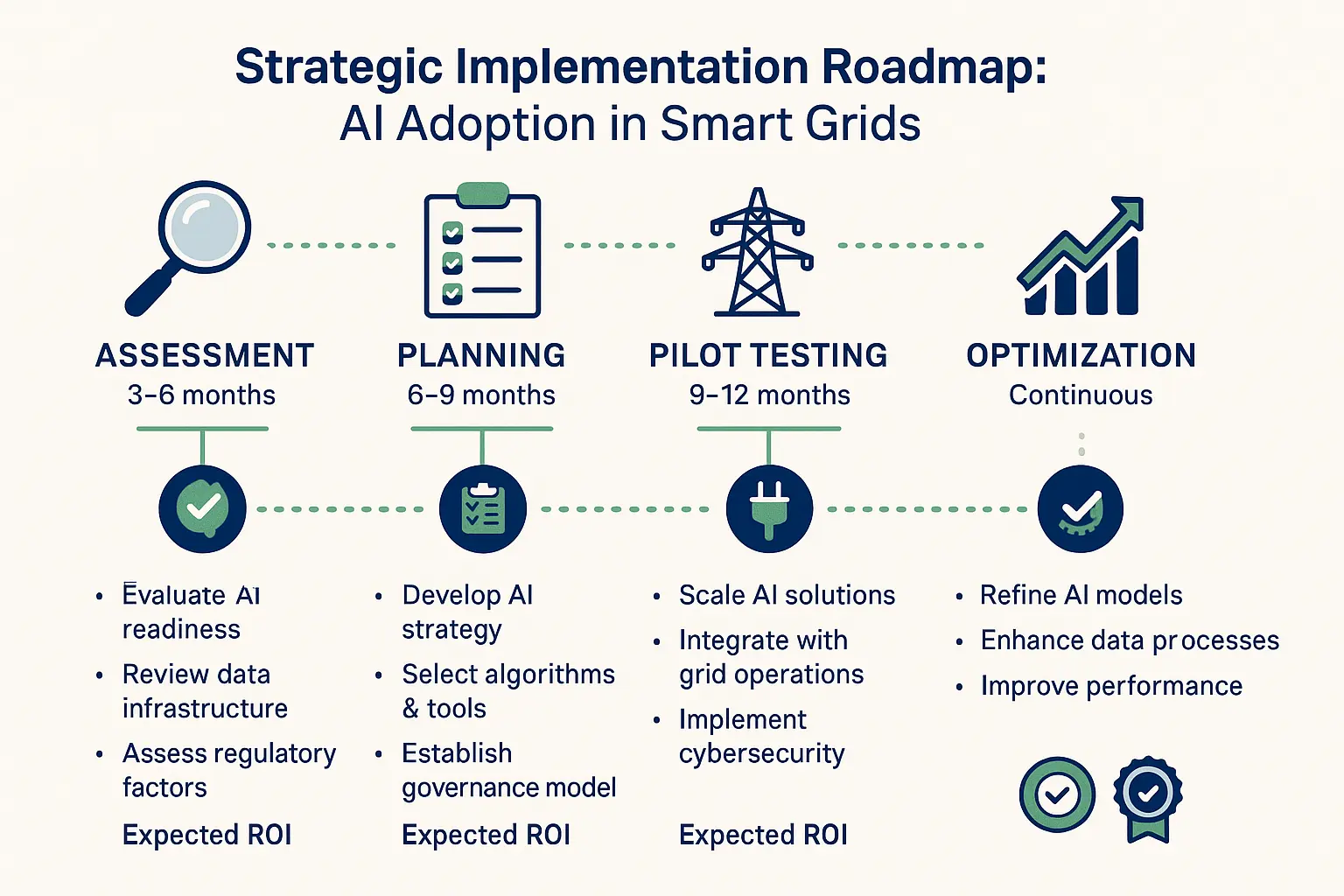
It’s a valid concern: doesn’t the massive computing power required for AI consume a huge amount of energy? The answer is yes, but it’s a critically incomplete picture. When implemented within a smart grid, AI’s efficiency gains create a powerful net-positive effect on energy consumption.
Think of it this way: AI is an investment in system-wide intelligence.
- Reducing Line Loss: AI optimizes power flow to minimize energy lost during transmission and distribution—a major source of waste in traditional grids.
- Maximizing Renewables: By making renewables more predictable, AI reduces the need for fossil-fuel-based “peaker” plants that run inefficiently to cover supply gaps.
- Optimizing Consumption: AI-driven demand-side management shifts energy use to off-peak hours, flattening demand curves and allowing the entire system to operate more efficiently.
The energy used to run the AI is dwarfed by the energy it saves across the entire ecosystem. An AI-powered grid isn’t just a solution for energy management; it’s the solution to managing energy consumption responsibly in the digital age.
The Path Forward: Implementation & Overcoming Challenges
Adopting AI is a journey, not a single step. A successful smart grid modernization project requires a strategic approach that acknowledges both the technology and the people who use it.
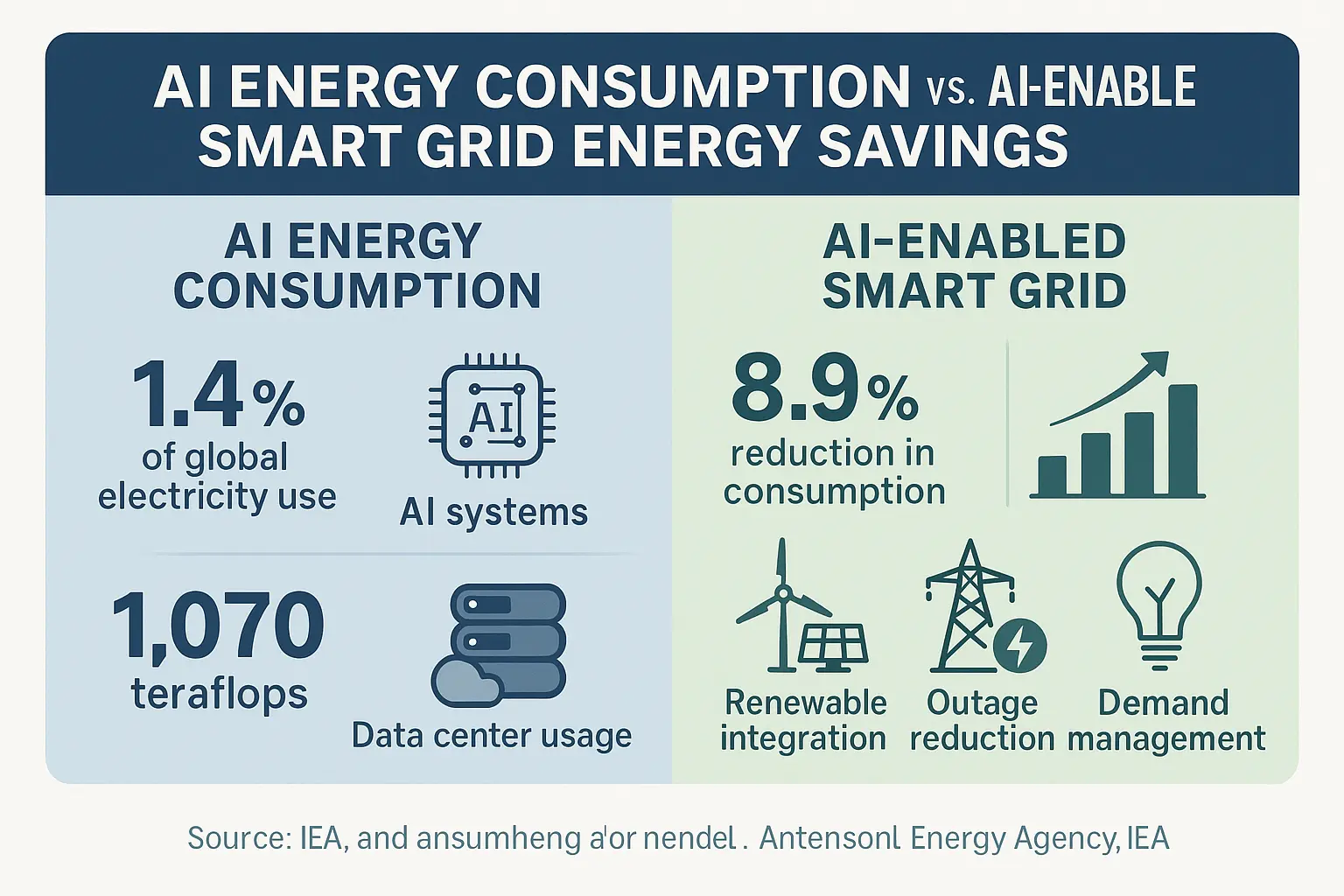
- Foundation: Data & Connectivity: It starts with robust sensor networks and Advanced Metering Infrastructure (AMI). You can’t manage what you can’t measure.
- Integration: Breaking Down Silos: AI thrives on data. Integrating previously siloed systems like your Energy Management System (EMS), Distribution Management System (DMS), and outage data is critical.
- Application: Pilot & Scale: Start with a high-impact use case, like predictive maintenance for a specific substation or demand forecasting for a key industrial area. Prove the value, then scale the solution across the network.
- Security: A Day-One Priority: Cybersecurity cannot be an afterthought. Build a defense-in-depth strategy with AI-powered monitoring from the very beginning.
Of course, challenges exist. Regulatory frameworks, data privacy concerns, and ensuring equitable access for all consumers are real hurdles. Partnering with an expert in [AI-driven energy solutions] can help you navigate these complexities and build a roadmap that delivers both technological and societal value.
Frequently Asked Questions
Is my current infrastructure compatible with AI?
Most modern SCADA and EMS systems can be augmented with AI. The key is data accessibility. Our approach focuses on integrating with your existing systems to leverage the data you already have, adding new sensor data strategically where it provides the most value.
What is the typical ROI on an AI grid management project?
ROI varies based on the specific application, but it’s typically driven by three factors:
- Operational Efficiency: Reduced maintenance costs and optimized crew deployment.
- Asset Longevity: Extending the life of transformers and other critical equipment through predictive maintenance.
- Energy Market Gains: Improved forecasting and optimized dispatch of resources like energy storage and renewables.We can work with you to model a specific business case based on your grid’s unique characteristics.
How do you ensure the security of an AI-controlled grid?
Our security model is multi-layered. It includes anomaly detection to identify threats in real-time, encrypted communications to protect data in transit, and strict access controls to prevent unauthorized actions. We treat grid security as a core function of the AI, not a separate feature.
We’re a smaller utility. Is this technology scalable for us?
Absolutely. Cloud-based AI platforms have made this technology accessible to utilities of all sizes. You don’t need a massive data center. The key is to start with a focused, high-value project that solves a specific pain point and demonstrates clear ROI before scaling up.
Your Partner in Building an Intelligent Energy Future
The transition to a modern, intelligent grid is the defining challenge of our industry. It requires more than just new hardware; it requires a new way of thinking—one that puts data, prediction, and automation at the core of your operations.
By understanding how specific AI tools solve specific grid challenges, you can cut through the hype and build a clear, data-driven strategy for modernization. You can move from reacting to problems to proactively preventing them, transforming your grid into a resilient, efficient, and intelligent asset for the future.
Ready to explore how AI can be tailored to your specific grid modernization goals? [Let’s schedule a consultation] to discuss your roadmap.
