
You’re looking at a dashboard that predicts a 15% spike in energy demand for tomorrow afternoon. Your current AI models are excellent at forecasting the what and the when. But they can’t answer the crucial follow-up questions: Why is the spike happening? Is it the heatwave, a new industrial park coming online, or a behavioral shift from a recent time-of-use pricing change?
And more importantly, what if you launched a demand-response campaign to targeted districts? Would it flatten the curve, or just shift the peak?
This is the intelligence gap where traditional machine learning falls short. In a sector where decisions have multi-million dollar consequences and impact critical infrastructure, relying on correlation alone is a high-stakes gamble. You need to move beyond prediction to understanding cause and effect. You need Causal AI.
The Energy Intelligence Gap: Where Traditional AI Falls Short
The AI in energy market is projected to surge from $5.1 billion to over $22.2 billion by 2033, a clear sign that the industry is betting big on data-driven intelligence. Yet, a critical vulnerability exists in how most of these systems operate. They are built on correlational models that are fundamentally unequipped for the unique physics and dynamics of energy systems.
Traditional ML models fail for several specific reasons in this environment:
- They assume a stable world: Most models are trained on historical data assuming future conditions will resemble the past (a concept known as i.i.d., or independent and identically distributed data). But energy grids are dynamic systems constantly shaped by new interventions—renewable sources coming online, policy changes, EV adoption, and extreme weather. A model that saw a correlation between sun and solar output can’t reason about the impact of a new subsidy for home battery storage.
- They ignore physics: An AI model might find a spurious correlation between two unrelated grid events, but it has no inherent understanding of thermodynamics or Kirchhoff’s laws. This leads to recommendations that are physically impossible or dangerously inefficient.
- They can’t handle interventions: A standard predictive model can’t tell you the precise impact of a deliberate action you haven’t taken before. It can only forecast based on what it’s already seen. This makes proactive planning and policy evaluation a guessing game.
- They are “black boxes”: When a model recommends curtailing power to a specific substation, operators and regulators need to know why. The lack of transparency in many ML systems is a major barrier to building trust in mission-critical applications.
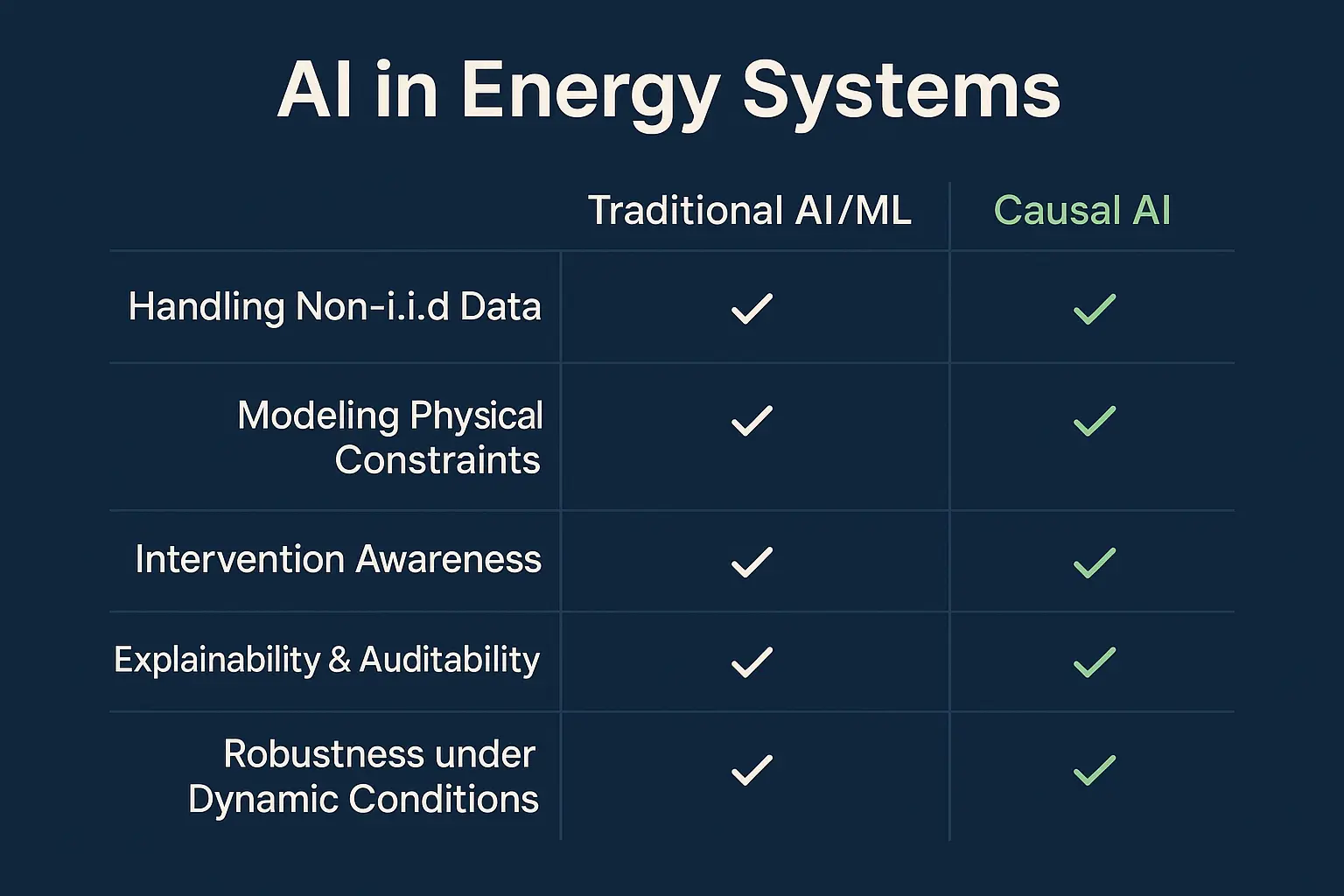
Causal AI is designed specifically to overcome these challenges. It moves beyond finding patterns to building a true model of the underlying system, allowing you to ask the questions that really matter.
Causal AI Explained: Unraveling Cause & Effect in Energy
At its core, Causal AI is a branch of artificial intelligence that focuses on identifying and understanding true cause-and-effect relationships within a system. Instead of just observing that A and B happen at the same time, it seeks to determine if A actually causes B.
For energy systems, this is achieved by creating a Structural Causal Model (SCM). Think of an SCM as a digital twin of your operational reality, but instead of just simulating physics, it maps the web of causal relationships between all relevant variables—from transformer load and weather patterns to market prices and consumer behavior.
This process involves two key stages:
- Causal Discovery: This is the process of learning the causal structure from your data, often augmented with domain expertise. It answers the question: “What influences what?” For example, discovering that increased solar irradiance directly causes a drop in demand from the central grid, but that this effect is mediated by the local adoption rate of rooftop solar panels.
- Causal Effect Estimation: Once the structure is known, this stage quantifies the strength of these relationships. It answers: “By how much?” For instance, quantifying that for every 1°C increase in temperature above 25°C, residential energy demand increases by 3.5%.
This two-step approach creates a robust, explainable model of your energy system that forms the foundation for a much more powerful form of analysis: counterfactual reasoning.
Counterfactual Reasoning: Simulating the Future of Energy Decisions
Counterfactuals are the technical term for “what-if” questions. They are questions about alternative histories—what would have happened if something had been done differently? While humans reason this way intuitively, traditional AI cannot. Causal AI makes it possible.
Using a Structural Causal Model, we can use a concept called the “do-operator” to simulate an intervention. We can digitally “reach into” our model of the energy system and change one variable while holding others constant to see the precise, isolated impact of that change.
Consider these scenarios, which are impossible to answer with correlation-based AI but straightforward for Causal AI:
- Policy Evaluation: “What would Germany’s carbon emissions have been last year if the renewable energy subsidy had been 10% higher?”
- Grid Investment: “If we invest $50 million in upgrading Substation C instead of building a new battery storage facility, what would be the impact on grid reliability during the next heatwave?”
- Operational Planning: “What would have been the effect on our system load yesterday if we hadn’t initiated the industrial demand-response program?”
Counterfactual analysis transforms decision-making from reactive to proactive. It allows you to test the consequences of your choices in a virtual environment before committing resources in the real world, drastically reducing risk and optimizing outcomes.
Applications in Energy Systems: From Grid to Policy
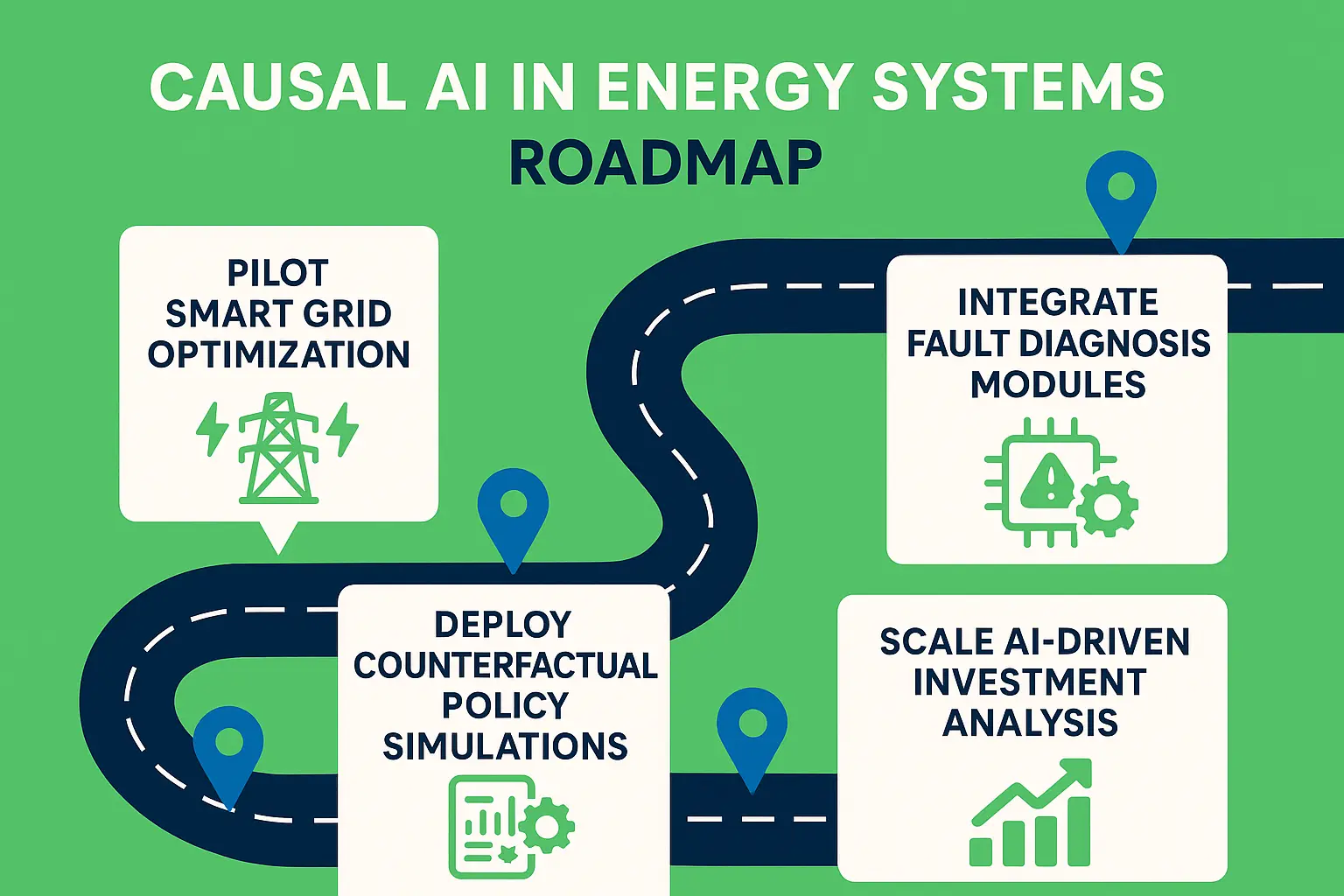
By moving from correlation to causation, Causal AI unlocks new levels of efficiency, reliability, and strategic foresight across the entire energy value chain. The applications are transformative because they address the core “why” behind operational challenges.
Smart Grid Optimization & Reliability
Instead of just predicting outages, Causal AI identifies their root causes. Is a series of transformer failures due to aging equipment, a specific weather pattern, or the harmonic distortions introduced by a new cluster of EV chargers? Knowing the true cause allows for targeted, cost-effective interventions—true grid modernization—rather than expensive blanket upgrades.
Energy Demand Forecasting & Management
As highlighted in research summarized by Causify.ai, causal models provide more accurate and robust energy demand predictions by untangling interdependent factors. They go beyond simple prediction to explain why consumption patterns are changing, enabling more effective load management, personalized energy efficiency recommendations, and smarter pricing strategies. This is the foundation of a truly intelligent energy management system.
Energy Policy & Investment Analysis
Counterfactual analysis is a game-changer for policymakers and investors. By simulating the effects of different carbon taxes, renewable energy incentives, or infrastructure investments, leaders can make evidence-based decisions that maximize positive impact while minimizing unintended consequences.
Fault Detection & Diagnosis
In complex systems like power plants or wind farms, Causal AI can distinguish between a symptom and its root cause. This accelerates diagnostics, reduces downtime, and allows maintenance to shift from a reactive to a predictive and preventative model.
Building Trust: Explainability, Auditability, and Robust Causal Evaluation
A common criticism, even within academic circles, is the “widespread lack of rigorous causal evaluation.” An AI that can’t be trusted is useless in a critical infrastructure context. This is why building Causal AI solutions for energy must have trust and transparency at its core.
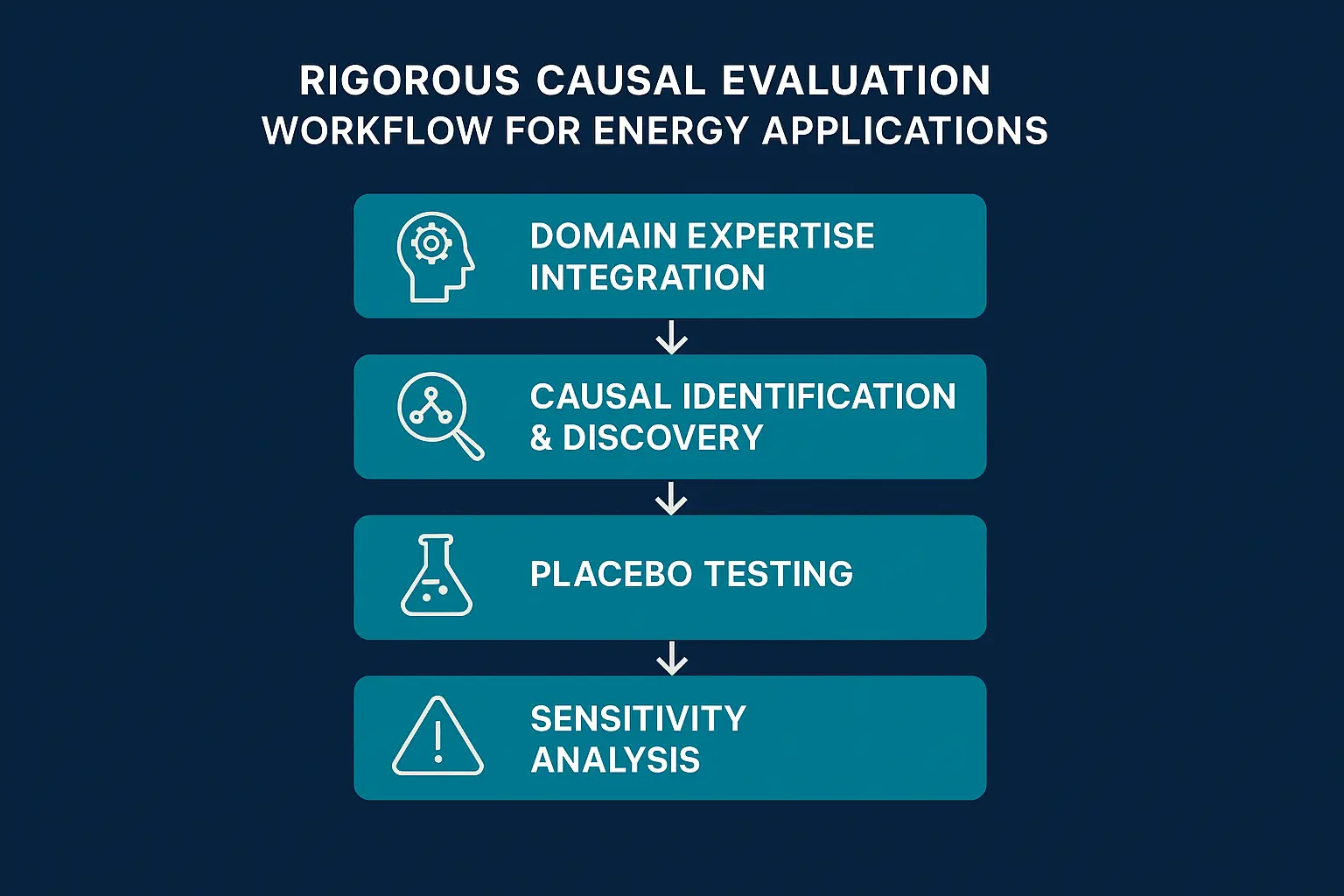
Unlike black-box models, causal models are inherently explainable. The Structural Causal Model itself serves as a clear, auditable map of how the system works. But true confidence comes from rigorous validation. Any robust causal claim should be supported by a suite of evaluation techniques:
- Placebo Tests: Intentionally testing a variable you know has no causal effect to ensure your model correctly finds a zero impact.
- Sensitivity Analysis: Testing how much the model’s conclusions change if you alter some of its underlying assumptions.
- Refutation Tests: Adding a random variable as a common cause to see if it changes the result; if it does, the original model may be flawed.
By combining these statistical methods with the integration of domain knowledge—the physics and engineering principles that govern energy systems—we can build AI that decision-makers can understand, question, and ultimately, trust.
The Energy Footprint of AI: Causal AI as Part of the Solution
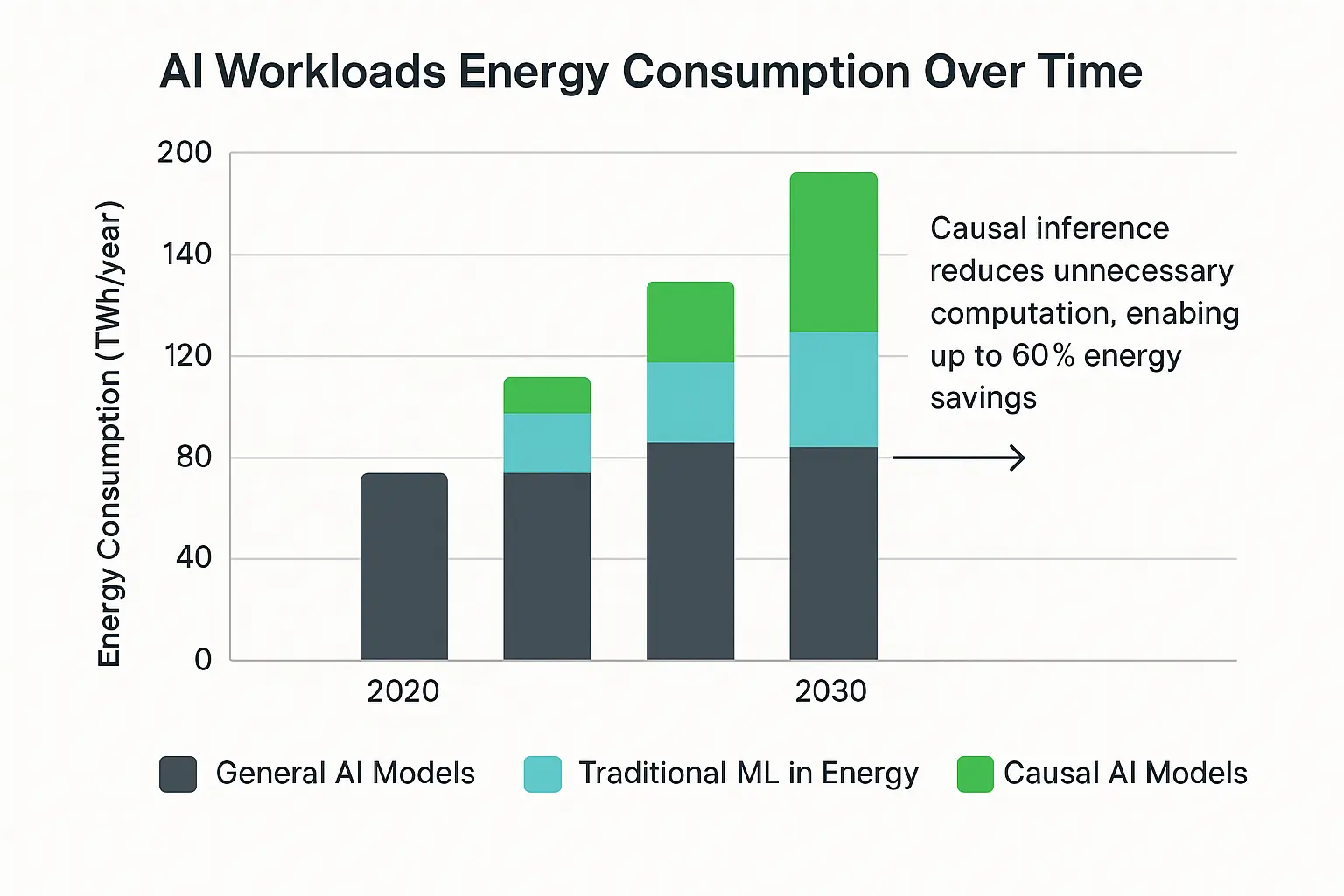
It’s impossible to discuss the future of AI without addressing its own significant energy consumption. Projections show that electricity demand from data centers could more than double by 2030, with AI workloads being a primary driver. As the U.S. prepares for total electricity consumption to grow over 55% by 2050, finding more efficient AI is not just an option—it’s a necessity.
This is another area where Causal AI offers a strategic advantage.
By identifying the most powerful causal levers in a system, Causal AI enables more targeted and efficient interventions. Instead of running massive, brute-force optimization models, you can focus on the few key drivers that create the most impact. This leads to not only more efficient energy systems but also more computationally efficient—and therefore energy-efficient—AI. A causal model that understands the true drivers of grid instability requires less data and processing power to find a solution than a correlational model sifting through terabytes of irrelevant data.
Your Questions on Causal AI, Answered
How is Causal AI different from the Explainable AI (XAI) we already use?
XAI techniques like SHAP or LIME are primarily “post-hoc” explainers. They try to approximate the reasoning of an existing black-box model, essentially explaining what the model paid attention to. Causal AI is different. It builds an intrinsically transparent model of the real-world system from the start. It explains why the system behaves the way it does, not just why the model made a particular prediction.
What kind of data is needed to implement Causal AI?
Causal AI can leverage the same time-series data, sensor readings, and operational logs you already collect. The key difference is the methodology. It benefits immensely from data on interventions—past policy changes, maintenance records, equipment upgrades, or new assets coming online. This intervention data is crucial for validating the learned causal relationships.
Isn’t this too academic? How practical is it for real-world operations today?
While rooted in decades of academic research by pioneers like Judea Pearl, Causal AI is now highly practical. Modern platforms have automated many of the complex steps of causal discovery and inference, making it accessible to enterprise data science teams and engineers. The value isn’t in the theory; it’s in applying that theory to solve concrete operational problems like reducing grid congestion or optimizing renewable energy integration.
What is the typical ROI on implementing a Causal AI solution?
The ROI comes from multiple sources: improved operational efficiency (e.g., reducing fuel costs by 10-20% through better dispatch), enhanced asset longevity (predicting and preventing failures), reduced capital expenditure (making smarter, targeted investments based on counterfactual analysis), and improved regulatory compliance through auditable decision-making. Specific ROI depends on the application, but it’s typically measured in the millions of dollars for large-scale energy systems.
The Future is Causal
The energy sector is at a crossroads. The complexity of managing a grid with distributed resources, dynamic loads, and climate uncertainty has surpassed the capabilities of traditional analytics. Continuing to rely on correlation-based AI is like trying to navigate a storm with only a weather forecast—it tells you rain is coming, but not where the leaks are or how to best patch the roof.
Causal AI provides the blueprint of the entire house. It empowers you to understand the system, simulate your decisions, and act with confidence.
Ready to move beyond mere prediction and start making truly intelligent energy decisions? Explore how a Causal Readiness Assessment can identify the highest-value opportunities to apply Causal AI in your operations.
