
The CISO’s Dilemma: Securing the AI-Driven Smart Grid Without Stifling Innovation
You’re tasked with modernizing your grid. AI promises unprecedented efficiency, predictive maintenance, and seamless integration of renewables. But every new smart meter, IoT sensor, and interconnected substation also represents a new doorway for cyber threats. The challenge isn’t just about preventing attacks; it’s about building a resilient, compliant, and trustworthy energy infrastructure for the future.
You’re not just looking for a security product. You’re looking for a strategy. You need a framework to evaluate the real risks, understand the capabilities of next-generation defenses, and ensure your data governance is as intelligent as your grid. This is where the gap often lies—between high-level academic theories and practical, actionable guidance for IT and OT leaders.
This guide bridges that gap. We’ll move beyond the buzzwords to provide a clear-eyed evaluation framework for securing your AI-driven smart grid, grounded in the realities of your operational environment.
The Evolving Threat Landscape of AI-Powered Smart Grids
The drive to modernize is undeniable, reflected in a global smart grid cybersecurity market projected to skyrocket from around $7 billion in 2023 to over $25 billion by 2033. This massive investment is a direct response to the escalating sophistication of cyber threats. The 2015 Ukraine power grid attack was a wake-up call, but today’s threats have evolved far beyond traditional malware.
AI is a double-edged sword. While it’s the key to unlocking grid potential, it also powers a new generation of attacks. The core challenge for every utility leader is balancing this powerful innovation with ironclad security and governance.
Decoding Smart Grid Vulnerabilities in an AI Era
To build an effective defense, you must first understand the specific vulnerabilities of a modern, interconnected grid. The attack surface is no longer a simple perimeter; it’s a dynamic, distributed ecosystem.
- Expanded Attack Surface: Every smart meter, EV charging station, and distributed energy resource (DER) is a potential entry point. As noted by industry experts at Cyient, this massive increase in connected devices multiplies vulnerabilities far beyond the traditional control center.
- Legacy System Integration: Your grid is a hybrid environment. Critical, decades-old SCADA systems must now communicate with modern IT networks. This convergence creates complex security gaps where legacy protocols, never designed for internet connectivity, are exposed to new threats.
- New AI-Powered Threat Vectors: Adversaries are now using AI to automate and accelerate their attacks. Imagine AI-generated “deepfake” commands mimicking a grid operator, or malicious AI poisoning the data from your sensors to create synthetic blackouts. These are no longer theoretical threats; they are emerging realities.
- The Persistent Human Element: Technology is only part of the equation. As academic analyses in journals like ScienceDirect consistently show, social engineering, phishing campaigns, and insider threats remain some of the most effective attack vectors against critical infrastructure.
AI as the Shield: Advanced Detection & Mitigation Strategies
While AI creates new threats, it’s also our most powerful defense. Traditional, signature-based Intrusion Detection Systems (IDS) are insufficient for the zero-day and polymorphic attacks targeting smart grids. The future of grid security lies in AI that can think, adapt, and respond in real time.
Moving Beyond Traditional IDS
Static, rule-based systems can’t keep up. They look for known threats, leaving you blind to novel attacks. The key is shifting from a reactive posture to a proactive, predictive one. This requires a new class of AI-driven security.
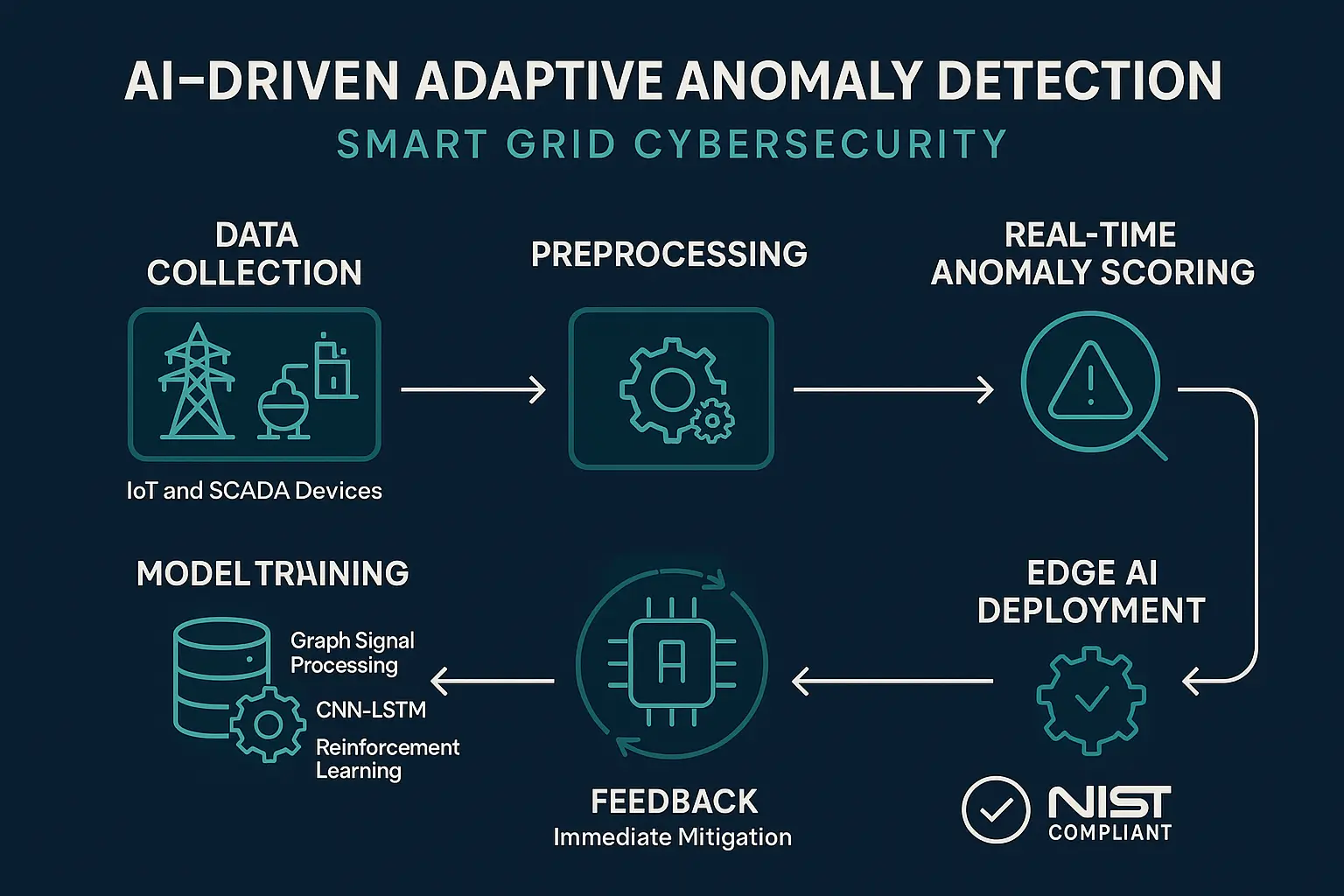
- Adaptive Anomaly Detection: True security intelligence involves teaching an AI model what “normal” looks like for your specific grid—every voltage fluctuation, data packet, and user command. By leveraging high-performance computing and advanced machine learning models (like Graph Signal Processing or CNN-LSTM architectures), this system can instantly spot subtle deviations that indicate a sophisticated attack in progress. This is the core of a modern AI-driven threat intelligence platform.
- Edge AI for Proactive Response: You can’t afford latency when a substation is under attack. Deploying AI models directly on edge devices within substations or at renewable generation sites allows for immediate, localized threat mitigation—isolating a compromised device or rerouting power in milliseconds, long before the threat reaches your central command.
- Digital Twins for Threat Simulation: How do you prepare for an attack you’ve never seen? By creating a virtual replica of your entire grid, you can use a “digital twin” to safely simulate a wide range of cyberattacks. This allows you to test your response protocols, identify hidden weaknesses, and train your AI models on a diverse set of threat scenarios without risking a single electron of live power.
Fortifying the Core: Secure Communication and a Zero Trust Architecture
Advanced threat detection is critical, but it must be built on a foundation of fundamentally secure architecture. In a distributed grid, this means securing data in transit and challenging the old security model of a trusted internal network.
A Layered Approach to Secure Protocols
There is no one-size-fits-all protocol. A robust strategy involves layering security based on the specific context and operational constraints of each data link.
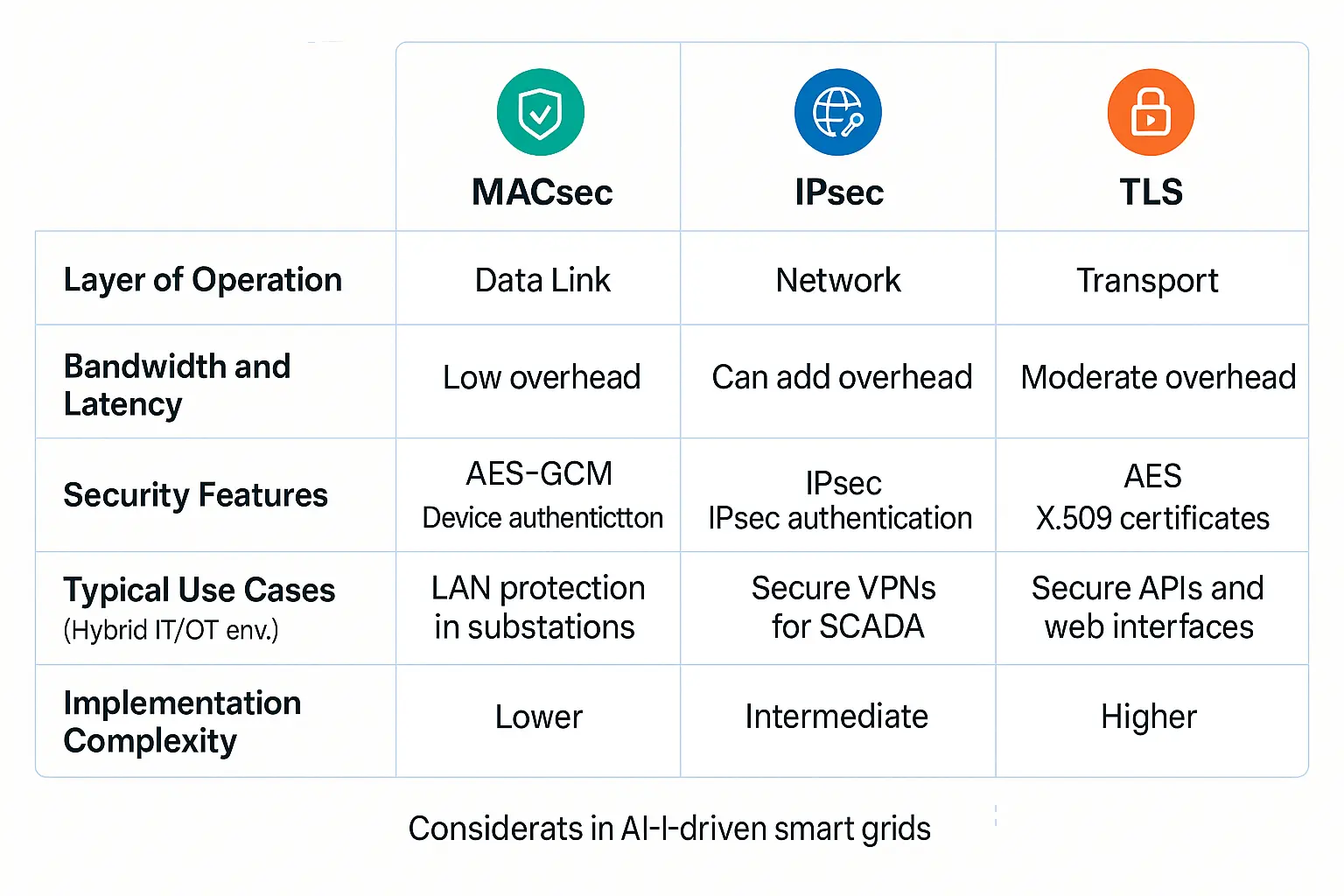
- TLS/IPsec: These are the workhorses for securing data over wide area networks (WANs), essential for protecting communications between control centers and remote substations.
- MACsec: This is a crucial but often overlooked layer. MACsec provides point-to-point security at the data link layer (Layer 2), making it ideal for securing high-speed, low-latency traffic within a substation or across a campus LAN. It protects against threats that IPsec can’t, like ARP spoofing and MAC flooding. Choosing between them isn’t an “either/or” decision; it’s about applying the right tool for the right job.
Adopting a Zero Trust Architecture (ZTA) for IT/OT
The concept of a secure perimeter is obsolete. A Zero Trust Architecture assumes that no user or device—inside or outside the network—should be trusted by default. For a smart grid, this means:
- Continuous Authentication: Every request to access data or control a device must be continuously verified, regardless of its origin.
- Micro-segmentation: The network is broken down into small, isolated zones. If one segment is breached (e.g., a bank of smart meters), the segmentation contains the threat and prevents it from moving laterally to more critical systems like grid controllers.
- Principle of Least Privilege: Users and devices are only granted the absolute minimum level of access required to perform their specific function.
Implementing a Zero Trust Architecture for critical infrastructure is not a product you buy; it’s a strategic shift in security philosophy that is essential for protecting a modern, hybrid IT/OT environment.
Data Governance & Ethical AI: Building Trust and Compliance
A secure grid is not enough; it must also be trustworthy. The vast amounts of data collected by smart meters and sensors create immense value, but also significant privacy risks and regulatory burdens. Robust data governance isn’t just a compliance checkbox—it’s a prerequisite for public and regulatory acceptance.
- The Data Deluge & Privacy Risks: Granular energy consumption data can reveal deeply personal information about a household’s lifestyle. A data breach doesn’t just risk grid stability; it risks a massive loss of public trust.
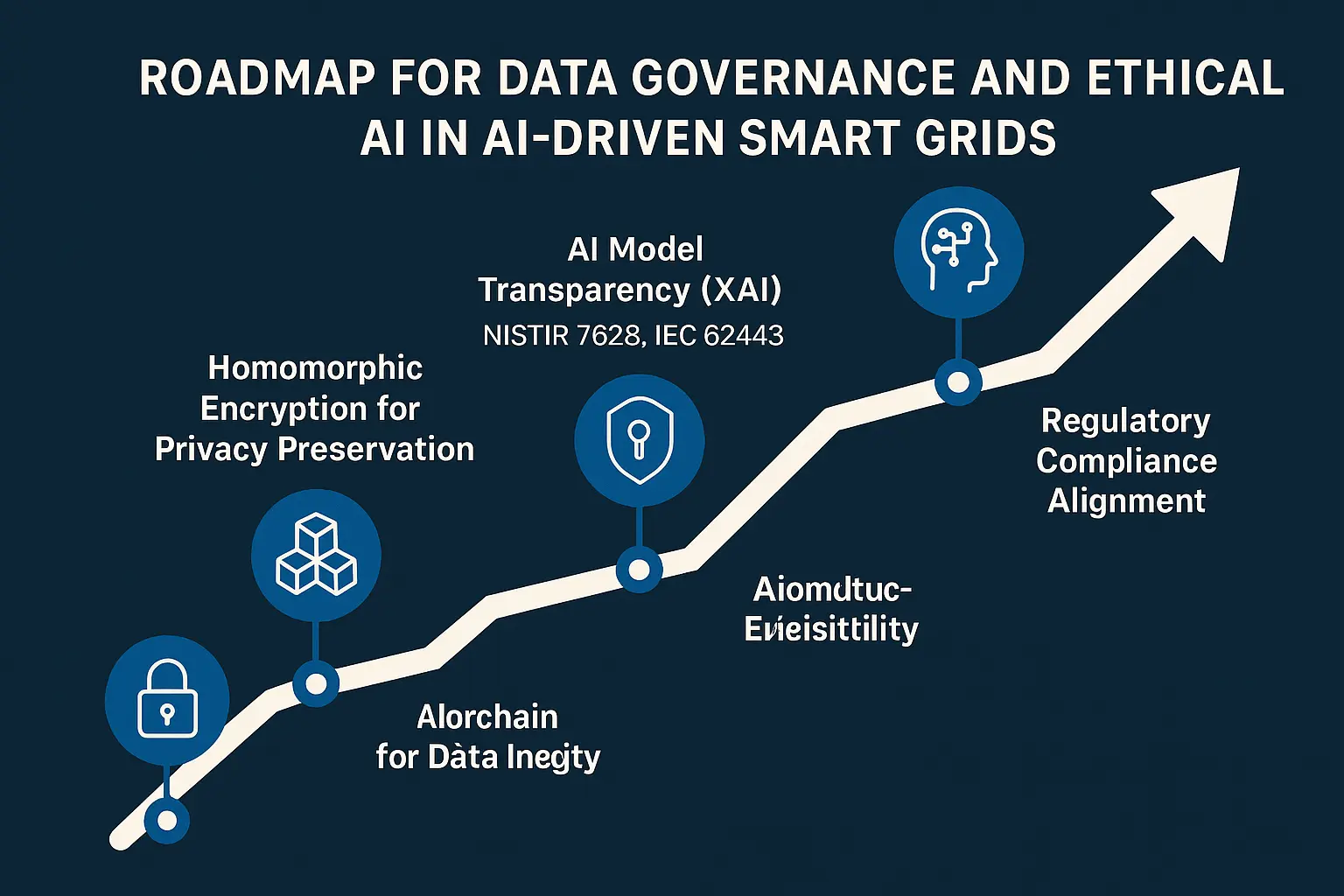
- Ethical AI Principles: The AI models managing our grid cannot be black boxes. We need Explainable AI (XAI) that can articulate why it made a certain decision. This transparency is crucial for forensic analysis after an incident and for proving to regulators that the system is operating without bias.
- Privacy-Preserving Techniques: Advanced methods like homomorphic encryption allow calculations to be performed on encrypted data without ever decrypting it, protecting consumer privacy while still enabling valuable analytics.
- Regulatory Alignment: Adherence to key frameworks is non-negotiable. This includes foundational guidance from NIST (NISTIR 7628, Cybersecurity Framework) and industry-specific standards like NERC CIP and IEC 62443. A sound strategy maps your security controls directly to these compliance requirements.
- Blockchain for Data Integrity: For critical operations like energy trading or tracking renewable energy credits, blockchain can provide an immutable, transparent, and auditable ledger, ensuring data integrity across multiple stakeholders.
Implementation Roadmap: Strategic Priorities for IT/OT Leaders
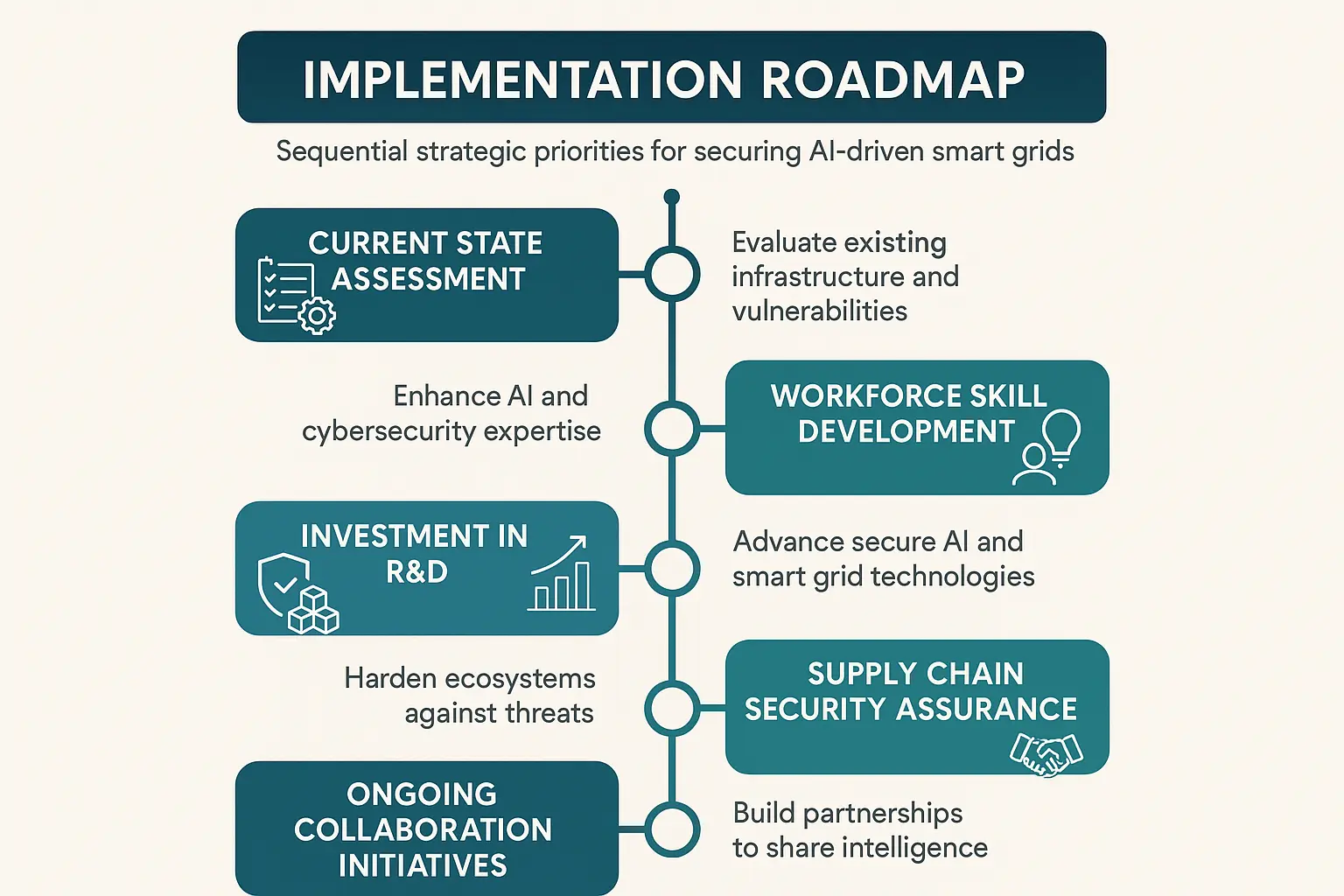
Moving from theory to practice requires a phased, strategic approach. For leaders evaluating solutions, the path forward should focus on building foundational capabilities first.
- Assess Your Current State: Begin with a comprehensive vulnerability and risk assessment across both your IT and OT environments. You cannot protect what you cannot see.
- Prioritize Crown Jewels: Identify your most critical assets and processes. Apply the most stringent security controls, like micro-segmentation and advanced threat detection, to these high-value targets first.
- Invest in Your People: The most advanced technology can be defeated by human error. Continuous workforce training on cybersecurity best practices is one of the highest-ROI investments you can make.
- Secure the Supply Chain: Your security is only as strong as your weakest vendor. Implement rigorous security audits and contractual requirements for all hardware and software suppliers.
- Foster Collaboration: Share threat intelligence with industry peers and government partners. The fight against cyber threats on critical infrastructure is a team sport.
Frequently Asked Questions (FAQ)
Q1: Our biggest challenge is integrating new security with legacy SCADA systems. How can we do this without a full “rip and replace”?
This is a common and critical concern. The key is to use compensating controls. You can’t change the legacy device, but you can wrap it in security. This involves using network segmentation to isolate the legacy systems, deploying gateway devices that can translate between modern and legacy protocols while enforcing security policies, and implementing an AI-powered anomaly detection system that can monitor the behavior of these systems for any sign of compromise.
Q2: How do we justify the high cost of advanced AI-driven security to our board and regulators?
The justification shifts from a cost-center discussion to a risk-management and value-creation conversation. Frame the investment in terms of:
- Risk Reduction: Quantify the potential financial and societal costs of a significant outage or data breach. Compare this to the investment in security.
- Regulatory Compliance: Proactive investment helps avoid significant fines and penalties associated with non-compliance with standards like NERC CIP.
- Innovation Enablement: Robust security is not a barrier; it’s the foundation that allows you to safely adopt new technologies like DERs and advanced grid analytics, unlocking new revenue streams and efficiencies.
- Resilience: The investment is not just in preventing attacks, but in ensuring you can recover quickly and maintain operations during an attack, which is a core expectation for critical infrastructure.
Q3: We have a small security team. How can we manage these complex AI systems without hiring an army of data scientists?
This is a crucial evaluation criterion for any solution. Look for platforms that are designed for operational teams, not just data scientists. The best solutions use AI to automate the most complex tasks—alert triage, threat correlation, and even initial response actions. They should provide clear, actionable insights and intuitive dashboards that empower your existing team to become more effective, rather than burying them in data. A good AI security partner acts as a force multiplier for your team.
Q4: How does Explainable AI (XAI) work in practice for grid security?
In a security event, a traditional AI might simply flag an anomaly. An XAI system will go further, telling you: “I have flagged this data stream as anomalous because the voltage signature deviates by 3 standard deviations from the learned baseline for this time of day, and it correlates with an unusual login attempt from an unrecognized IP address.” This level of detail is critical for your operators to quickly validate the threat and take the correct action, and for later forensic analysis. It turns the AI from a black box into a trusted advisor.
Towards a Resilient, Secure, and Ethical Smart Grid Future
Securing the AI-driven smart grid is one of the most complex and critical challenges of our time. It requires a fundamental shift away from siloed products and reactive postures towards an integrated strategy that weaves together advanced technology, robust data governance, and a deep commitment to ethical principles.
The goal is not to eliminate risk—that’s impossible. The goal is to build resilience. By adopting a proactive, intelligence-driven approach, you can confidently embrace the innovation that AI offers while building a grid that is secure, trustworthy, and ready for the future.
Ready to build your smart grid security strategy? Explore our in-depth guide on implementing a Zero Trust Architecture for your IT/OT environment to take the next step.
