
Choosing the Right Deep Learning Architecture for Your Energy System: A Practical Guide
You’re tasked with leveraging AI to forecast energy demand, optimize the grid, or predict equipment failures. You know deep learning is the answer, but the alphabet soup of architectures—CNN, RNN, GNN, Transformer—presents a daunting challenge. Choosing the wrong model means wasted resources, stalled projects, and subpar results in a sector where precision is non-negotiable. How do you select the architecture that not only works, but excels with the unique physics and data structures of your energy system?
This guide is built for that exact decision point. We move beyond generic definitions to provide a practical framework for energy professionals. Here, we’ll dissect how each major deep learning architecture interacts with the specific data landscapes of the energy sector—from the relentless flow of time-series data to the complex topology of the power grid. By the end, you’ll have the clarity to confidently select, advocate for, and implement the right model for your specific challenge.
Executive Summary: Navigating Deep Learning for Energy
The energy sector’s transition to a decentralized, renewable-powered future is fundamentally a data challenge. Successfully managing this complexity hinges on choosing the right deep learning tools. This guide offers an authoritative comparison of leading architectures, grounded in recent academic research and real-world implementation hurdles, to empower engineers, data scientists, and strategists to make smarter, data-driven decisions.
The Energy Data Landscape: Why Architecture Matters
In energy systems, data isn’t just a stream of numbers; it has shape, structure, and relationships. A model’s architecture must be designed to understand this underlying structure. A generic model applied to specialized energy data is like using a hammer to turn a screw—it might work, but it’s inefficient and risks breaking things.
Here’s a breakdown of common energy data types and why architectural fit is critical:
- Time-Series Data: This is the lifeblood of the grid—minute-by-minute load, solar generation, and market prices. This data is sequential, and its patterns are deeply dependent on time.
- Spatial Data: Think of satellite imagery for solar forecasting, thermal maps of substations for predictive maintenance, or geographical layouts of wind farms. The value here is in the spatial relationships between pixels or points.
- Graph Data: The power grid is a literal network of nodes (substations, generators) and edges (transmission lines). Understanding power flow, identifying vulnerabilities, and optimizing distribution requires a model that thinks in terms of graphs.
- Event Data: These are discrete occurrences like equipment faults, grid outages, or demand response triggers. They are often sparse but carry immense informational weight.
Selecting an architecture that natively understands your primary data type is the first and most critical step toward building a high-performing and reliable AI solution.
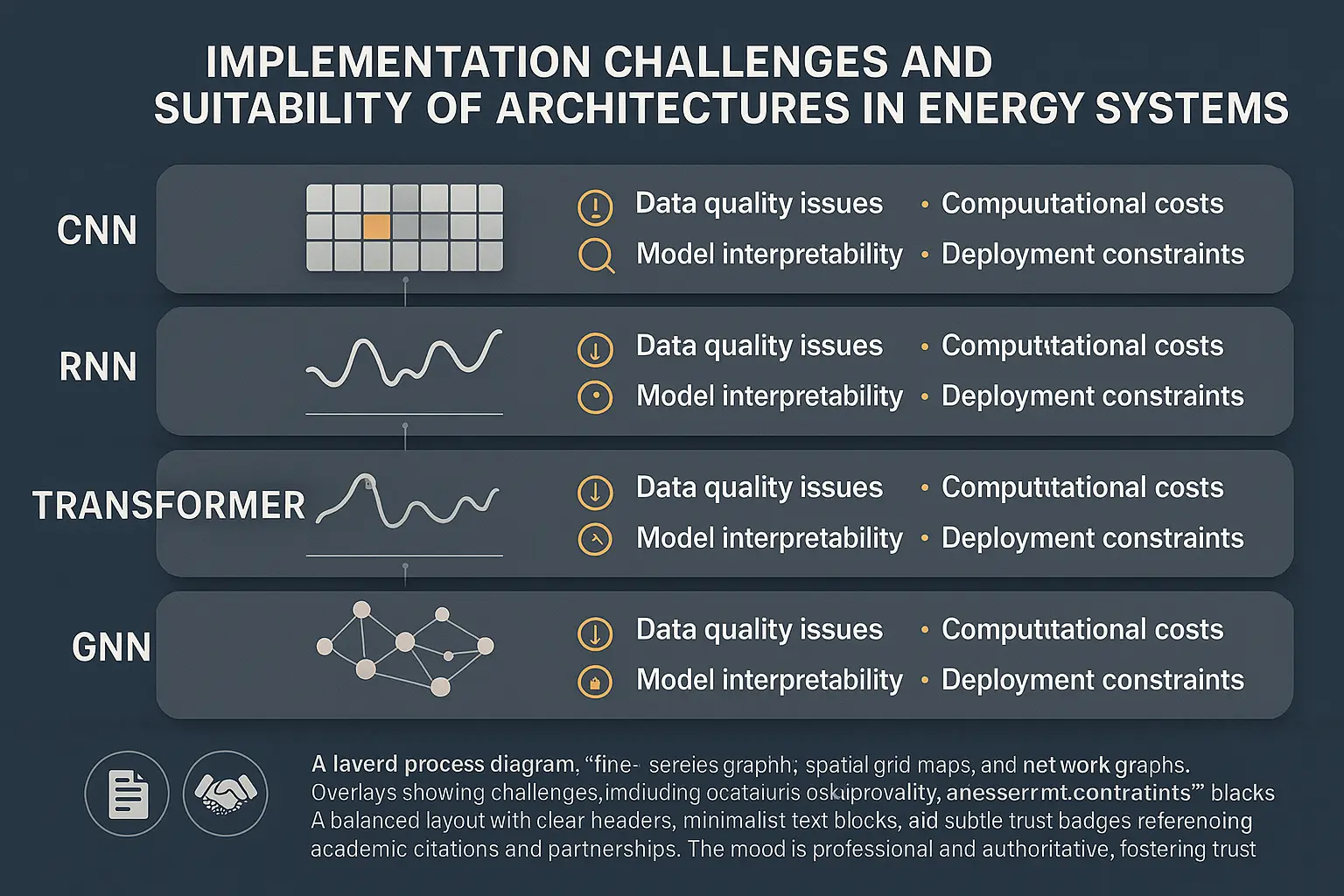
Deep Dive into Architectures: Suitability & Challenges in Energy Systems
Let’s move from the abstract to the specific. We’ll explore the four cornerstone architectures, mapping their mechanics directly to energy applications and highlighting the real-world challenges you’ll face.
Convolutional Neural Networks (CNNs) for Spatial Energy Data
- Core Principle: CNNs use filters (kernels) to scan for patterns in grid-like data. They are masters of spatial hierarchy, learning simple features like edges and textures first, then combining them into more complex objects.
- Energy System Suitability:
- Fault Detection: Analyzing thermal images of grid components to identify overheating hotspots before they fail.
- Renewable Forecasting: Processing satellite imagery to predict cloud cover movement and its impact on solar generation.
- Asset Monitoring: Using aerial imagery to detect vegetation encroachment near power lines.
- Implementation Challenges:
- Data Labeling: Requires large, accurately labeled datasets of images (e.g., thousands of images of “healthy” vs. “failing” components), which can be labor-intensive to create.
- Non-Euclidean Data: Standard CNNs struggle with the irregular structure of a power grid. While you can represent grid data as an image, it’s often an unnatural fit. This is where Graph Neural Networks often provide a more elegant solution.
Recurrent Neural Networks (LSTMs & GRUs) for Complex Energy Time-Series
- Core Principle: RNNs, particularly advanced variants like LSTM (Long Short-Term Memory) and GRU (Gated Recurrent Unit), are designed with a “memory loop.” This allows them to persist information across sequential data points, making them ideal for time-series analysis.
- Energy System Suitability:
- Load & Generation Forecasting: This is the classic use case. LSTMs excel at capturing the complex daily, weekly, and seasonal patterns in energy consumption and generation. Research consistently shows that DL models like LSTMs outperform traditional statistical methods in forecasting variable renewable energy sources by capturing these nonlinear relationships.
- Battery State-of-Charge Prediction: Modeling the degradation and charge/discharge cycles of energy storage systems over time.
- For a deeper look, explore our guide on Recurrent Neural Networks (LSTMs, GRUs) for Complex Energy Time-Series.
- Implementation Challenges:
- Vanishing/Exploding Gradients: While LSTMs and GRUs mitigate this, very long-term dependencies can still be a challenge.
- Data Quality Sensitivity: Performance is highly dependent on clean, consistent, and uninterrupted time-series data. Missing values or sensor drift can severely degrade accuracy, a common problem identified as a critical barrier to ML adoption in grids.
Transformer Models for Long-Range Dependencies in Grid Data
- Core Principle: Transformers use a mechanism called “self-attention” to weigh the importance of all data points in a sequence relative to each other simultaneously. Unlike RNNs, which process data sequentially, Transformers can see the entire sequence at once, allowing them to capture very long-range dependencies.
- Energy System Suitability:
- Long-Term Load Forecasting: Identifying how an event today (e.g., a heatwave announcement) might impact energy demand two weeks from now, bypassing the shorter-term memory limitations of some RNNs.
- Multi-Variate Forecasting: Incorporating diverse data sources (e.g., weather, market prices, grid status) and understanding their complex, long-range interactions. For a dedicated analysis, see our article on Transformer Models for Long-Range Dependencies in Grid Data.
- Implementation Challenges:
- Computational Cost: The self-attention mechanism is computationally expensive, scaling quadratically with the length of the sequence. This can be prohibitive for very high-frequency, real-time grid applications.
- Data Hungry: Transformers typically require massive datasets to perform well. A recent Nature study on solar power prediction noted that a standard Transformer performed poorly without architectural modifications, likely due to a geographically limited dataset.
Graph Neural Networks (GNNs) for Power Grid Topology
- Core Principle: GNNs are purpose-built to operate on graph-structured data. They work by passing messages between connected nodes, allowing each node to learn from its neighbors and understand its role within the broader network context.
- Energy System Suitability:
- Power Flow Optimization: Modeling the physics of electricity flow through the grid’s complex topology to optimize efficiency and prevent congestion.
- Cascading Failure Analysis: Simulating how a fault in one part of the grid could propagate and impact other components, a task impossible for non-graph-aware models.
- Grid Resilience & Security: Identifying critical vulnerabilities in the grid network. Get the full technical breakdown in our brief on Graph Neural Networks for Power Grid Topology Optimization.
- Implementation Challenges:
- Dynamic Graphs: Power grids are not static; circuit breakers trip and lines go down. Handling these dynamic changes to the graph structure in real-time is a complex engineering challenge.
- Scalability: Applying GNNs to massive, continent-spanning power grids requires highly optimized algorithms and significant computational resources.
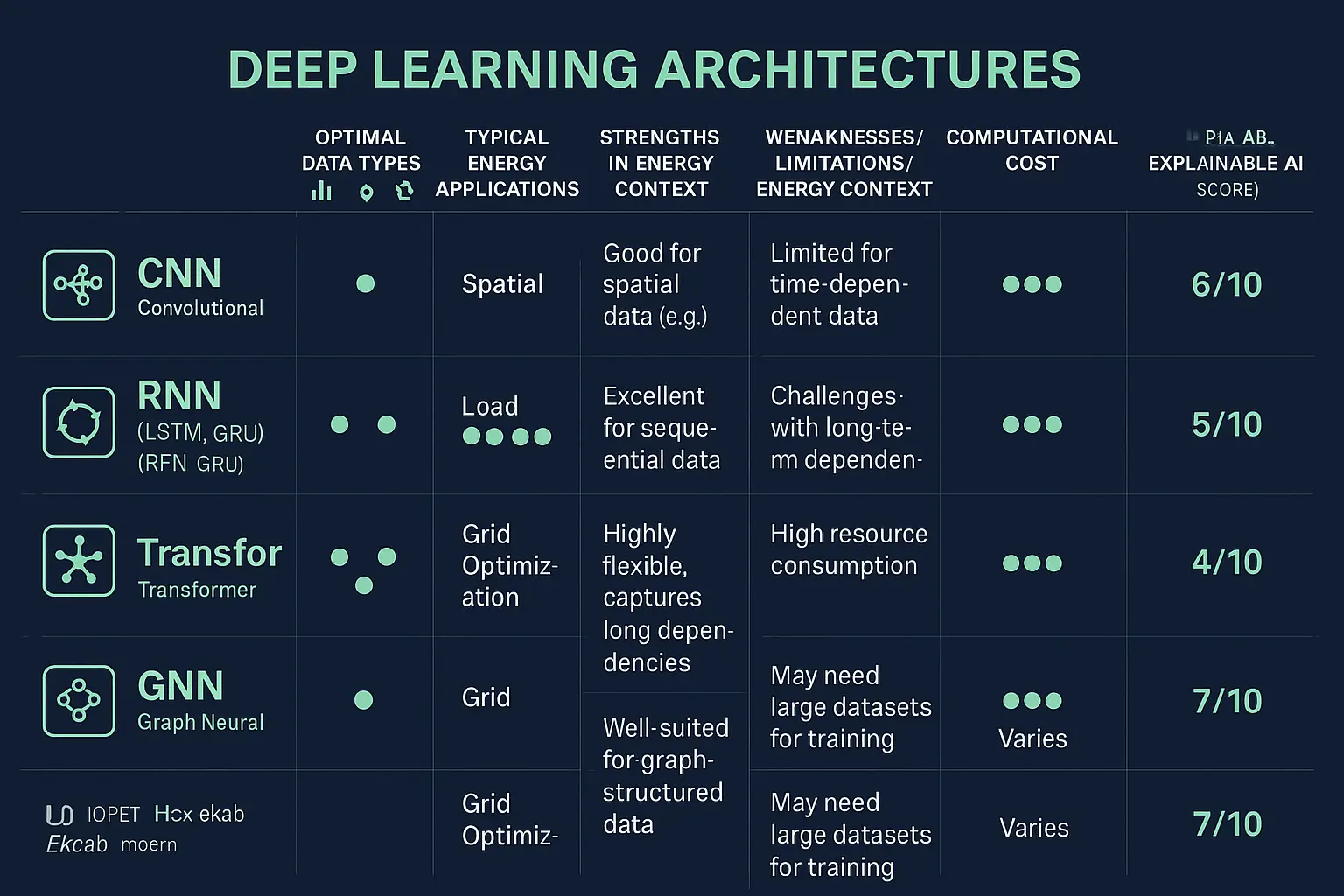
Comparative Analysis Matrix: Choosing Your Energy DL Architecture
To help you evaluate these options side-by-side, this matrix maps each architecture to the decision criteria most relevant for energy system professionals.
| Criteria | Convolutional Neural Network (CNN) | Recurrent Neural Network (RNN/LSTM) | Transformer | Graph Neural Network (GNN) |
|---|---|---|---|---|
| Optimal Data Type | Spatial / Grid-like (e.g., Images) | Sequential / Time-Series | Long Sequential / Multi-variate | Graph / Network |
| Typical Energy Apps | Fault detection, Asset monitoring | Load/price forecasting, Battery modeling | Long-term forecasting, Anomaly detection | Power flow optimization, Resilience analysis |
| Strengths | Excellent at feature extraction from spatial data. Computationally efficient. | Proven performance in time-series forecasting. Captures temporal dependencies. | Captures very long-range dependencies. Highly parallelizable. | Natively understands network physics and topology. Context-aware. |
| Weaknesses | Struggles with non-Euclidean data like grid topology. | Can have difficulty with very long-term memory. Processes data serially. | Computationally expensive. Requires very large datasets to excel. | Complex to implement. Can be challenged by dynamic graph structures. |
| Computational Cost | Low-Medium | Medium | High | Medium-High |
| Interpretability | Medium (via techniques like Grad-CAM) | Low (difficult to trace decisions over time) | Low-Medium (attention maps help) | Medium (node importance can be inferred) |
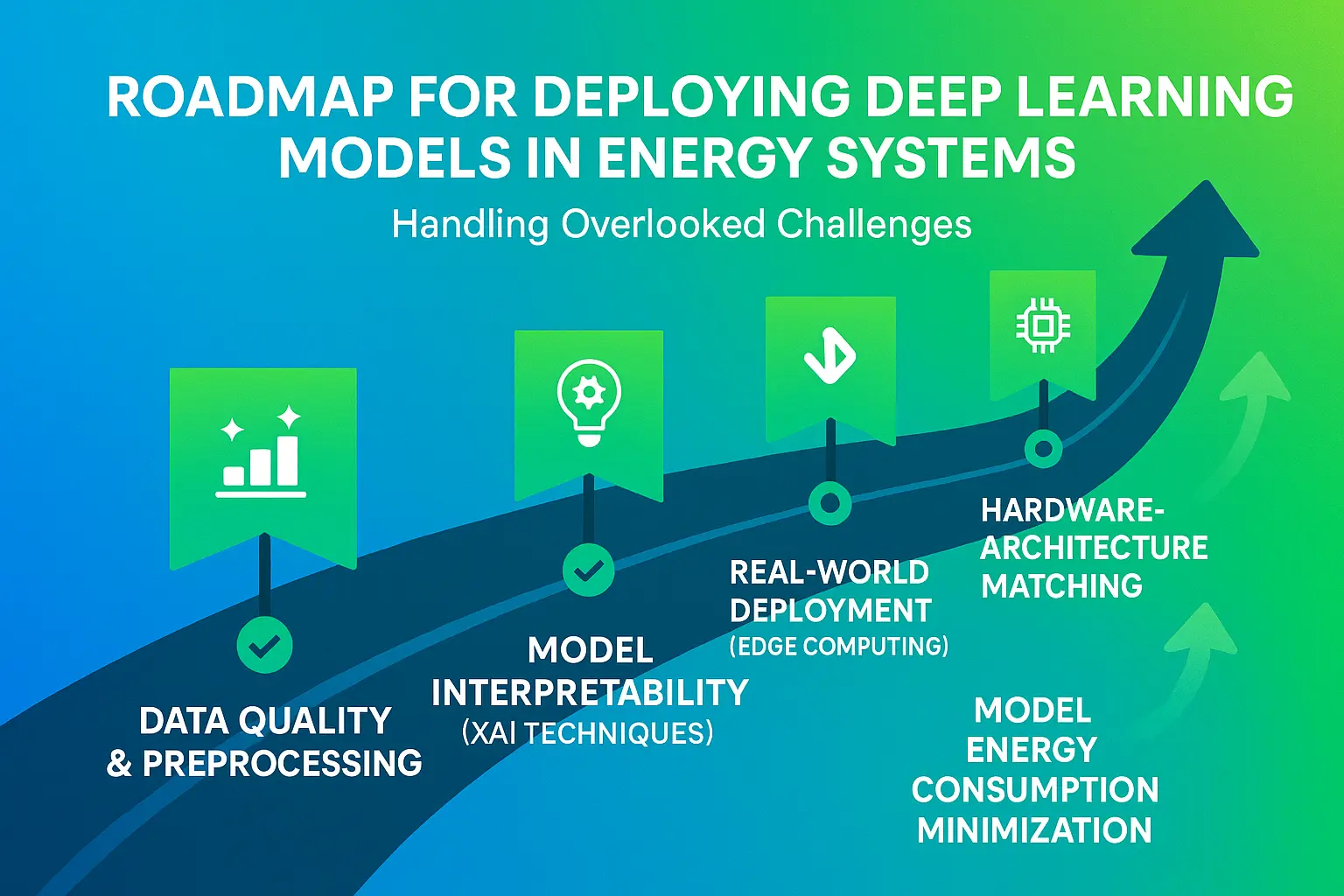
Overcoming the Overlooked: Practical Solutions for Energy DL Deployment
Choosing the right architecture is only half the battle. Successful deployment in a critical infrastructure environment requires addressing challenges that are often glossed over in purely academic research. A comprehensive review in ScienceDirect highlights data quality, model interpretability, and real-time limitations as major barriers to adoption.
Here’s how to proactively tackle them.

1. Address Data Quality Head-On
- Problem: Energy datasets are notoriously noisy, with missing values from sensor failures and inconsistent reporting formats.
- Solution: Implement robust data preprocessing pipelines that include techniques for imputation (filling missing values intelligently), normalization (scaling data to a common range), and outlier detection. For time-series, use methods that respect temporal order, like forward-fill or interpolation.
2. Prioritize Model Interpretability (XAI)
- Problem: Grid operators cannot trust a “black box” to make mission-critical decisions. If a model predicts a massive spike in demand, they need to know why.
- Solution: Integrate Explainable AI (XAI) techniques from the start. For Transformers, “attention maps” can show which past data points the model focused on. For CNNs, “saliency maps” can highlight the pixels in an image (e.g., a hotspot on a transformer) that led to a fault prediction.
3. Design for Real-World Deployment
- Problem: A model that takes hours to run on a cloud server is useless for real-time grid control.
- Solution: Plan for your target environment. For edge devices with limited power, explore lightweight architectures like MobileNet (for CNNs) or use model quantization and pruning to shrink your model’s size. For real-time applications, ensure your data pipelines and model inference are optimized for low latency.
4. Account for the Model’s Energy Footprint
- Problem: It’s ironic for the energy sector to deploy AI solutions that are themselves incredibly energy-intensive. Training large models like Transformers can have a significant carbon footprint.
- Solution: Measure and optimize your model’s energy consumption. Choose more efficient architectures where possible. Employ efficient training techniques and consider the hardware-model interaction—some hardware is better optimized for specific types of computations, reducing overall energy use.
Emerging Trends & Future Directions
The field is evolving rapidly. Keep an eye on these next-generation approaches:
- Hybrid Architectures: Models like CNN-LSTM are gaining traction for their ability to process spatio-temporal data, such as using satellite image sequences (CNN part) to forecast solar output over time (LSTM part). Research into hybrid optimization, such as combining genetic algorithms with DNNs, has shown the potential to improve accuracy by as much as 27%.
- Physics-Informed Neural Networks (PINNs): These models embed the laws of physics (like Kirchhoff’s laws for power grids) directly into the learning process. This leads to more accurate, reliable, and data-efficient models because they are constrained by real-world physical principles.
- Federated Learning: For managing distributed energy resources (DERs) like rooftop solar and EVs, federated learning allows a model to be trained across multiple decentralized devices without sharing raw data, preserving privacy and reducing data transmission costs.
Frequently Asked Questions (FAQ)
Q1: Aren’t these models too much of a ‘black box’ for critical grid operations?This is a primary concern and why interpretability is crucial. While complex, techniques like SHAP (SHapley Additive exPlanations) and LIME (Local Interpretable Model-agnostic Explanations) exist to explain individual predictions. For a GNN predicting grid stress, you can identify which specific substations or transmission lines are contributing most to the risk score. The goal isn’t to make the model simple, but to make its decisions transparent.
Q2: How much data do I need to get started with a deep learning model?It depends on the problem’s complexity and the architecture. For time-series forecasting with an LSTM, several years of hourly data is a good starting point. For image-based fault detection with a CNN, you might need thousands of labeled images. Transformers generally require the most data. However, techniques like transfer learning (using a pre-trained model as a starting point) can significantly reduce data requirements.
Q3: What is the typical ROI for implementing these advanced forecasting models?The ROI comes from multiple areas:
- Improved Efficiency: More accurate load forecasting reduces the need for expensive spinning reserves, lowering operational costs.
- Enhanced Reliability: Predictive maintenance based on AI can prevent costly unplanned outages.
- Capital Deferment: Better optimization of existing assets can delay the need for expensive infrastructure upgrades.While specific numbers vary, even a 1-2% improvement in forecasting accuracy can translate to millions of dollars in savings for a large utility.
Empowering a Smarter Energy Future
Choosing the right deep learning architecture is a strategic decision that reverberates through your entire organization—from data collection to operational deployment. It’s not about finding the single “best” model, but about finding the optimal fit for your data, your specific challenge, and your real-world operational constraints.
By moving beyond the hype and focusing on the granular details of architectural suitability and practical implementation, you can unlock the transformative potential of AI. You can build solutions that are not only accurate but also reliable, interpretable, and efficient—powering a more resilient and sustainable energy future.
Ready to move from theory to implementation? Let’s discuss how to tailor the right AI architecture to your unique energy system challenges.
