
The energy grid is undergoing its most significant transformation in a century. The rise of Distributed Energy Resources (DERs)—from rooftop solar and home batteries to EV chargers and smart appliances—creates an unprecedented opportunity for a cleaner, more resilient grid. But it also introduces immense complexity.
How do you optimize thousands, or even millions, of independent assets in real-time without overwhelming your infrastructure? More importantly, how do you harness the valuable data they generate without compromising the privacy of homes and businesses?
This isn’t just a technical puzzle; it’s the central evaluation challenge for modern energy leaders. The traditional approach of centralizing all data for analysis is becoming slow, expensive, and a significant security risk. A new paradigm is needed. This guide explores that paradigm: collaborative AI, with a focus on Federated Learning (FL), a framework that delivers grid-level intelligence while keeping sensitive data exactly where it belongs—at the edge. We’ll move beyond the academic theory to provide the comparative frameworks and practical insights you need to make a confident decision.
Federated Learning vs. Centralized AI for DERs: A Head-to-Head Comparison
At the heart of your evaluation is a fundamental choice of architecture. While centralized AI has been the default for years, Federated Learning presents a compelling alternative designed specifically for the challenges of a distributed world. Understanding the trade-offs is the first step toward building a future-proof energy management strategy.
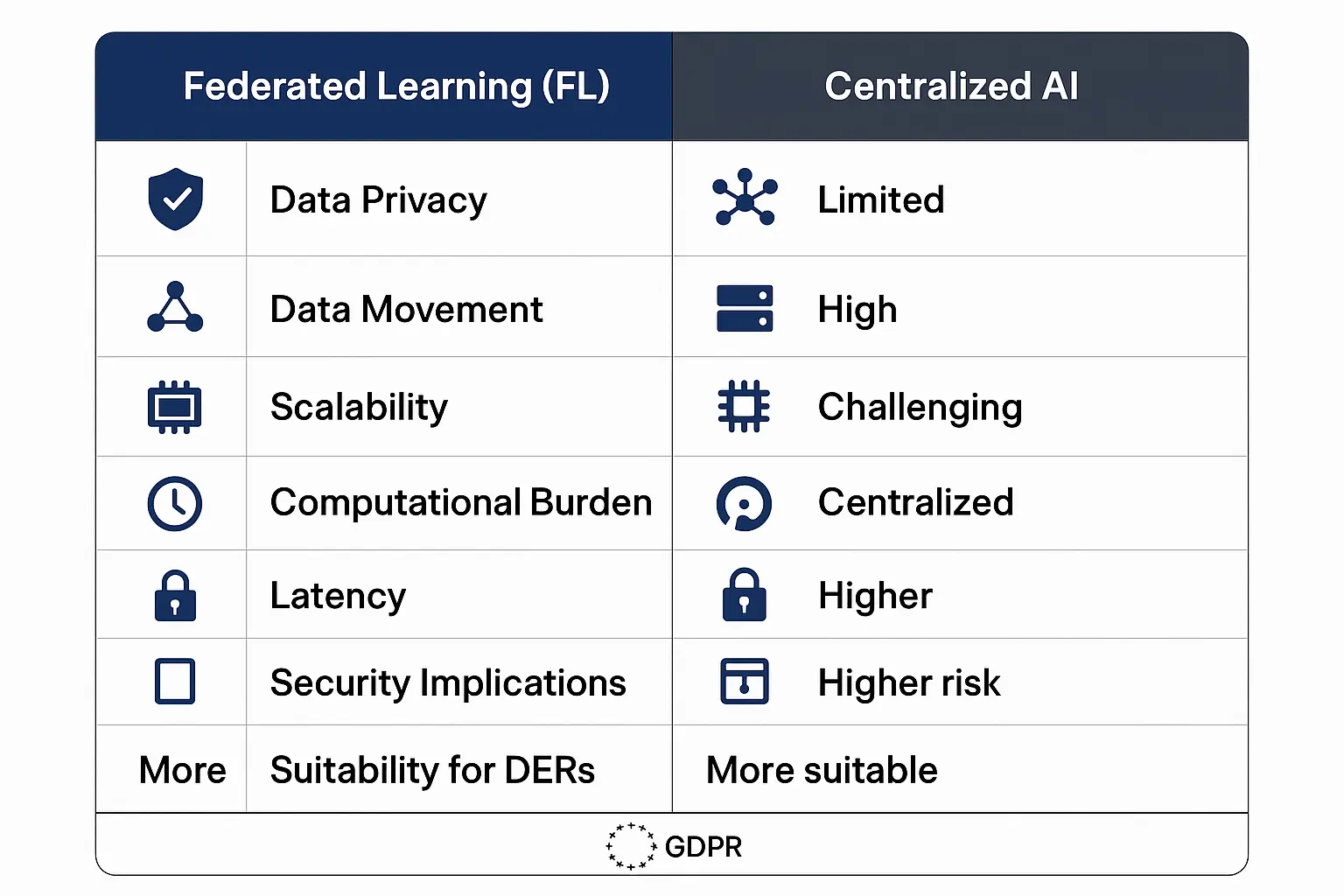
Let’s break down the critical differences:
| Evaluation Criterion | Centralized AI | Federated Learning (Collaborative AI) |
|---|---|---|
| Data Privacy | High Risk. All raw data (e.g., household consumption) is sent to a central server, creating a single point of failure and privacy concerns. | Privacy-First. Raw data never leaves the local device (the DER). Only anonymized model updates are shared, significantly reducing privacy risks. |
| Data Movement & Cost | High. Requires constant, high-bandwidth transmission of large raw datasets, leading to significant communication costs. | Low. Only small, compressed model parameters are transmitted, drastically reducing network bandwidth requirements and costs. |
| Scalability | Limited. Becomes a bottleneck as the number of DERs grows into the millions. Central processing power and storage needs escalate quickly. | Highly Scalable. Computation is distributed across edge devices. Adding new DERs doesn’t create a central bottleneck. |
| Latency | Higher. Data must travel to a central server and back for a decision to be made, introducing delays. | Lower. Enables real-time analytics and control decisions at the edge, crucial for rapid demand response and grid stabilization. |
| Computational Burden | Concentrated. Requires massive, expensive central servers to process all incoming data. | Distributed. Leverages the existing computational power of DERs and edge devices, reducing reliance on central infrastructure. |
| Security Implications | Single Point of Attack. A breach of the central server compromises all data from every participant. | Resilient. No central data repository to target. An attack on one node does not compromise the entire system’s data. |
| Suitability for DERs | Good for historical analysis and less time-sensitive tasks. Struggles with real-time control of a highly distributed network. | Ideal for dynamic, real-time optimization, demand response, and predictive maintenance across a vast and diverse network of DERs. |
The takeaway is clear: for applications requiring real-time control, robust privacy, and massive scalability—the defining features of modern DER management—Federated Learning offers a structurally superior approach.
Unlocking the Benefits: How Collaborative AI Transforms DER Optimization
Moving from a centralized to a federated model isn’t just an architectural shift; it’s a strategic one that unlocks tangible benefits for grid operators, energy communities, and end-users. Research shows a rapidly growing interest in these models, with the federated learning market projected to reach nearly $300 million by 2030, driven by its powerful value proposition in sectors like energy.
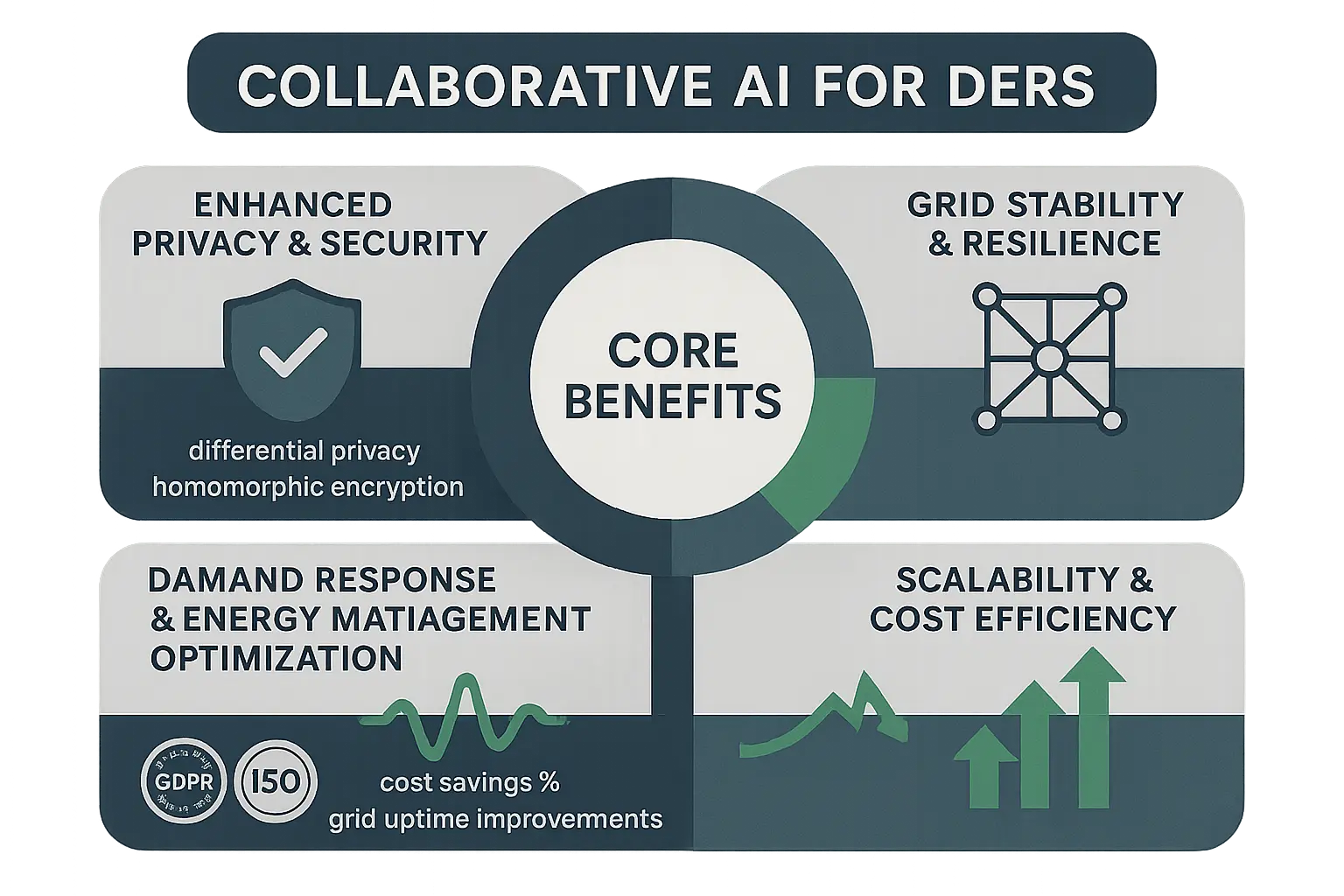
Enhanced Privacy and Security by Design
Privacy is no longer optional. With regulations like GDPR and a public increasingly aware of data rights, building consumer trust is paramount. Federated Learning is fundamentally a privacy-preserving AI technique. By training models locally on each DER, sensitive information—like when a family uses their oven or charges their EV—never needs to be exposed. This approach is often strengthened with techniques like:
- Secure Aggregation: Cryptographic methods ensure the central server can only decrypt the combined model update from all devices, not individual contributions.
- Differential Privacy: Mathematical “noise” is added to individual updates, making it impossible to reverse-engineer information about any single participant from the final model.
Improved Grid Stability and Resilience
A decentralized grid demands decentralized intelligence. When a fault occurs, you don’t have time to send data to the cloud and wait for instructions. Collaborative AI enables:
- Faster Fault Detection: Local models can identify anomalies in voltage, frequency, or performance instantly and isolate issues before they cascade.
- Predictive Maintenance: By learning from the performance of thousands of similar assets (e.g., inverters, batteries), the collective model can predict failures with much higher accuracy.
- Adaptive Control: A network of DERs can collectively learn to balance local supply and demand, forming resilient microgrids that can operate independently during a wider grid outage. This is a core component of building true decentralized AI for grid resilience.
Optimized Demand Response and Energy Management
Collaborative AI allows for far more granular and effective demand response. Instead of broadcasting a generic “reduce consumption” signal, a global model informed by thousands of local contexts can orchestrate a precise, optimized response. This means predicting load on a hyper-local level, coordinating EV charging to absorb excess solar generation, and managing community battery storage to reduce peak demand charges—all while respecting individual user constraints.
The Roadblocks & How to Overcome Them: Challenges of Implementing Collaborative AI in DERs
No transformative technology comes without challenges. A core part of your evaluation process is to understand these potential roadblocks and seek partners who have proven strategies to navigate them. Being transparent about these hurdles is key to building a robust and reliable system.
-
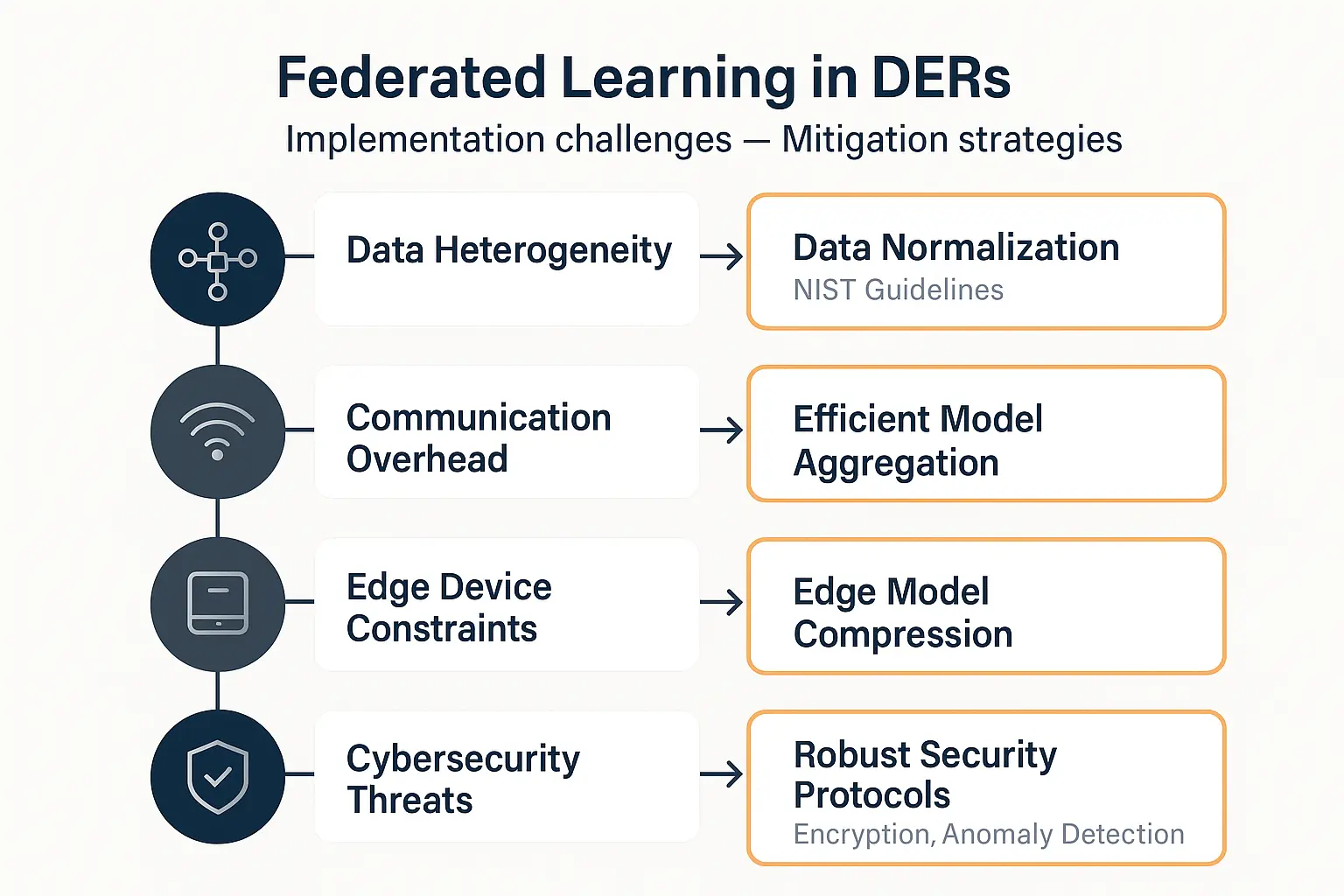
Challenge: Data Heterogeneity
- The Problem: DERs come from different manufacturers, run different software, and produce data in varying formats. This “non-IID” (not independent and identically distributed) data can bias the global model.
- The Solution: Implement robust data normalization and standardization protocols at the edge before local training begins. Advanced federated algorithms can also adapt the aggregation process to account for statistical differences between nodes, ensuring the global model is balanced and accurate.
-
Challenge: Communication Overhead
- The Problem: While FL reduces bandwidth needs compared to centralized AI, frequent model updates from millions of devices can still strain communication networks.
- The Solution: Use model compression techniques to shrink the size of updates. Implement intelligent update schedules, where devices only transmit updates when they have learned something significant, rather than on a fixed timer.
-
Challenge: Computational Constraints at the Edge
- The Problem: Many DERs have limited processing power and memory, making it difficult to train complex AI models locally.
- The Solution: Design lightweight, efficient model architectures optimized for edge devices. Techniques like knowledge distillation can be used, where a large, complex model trains a smaller, more efficient “student” model for deployment on resource-constrained devices.
-
Challenge: Cybersecurity Beyond Privacy
- The Problem: While FL protects data, the model itself can be vulnerable. A malicious actor could attempt to “poison” the global model by sending intentionally corrupted updates.
- The Solution: Deploy robust anomaly detection at the central aggregator. Before incorporating an update, the system should verify that it is not a statistical outlier and aligns with the expected learning direction. This, combined with secure aggregation, creates multiple layers of defense.
Implementation Playbook: A Step-by-Step Guide to Deploying Community Energy Management Systems with AI
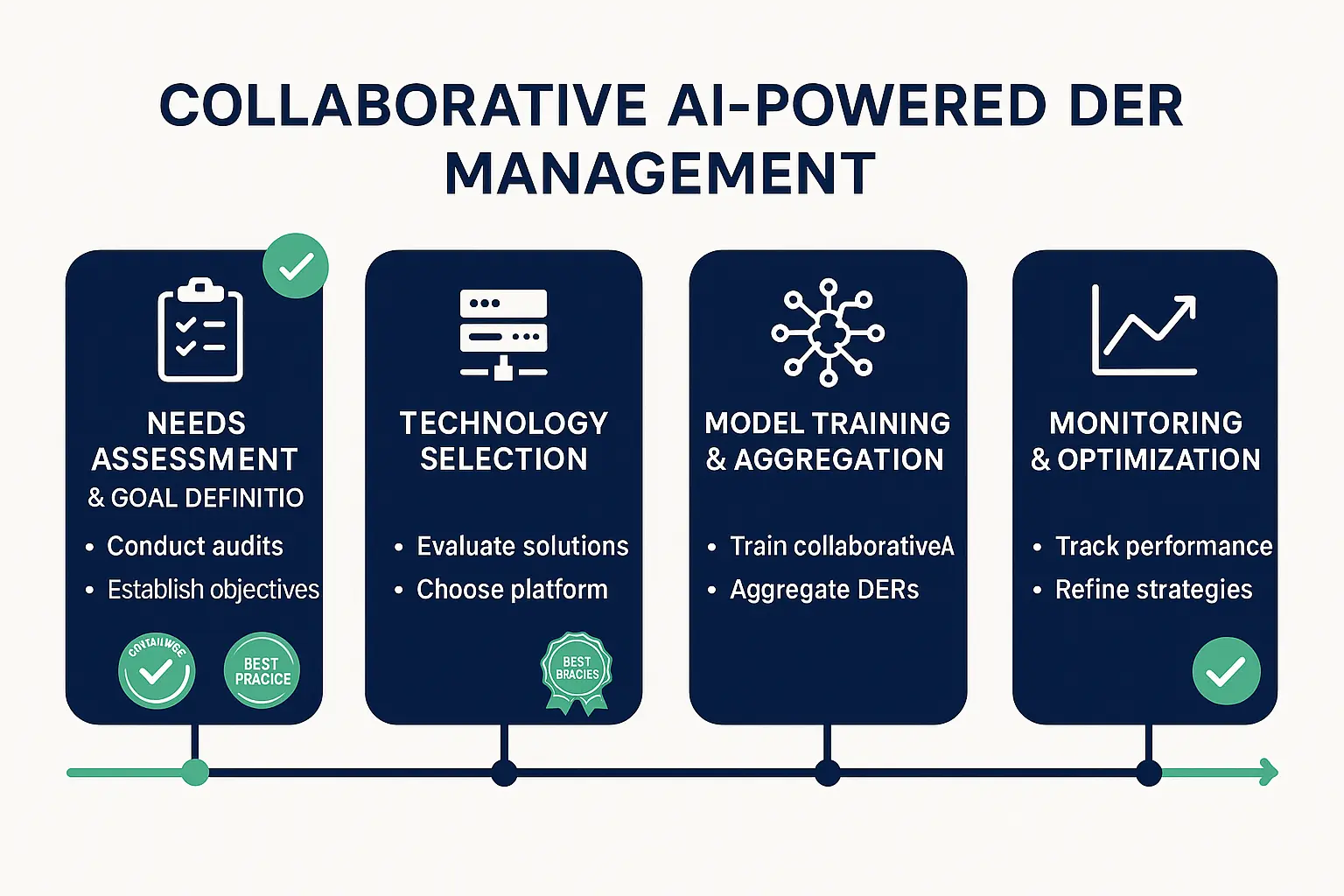
Adopting a collaborative AI framework is a strategic journey, not a single product purchase. This phased approach provides a clear roadmap for decision-makers, moving from initial concept to a fully optimized, intelligent system.
-
Phase 1: Needs Assessment & Goal Definition
- Action: Conduct a thorough audit of your DER assets. Engage with stakeholders—from grid engineers to community members—to define clear objectives. Are you aiming to reduce peak load, maximize renewable self-consumption, or improve fault response times?
- Outcome: A clear set of KPIs and a business case that justifies the investment.
-
Phase 2: Technology Selection & Architecture Design
- Action: Evaluate federated learning frameworks, edge hardware capabilities, and secure communication protocols. Design a solution architecture that accounts for your specific DER mix and network topology.
- Outcome: A vendor-neutral technical blueprint for your community energy management system.
-
Phase 3: Model Training & Iterative Refinement
- Action: Begin by deploying a foundational model and training it on local DER data. The central aggregator combines the insights into a global model, which is then pushed back to the devices for further refinement.
- Outcome: An increasingly intelligent model that continuously adapts to changing conditions and learns the unique behaviors of your network.
-
Phase 4: Monitoring, Evaluation & Optimization
- Action: Continuously monitor the performance of the global model against your initial KPIs. Use a “human-in-the-loop” approach where operators can validate AI recommendations and provide feedback to further improve the system.
- Outcome: A dynamic, self-improving system that delivers measurable improvements in efficiency, resilience, and cost savings.
Future Forward: Human-AI Collaboration in DERs
The goal of collaborative AI is not to replace human operators but to empower them. Emerging trends point toward systems where AI handles the millisecond-by-millisecond optimization across millions of nodes, while human experts focus on high-level strategy, anomaly investigation, and long-term planning. This “human-in-the-loop” model combines the computational power of machines with the contextual understanding and intuition of experienced engineers, creating a system that is more robust, trustworthy, and effective than either could be alone.
FAQs about Federated Learning and Collaborative AI for DERs
Is Federated Learning a mature enough technology for critical grid infrastructure?Yes. While its application in the energy sector is emerging, the core technology is well-established and used by major tech companies to train models on billions of devices. The key is to partner with experts who understand both the AI framework and the specific operational demands of energy grids.
How does this integrate with our existing SCADA and DERMS systems?A collaborative AI platform should be designed to augment, not replace, your existing systems. It acts as an intelligent optimization layer, taking in data from your current infrastructure and providing advanced forecasting, control signals, and insights that your DERMS can then execute.
What is the ROI for implementing a system like this?The ROI comes from multiple sources:
- Operational Efficiency: Reduced peak demand charges and optimized energy arbitrage.
- Infrastructure Savings: Lowered data transmission and storage costs compared to a centralized model.
- Improved Resilience: Reduced outage duration and associated financial penalties.
- Increased Customer Engagement: Offering privacy-first smart home energy management can be a powerful differentiator.
Doesn’t local training put a strain on the DER devices themselves?Models are specifically designed to be lightweight. Furthermore, training can be scheduled to run during periods of low device activity or high energy availability (e.g., in the middle of the day for a solar-powered home), ensuring minimal impact on the device’s primary function.
The transition to a distributed energy future is inevitable. The leaders who succeed will be those who adopt an intelligence framework that is as distributed, resilient, and secure as the grid they manage. By embracing collaborative AI, you can unlock the full potential of your DERs, building a smarter, more efficient, and more reliable energy system for everyone.
If you’re ready to move beyond the theory and discuss how a privacy-first, collaborative AI approach can solve your specific DER management challenges, let’s connect.
