
You’ve seen the numbers. An AI-powered Energy Management System (AI EMS) can slash commercial building energy costs by 20-40%, reduce maintenance overhead, and boost asset value. But navigating the financial landscape to fund such a project can feel like a maze of grants, tax credits, and complex financing models. How do you move from understanding the potential ROI to actually securing the investment?
This isn’t just about finding a single grant. It’s about building an integrated financial strategy that minimizes your upfront cost and maximizes your long-term return. Many building owners get stuck piecing together fragmented information from government websites and grant finders, missing the critical connections that unlock the full economic power of an AI EMS investment.
This guide provides the clear, authoritative framework you need. We’ll move beyond surface-level lists to give you an actionable plan for funding your AI EMS project, leveraging every available financial instrument to de-risk your investment and accelerate your path to profitability.
The Strategic Value of Investing in AI EMS
Before diving into funding mechanisms, it’s crucial to understand why AI EMS is a fundamentally different type of investment. Unlike static efficiency upgrades, an AI EMS is an intelligent, dynamic system that continuously optimizes performance. This creates a powerful financial case that resonates with modern investors and lenders.
The core value proposition is twofold:
- Deep Energy Savings: By analyzing real-time data from thousands of points, an AI EMS makes predictive adjustments to HVAC, lighting, and other systems, delivering energy cost reductions between 20-40% that traditional building automation systems can’t match.
- Enhanced Operational Intelligence: The system provides predictive maintenance alerts, optimizes equipment runtime to extend its lifespan, and generates the precise data needed for ESG reporting and compliance—turning a cost center into a source of strategic value.
This dual benefit is why the market is shifting. The question is no longer if you should invest, but how to do so most effectively.
Federal Funding & Tax Credits: The Foundation of Your Financial Stack
Federal incentives are designed to catalyze private investment in clean technology. For commercial building owners, they represent the foundational layer of any AI EMS financial strategy, significantly reducing the initial capital required.
Key Federal Tax Credits
While specific programs evolve, the core mechanisms often include investment tax credits (ITCs) that allow businesses to deduct a percentage of their qualified investment cost directly from their federal tax liability. These credits often apply to the core components of an AI EMS project, including smart controls, sensors, software, and integration with renewable energy sources like solar or geothermal HVAC. As the IRS’s support for advanced manufacturing through the CHIPS Act shows, there is strong federal precedent for incentivizing strategic technology adoption.
The “Direct Pay” Game-Changer for Tax-Exempt Entities
A critical development for non-profits, schools, hospitals, and local governments is the “direct pay” (or elective pay) option. This provision allows tax-exempt organizations to receive the cash value of federal clean energy tax credits as a direct refund from the IRS. It transforms tax credits from an instrument only usable by for-profit entities into a direct grant, making AI EMS projects accessible to a much broader range of commercial building owners.
Federal Grant and Loan Programs
Beyond tax credits, several federal agencies offer direct funding:
- Department of Energy (DOE): The DOE regularly releases funding opportunities for projects that advance energy efficiency and smart building technology.
- USDA Rural Energy for America Program (REAP): For agricultural producers and rural small businesses, REAP provides both grants and loan guarantees for renewable energy systems and energy efficiency improvements—a perfect fit for eligible commercial operations looking to install an AI EMS.
Building a robust federal funding strategy is the first step. For more details on current programs, explore our complete guide to Government Grants & Tax Credits for Commercial Energy Efficiency.
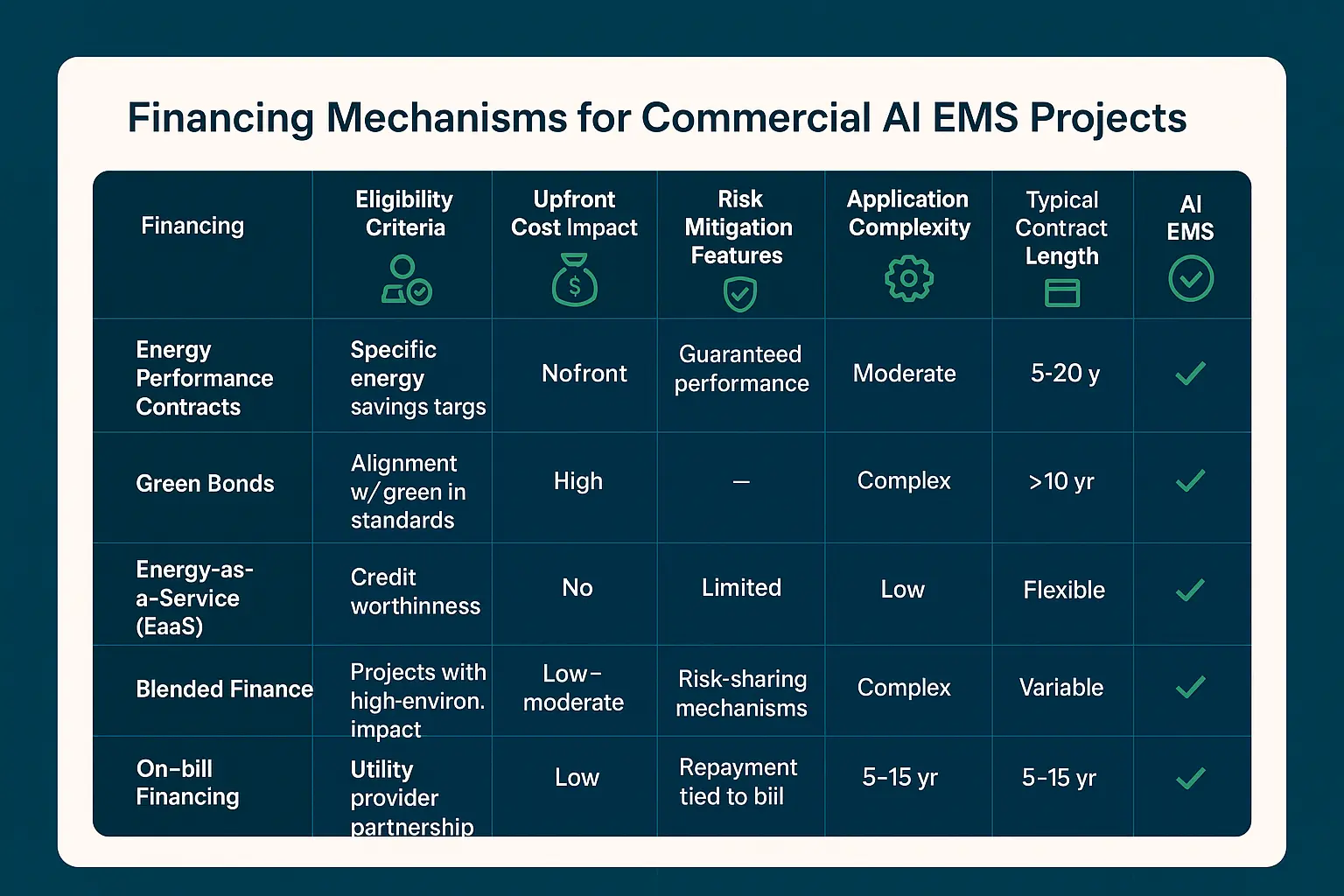 Caption: Authoritative visual mapping federal financial incentives and stacking strategies for commercial AI EMS investments, reinforcing program credibility and resource integration.
State & Local Incentives: Layering Your Financial Strategy
The most successful financial strategies are “stacked,” combining federal incentives with state, local, and utility-level programs. This is where a national policy becomes a hyper-localized advantage.
These programs vary widely but typically fall into a few categories:
- State Tax Credits: Many states offer their own tax credits that can be combined with federal incentives.
- Utility Rebates: Local utilities are often the most direct source of funding. They provide prescriptive rebates for specific equipment (e.g., VFDs, smart thermostats) or custom rebates based on projected energy savings—a model where AI EMS excels due to its high performance.
- Grants and Low-Interest Loans: State energy offices and clean energy funds, like the Nevada Clean Energy Fund, offer targeted grants and flexible, low-cost financing specifically for commercial building owners.
The key is to view these not as separate options but as interconnected layers. For instance, a project in California might leverage a federal tax credit, a state-level grant, and a local utility rebate simultaneously. This stacking effect is powerful; California’s programs have demonstrated how $149 million in public funding can generate nearly $1.3 billion in private investment.
Innovative Financing Mechanisms for AI EMS Projects
For many organizations, the primary barrier to adoption isn’t the total cost but the upfront capital expenditure. This is where innovative financing models, designed to align payments with performance, become essential. These structures move the conversation from “how much does it cost?” to “how quickly can it pay for itself?”
Here are the leading models for commercial AI EMS projects:
- Energy Performance Contracts (EPCs): You partner with an Energy Service Company (ESCO) that designs, implements, and finances the AI EMS project. The ESCO guarantees a certain level of energy savings, and the project is paid for over time using the money saved on utility bills. The superior measurement and verification (M&V) capabilities of an AI system significantly de-risk these contracts for both the building owner and the ESCO. To learn more, see our full breakdown on
Understanding Energy Performance Contracts (EPCs). - Energy-as-a-Service (EaaS): This model eliminates upfront capital costs entirely. You pay a recurring fee to a provider who owns, operates, and maintains the AI EMS. Your payments are tied to the system’s performance and the energy savings it delivers, transforming a capital expense into a predictable operating expense.
- Green Bonds & Sustainable Finance: For organizations with large real estate portfolios, issuing green bonds is an increasingly popular way to fund a wide-scale rollout of AI EMS. The system’s robust data collection and reporting capabilities provide the auditable proof of environmental impact that bond investors demand. This is one of the most sophisticated
Green Financing Options for Commercial Real Estate. - Commercial Property Assessed Clean Energy (C-PACE): C-PACE financing allows building owners to fund energy efficiency projects with a special property tax assessment. The loan is tied to the property, not the owner, and can be paid back over a long term (up to 20-30 years). The annual energy savings typically exceed the annual payment, making projects cash-flow positive from day one.
Choosing the right model depends on your organization’s capital availability, risk tolerance, and long-term goals.
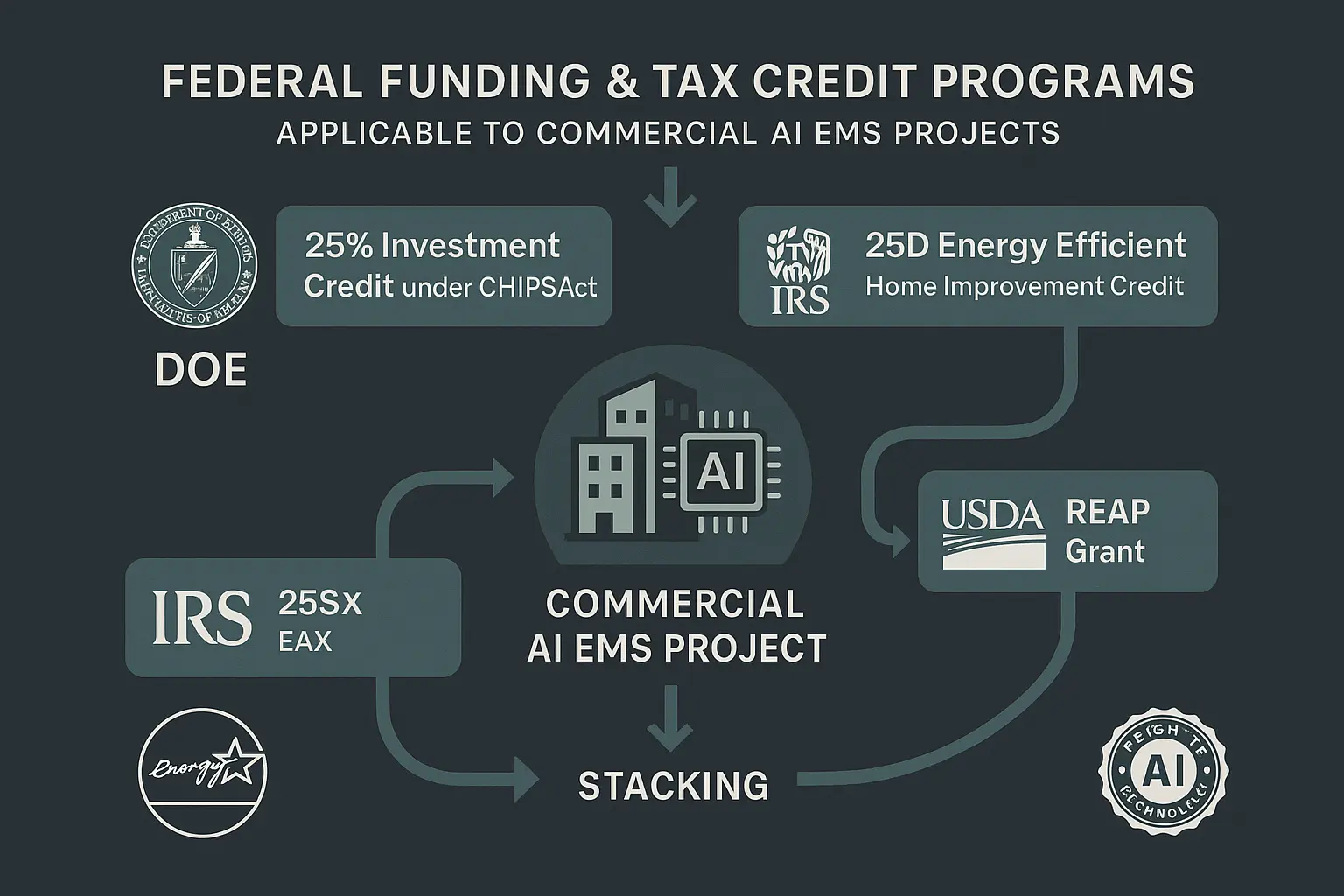 Caption: Comparison matrix highlighting key features, benefits, and considerations of innovative financing methods for commercial AI EMS investments.
Calculating Your AI EMS Financial Return: A Total Cost of Ownership (TCO) Approach
A simple ROI calculation based on energy savings alone only tells part of the story. Decision-makers need a comprehensive Total Cost of Ownership (TCO) analysis to grasp the full financial impact. A proper TCO model accounts for every economic factor over the system’s lifecycle.
Your TCO framework should include:
- Initial Capital Outlay: The total upfront cost of hardware, software, and installation.
- Less: Incentives: The combined value of all federal, state, and utility grants, credits, and rebates.
- Ongoing Operational Costs: Subscription fees, maintenance, and support.
- Plus: Lifetime Savings:
- Direct Energy Savings: The 20-40% reduction in utility bills.
- Maintenance & Repair Savings: Reduced wear and tear from optimized equipment runtime extends asset life.
- Operational Efficiency: Automated monitoring and reporting frees up staff time for higher-value tasks.
- Plus: Increased Asset Value: Modern, high-performance buildings command higher rents and valuations.
When you map these factors over a 5-10 year period, the financial case becomes undeniable. The initial investment, significantly reduced by incentives, is quickly surpassed by compounding operational savings and enhanced asset value. Our complete guide provides a framework for conducting a Total Cost of Ownership (TCO) Analysis for AI EMS.
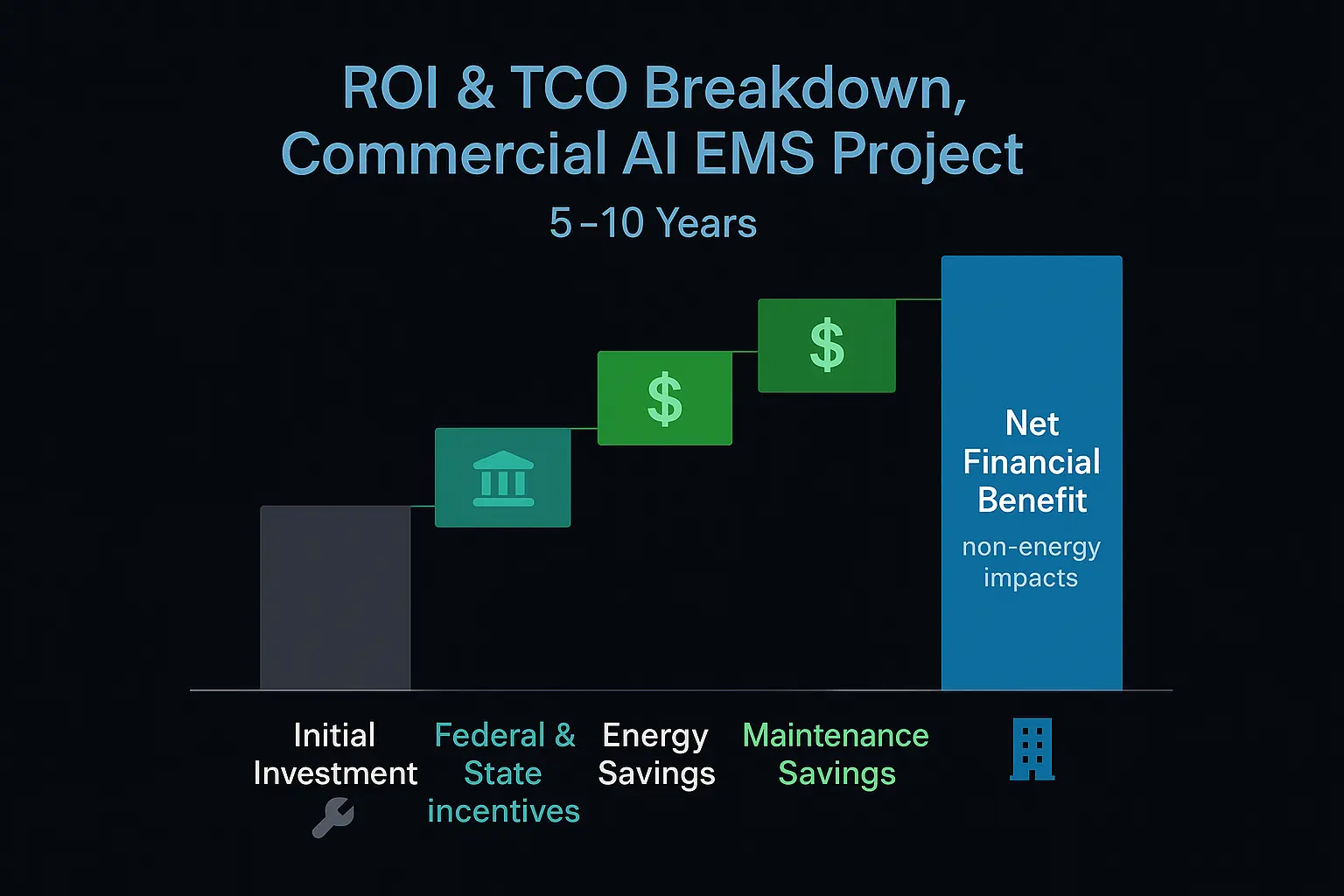 Caption: Projected ROI and comprehensive TCO analysis over 10 years highlighting how AI EMS investment, combined with incentives and operational savings, creates substantial net benefits.
Implementing Your Financial Strategy: A Step-by-Step Guide
Moving from theory to action requires a methodical approach. This roadmap outlines the key steps to successfully finance and deploy your commercial AI EMS.
- Energy Audit & Baselining: Establish a clear baseline of your current energy consumption. This is the foundation for measuring savings and is often a prerequisite for incentives.
- Identify & Qualify Incentives: Systematically research all available federal, state, and utility programs for which you are eligible. Document deadlines, application requirements, and potential funding amounts.
- Evaluate Financing Models: Using your TCO framework, compare the financial implications of a direct purchase, an EPC, an EaaS agreement, or C-PACE financing.
- Engage with Partners: Talk to qualified AI EMS providers, ESCOs, and financial institutions. A good partner will act as a strategic advisor, helping you navigate the application process and secure the best possible financing package.
- Develop the Project Proposal: Create a comprehensive proposal that clearly outlines the project scope, expected costs, projected savings (backed by data), and your complete financing stack. This document is essential for securing internal buy-in and external funding.
- Deploy & Commission: Implement the AI EMS according to your project plan.
- Measure, Verify & Report: Use the AI EMS’s own advanced M&V capabilities to track performance against your baseline, validate savings for EPCs or lenders, and report on incentive compliance.
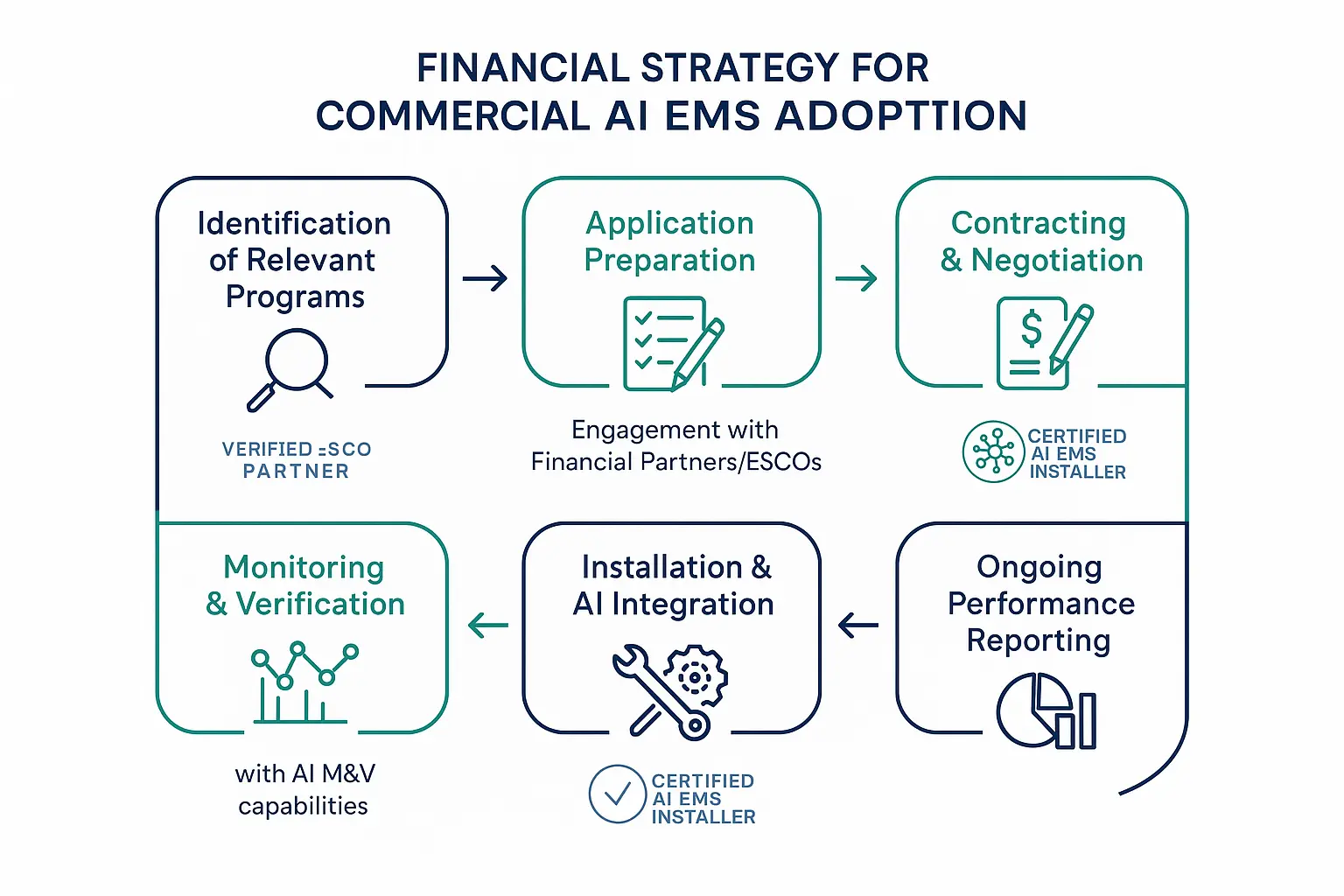 Caption: Clear implementation roadmap guiding commercial building owners through the financial strategy and project lifecycle of AI EMS deployment, enhancing procedural confidence.
Frequently Asked Questions (FAQ)
Q: Is financing this complex for a smaller commercial building?
A: Not necessarily. While the full range of options can seem daunting, a smaller project may be fully funded by stacking a federal tax credit with a local utility rebate, avoiding the need for more complex models like EPCs or Green Bonds. The key is to know which tools are right for your scale.
Q: How can I be sure the projected savings will be realized?
A: This is a key advantage of AI EMS. Unlike static upgrades, an AI-powered system provides continuous, real-time Measurement and Verification (M&V). You can see the savings as they accrue, and this verifiable data is what underpins guaranteed-savings models like EPCs and satisfies lenders.
Q: What if my organization is tax-exempt and can’t use tax credits?
A: The “direct pay” option was designed specifically for you. It allows non-profits and other tax-exempt entities to receive the full cash value of federal clean energy tax credits as a direct payment from the government, effectively turning the credit into a grant.
Q: Can I really combine federal grants, state tax credits, and utility rebates?
A: Absolutely. This “stacking” is not only possible but is the basis of the most effective financial strategies. Most programs are designed to be complementary. However, it’s crucial to read the specific rules for each program to ensure there are no restrictions on combining funds.
Your Path Forward
Financing a commercial AI EMS is not a barrier; it’s a strategic opportunity. By moving beyond a simple cost-benefit analysis and embracing a holistic financial strategy, you can leverage a powerful ecosystem of public incentives and private capital. The tools are available to transform this high-impact technology from a capital expense into a self-funding engine for efficiency, resilience, and value creation.
The next step is to translate this framework into a specific financial plan for your property.
Ready to build your personalized AI EMS financial strategy? Contact our specialists today for a comprehensive assessment of your funding opportunities.
