
The Definitive Guide to IIoT for Energy Monitoring & Optimization
You’re under constant pressure to reduce operational costs, meet escalating sustainability targets, and improve overall equipment effectiveness. You know that energy is one of your biggest—and most opaque—expenses. But without granular, real-time data from your machinery and facilities, any attempt at optimization is just guesswork. You’re not looking for vague promises; you’re evaluating a concrete solution and need a clear, technical roadmap to justify the investment.
This is precisely where the Industrial Internet of Things (IIoT) transforms energy management from a reactive cost center into a proactive, data-driven discipline. With the IIoT energy management market projected to grow at a staggering 17.8% CAGR, leading operators are already capitalizing on this shift. They’re consistently achieving 10-30% reductions in energy costs, with most projects delivering a full payback in under 18-24 months.
This guide moves beyond the high-level benefits to give you, the OT manager or plant engineer, the detailed technical framework you need. We’ll explore the foundational hardware, compare critical connectivity protocols, and map out the software architecture required to turn raw data into measurable savings.
Decoding Your Energy Blueprint: Why Granular Data is Non-Negotiable
Traditional energy management often relies on monthly utility bills, offering a single, aggregated data point for an entire facility. This makes it impossible to answer critical questions:
- Which specific machine is the primary driver of our peak demand charges?
- Is that compressor leaking air—and money—after hours?
- How much energy is wasted by machines left idling between shifts?
- Is our HVAC system fighting an unsealed loading dock door?
Without machine-level data, you’re flying blind. IIoT provides the “energy blueprint” of your operations by deploying sensors and systems that capture data at its source. This granular visibility is the first and most crucial step toward identifying waste, optimizing processes, and predicting failures before they happen.
The Foundation: Essential IIoT Hardware for Energy Data Collection
The accuracy of your entire energy optimization strategy depends on the quality of the data you collect. This starts with selecting the right hardware designed for demanding industrial environments.
Sensor Technologies Deep Dive
Think of sensors as the nerve endings of your IIoT system. For energy monitoring, the most critical are current transducers.
- Current Transducers (CTs): These devices measure the electrical current flowing to a specific machine or circuit. By clamping around a power line, they provide the real-time consumption data needed to understand equipment performance. When selecting CTs, consider:
- Type: Split-core or clamp-on CTs are ideal for retrofitting (brownfield deployments) as they can be installed without powering down and disconnecting wiring. Solid-core CTs offer higher accuracy but require more invasive installation.
- Accuracy: Look for an accuracy class of 1% or better for reliable billing-grade data.
- Range: Ensure the CT’s amperage range matches the load of the equipment you’re monitoring to avoid inaccurate readings.
- Temperature Sensors: An overheating motor or electrical panel is a clear sign of inefficiency and a potential safety hazard. Attaching temperature sensors can provide early warnings, correlating temperature spikes with increased energy draw to pinpoint failing components.
- Vibration Sensors: Changes in a machine’s vibration signature often precede mechanical failure. By monitoring vibrations alongside energy consumption, you can identify issues like bearing wear or misalignment that cause a motor to work harder and consume more power. This is the cornerstone of predictive maintenance, which can reduce downtime by up to 50%.
Data Acquisition Units (DAQs) & Edge Devices
Sensors generate a constant stream of raw data. A Data Acquisition Unit (DAQ) or an edge computing device acts as the local brain. It aggregates signals from multiple sensors, digitizes them, and often performs initial data processing right at the source. This is a crucial function that reduces the amount of “noise” sent to the cloud, saving bandwidth and enabling faster, localized responses.
Connecting the Dots: IIoT Connectivity Protocols for Industrial Energy Monitoring
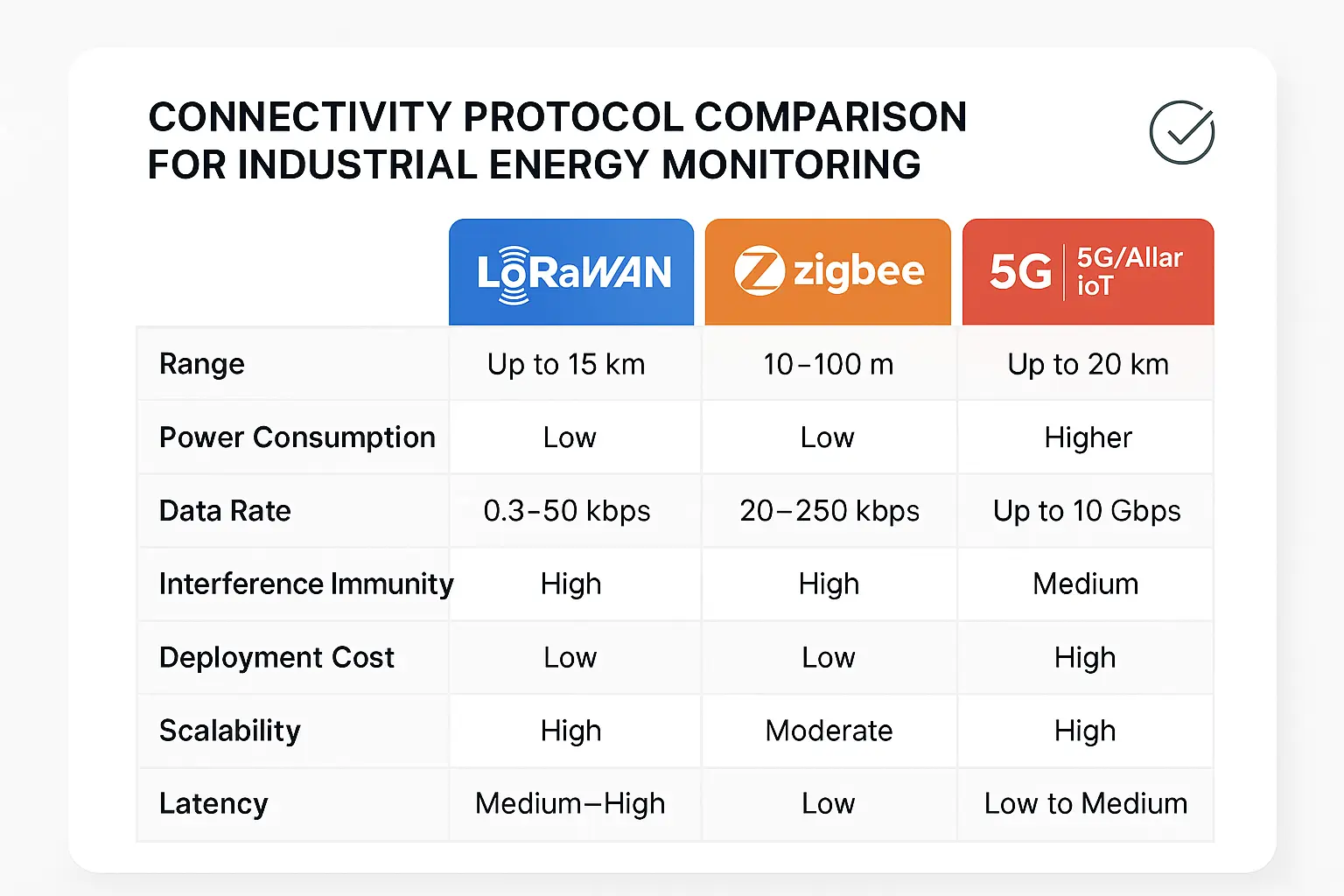
Once you collect the data, you need a reliable way to transmit it. The industrial environment—with its steel, concrete, and electromagnetic interference—presents unique challenges. Not all wireless protocols are created equal. Your choice will depend on your facility’s size, layout, and data requirements.
- LoRaWAN (Long Range Wide Area Network): This is often the leading choice for large-scale industrial sites. Its key strengths are excellent range (kilometers), deep indoor penetration through dense materials, and extremely low power consumption, allowing battery-powered sensors to last for years. It’s ideal for collecting small data packets (like energy readings) from thousands of sensors spread across a factory or campus.
- Zigbee: Operating on a mesh network, Zigbee offers shorter range than LoRaWAN but a higher data rate. It’s well-suited for dense deployments in smaller areas where devices are relatively close together and can relay data for one another. It’s a good fit for monitoring a cluster of machines within a single production hall.
- 5G/Cellular IoT (LTE-M/NB-IoT): While full 5G is known for high-bandwidth video streaming, cellular IoT variants are designed for IIoT. They offer the reliability and security of a carrier network, eliminating the need to build your own network infrastructure. This is an excellent choice for remote assets or when a guaranteed quality of service is non-negotiable, though it typically comes with higher costs and power consumption than LoRaWAN.
From Raw Data to Real-time Decisions: IIoT Software & Analytics Architecture
Hardware collects data, but software turns it into intelligence. A modern IIoT architecture leverages a multi-layered approach to deliver insights where they’re needed most.
Edge Computing for Localized Intelligence
Instead of sending every single data point to a distant cloud server, edge computing processes data on-site. This architecture is revolutionary for industrial settings. An edge device can be programmed to:
- Trigger immediate alerts: If a machine’s power draw suddenly spikes beyond its normal operating threshold, the edge device can send an instant alert to an operator’s dashboard without waiting for a round trip to the cloud.
- Perform local control: Automatically power down non-essential equipment when the facility approaches a new peak demand threshold to avoid costly utility penalties.
- Filter and aggregate data: Average out readings over a minute or report only on significant changes, drastically reducing bandwidth costs and cloud storage needs.
Data Platforms & Seamless Integration
Your IIoT data becomes exponentially more valuable when combined with data from your other operational systems. A robust IIoT platform must offer seamless integration with your existing Manufacturing Execution System (MES), Enterprise Resource Planning (ERP), and SCADA systems. By correlating energy data with production schedules and output, you can calculate true energy intensity per unit produced—a critical KPI for efficiency.
AI/Machine Learning in Energy Optimization
This is where true optimization happens. AI and machine learning (ML) algorithms analyze your historical and real-time data to uncover patterns a human could never see.
- Anomaly Detection: ML models learn the normal “energy heartbeat” of each machine. They can instantly flag subtle deviations that indicate developing faults, compressed air leaks, or inefficient operations.
- Predictive Maintenance: By correlating energy signatures with vibration and temperature data, AI can predict equipment failures with high accuracy, allowing you to schedule maintenance proactively.
- Demand Forecasting: AI can analyze historical consumption, production schedules, and even weather forecasts to predict your facility’s future energy needs, optimizing energy procurement and on-site generation. These models can drive 3-15% cost reductions in demand management alone.
Trust Your Data, Trust Your Savings: Advanced Data Validation & Cybersecurity in IIoT Energy Systems
An optimization strategy built on faulty data is worse than no strategy at all. In the industrial world, data integrity is paramount. Similarly, with 71% of energy professionals reporting increased OT vulnerability, a “secure-by-design” approach isn’t optional.
Data Validation at the Source
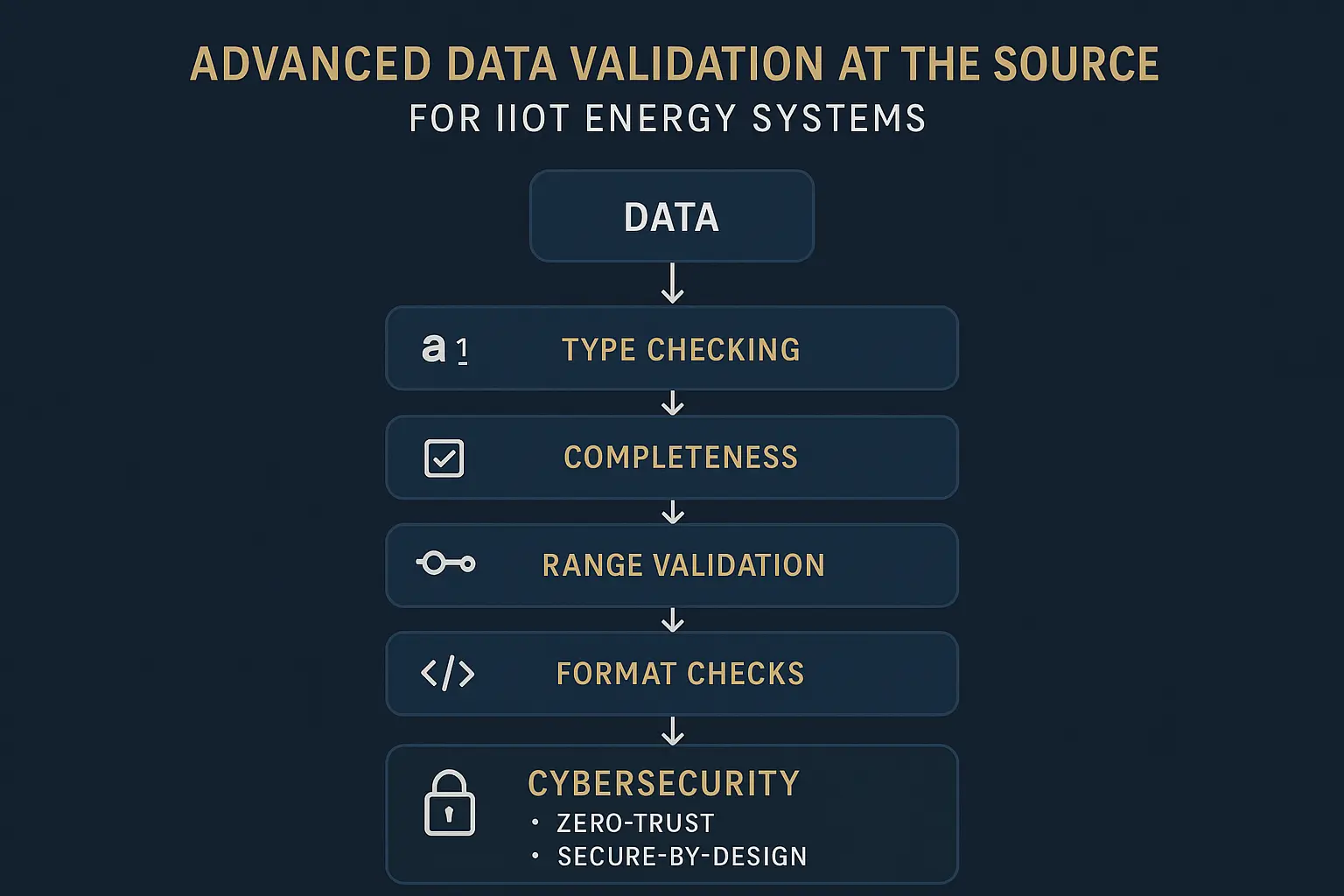
Before data is ever used for analytics, it must be validated. This should happen as close to the source as possible, often on the edge device itself. Best practices include:
- Type & Format Check: Ensure the data is in the expected format (e.g., a number, not text).
- Range Check: Verify the reading is within a plausible range (e.g., a current reading isn’t negative or impossibly high).
- Completeness Check: Ensure all required data fields from a sensor packet are present.
Implementing these simple checks at the edge prevents corrupt data from polluting your analytics and leading to flawed business decisions.
Cybersecurity Frameworks for OT Environments
Connecting operational technology (OT) to IT networks requires a robust security strategy. A Zero-Trust architecture, which assumes no user or device is trusted by default, is critical. Every connection and data request must be authenticated and authorized, minimizing the potential attack surface.
Implementing Success: IIoT Energy Monitoring Deployment Strategies
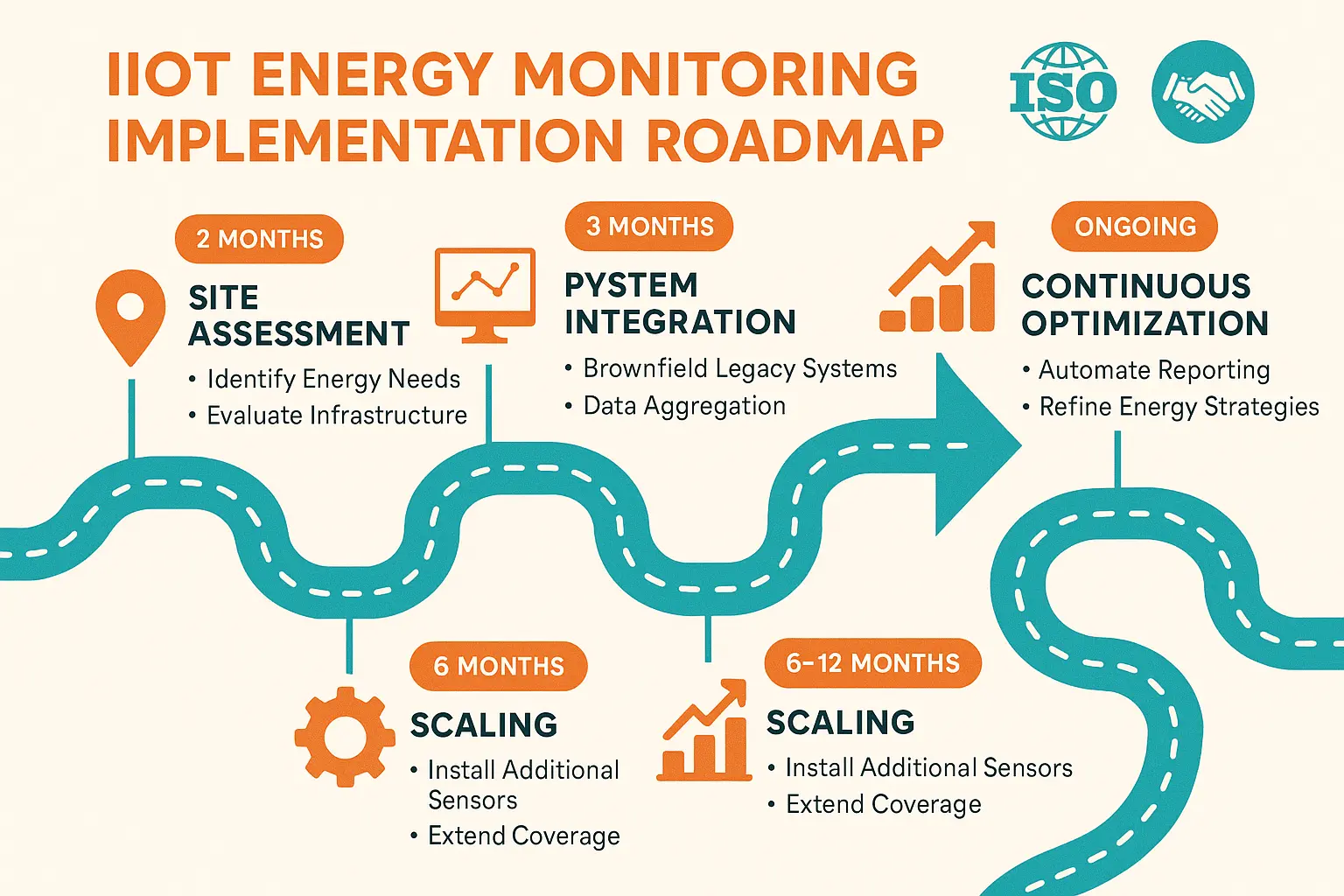
A successful IIoT project is a marathon, not a sprint. A methodical, phased approach ensures buy-in, minimizes risk, and demonstrates value quickly.
- Assess & Plan: Start with a site assessment to identify the most energy-intensive areas or “bad actors.” Define clear, measurable goals for a pilot project (e.g., “reduce energy consumption of CNC line #3 by 10% in 3 months”).
- Launch a Pilot Project: Choose a single production line or critical system. Deploy the core hardware and software, validate the data, and establish baseline performance. This allows you to work out any kinks on a small scale and build a powerful internal case study. For example, Precision Components Inc. launched a pilot that led to a 15% overall energy reduction, saving $97,500 annually and uncovering a 90% reduction in compressed air leakage.
- Analyze, Refine & Scale: Use the insights from the pilot to refine your strategy. Once you’ve demonstrated clear ROI, you can develop a roadmap for a facility-wide or enterprise-wide rollout, leveraging the lessons learned to accelerate deployment.
The Bottom Line: Calculating Your IIoT Energy Savings & ROI
To secure budget and executive buy-in, you need to speak the language of finance. Building a business case for IIoT is straightforward when you focus on tangible metrics.
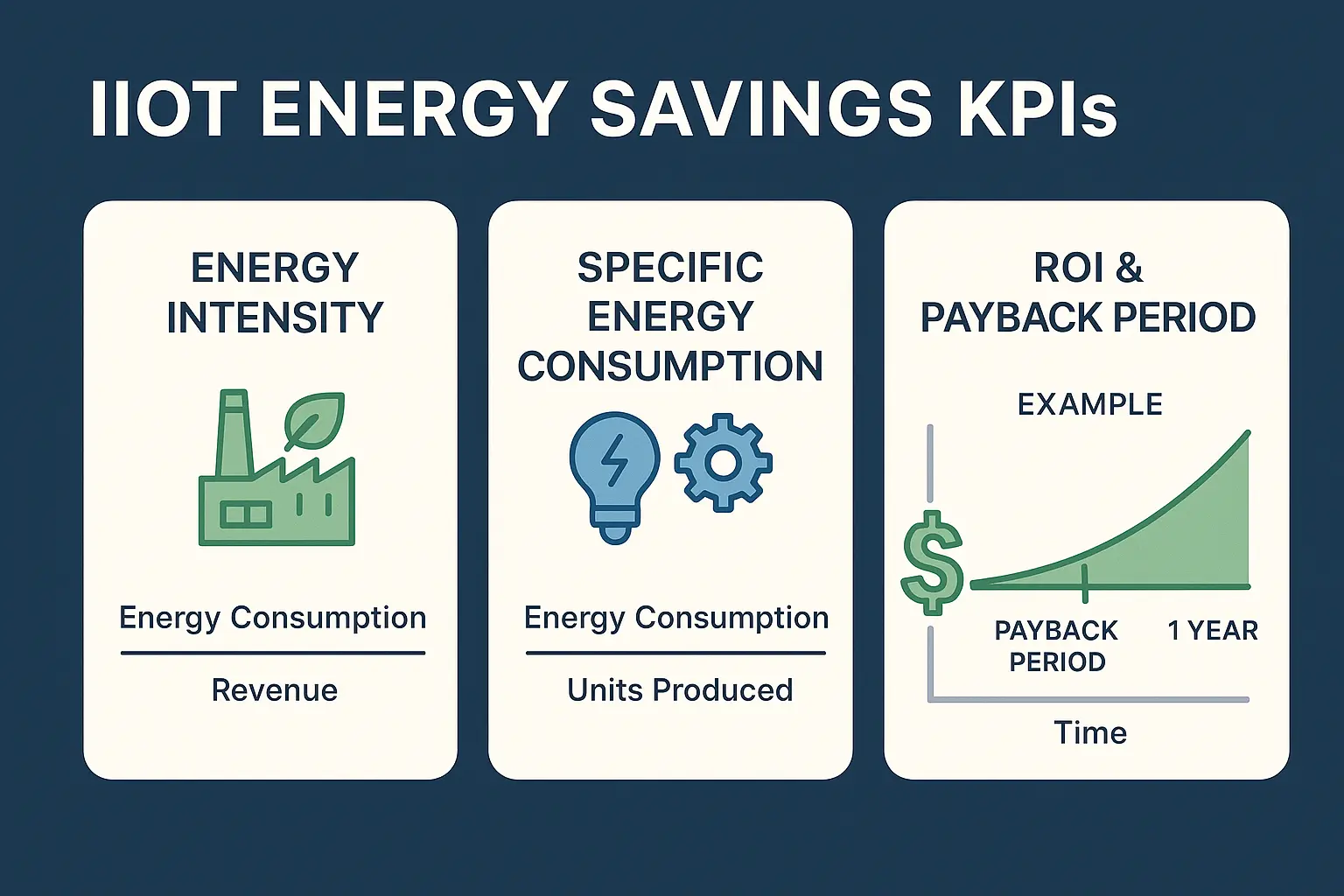
- Key Performance Indicators (KPIs): Track metrics like Energy Intensity (kWh per unit of production) and Specific Energy Consumption (SEC) for key equipment. Improvement in these KPIs directly translates to bottom-line savings.
- Calculating Savings: The basic formula is simple:
(Baseline Energy Spend - Post-IIoT Energy Spend) = Gross Savings. Factor in project costs (hardware, software, installation) to calculate your simple payback period:Total Project Cost / Annual Savings = Payback Period in Years.
Most importantly, IIoT savings aren’t just a one-time event. They compound over time as your system uncovers deeper and deeper layers of inefficiency, creating a virtuous cycle of continuous improvement.
Future-Proofing Your Factory: Trends & Innovations
The field of IIoT is constantly evolving. Staying ahead means understanding trends like advanced AI for autonomous operations, digital twins for simulating efficiency scenarios before implementation, and even energy harvesting sensors that power themselves. Building your IIoT foundation on an open, scalable platform ensures you can incorporate these innovations as they mature.
Frequently Asked Questions
1. How does an IIoT system integrate with our existing SCADA or MES?Modern IIoT platforms are designed with integration in mind, typically using open standards and APIs like REST or MQTT. The platform can pull in contextual data (like production counts) from your MES and push targeted energy alerts or data back into your SCADA HMI, enriching your existing systems rather than replacing them.
2. What is a realistic payback period for an IIoT energy monitoring project?While every facility is different, industry data consistently shows payback periods between 18 and 24 months. Projects that quickly identify major issues like large compressed air leaks or misconfigured HVAC systems often see a payback in under a year. You can use our free ROI calculator to estimate the potential for your specific facility.
3. We have a mix of old and new machines. Can IIoT still be deployed?Absolutely. This is a primary strength of IIoT. Clamp-on sensors and non-invasive hardware are specifically designed for “brownfield” environments with legacy equipment. They allow you to bring older, “dumb” assets into your smart factory ecosystem without expensive and risky machinery overhauls.
4. How can we ensure our operational data is secure?Security is a multi-layered process. It starts with secure-by-design hardware, uses encrypted communication protocols (like TLS) for data in transit, and employs robust cloud security with strict access controls. A Zero-Trust approach ensures that every part of the system is continuously verified, providing a resilient defense against cyber threats.
Your Roadmap to Energy Efficiency Starts Now
Moving from reactive to proactive energy management is the single greatest opportunity for industrial operators to impact the bottom line while advancing sustainability goals. The technology is mature, the business case is proven, and the roadmap is clear. By building a solid foundation of data, you unlock the insights needed to eliminate waste and optimize every corner of your operation.
Ready to build your facility’s energy blueprint? Talk to one of our IIoT specialists today to schedule a personalized assessment and discover the specific optimization opportunities hiding in your plant.
