
You’re managing a portfolio of renewable assets, and the same challenge surfaces every day: intermittency. The sun doesn’t always shine, the wind doesn’t always blow, and this variability creates a cascade of operational and financial risks. Traditional forecasting models are hitting their limits, leading to costly grid curtailment, unstable power flow, and missed revenue opportunities. You know AI is the answer, but the market is a sea of complex algorithms and competing claims.
How do you move beyond abstract promises of “higher accuracy” to choose a solution that delivers tangible grid stability and financial returns?
This guide is designed for that exact purpose. We’ll move past the academic theory and provide a clear, practical framework for evaluating and implementing intelligent forecasting and integration solutions. We’ll explore not just which models are most accurate, but which are most practical, interpretable, and cost-effective for your specific operational needs.
Section 1: Introduction: The Imperative of Intelligent Renewable Energy Forecasting & Integration
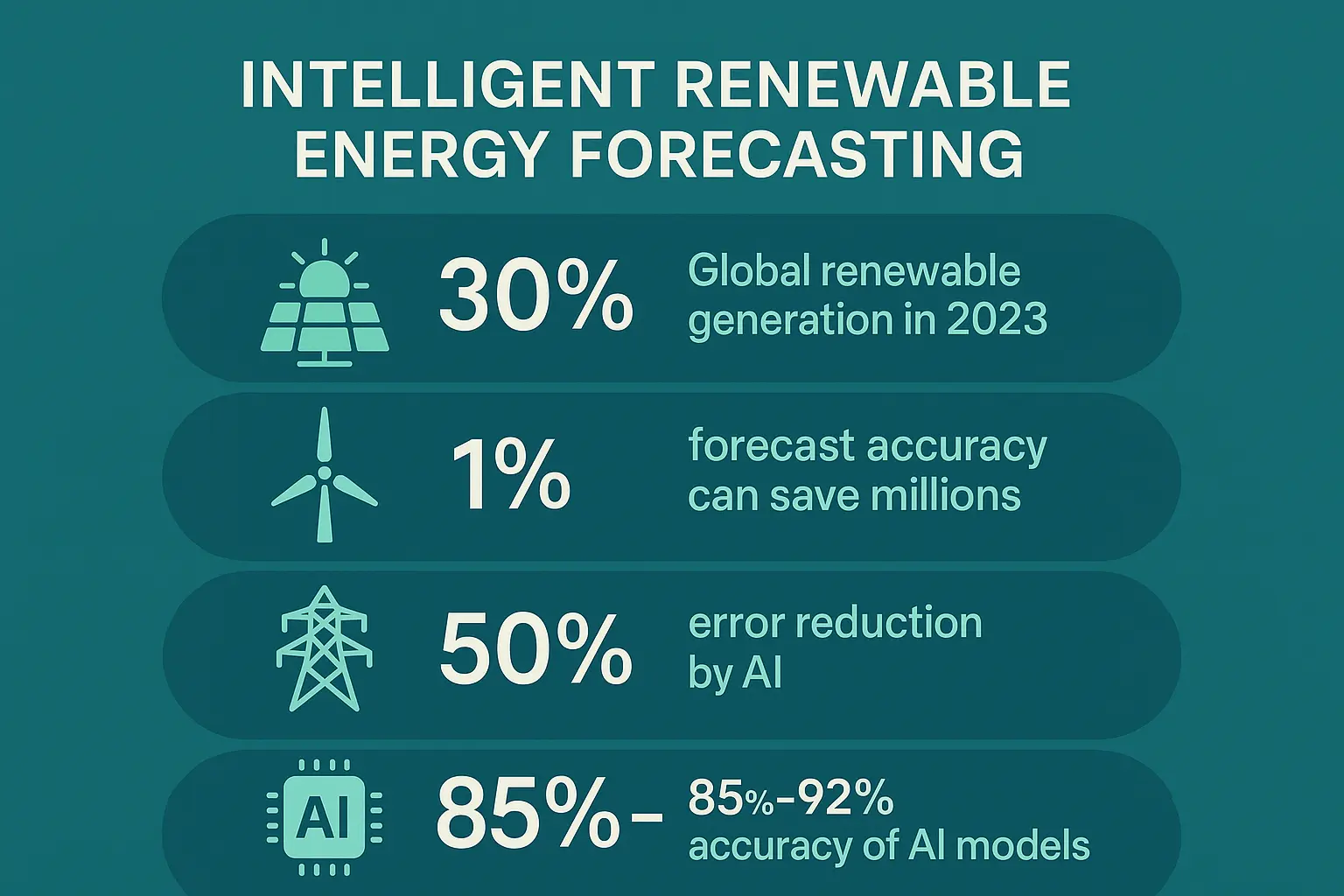
As renewables are projected to make up 42% of global generation by 2030, the pressure to integrate them seamlessly is immense. The core problem isn’t the energy source itself, but its unpredictability. This uncertainty translates directly into financial and operational risk. However, viewing this through the lens of artificial intelligence transforms it from a liability into a software-defined asset. Even a modest 1% improvement in forecast accuracy can save an energy producer millions of dollars annually through optimized trading and reduced balancing costs. This is the new benchmark for performance.
The AI Advantage: From Prediction to Profitability
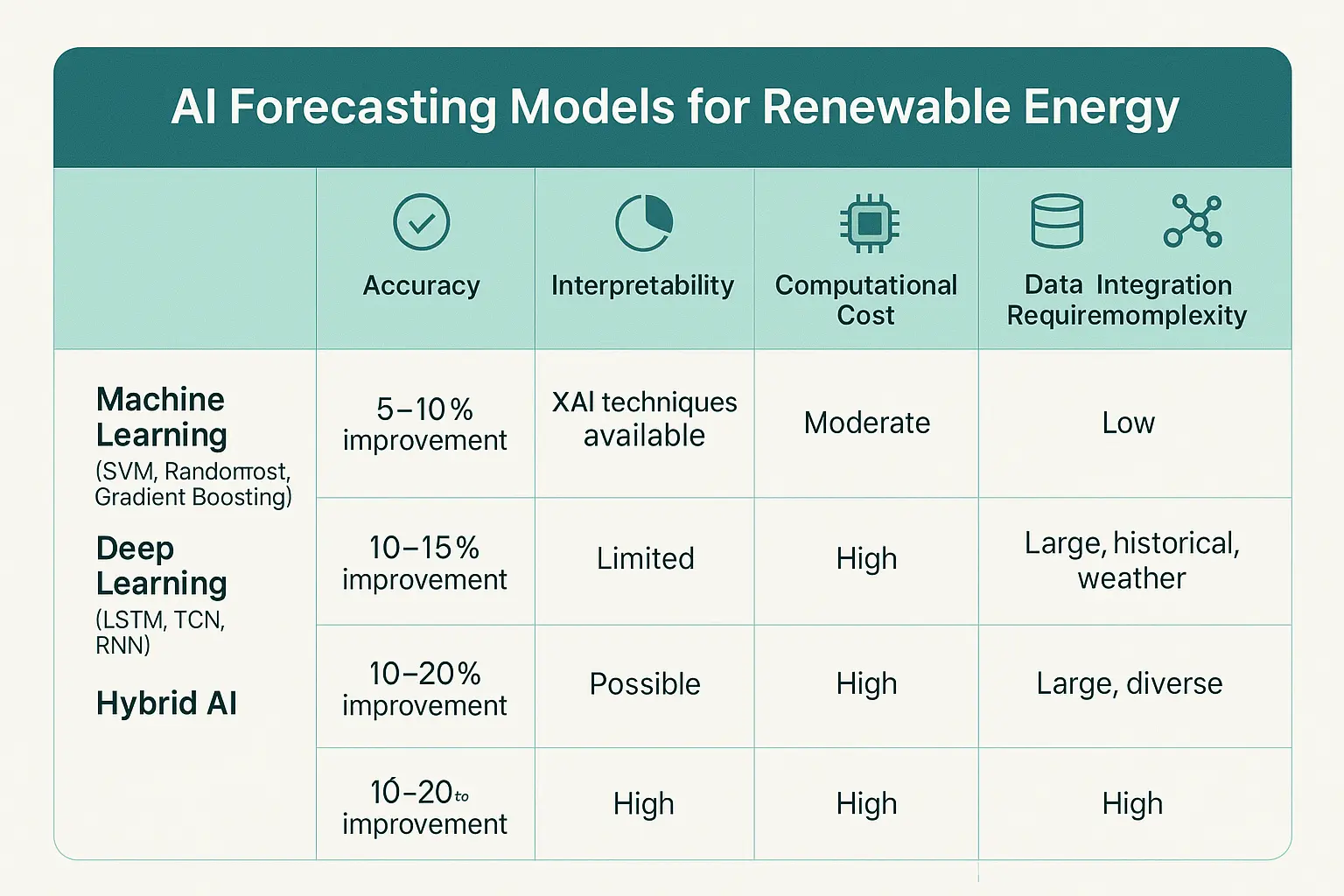
The shift from legacy forecasting methods to AI-driven intelligence is not incremental; it’s transformative. Where traditional numerical weather prediction (NWP) models provide a baseline, AI layers on historical performance data, real-time sensor inputs, and complex pattern recognition to achieve a level of precision that was previously unattainable.
Machine Learning (ML) for Resource Prediction
Standard ML models are the workhorses of modern forecasting. They excel at learning from vast datasets to identify relationships that simple statistical models miss. By analyzing years of weather data alongside actual power output, they can deliver wind speed predictions with up to 25% higher accuracy than traditional methods.
Deep Learning (DL) for Unseen Complexity
Deep Learning, a subset of ML, takes this a step further. Architectures like Long Short-Term Memory (LSTM) and Temporal Convolutional Networks (TCN) are specifically designed for time-series data, making them exceptionally good at understanding the complex, non-linear patterns of solar irradiance. This is how Google’s DeepMind was able to achieve a 50% reduction in error for its short-term solar forecasts. These models don’t just see the data; they understand its temporal context.
Hybrid AI Models: The Ultimate Synthesizer
For operators managing a mix of solar, wind, and hydro assets, hybrid models represent the gold standard. By combining different AI techniques—for instance, using a metaheuristic algorithm to fine-tune a deep learning model—these systems can achieve a comprehensive forecast accuracy of up to 92%. They create a single, unified view of your entire generation portfolio, optimizing the dispatch of each asset in concert.
Section 4: From Forecast to Grid: Intelligent Integration Strategies
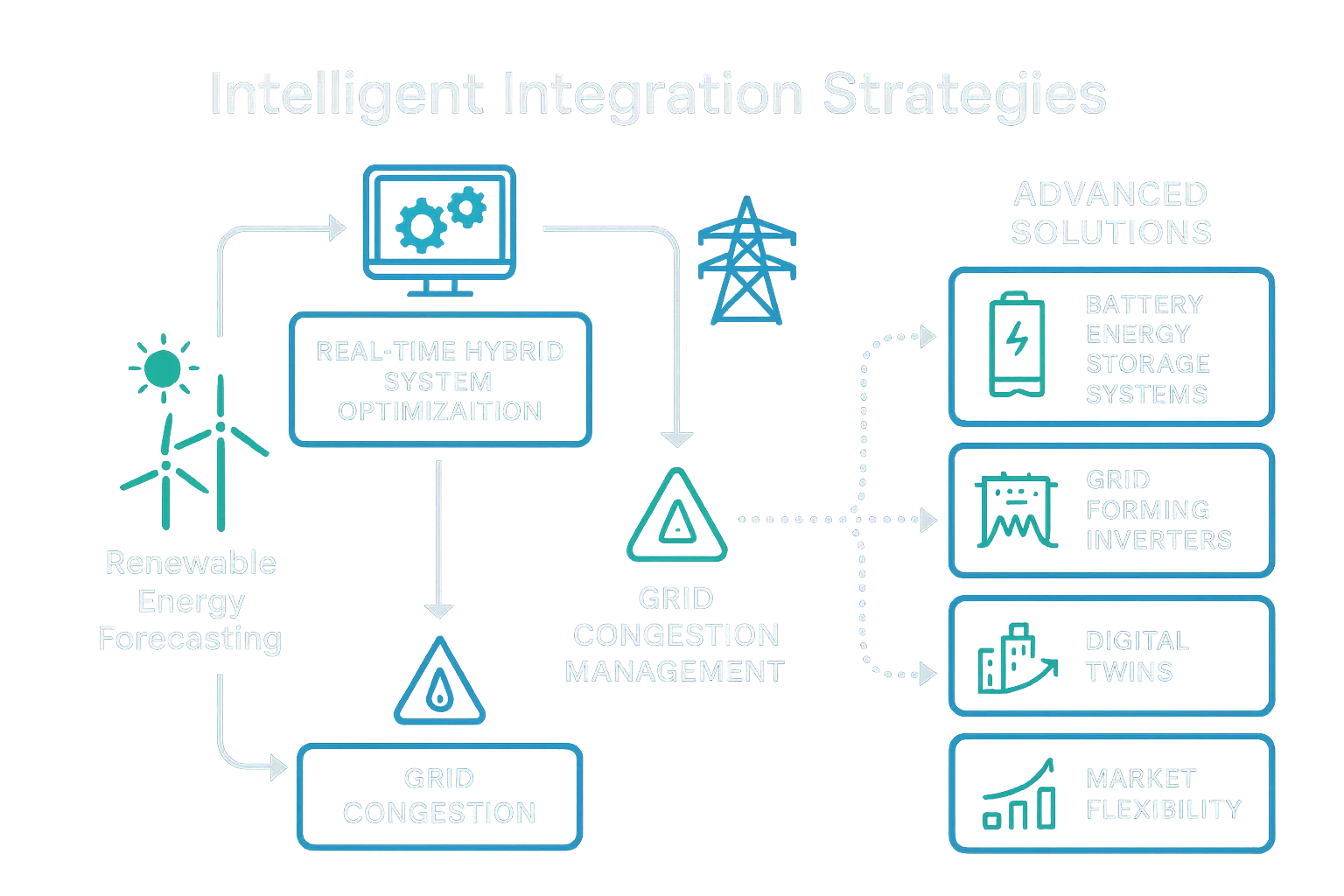
An accurate forecast is only valuable if you can act on it. Intelligent integration is the bridge between prediction and real-world grid stability. This is where AI moves from a passive analytical tool to an active control system, directly addressing the core challenges of high renewable penetration.
The primary issues are well-known: transmission bottlenecks causing congestion, rapid voltage and frequency fluctuations due to low grid inertia, and forced curtailment when supply overwhelms the grid’s capacity to absorb it.
Advanced AI-powered solutions tackle these issues head-on:
- AI-Optimized Battery Storage (BESS): Instead of simple charge/discharge cycles, AI determines the most profitable and stabilizing times to store or release energy, factoring in market prices, grid demand, and upcoming weather patterns. This approach is projected to cut renewable energy curtailment by 50% within a decade.
- Grid-Forming Inverters: AI-controlled inverters can provide “synthetic inertia,” mimicking the stabilizing effect of traditional thermal generators to automatically counteract frequency dips and maintain grid stability.
- Digital Twins & Smart Grid Software: These platforms create a real-time virtual replica of the grid. AI uses this model to run thousands of simulations, predicting potential congestion or instability points hours in advance and recommending preventative actions, such as rerouting power or dispatching storage.
Section 5: The MOFU Decision Matrix: Evaluating Intelligent Forecasting Solutions
Choosing the right AI solution requires a more sophisticated evaluation than just comparing Root Mean Square Error (RMSE) metrics. A model can be incredibly accurate but computationally expensive or completely opaque, making it useless in practice. Use this framework to guide your decision-making.
Factor 1: Performance & Accuracy
Look beyond a single metric. A solution’s performance should be judged on metrics relevant to your use case.
- Key Metrics: RMSE, Mean Absolute Error (MAE), and R-squared (R2) are standard. A model with an R2 score of 0.98, like the one detailed in a recent Nature paper, indicates it explains 98% of the variability in the data—a mark of exceptional performance.
- Context is Key: Is the model optimized for short-term (minutes-to-hours) or long-term (days-to-weeks) forecasting? High accuracy in one horizon doesn’t guarantee it in another.
Factor 2: Interpretability & Trust (Explainable AI)
One of the biggest hurdles to AI adoption is the “black box” problem. If operators and regulators can’t understand why a model is making a certain prediction, they won’t trust it. This is where Explainable AI (XAI) becomes non-negotiable.
- Practical XAI: Techniques like SHAP (SHapley Additive exPlanations) values are critical. They break down a forecast and show exactly which inputs (e.g., cloud cover, wind speed, air pressure) had the biggest impact. This provides a clear audit trail and builds operator confidence, turning a black box into a glass box.
Factor 3: Computational Cost & Efficiency
The most advanced deep learning model is impractical if it requires a supercomputer to run.
- Evaluate Resource Needs: Assess the model’s execution time, memory usage, and CPU load. A highly efficient model, like the DTCN architecture from the Nature study, could execute in under 24 seconds with minimal resource draw, making it viable for real-time deployment without massive hardware investments.
- Scalability: Can the solution scale from a single solar farm to a utility-wide portfolio without a linear increase in computational cost?
Factor 4: Data Requirements & Integration
A model is only as good as its data.
- Data Inputs: What data does the system require? Historical generation data, SCADA sensor readings, satellite imagery, and NWP data are common. Clarify the required data quality and granularity.
- Integration Complexity: How easily does the solution integrate with your existing Energy Management Systems (EMS), SCADA, and data historians? A solution with flexible APIs and established integration pathways will dramatically reduce deployment time and cost.
Section 6: Emerging Frontiers: The Future of Intelligent Integration
The field is evolving rapidly. While evaluating today’s solutions, it’s wise to understand the technologies that will define the grid of tomorrow. These aren’t just theoretical concepts; they represent the next wave of optimization and control that will be built on the foundation of today’s AI.
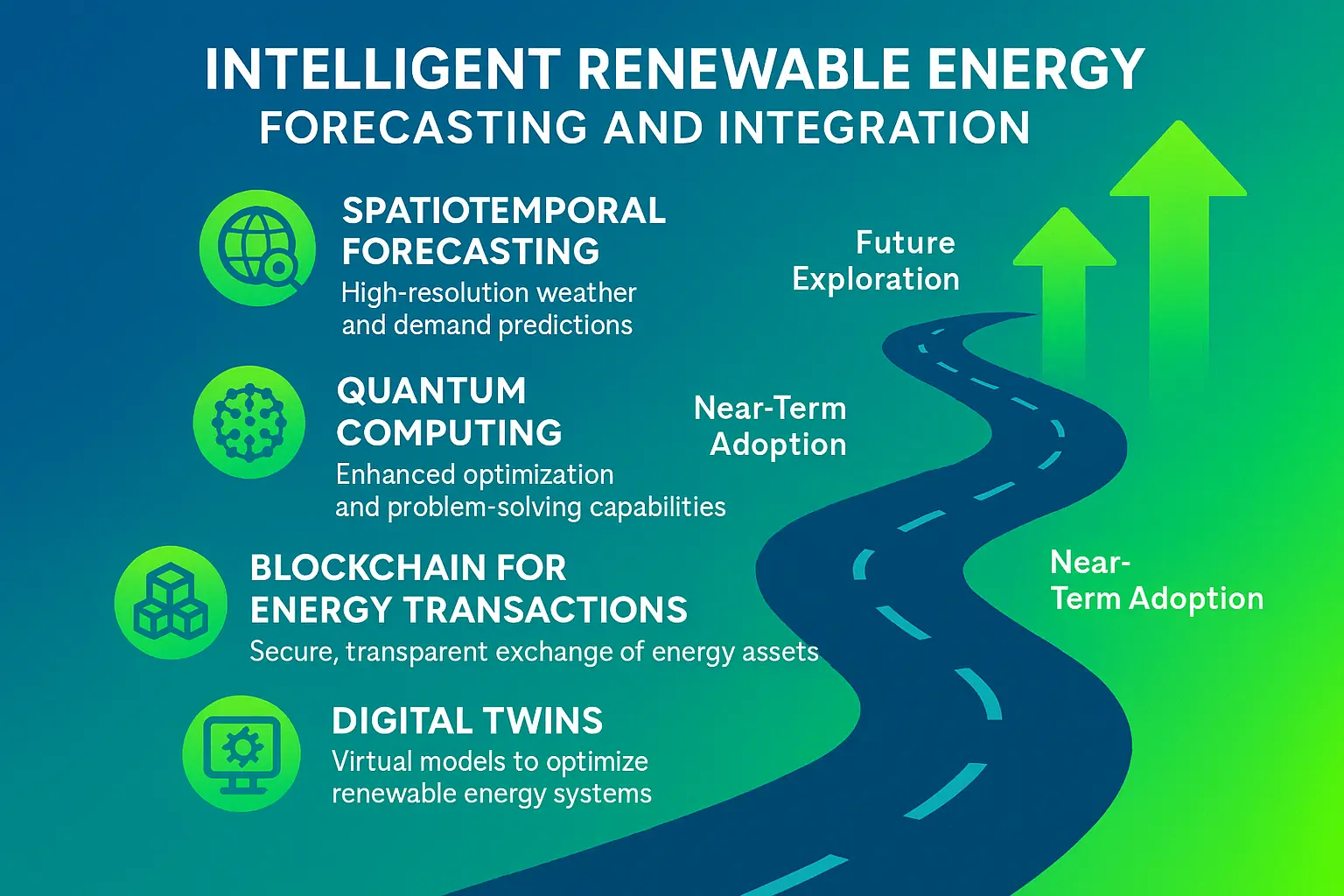
- Spatiotemporal Forecasting: Moves beyond predicting output at a single point to forecasting generation across entire geographical regions, anticipating how cloud cover or wind fronts will move across a fleet of assets.
- Quantum Computing: While still in its infancy, quantum computing holds the promise of solving complex grid optimization problems (like optimal power flow for an entire country) in seconds, a task that is impossible for today’s computers.
- Blockchain: Offers a secure, decentralized ledger for peer-to-peer energy trading and transparent tracking of renewable energy credits, enabling more dynamic and localized energy markets.
Frequently Asked Questions
What kind of data is required to start with AI forecasting?
At a minimum, you need historical energy generation data (ideally 1-3 years’ worth with a 15-minute or hourly granularity) and corresponding local weather data. For higher accuracy, integrating real-time sensor data from on-site pyranometers (for solar) or anemometers (for wind), along with satellite imagery and NWP model outputs, is highly recommended. The key is data quality; a robust solution should include data cleansing and preprocessing features.
How can we justify the ROI of an advanced forecasting system?
The ROI is calculated from several key areas:
- Reduced Curtailment: By predicting oversupply events, you can proactively manage generation or battery charging, minimizing lost revenue.
- Optimized Energy Trading: More accurate forecasts allow for more profitable participation in day-ahead and intraday energy markets.
- Lower Balancing Costs: Avoid penalties for deviating from nominated generation by having a more reliable forecast.
- Increased Asset Lifespan: Smarter battery dispatch strategies based on forecasts can reduce degradation and extend the operational life of storage assets.
Are these solutions only for large utility-scale operators?
Not at all. While utilities benefit greatly, operators of commercial and industrial microgrids, community solar projects, and large-scale renewable portfolios all face the same intermittency challenges. Modern AI solutions are often scalable, offered as software-as-a-service (SaaS) platforms that make them accessible and cost-effective for a wide range of asset owners.
How long does it take to implement and see results?
Implementation times vary depending on data integration complexity, but a typical pilot project can be up and running within a few weeks to a few months. Meaningful results, in the form of improved forecast accuracy metrics (like a reduction in MAE), can often be seen immediately after the models are trained on your specific historical data. Financial benefits accrue over subsequent months as your operations team begins making dispatch and trading decisions based on the more reliable forecasts.
Building the Software-Defined Grid
The transition to a renewable-dominant energy future depends on our ability to manage variability with intelligence. AI-powered forecasting and integration are the enabling technologies that make this possible, transforming intermittent resources into firm, predictable, and highly profitable assets.
By moving your evaluation beyond a single accuracy metric to a holistic framework that balances performance, interpretability, and operational efficiency, you can select a solution that not only predicts the future but helps you control it. The goal is no longer just to forecast the weather; it’s to build a resilient, software-defined grid that unlocks the full value of your renewable investments.
