
Beyond Big Data: The Definitive Guide to Knowledge Representation for Semantic Energy Intelligence
The energy sector is drowning in data. Over 90% of all electrical grid data has been generated in the last five years, yet less than 4% of it is ever actually used for decision-making. This isn’t a data problem; it’s a knowledge problem. Your SCADA systems, IoT sensors, and GIS databases produce a constant stream of information, but without context, relationships, and meaning, it remains a collection of disconnected facts—incapable of driving the intelligent, autonomous, and resilient energy systems of the future.
You’re likely evaluating AI solutions that promise to unlock the value in this data. But many fall short because they treat all data as equal, failing to understand the fundamental physics and operational rules of the energy domain. This is where Knowledge Representation (KR) and ontologies come in. They form the indispensable backbone for AI that doesn’t just process data but genuinely understands it, creating a system that is not only smarter but also transparent and trustworthy. This guide will walk you through how this foundational approach moves beyond surface-level analytics to create true semantic energy intelligence.
The Shift from Data to Knowledge
For decades, we’ve focused on storing data in rows and columns. This works well for structured information but fails to capture the intricate web of relationships in an energy system. A circuit breaker isn’t just a record in a database; it’s a physical asset with a specific model, connected to a particular substation, governed by operational rules, and subject to maintenance schedules.
Knowledge Representation is the discipline of creating formal, machine-readable models of a domain. Instead of just storing the word “transformer,” a knowledge-based system understands what a transformer is, its function, its connections to other assets, and the physical laws that govern its behavior. This shift from raw data to structured knowledge is the critical first step toward building more advanced and reliable AI applications. It’s the difference between an AI that can spot an anomaly and an AI that can explain why it’s an anomaly and recommend the safest, most efficient response.
The Blueprint of Intelligence: Understanding Ontologies in Energy
If knowledge representation is the strategy, an ontology is the blueprint. An ontology is a formal specification of the concepts, properties, and relationships within a specific domain. Think of it as a shared, unambiguous dictionary for both your human experts and your AI systems. It defines what entities like “substations,” “feeders,” and “inverters” are, and precisely how they relate to one another.
In the energy sector, standardization is key to interoperability. Several ontologies have been developed to model different aspects of the energy landscape. Choosing the right one—or a combination—is a critical decision in your evaluation process. While many vendors talk broadly about AI, a deep understanding of these frameworks separates true semantic solutions from generic data platforms.
Here’s a look at some of the most prominent energy ontologies:
- Brick Schema: Primarily focused on describing buildings and their subsystems (HVAC, lighting, sensors). It’s excellent for standardizing metadata in Building Energy Management Systems (BEMS).
- SAREF4ENER (Smart Appliances REFerence ontology extension for ENERgy): An extension of the SAREF standard, it’s designed to model energy-related concepts, including metering, demand response, and connections to the smart grid.
- Common Information Model (CIM): The dominant standard for power system modeling in control centers. It provides a standard way to represent power system components and their relationships, crucial for grid management and data exchange between utilities.
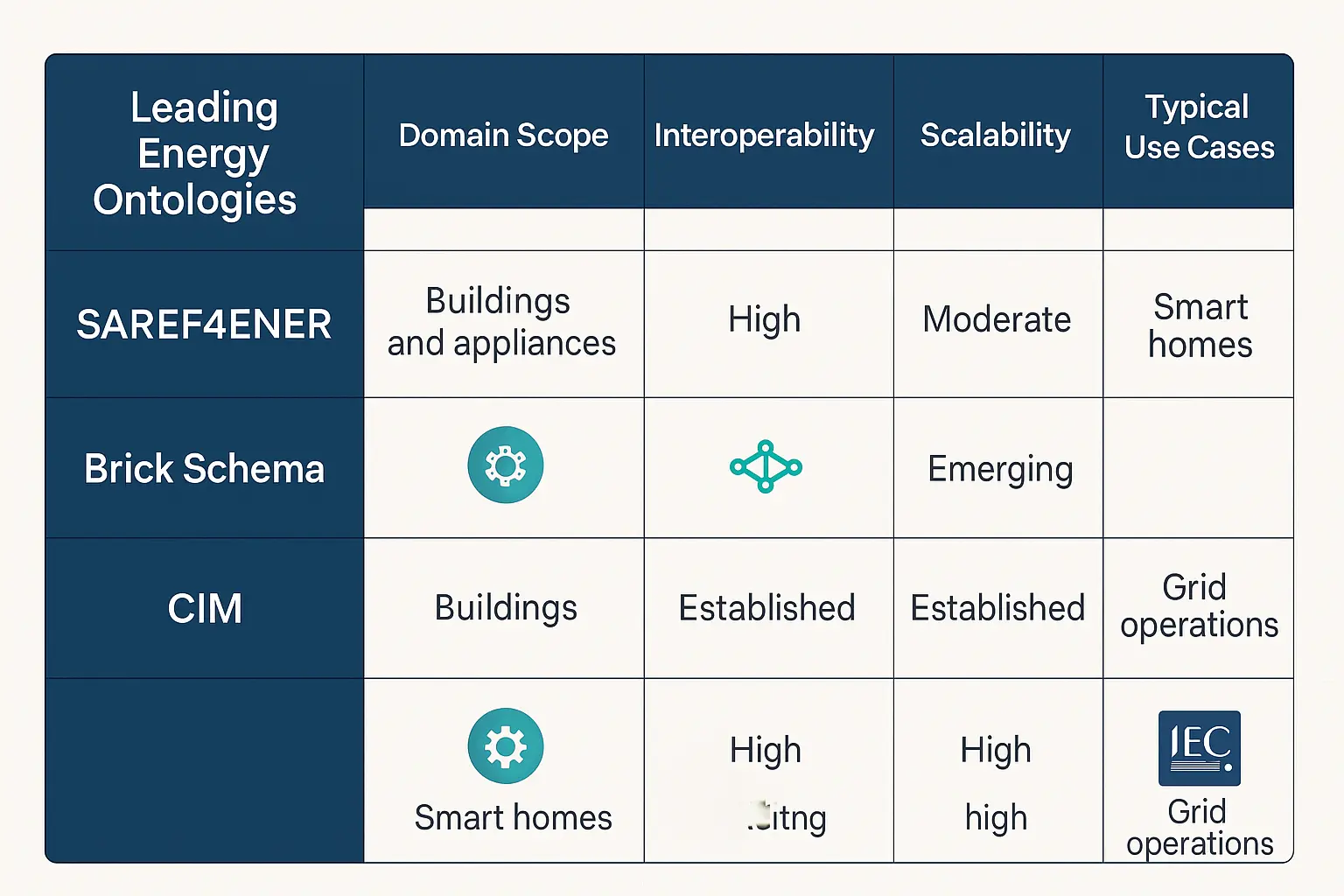
Understanding these ontologies is the first step in creating a system that can seamlessly integrate data from across your operations, breaking down the silos that currently hinder performance.
Connecting the Grid: Knowledge Graphs for Interconnected Energy Assets
Once you have the ontological blueprint, you can build the structure: a Knowledge Graph. A knowledge graph uses the ontology’s definitions to connect your disparate data points—from asset management systems, real-time sensors, weather forecasts, and market pricing—into a single, unified network of knowledge.
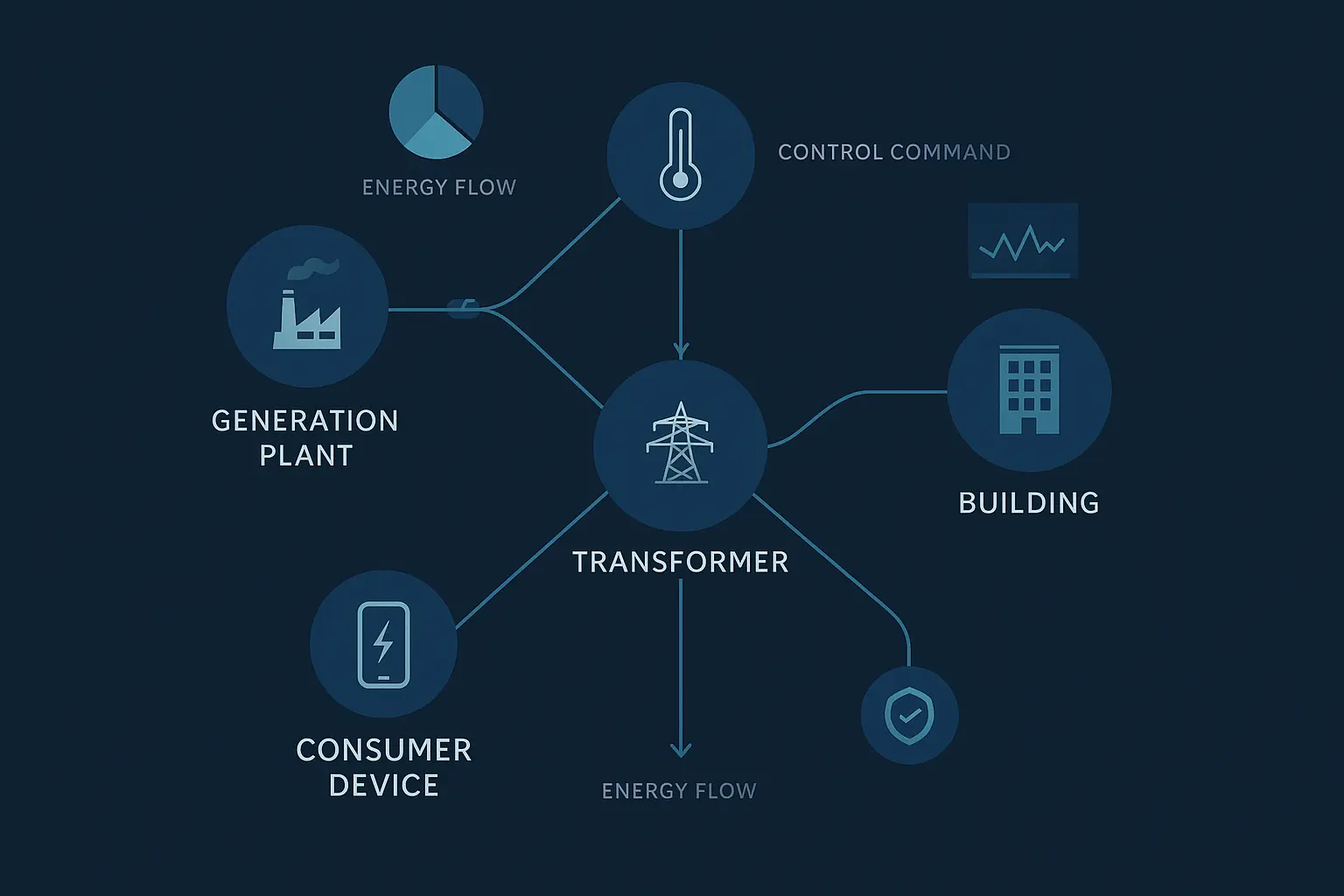
The beauty of this approach is that the knowledge graph’s architecture mirrors the physical reality of the energy grid. As Neo4j aptly puts it, the “physical architecture and database architecture mirror one another.” This isn’t just an elegant technical solution; it has profound practical implications. When a fault occurs, your AI can traverse the graph in milliseconds, identifying upstream and downstream impacts, pinpointing likely causes, and simulating the cascading effects of potential interventions. This is impossible with siloed, tabular data.
The ERCOT blackout in Texas served as a stark reminder of the risks of an interconnected but poorly understood system. A knowledge graph provides that deep understanding, modeling the complex dependencies between generation assets, transmission lines, weather patterns, and market demands, moving from reactive crisis management to proactive risk mitigation. This holistic view is fundamental to building a more resilient and reliable grid.
The Trust Factor: Explainable AI through Ontological Foundations
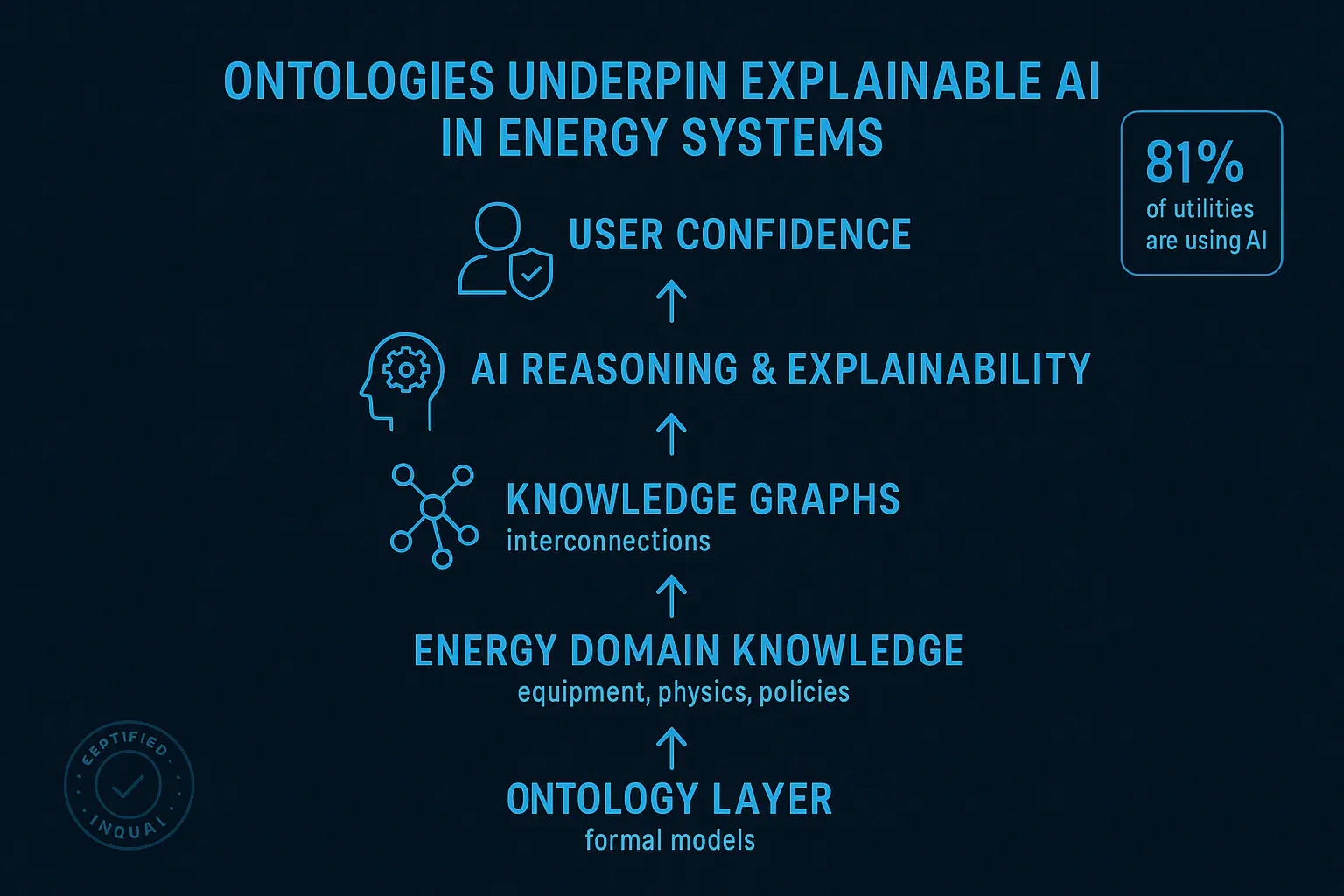
In critical infrastructure, “black box” AI is a non-starter. For operators, regulators, and executives to trust an AI’s recommendation, they must understand the reasoning behind it. This is perhaps the most significant advantage of a knowledge-based approach and a key differentiator you should look for when evaluating AI-powered energy management solutions.
Because an ontology provides a formal, human-readable structure, the AI’s reasoning path becomes transparent and auditable. If the system recommends shedding load in a specific sector, it can provide a clear explanation:
“I am recommending this action because Substation B is reporting a voltage drop of 15% (Data Point A), which is linked to Transformer T-101 (Relationship B). This transformer is currently operating at 98% of its thermal limit (Data Point C) due to an unexpected heatwave (Data Point D), and failing to reduce load risks a cascading failure impacting Sectors 4 and 5 (Inference E).”
This level of explainability builds confidence and transforms the AI from a mysterious tool into a trusted advisor. It directly addresses major adoption barriers like cybersecurity and data privacy, which concern 55% of energy companies, by providing a clear framework for data governance and access control. When you know exactly what your data means and how it’s connected, securing it becomes far more manageable.
Building Your Energy Knowledge Graph: A Phased Implementation Roadmap
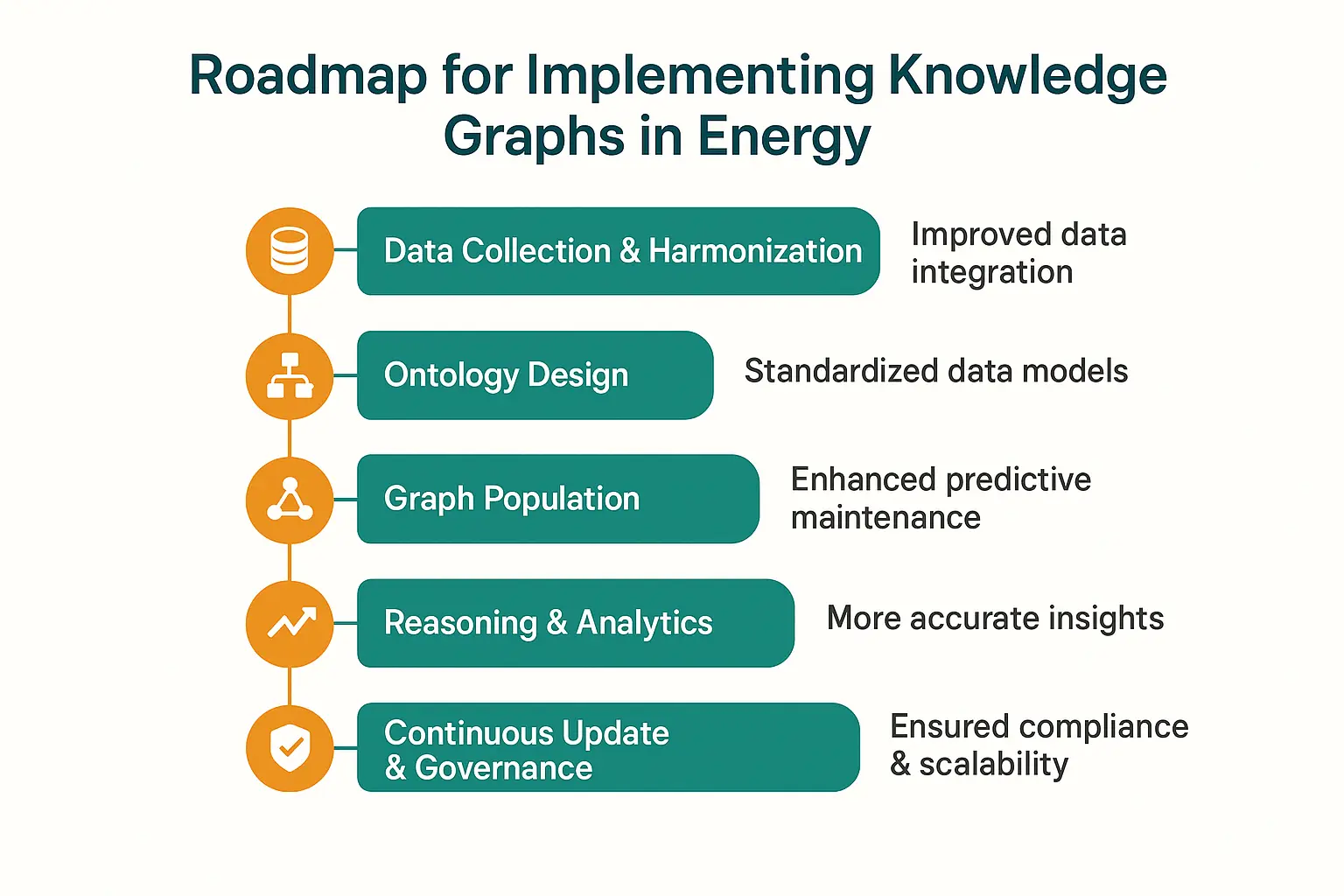
Adopting a semantic approach may seem daunting, but it can be implemented in manageable phases that deliver incremental value. A robust strategy moves from data chaos to intelligent automation systematically.
- Phase 1: Data Discovery & Ontology Design. The first step is to identify your key data sources and select or design an ontology that models your specific business entities and rules. This involves collaboration between your domain experts and data scientists.
- Phase 2: Knowledge Graph Population. In this phase, you begin to ingest and harmonize data from disparate systems, mapping it to the ontology and building the initial knowledge graph. This immediately starts to break down data silos and can provide a unified view of your assets for the first time.
- Phase 3: Foundational Analytics & Visualization. With the graph in place, you can run complex queries that were previously impossible. This phase focuses on creating dashboards and visualization tools that allow operators to explore relationships and gain new insights from the interconnected data.
- Phase 4: Advanced Reasoning & AI Application. Once the knowledge foundation is solid, you can layer on advanced AI and machine learning applications. Your AI now operates on high-quality, contextualized knowledge, enabling far more accurate predictive maintenance, demand forecasting, and automated policy enforcement.
This phased approach helps demystify implementation and addresses the talent gap, a concern for 38% of the industry, by allowing your team to build skills and see value at each stage.
Frequently Asked Questions
Isn’t this overly complex compared to our existing data warehouse?
While the initial setup requires a different mindset, the long-term benefits in flexibility and intelligence far outweigh the complexity. Traditional data warehouses are rigid and require extensive remodeling for new questions. A knowledge graph is flexible by design, allowing you to easily add new data sources and relationships without breaking the existing structure. It answers questions you didn’t even know you needed to ask.
How is this different from a standard data lake?
A data lake stores raw data in its native format but lacks semantic structure. It solves the data storage problem but creates an analytics problem, often becoming a “data swamp.” A knowledge-based system enriches that raw data with meaning and context before the analysis, ensuring every piece of information is clean, connected, and understood by the AI.
What kind of ROI can we expect?
The ROI comes from multiple areas. Operationally, AI-driven demand response programs can cut peak demand by 10-20%. In asset management, more accurate predictive maintenance reduces downtime and extends equipment life. Strategically, the ability to accurately forecast and simulate grid behavior reduces financial risk and improves capital planning. Companies like C3 AI report customers achieving up to a 5% reduction in GHG emissions and 4% in costs.
What skills do we need on our team to manage this?
Success requires a blend of skills. You need your existing domain experts (engineers, grid operators) to help define the ontology. You also need data engineers and data scientists who are comfortable with graph technologies and semantic web standards (like RDF and OWL). The key is to find a technology partner who can help bridge this gap and augment your team’s capabilities during the initial implementation. You can learn more by exploring our guide to building a semantic data integration team.
Powering the Future with Intelligent Knowledge
The future of energy management will not be won by the organization with the most data, but by the one that can transform its data into the most reliable and actionable knowledge. AI is a powerful tool, but its effectiveness is capped by the quality of the foundation it’s built upon.
Knowledge Representation and ontologies provide that foundation. They move you beyond simple pattern recognition to a state of true semantic intelligence, creating systems that are more efficient, resilient, and, most importantly, trustworthy. As you evaluate solutions, look past the generic promises of “AI” and ask how they handle the fundamental representation of knowledge. That is the question that will determine your success in building the intelligent energy system of tomorrow.
