
You’re facing a paradox. On one hand, AI is essential for modernizing the energy grid, promising unprecedented efficiency and resilience. On the other, the massive deep learning models powering this revolution are becoming a significant strain on the very energy resources they’re meant to optimize. As data centers are projected to double their energy consumption by 2030, you’re likely asking a critical question: how can we leverage AI’s power without succumbing to its unsustainable appetite?
The answer isn’t a bigger, more powerful model. It’s a fundamentally smarter, more elegant approach. This is where decision-makers are now focusing their evaluation—moving beyond the hype of general “AI” to identify specific methodologies that deliver on the promise of trustworthy, explainable, and efficient energy management.
This guide provides the framework for that evaluation. We’ll explore Neuro-Symbolic AI (NSAI), a hybrid approach that combines the pattern-recognition strengths of neural networks with the logical reasoning of symbolic systems. It’s the architecture that finally allows AI to understand not just correlation from data, but also the fundamental laws of physics that govern our critical energy infrastructure.
Understanding the “Why”: Limitations of Pure AI Paradigms in Energy
In safety-critical energy applications, choosing the right AI architecture is paramount. Relying on a single methodology means inheriting its weaknesses, which can create unacceptable risks. The most common approaches, deep learning and symbolic AI, each offer powerful capabilities but fall short on their own.
The Power and Problem of Pure Neural Networks
Deep learning models are exceptional at identifying subtle patterns in vast datasets. They can analyze sensor readings, weather patterns, and consumer behavior to predict demand or potential equipment failures. However, their “black box” nature is a significant liability in the energy sector. Operators can’t easily audit why a model made a specific decision, making it difficult to trust in high-stakes scenarios. Furthermore, these models struggle to rigorously enforce hard physical constraints, like voltage limits or transmission capacities, without being explicitly trained on every possible edge case—an impossible task.
The Rigidity of Pure Symbolic AI
Symbolic AI, or rule-based systems, operates on clear, human-readable logic. An engineer can write explicit rules like “IF voltage exceeds X, THEN reroute power through circuit Y.” This makes the system’s reasoning completely transparent and auditable. The downside is brittleness. These systems can’t easily adapt to new situations or learn from noisy, real-world data. Manually encoding all the knowledge required to manage a modern grid is an intractable and never-ending task.
Neuro-Symbolic AI resolves this conflict by creating a symbiotic relationship, delivering a solution that is both data-savvy and rule-abiding.
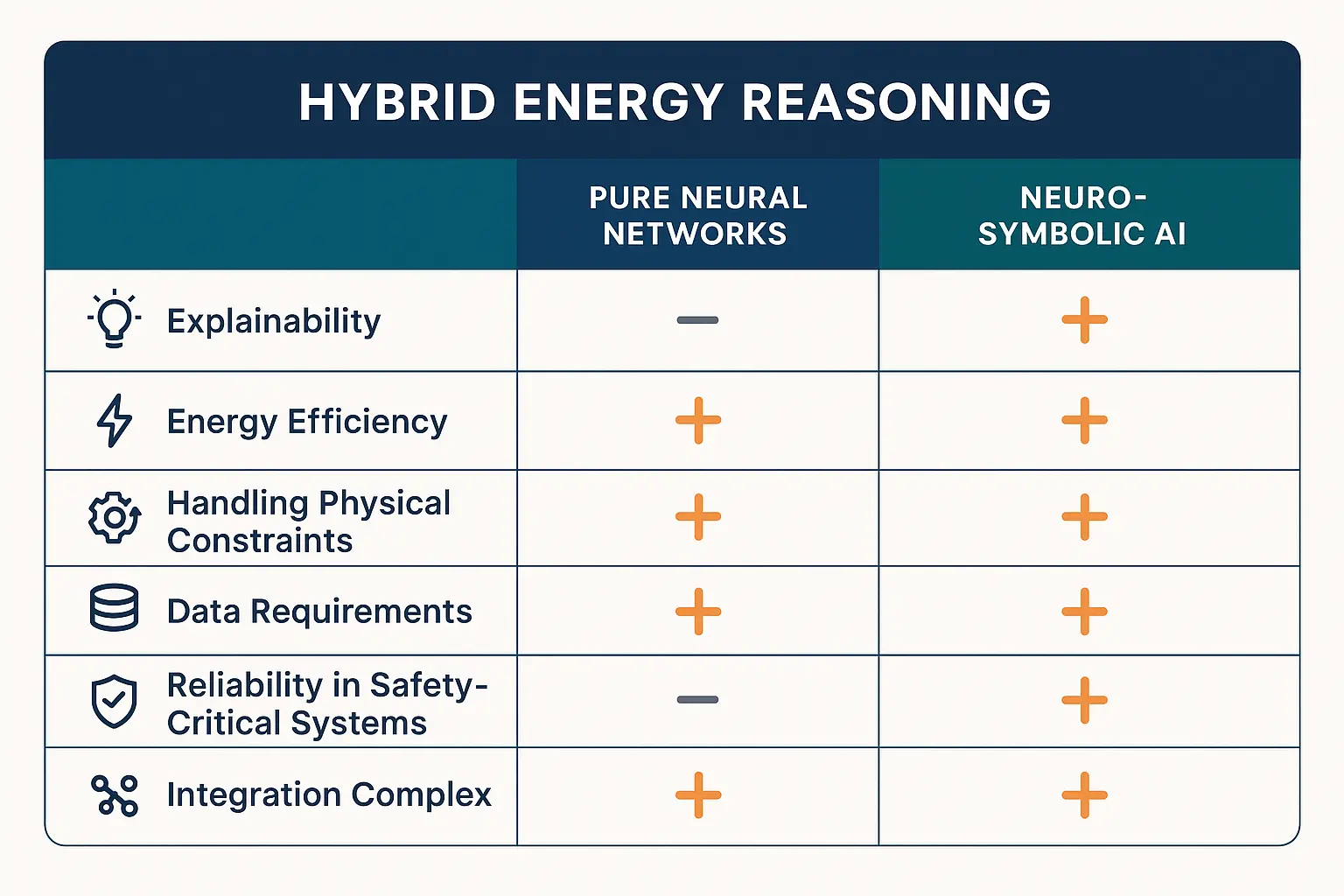
The Neuro-Symbolic AI Framework for Hybrid Energy Reasoning
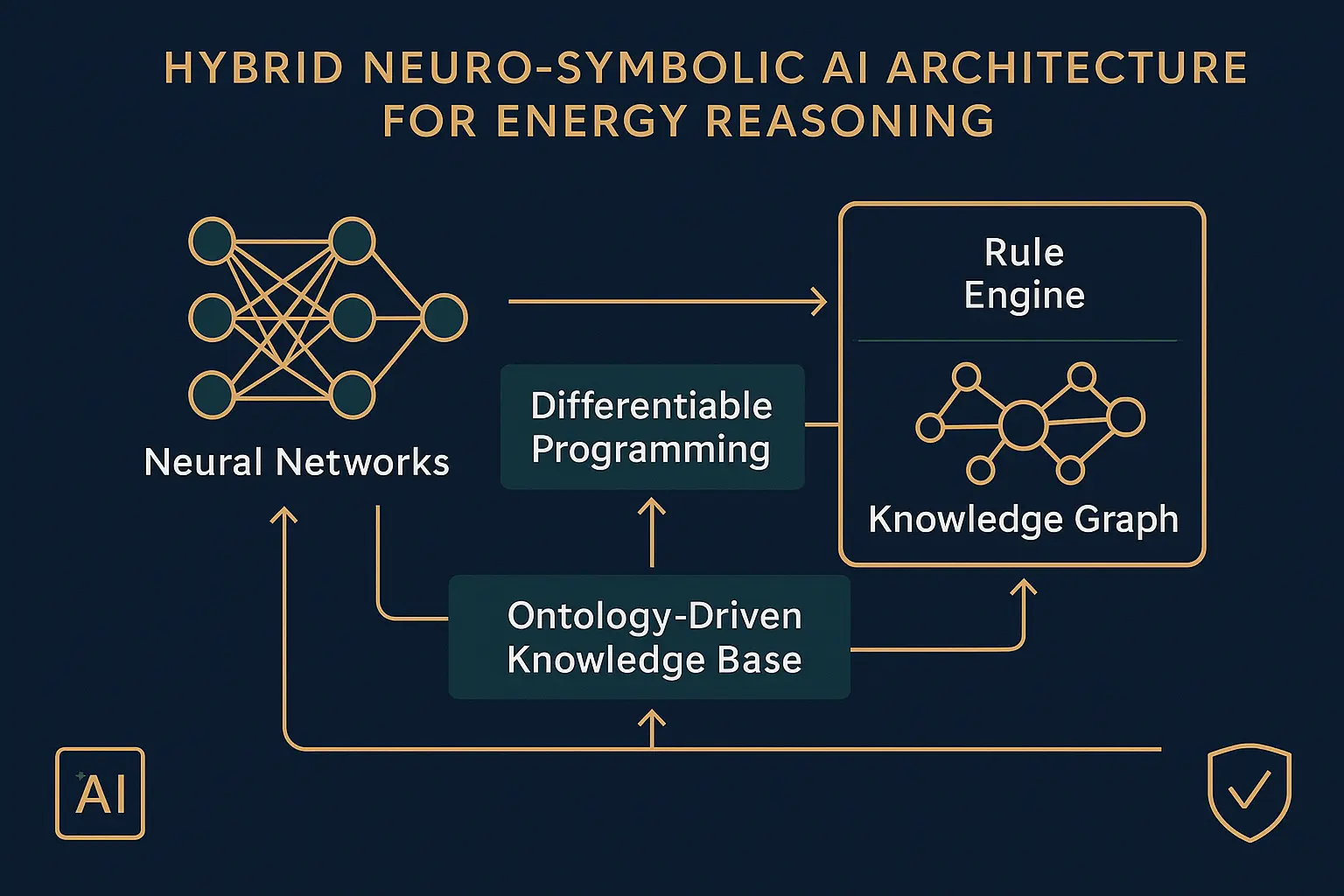
At its core, NSAI is not a single product but a flexible architectural framework designed to integrate learning and reasoning. This hybrid approach allows systems to perceive the world through data while reasoning about it using structured knowledge.
The process typically involves two key components working in concert:
- The Connectionist (Neural) System: This is the deep learning part of the duo. It ingests large volumes of unstructured data—like sensor streams, weather data, or market prices—and excels at tasks like perception, pattern recognition, and probabilistic forecasting.
- The Symbolic System: This component contains structured domain knowledge. Think of it as a digital library of facts, rules, and relationships, often represented in a knowledge graph. This is where the laws of physics, grid topology, regulatory constraints, and operational safety protocols are explicitly defined.
These two systems can be integrated in several powerful ways:
- Symbolic Knowledge Injection: Physical laws and constraints from the symbolic reasoner are “injected” into the neural network during training. This guides the learning process, ensuring the model’s outputs are physically plausible and compliant from the start.
- Neural-to-Symbolic Reasoning: The neural network first processes raw data to generate insights or predictions (e.g., “High probability of fault in Substation B”). This output is then fed to the symbolic reasoner, which uses its rule-based knowledge to perform a root-cause analysis, verify the conclusion against known constraints, and recommend a specific, auditable course of action.
- Constraint-Satisfying Layers: Hybrid models can incorporate layers that computationally enforce hard rules, ensuring that no matter what the neural network suggests, the final output never violates a critical safety or operational boundary.
Transforming the Grid: Key Applications of Neuro-Symbolic AI
Moving from theory to practice, NSAI is uniquely positioned to solve the most complex challenges in energy management. Its hybrid nature makes it the ideal candidate for applications where both data-driven agility and logical rigor are non-negotiable.
Combining Deep Learning with Rule-Based Systems for Grid Control
Modern grids are a chaotic dance of fluctuating renewable energy sources, shifting demand, and aging infrastructure. A pure deep learning model might predict an impending imbalance but struggle to recommend a safe control action. By combining deep learning with rule-based systems for grid control, an NSAI agent can use its neural component to anticipate instability and its symbolic component to instantly identify a sequence of control actions (e.g., adjusting generator output, rerouting power) that is guaranteed to comply with N-1 contingency rules and physical operating limits.
Symbolic Knowledge Injection for Energy Forecasting
Accurate forecasting is the bedrock of grid management. Instead of relying solely on historical data, symbolic knowledge injection into neural networks for energy forecasting enhances models with contextual understanding. For example, the model can be explicitly told about a planned maintenance event, the efficiency curve of a specific wind turbine model, or the typical demand impact of a public holiday. This reduces the amount of training data needed, improves accuracy during unusual events, and allows the model to explain its forecast by referencing the specific rules or facts it used.
Explainable Neuro-Symbolic Models for Diagnostics
When a fault occurs in a power system, identifying the root cause quickly and accurately is critical. An NSAI system can analyze complex patterns of sensor alerts that might precede a failure (the neural part) and then map these patterns against a detailed knowledge graph of the grid’s topology and component dependencies (the symbolic part). This allows for truly explainable neuro-symbolic models for diagnostics that don’t just flag an anomaly but can produce a human-readable causal chain: “Alert on Relay 5 is the likely root cause because it protects Transformer T2, which is showing abnormal temperature readings, and a failure here would explain the voltage sags detected downstream.”
Hybrid Architectures for Demand Response Optimization
Effective demand response requires balancing grid needs, consumer preferences, and economic signals. Hybrid architectures for demand response optimization use neural networks to predict load flexibility based on user behavior and real-time conditions. The symbolic reasoner then uses this information to create an optimal dispatch strategy that respects all constraints: customer-defined temperature ranges, contractual obligations, and local grid capacity limits. The system can automate load-shifting decisions and justify them with clear, rule-based explanations.
Neuro-Symbolic AI: The Energy-Efficient and Trustworthy Choice
For decision-makers evaluating AI solutions, two of the most critical factors are long-term operational cost and risk mitigation. Neuro-Symbolic AI provides a compelling advantage on both fronts, moving beyond a theoretical preference to a clear business case.
A Leap in Energy Efficiency
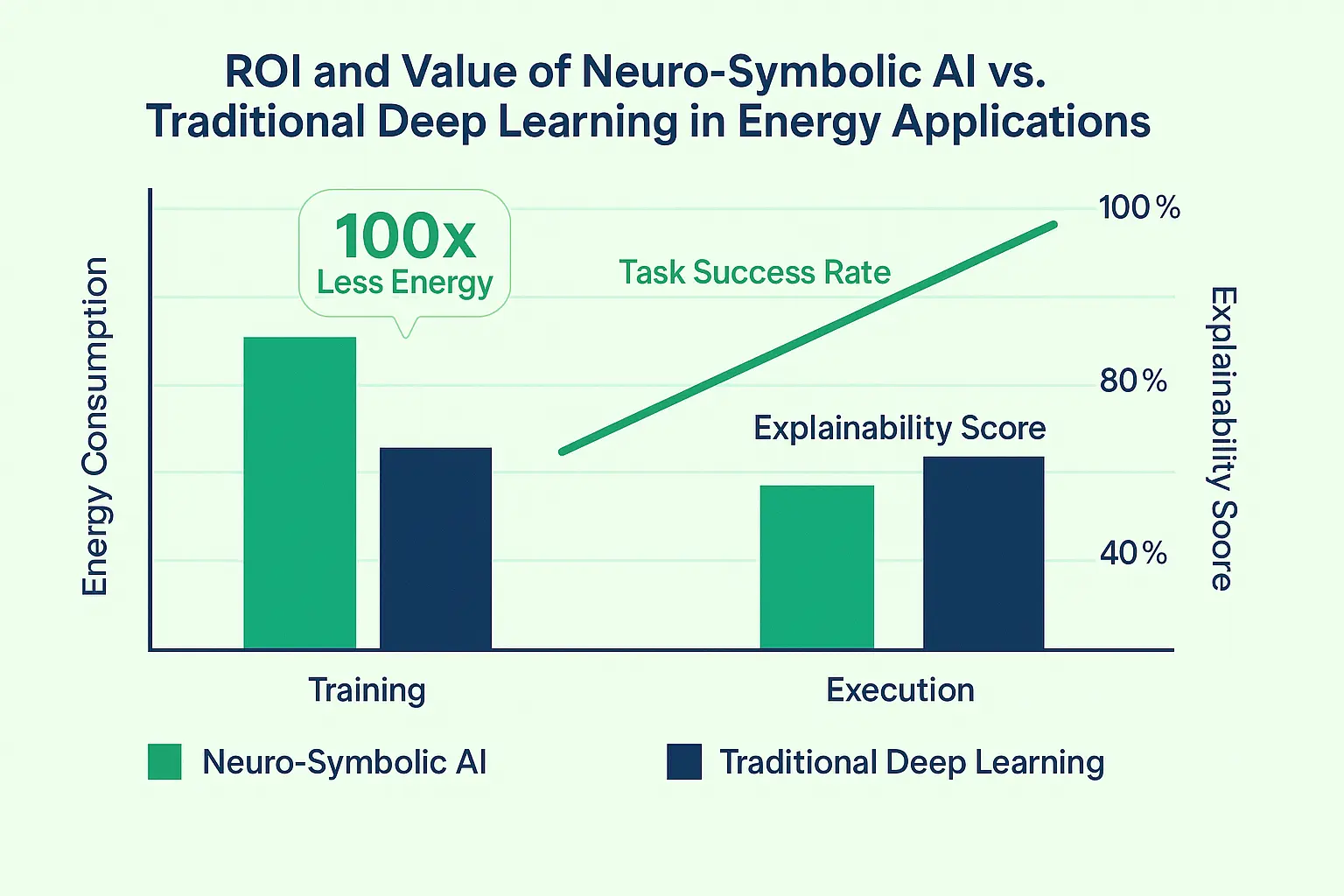
Because NSAI systems are guided by explicit knowledge, they learn more efficiently and require less brute-force training on massive datasets. The results are dramatic. A recent Tufts-led study found that a neuro-symbolic system could perform complex tasks with a 95% success rate while using 100 times less energy than a standard deep learning model, which only achieved a 34% success rate. The NSAI approach used just 1% of the energy for training and 5% during execution, directly addressing the paradox of AI’s growing energy footprint.
The Foundation for Trustworthy AI
As regulations like the EU AI Act come into force, “explainability” is shifting from a desirable feature to a mandatory requirement for high-risk systems. NSAI is built for this reality. Its ability to produce auditable, causal decision trails means that when an incident occurs, operators and regulators can understand precisely why the AI took a specific action. This transparency is the foundation of trust and a critical component of any robust risk management strategy.
Overcoming Implementation Hurdles: A Practical Roadmap
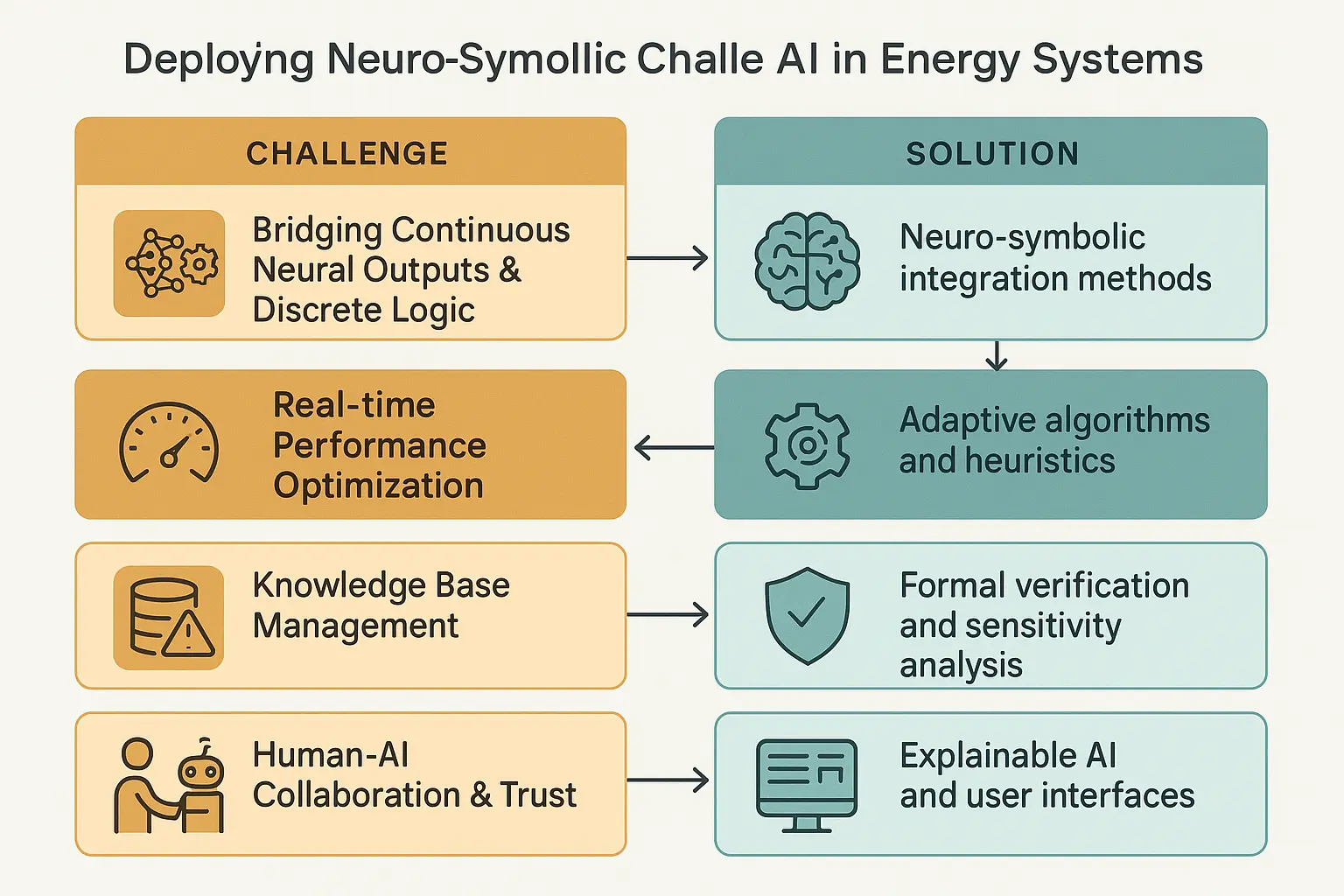
Adopting a powerful new architecture like Neuro-Symbolic AI involves navigating both technical and operational challenges. Acknowledging these hurdles is the first step toward a successful deployment. A strategic approach focuses on bridging paradigms, ensuring performance, and building operator trust.
Here are the key considerations for your implementation roadmap:
- Architectural Integration: The primary technical challenge is creating a seamless bridge between the continuous, probabilistic world of neural networks and the discrete, logical world of symbolic reasoners. This requires careful architectural design and often involves specialized software frameworks.
- Knowledge Base Management: The performance of the symbolic system depends entirely on the quality of its knowledge base. This requires a dedicated effort to codify domain expertise, grid topology, and operational rules into a structured format like an ontology or knowledge graph, and a plan to keep it updated as the grid evolves.
- Real-Time Performance: Grid control and protection systems demand decisions in milliseconds. NSAI architectures must be optimized for low-latency inference, ensuring that the combined reasoning process doesn’t introduce dangerous delays.
- Robustness and Verification: The system must be rigorously tested to understand how it behaves with noisy or incomplete data. Formal verification methods are often used to prove that the symbolic component will always respect critical safety constraints, providing a level of assurance that purely neural systems cannot match.
- Building Operator Trust: The ultimate goal is not to replace human operators but to empower them. The explanations generated by the NSAI system must be intuitive and actionable for a control room environment. The system should be introduced as a trusted advisor that enhances, rather than usurps, human expertise.
Frequently Asked Questions
1. Isn’t building a hybrid system more complex than just using a standard deep learning model?While the initial architecture is more involved, the long-term benefits in reliability, efficiency, and maintenance often outweigh the upfront complexity. Injecting domain knowledge reduces the reliance on massive datasets and endless fine-tuning. The built-in explainability also dramatically simplifies debugging, validation, and regulatory compliance, reducing operational overhead.
2. How difficult is it to create and maintain the symbolic knowledge base?This is a critical effort, but modern tools like knowledge graphs and ontologies streamline the process. The initial build requires collaboration between domain experts (grid engineers) and data scientists. Maintenance can be semi-automated, with systems that can suggest updates based on new data or documentation, ensuring the knowledge base remains a living asset rather than a static document.
3. Can Neuro-Symbolic AI operate in real-time for critical grid control?Yes. Performance is a key design consideration. Architectures are often optimized by running the computationally intensive neural learning offline, while the faster symbolic reasoning engine operates in real-time. For ultra-low latency applications, the logic can be compiled and deployed on edge devices directly within a substation, ensuring decisions are made in milliseconds.
4. What kind of talent do we need to implement these systems?Successful NSAI projects require collaborative teams. You need data scientists with deep learning expertise, software engineers who understand symbolic logic and knowledge representation (e.g., RDF, OWL), and, most importantly, deep engagement from your energy domain experts who provide the foundational rules and constraints.
Your Path to a Smarter, Sustainable Grid
The energy industry is at a crossroads. The path of bigger, more energy-intensive AI is a dead end. The future belongs to systems that are not only powerful but also efficient, transparent, and trustworthy.
Neuro-Symbolic AI provides the practical framework to build this future. By combining data-driven learning with principled, rule-based reasoning, it delivers the performance needed to manage a complex modern grid while providing the explainability and reliability that safety-critical infrastructure demands. As you evaluate your options, consider not just what AI can predict, but what it can provably guarantee. That is the Neuro-Symbolic difference.
