
Optimizing Back-Office Operations: The Transformative Power of AI Agents (and Why It’s More Than Just RPA)
You know your back office is the engine of your business. But right now, that engine is likely sputtering, bogged down by repetitive tasks, manual data entry, and legacy systems that don’t talk to each other. You’ve heard about automation, maybe even invested in Robotic Process Automation (RPA), but you’re still hitting a wall. The promise of massive efficiency gains feels just out of reach.
The problem isn’t the goal; it’s the tools. While RPA was a crucial first step, it’s like using a calculator when you really need a data scientist. To truly transform your back office, you need to move beyond simple, rule-based automation. You need autonomous AI agents that can think, reason, and adapt.
The Unseen Engine of Business (and Its Bottlenecks)
Back-office operations—finance, HR, IT, and supply chain—are the critical support structures that allow your business to function. When they run smoothly, they’re invisible. But when they don’t, the entire organization feels the pain.
Inefficiency is a silent killer of growth. Employees spend nearly 45% of their time on manual administrative tasks and another 19% just searching for the information they need to do their jobs. This isn’t just frustrating; it’s costly. Poor data quality, often stemming from manual entry errors, costs US businesses an estimated $700 billion annually.
For years, RPA was hailed as the solution. These software “bots” are excellent at mimicking human actions for structured, repetitive, rule-based tasks. But the moment they encounter an exception, unstructured data like a non-standard invoice, or a process that requires judgment, they break. This is where the evolution to AI agents becomes a strategic necessity.
Understanding the Evolution: From RPA to Autonomous AI Agents
To make a confident decision, you need to understand the fundamental difference between yesterday’s automation and today’s. It’s not just an upgrade; it’s a paradigm shift.
What is RPA?Think of RPA as a digital assistant that follows a very specific script. It’s perfect for tasks like copying data from a spreadsheet to a CRM system or processing a batch of identical forms. Its strength lies in high-volume, low-exception environments. Its weakness? It can’t handle variability or make decisions outside its programmed rules.
Introducing AI AgentsAI agents are autonomous, goal-driven software programs that use artificial intelligence, including large language models (LLMs) and natural language processing (NLP), to perceive their environment, make decisions, and take actions to achieve specific outcomes. They don’t just follow a script; they understand intent, interpret unstructured data, and learn from feedback.
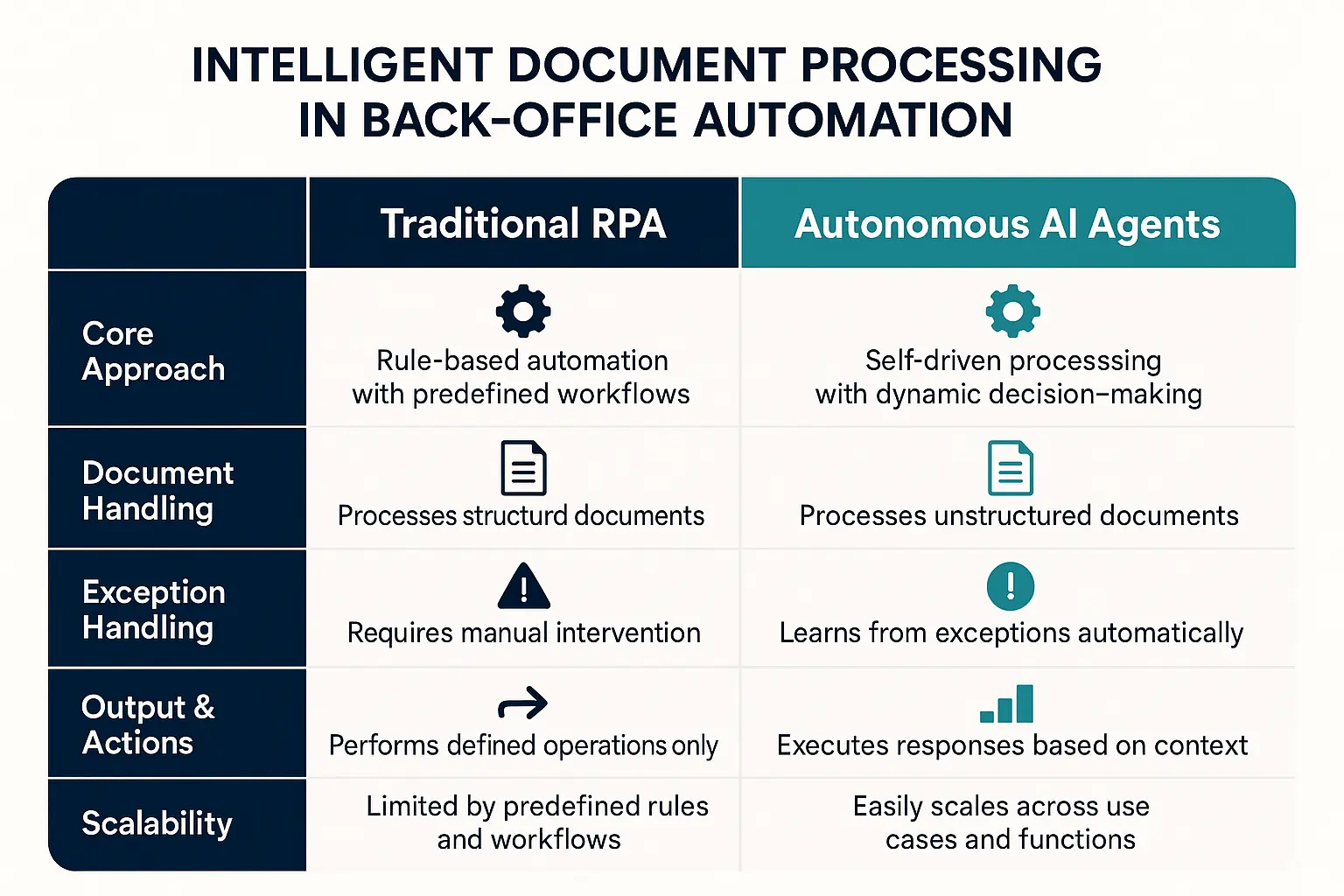
This distinction is most clear when looking at a common back-office task like intelligent document processing. An RPA bot can extract data from a fixed-template invoice. An AI agent, however, can read, understand, and process invoices in any format, flag discrepancies based on historical context, and even communicate with a vendor to resolve an issue—all without human intervention.
The Tangible Benefits: Why AI Agents Drive Superior ROI in the Back Office
Moving from RPA to AI agents isn’t just a technical upgrade; it’s a strategic business decision that unlocks a new level of value. While 82% of companies report a positive ROI from AI, the most significant gains come from deep, functional automation in the back office.
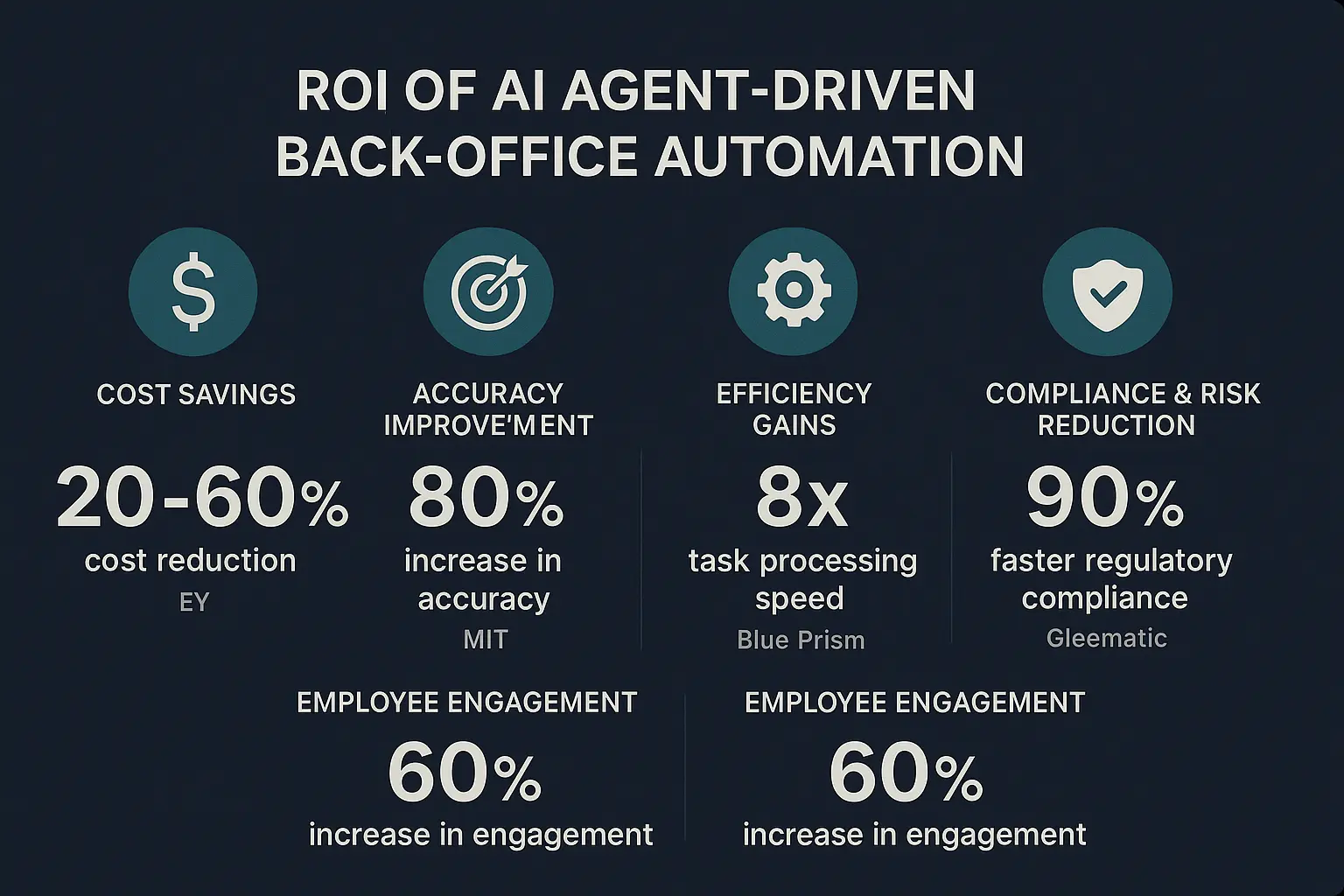
Here’s the measurable impact you can expect:
- Radical Cost Reduction: Go beyond incremental savings. An MIT report identified back-office automation as delivering the single biggest ROI by enabling companies to eliminate BPO contracts and cut external agency costs. Some estimates show savings of 20-60% on FTE costs alone.
- Near-Perfect Accuracy: Human error is inevitable—and expensive. AI agents dramatically reduce these risks. In fact, 90% of organizations see improved data accuracy after implementing automation, directly tackling the multi-million dollar problem of poor data quality.
- Exponential Efficiency: When AI agents handle complex, time-consuming tasks like financial reconciliation or vendor onboarding, your team is freed to focus on strategic analysis, partner relationships, and business growth.
- Robust Compliance and Risk Management: AI agents create perfect, automated audit trails for every action. They can be trained to enforce compliance rules consistently and even proactively flag anomalies that might indicate fraud, giving you an unprecedented level of control.
- Effortless Scalability: Need to process 10,000 invoices this month instead of 1,000? An AI agent workforce can scale instantly without the time and cost associated with hiring and training more people.
AI Agents in Action: Transforming Key Back-Office Functions
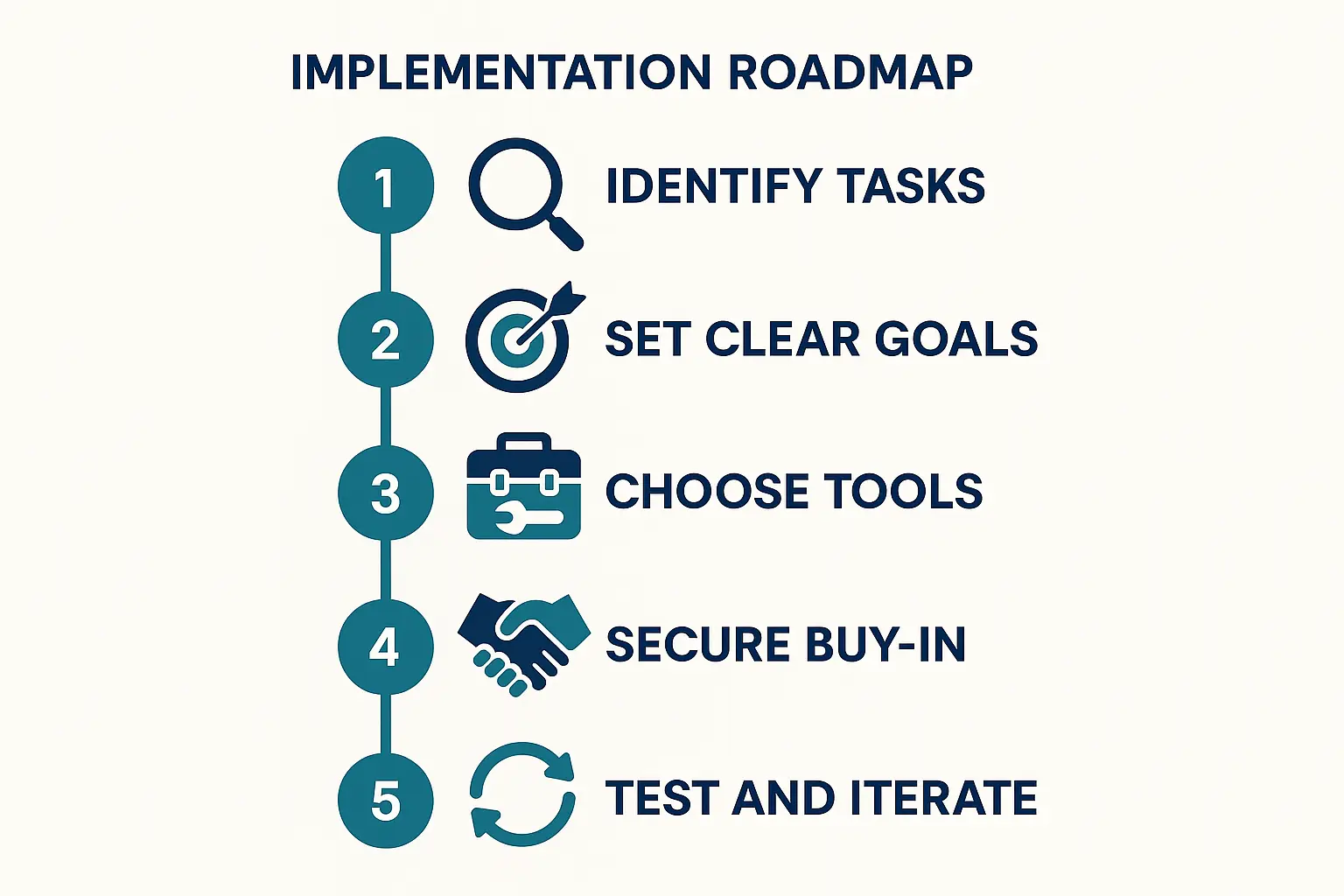
The true power of AI agents becomes clear when you see how they solve specific, persistent problems across your organization. They aren’t just tools; they are specialized digital employees.
Finance & Accounting
- The Pain Point: Manually matching thousands of invoices, purchase orders, and receipts is slow and error-prone. Closing the books requires days of painstaking reconciliation.
- The AI Agent Solution: An agent for financial reconciliation can ingest data from multiple systems (bank statements, ERPs, invoices), understand context, match transactions with near-perfect accuracy, and flag only the true exceptions for human review.
Human Resources
- The Pain Point: The HR team is constantly fielding the same questions about benefits, time off policies, and payroll. The onboarding process is a disjointed series of manual tasks.
- The AI Agent Solution: An HR self-service bot can answer complex employee questions conversationally, 24/7. An onboarding agent can orchestrate the entire process—from sending offer letters to provisioning IT equipment and scheduling orientation—ensuring a seamless experience for new hires.
IT Operations
- The Pain Point: The IT help desk is swamped with repetitive requests like password resets and software access provisioning. Monitoring system health requires constant human vigilance.
- The AI Agent Solution: An IT agent can autonomously resolve Tier 1 support tickets, monitor network performance, detect security anomalies, and trigger incident response protocols faster than any human team.
Supply Chain & Procurement
- The Pain Point: Managing vendor communications, tracking shipments, and processing purchase orders across hundreds of suppliers creates massive administrative overhead.
- The AI Agent Solution: A procurement agent can automate order processing, communicate with suppliers to confirm shipping dates, monitor inventory levels, and even identify opportunities for cost savings by analyzing purchasing patterns.
Navigating the Transformation: Challenges & Best Practices for Implementation
Adopting AI agents is more than a technology project; it’s a strategic transformation. The biggest hurdle isn’t the tech, but evolving your operating model to manage a hybrid human-digital workforce.
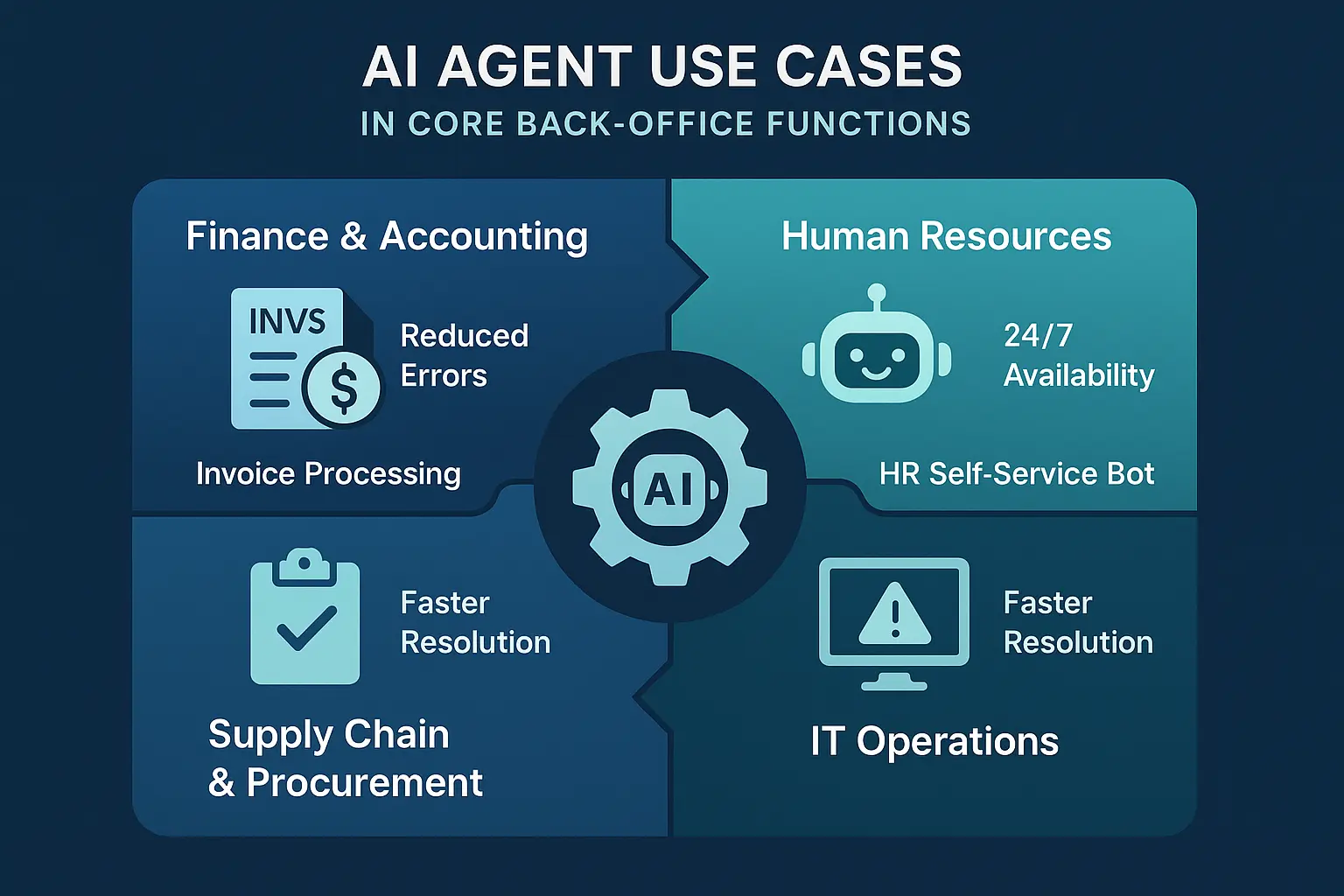
Here are the critical factors to address for a successful implementation:
- Start with High-Impact Processes: Don’t try to boil the ocean. Identify a process that is manual, high-volume, and a significant pain point. Automating accounts payable or expense reporting are often excellent starting points.
- Establish Robust AI Governance: From day one, you need a clear framework for how agents are built, tested, deployed, and monitored. This ensures security, compliance, and ethical use, building trust across the organization.
- Embrace a Human-in-the-Loop Model: The goal is not to replace humans but to augment them. Design workflows where agents handle 95% of the work and seamlessly escalate the most complex exceptions or judgment-based decisions to the right person.
- Focus on Integration: The real power of AI agents is unlocked when they can seamlessly connect your existing systems—ERPs, CRMs, and proprietary software—to create a unified, automated workflow.
- Plan for Scale: Choose a platform and a partner that can help you move beyond isolated pilot projects to an enterprise-wide automation strategy, leveraging concepts like multi-agent orchestration systems to manage your entire digital workforce.
Frequently Asked Questions
Will AI agents replace our employees?
The goal is to elevate your workforce, not eliminate it. By automating tedious, repetitive tasks, AI agents free up your employees to focus on higher-value activities like strategic analysis, customer relationships, and creative problem-solving. This shift leads to higher job satisfaction and allows your company to achieve more with the talented people you already have.
How is this different from the RPA we already have?
RPA is great for automating simple, structured tasks. AI agents are the next generation. They can handle unstructured data (like PDFs, emails, and images), understand context, make decisions, and learn over time. If your RPA bots are struggling with exceptions and complex workflows, it’s a clear sign you need to evolve to AI agents.
How do we ensure data security and compliance with autonomous agents?
Security is paramount. A robust AI agent platform should include enterprise-grade security features, including role-based access controls, encrypted data handling, and comprehensive audit logs that track every action an agent takes. Proper AI governance ensures agents operate strictly within pre-defined business rules and compliance boundaries.
What’s the typical implementation time and ROI?
Implementation can be surprisingly fast for well-defined use cases, often taking a matter of weeks, not months. The ROI is typically realized quickly through direct cost savings on labor, error reduction, and increased processing speed. Many organizations see a full return on their investment in under a year.
The Strategic Imperative of AI Agents
The conversation around back-office automation is no longer about if, but how. Relying solely on traditional RPA is like trying to compete in today’s market with yesterday’s technology.
Autonomous AI agents represent a fundamental leap forward, giving you the power to build a back office that is not just efficient, but intelligent, resilient, and ready for the future. By taking on the complex, cognitive work that bogs your team down, they unlock the human potential in your organization and create a durable competitive advantage.
Ready to see how advanced AI agents can transform your back-office operations? Request a personalized assessment to discover the highest-impact automation opportunities within your organization.
