
You’ve seen the projections. AI-driven energy management systems (EMS) promise transformative results—slashing energy consumption in commercial buildings by as much as 37%. But as a decision-maker, you know the real challenge begins after the system goes live. The critical question isn’t just “How much can I save?” but “How can I prove it, sustain it, and continuously improve it?”
Deploying an AI EMS is just the first step. Without a robust strategy for post-implementation monitoring and optimization, that initial potential can quickly fade, leaving you with a sophisticated tool that fails to deliver on its core promise. This is the evaluation gap where many projects falter—moving from theoretical ROI to tangible, year-over-year value.
This guide provides the framework you need. We’ll move beyond high-level benefits and dig into the essential post-implementation strategies that separate successful AI deployments from expensive experiments. You’ll learn how to verify savings with confidence, tackle complex optimization challenges, and ensure your system evolves to deliver maximum efficiency for the long haul.
Measurement & Verification (M&V) for AI Energy Savings: Your Blueprint for Proving Value
The foundation of any successful energy management initiative is trust. Measurement and Verification (M&V) is the process that builds that trust, transforming claimed savings into proven financial returns. For an AI-driven system, M&V is non-negotiable; it’s the mechanism that justifies your investment to stakeholders.
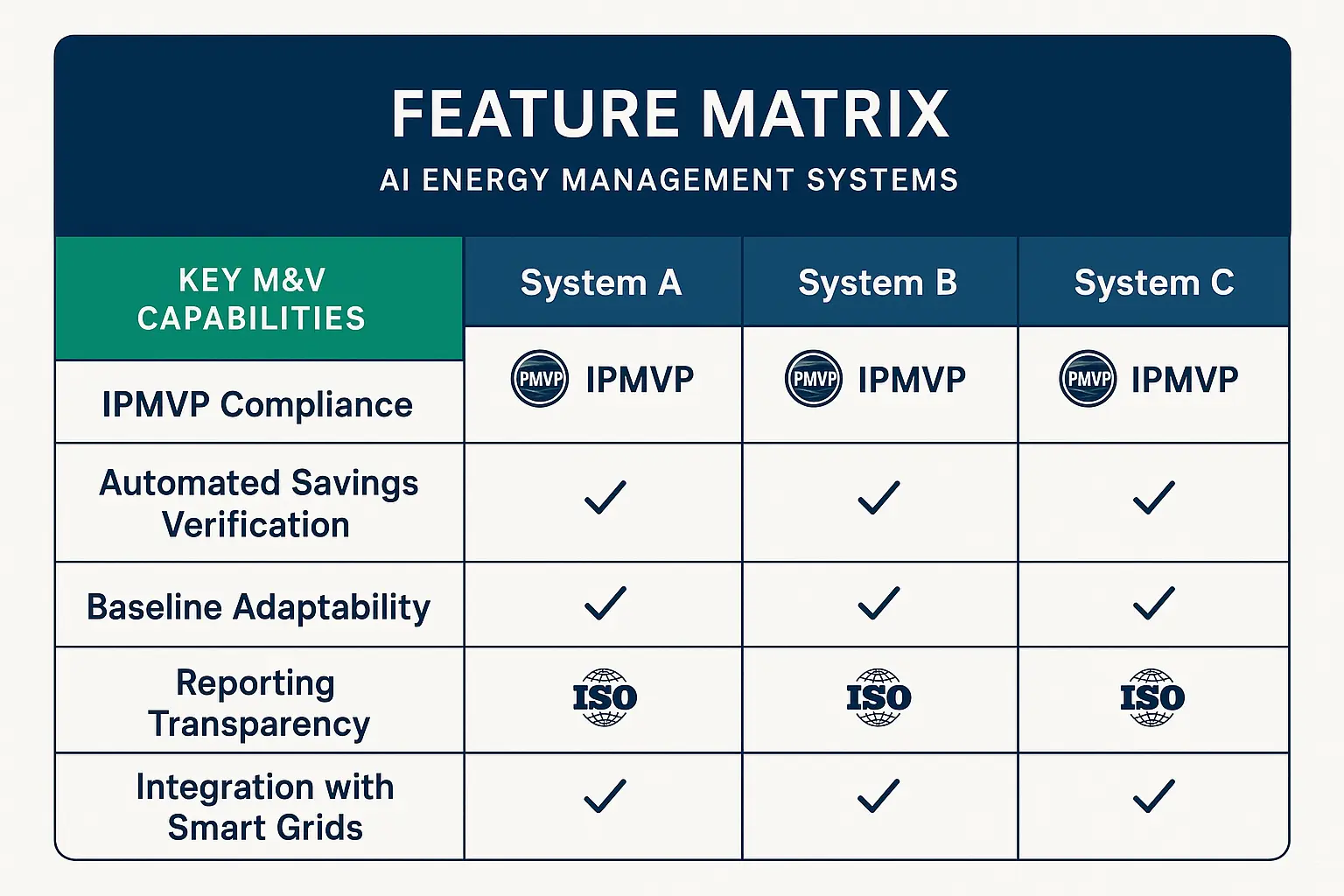
The gold standard for this is the International Performance Measurement and Verification Protocol (IPMVP). A proper M&V plan isn’t just about looking at a lower utility bill. It involves:
- Establishing an Accurate Baseline: Before the AI takes over, you need a precise model of your building’s energy consumption under normal conditions. This baseline must account for variables like weather, occupancy, and operating hours. AI excels at creating these dynamic, multi-variant baselines, offering a far more accurate starting point than traditional static models.
- Isolating AI’s Impact: Your M&V methodology must clearly distinguish between savings generated by the AI’s actions and those resulting from other factors, like an equipment upgrade or a change in utility rates.
- Transparent Reporting: The process should culminate in clear, defensible reports that detail energy savings, cost avoidance, and operational improvements. This is the data you’ll use to prove ROI.
Many providers offer M&V as a feature, but the depth and adherence to standards like IPMVP vary wildly. True M&V isn’t a simple dashboard; it’s a rigorous, data-driven discipline that provides the financial certainty you need. As you evaluate solutions, it’s crucial to understand how deeply our AI energy management platform integrates these principles.
Decoding Performance: Benchmarking & Baselines in the AI Era
Once your baseline is set, the focus shifts to continuous performance measurement. An AI EMS shouldn’t be a “set it and forget it” solution. It’s a dynamic system that requires clear targets and constant benchmarking to ensure it’s operating at peak efficiency.
Effective benchmarking involves comparing your building’s performance against:
- Itself (Historical Data): Tracking performance against your verified baseline to see trends and confirm savings.
- Pre-set Targets (KPIs): Defining specific goals for energy use intensity (EUI), cost per square foot, or carbon emissions.
- External Standards (Peer Data): Comparing your facility’s performance to similar buildings in your industry or region to identify larger opportunities for improvement.
The challenge with AI is that it constantly learns and adapts, which can make traditional benchmarking difficult. A key capability to look for is a system that can manage dynamic baselines—models that continuously adjust for changing conditions—while still providing clear, apples-to-apples performance comparisons over time.
Beyond Monitoring: Strategies for Iterative Optimization with AI EMS
True value comes from moving beyond passive monitoring to active, continuous optimization. This is where the concept of Continuous Commissioning (CCx) becomes critical. For an AI EMS, this means the system is perpetually hunting for new efficiencies and refining its control strategies.
Key strategies for iterative optimization include:
- Adaptive Control: The AI shouldn’t just follow static rules. It must adapt its control of HVAC, lighting, and other systems in real-time based on predictive data for weather, occupancy, and energy pricing.
- Predictive Anomaly Detection: Instead of waiting for a maintenance alert, the AI should identify subtle deviations in equipment performance that signal an impending failure or inefficiency, allowing for proactive intervention.
- Closed-Loop Optimization: The system should not only recommend changes but, where appropriate, execute them automatically. This closed-loop control ensures that optimization opportunities are captured instantly without requiring manual input.
This iterative process transforms your building from a static asset into a dynamic, self-optimizing ecosystem that gets smarter and more efficient over time.
Tackling the Tough Stuff: Advanced Technical Challenges in AI Energy Optimization (and Our Solutions)
Many AI solutions look great on the surface but struggle with the complex realities of a commercial building’s operations. When evaluating platforms, you need to ask the tough questions about the underlying technology.
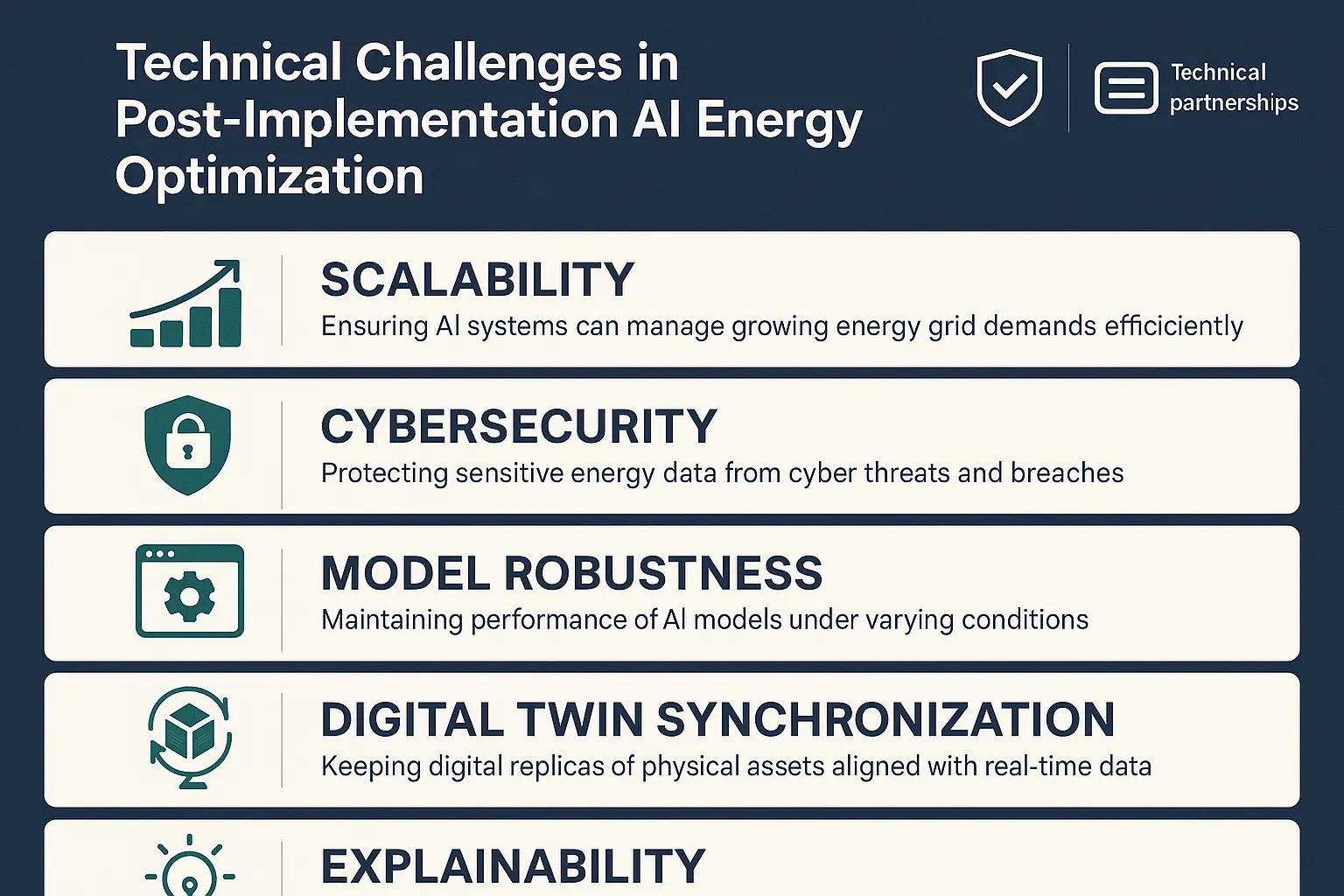
Here are critical challenges a truly robust AI EMS must solve:
- Scalability & Speed: Can the system process vast amounts of data from thousands of sensor points in real-time without latency? The trade-off between speed and accuracy is critical for effective control.
- Model Robustness: How does the AI perform during unexpected events—a sudden equipment failure, a drastic weather shift, or an unplanned change in occupancy? A brittle model will fail, but a robust one will adapt gracefully.
- Cybersecurity: In connecting building systems to the cloud, how does the platform protect against cyber-physical risks? Security cannot be an afterthought; it must be built into the core architecture.
- Explainability (XAI): Can the system explain why it made a particular decision? “Black box” AI erodes trust. An explainable AI provides transparency, helping your team understand and validate the system’s logic.
Addressing these challenges is what separates a market-leading solution from the rest. It’s essential to understand our technology's approach to these core issues to ensure you’re investing in a reliable, secure, and transparent platform.
The AI Energy Paradox: Optimizing Efficiency While Managing AI’s Footprint
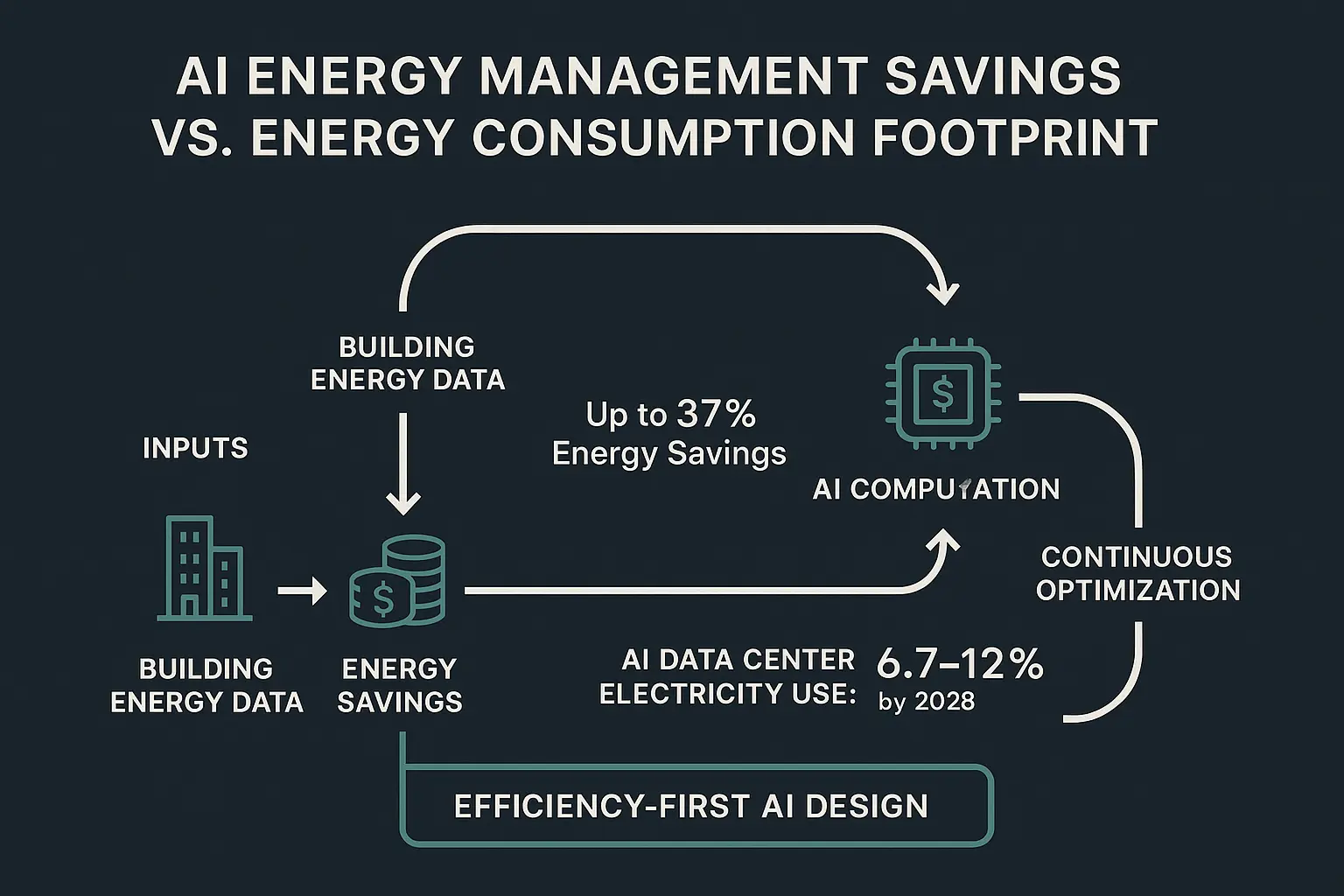
There’s an important conversation happening that many vendors avoid: the energy consumption of AI itself. With data centers projected to consume between 6.7% and 12.0% of total U.S. electricity by 2028, the very tool used to save energy can become a significant energy consumer.
This is the AI Energy Paradox. A system that requires massive computational power to run could potentially offset the savings it generates.
This is why efficiency-first AI design is a critical, yet often overlooked, evaluation criterion. You need a solution designed from the ground up to be lean and powerful, not bloated and resource-intensive. This involves:
- Optimized Algorithms: Using models that deliver maximum predictive accuracy with minimum computational load.
- Edge Computing: Processing data locally on-site where possible, reducing the need to send massive datasets to energy-hungry cloud servers.
- Intelligent Scheduling: Running the most intensive computational tasks during off-peak hours when energy is cheaper and cleaner.
A truly sustainable solution doesn’t just reduce your building’s energy footprint; it minimizes its own. The goal is to maximize net energy savings, and that requires transparency about the AI’s own operational cost.
Long-Term Energy Performance Tracking & Reporting: Building Trust & Demonstrating Sustained Impact
Your AI EMS should be a source of continuous insight. Post-implementation success hinges on turning raw data into actionable intelligence for every stakeholder, from facilities managers to the C-suite.
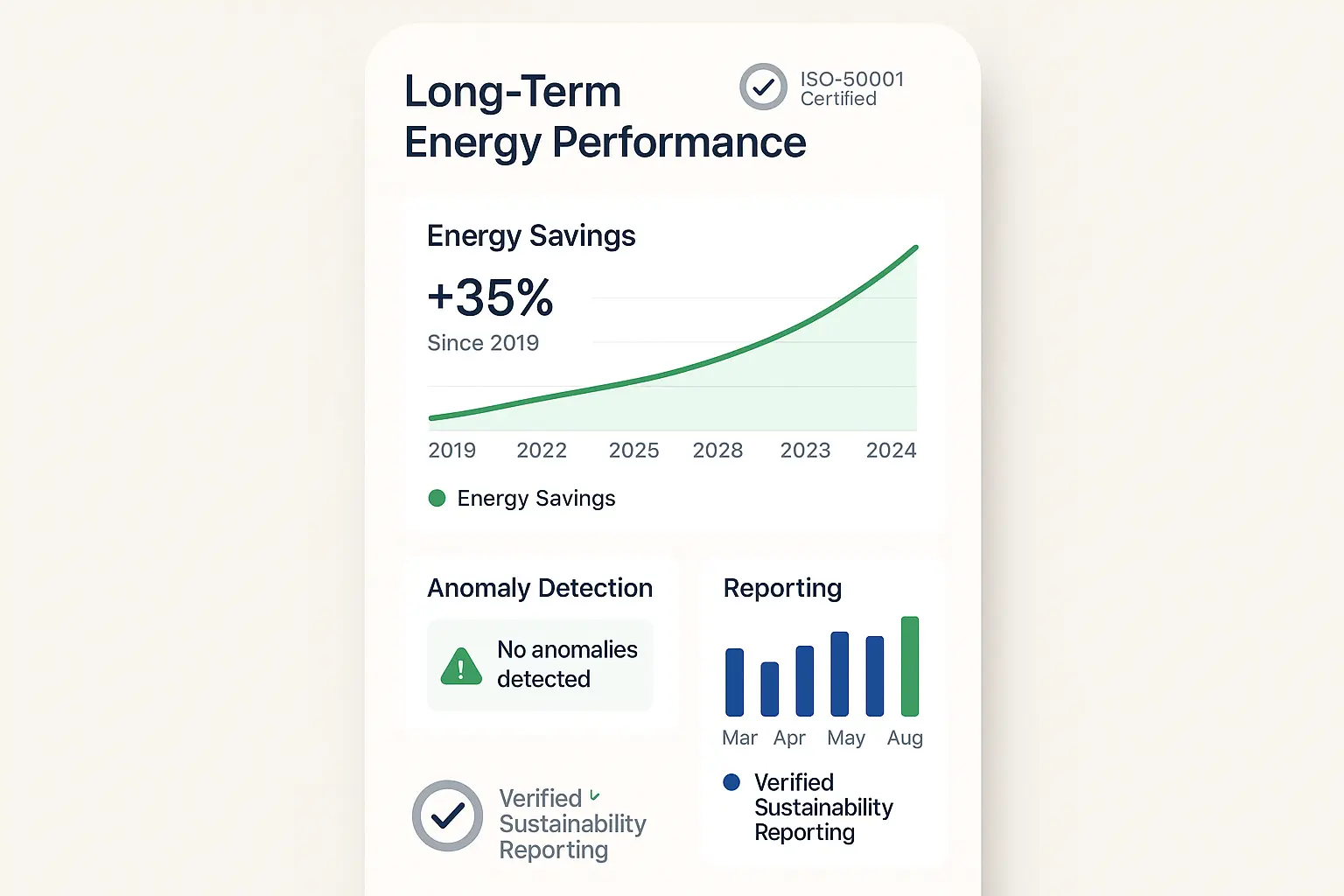
Robust long-term reporting capabilities should provide:
- Customizable Dashboards: Tailored views that show the most relevant KPIs for different users.
- Automated Alerts: Proactive notifications for performance deviations, maintenance needs, or savings milestones.
- Executive Summaries: High-level reports that clearly communicate financial impact, carbon reduction, and overall ROI over time.
This continuous feedback loop does more than just track progress; it fosters a culture of efficiency and empowers your team to make smarter, data-driven decisions. By making performance visible and understandable, you build confidence and demonstrate the sustained impact of your investment. You can see how we make this possible by exploring our case studies with leading commercial clients.
Frequently Asked Questions
How long does it take to see a return on my AI EMS investment?
While payback periods vary based on building size, existing infrastructure, and utility rates, a properly implemented system with a strong M&V plan can demonstrate positive ROI within 18-36 months. The key is the ability to accurately measure and verify savings from day one to build a clear financial case.
Will this system create more work for my already busy facilities team?
A well-designed AI EMS should reduce workload, not add to it. By automating complex control sequences, providing predictive maintenance alerts, and simplifying reporting, the system should free up your team to focus on high-value strategic tasks rather than manual adjustments and troubleshooting.
How do you ensure the AI’s recommendations are reliable and not just a ‘black box’?
This is where Explainable AI (XAI) is essential. Our platform is designed for transparency, providing clear reasoning behind its optimization decisions. This allows your team to understand, trust, and even override the AI if necessary, ensuring they always remain in control.
How does your system handle unexpected events, like a sudden heatwave or equipment failure?
Our AI models are built for robustness. They are trained on a wide range of historical and simulated data to ensure they can adapt to unforeseen circumstances. When an anomaly occurs, the system is designed to respond gracefully, maintaining stability and alerting operators immediately with a recommended course of action.
Your Partner for Sustained Performance
Choosing an AI energy management system is a long-term commitment. The real measure of success lies in the sustained, verifiable performance delivered years after the initial installation. It requires a partner who is not only an expert in AI but is also deeply committed to the principles of rigorous M&V, continuous optimization, and transparent reporting.
By focusing on these post-implementation fundamentals, you can move from promising projections to proven performance, ensuring your investment delivers compounding returns for years to come.
Ready to see how a truly transparent and robust AI EMS can deliver verifiable savings for your portfolio? Schedule a personalized demo and let us walk you through our M&V and continuous optimization capabilities.
