
You’re facing a pivotal decision. The energy landscape is more complex than ever—volatile prices, intermittent renewables, and distributed assets demand a control strategy that’s more than just reactive. You know advanced controls are the answer, but the path forward is split between two powerful paradigms: Reinforcement Learning (RL) and Optimal Control, particularly Model Predictive Control (MPC).
Choosing the right path isn’t just a technical exercise; it’s a strategic decision that will define your operational efficiency, cost structure, and future-readiness for years to come.
This guide is designed for decision-makers like you. We’ll move beyond dense academic theory to provide a clear, data-driven comparison of RL and MPC. We’ll break down how they work, where they excel, and—most importantly—which is the right fit for your specific energy management challenges.
The Foundations: Two Paths to Optimization
Before we compare them head-to-head, let’s establish a clear understanding of each approach. Think of them as two elite specialists you might hire for a critical job. One is a brilliant, data-driven prodigy who learns by doing (RL), and the other is a meticulous, model-based planner who calculates every move in advance (MPC).
Reinforcement Learning: The Adaptive Learner
Reinforcement Learning is a type of machine learning where an “agent” learns to make optimal decisions through trial and error. It interacts with an environment (like a microgrid or an HVAC system), takes actions, and receives rewards or penalties based on the outcome. Over millions of simulated trials, it develops a sophisticated policy—a “brain”—that intuitively knows the best action to take in any given situation to maximize its long-term reward.
Core RL Algorithms in Energy Management:
- Q-learning & Deep Q-Networks (DQN): Ideal for problems with discrete actions, like turning an appliance on or off. DQN uses deep neural networks to handle more complex state information, making it a foundational algorithm for many energy applications.
- Policy Gradients (PPO, DDPG, SAC): These are the powerhouses for dynamic environments. They can learn policies that output continuous actions—like adjusting a battery’s charge rate from 0 to 100 kW. This makes them perfectly suited for fine-grained control of power flows, EV charging, and complex industrial processes. For a deeper technical review, see our complete guide on advanced RL algorithms for dynamic system control.
The true power of RL is its ability to operate without a perfect model of the system. It learns the system’s dynamics directly from data, making it incredibly resilient to changing conditions and unmodeled complexities.
Optimal Control: The Meticulous Planner
Optimal Control, and specifically Model Predictive Control (MPC), is a more established engineering discipline. At its core, MPC uses an explicit mathematical model of a system to predict its future behavior.
Here’s how it works:
- Model: It starts with a detailed model of the system (e.g., the thermal dynamics of a building or the efficiency curve of a battery).
- Predict: At each step, it looks ahead over a defined time horizon, forecasting variables like energy prices, weather, and load demand.
- Optimize: It then calculates the optimal sequence of control actions over that horizon to minimize a cost function (e.g., energy cost) while respecting all system constraints (e.g., room temperature bands, battery state-of-charge limits).
- Implement & Repeat: It implements only the first action in that optimal sequence, then repeats the entire process at the next time step with updated information.
This constant re-planning makes MPC highly effective and robust for systems where operational constraints are rigid and safety is paramount. Its reliance on a model is both its greatest strength and its primary limitation.
The Great Debate: RL vs. MPC in Energy Management
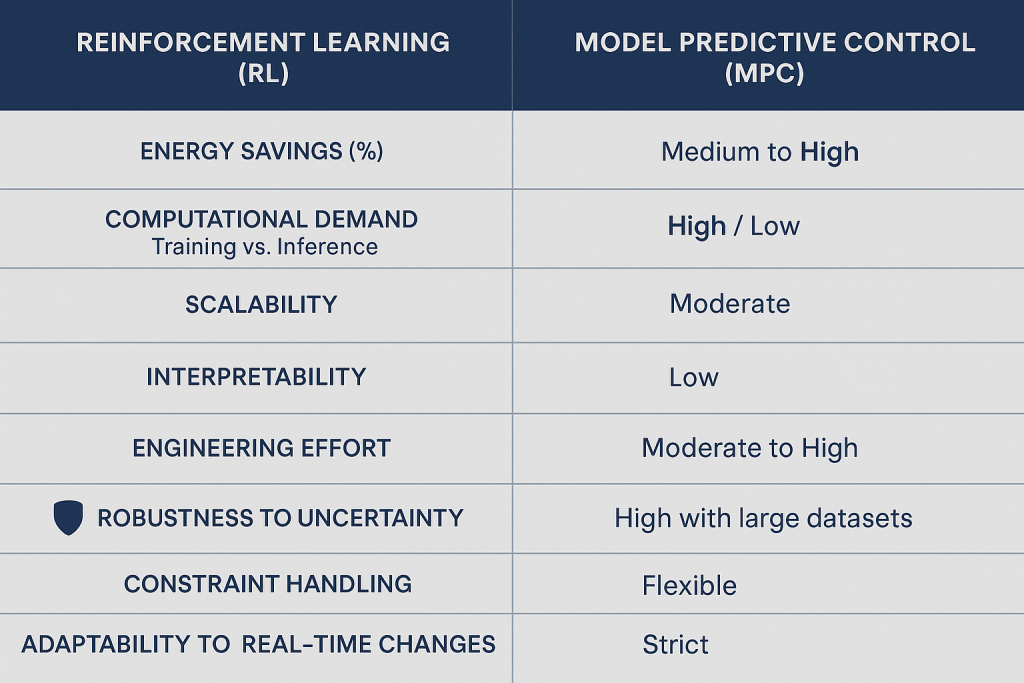
This is the central question for anyone evaluating control solutions. The answer isn’t that one is universally better; it’s about which one is better suited for your operational reality. The research is clear: both approaches deliver significant gains, but in different contexts. For instance, in HVAC control, some studies show MPC achieving 20% savings and RL achieving 22%, but MPC often performs better when comfort constraints are heavily weighted.
Here’s a direct comparison of their key attributes:
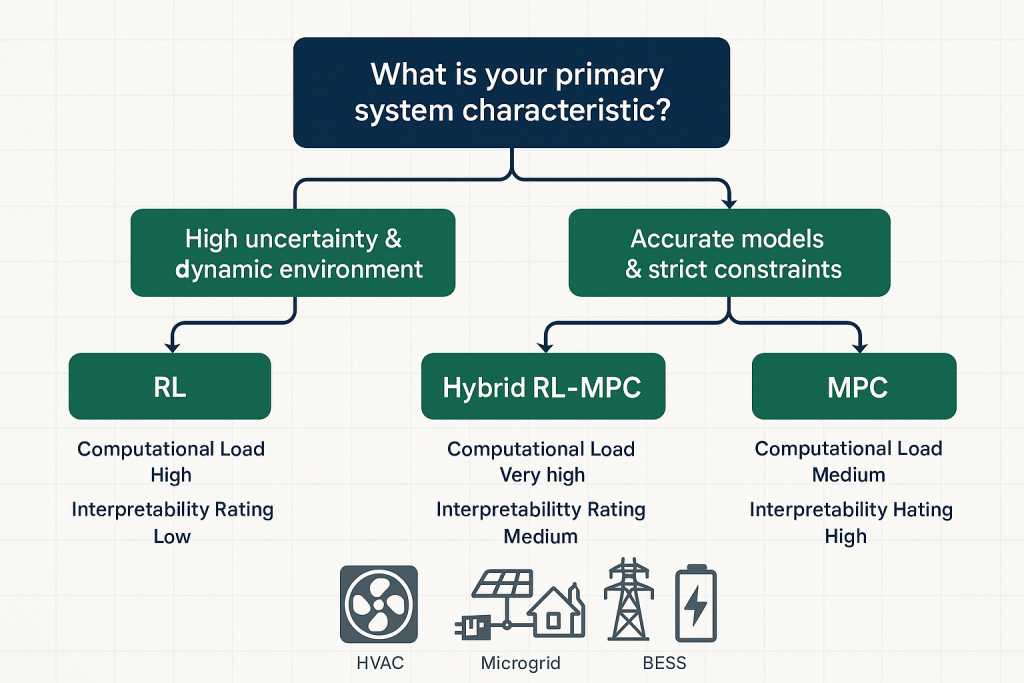
When to Choose Reinforcement Learning
Choose RL when your environment is:
- Complex and Data-Rich: You have access to large historical or simulated datasets, but creating an accurate mathematical model is difficult or impossible.
- Highly Dynamic: The system is subject to frequent, unpredictable changes (e.g., volatile real-time energy prices, intermittent renewable generation).
- Evolving Over Time: The system’s characteristics may change (e.g., battery degradation, changes in building occupancy), and you need a controller that can adapt continuously.
When to Choose Model Predictive Control
Choose MPC when your system requires:
- Strict Constraint Adherence: You have hard operational or safety limits that absolutely cannot be violated. MPC’s planning-based nature is inherently better at handling these constraints.
- High Interpretability: You need to understand why the controller is making a specific decision. MPC’s model-based logic is far more transparent than a neural network policy.
- A Well-Understood System: You can create a reasonably accurate mathematical model of your asset’s physics and behavior. Our work in Model Predictive Control for optimizing HVAC systems shows how a strong model is the foundation for success.
The Power of Hybrid Approaches
Increasingly, the future isn’t a choice between RL and MPC but a synthesis of both. Hybrid RL-MPC controllers use RL to learn complex dynamics or set high-level goals, while MPC handles the low-level control and ensures safety constraints are always met. This approach mitigates the weaknesses of each method, addressing academic findings that model-free RL can struggle in realistic environments with external uncertainties.
Real-World Impact: The Economic Case for Advanced Control
Theory is valuable, but results are what matter. The economic benefits of deploying these advanced control strategies are proven and substantial across every sector of the energy industry.
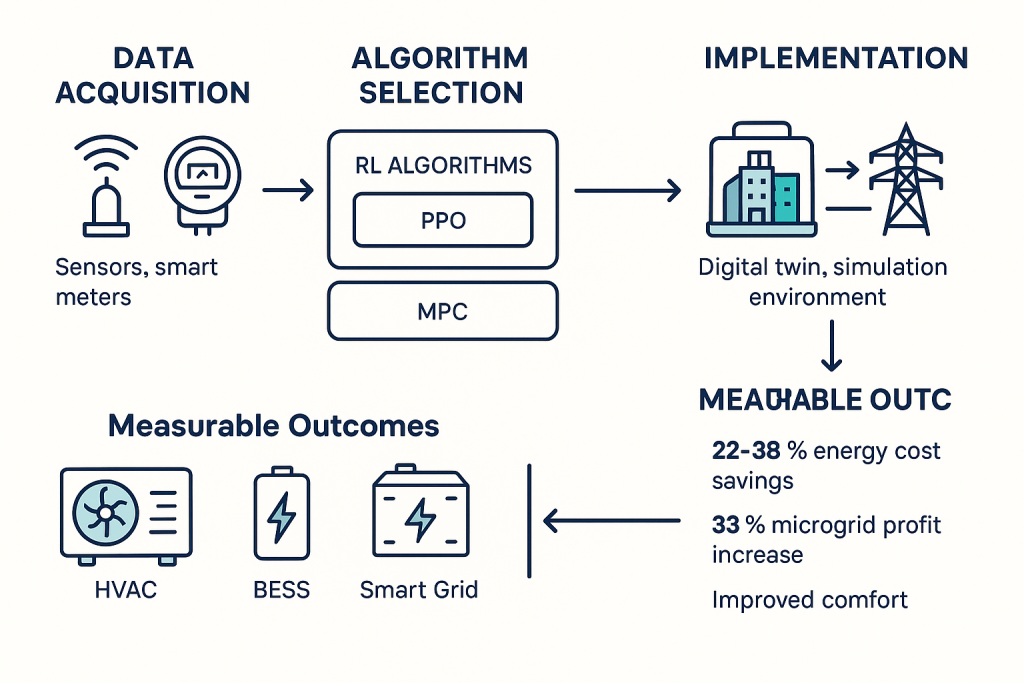
- Microgrid Profit Maximization: A deep reinforcement learning controller can increase operator profit by as much as 33.74% and improve the microgrid’s self-balancing rate by 22.97% by intelligently managing renewable energy, battery storage, and even connected electric vehicles.
- Commercial & Industrial Savings: In process industries, optimal control yields an average of 5% fuel savings. One aluminum plant increased production by 3,000 tons per year—worth $6 million annually—simply through better process control.
- Smart Building & HVAC Efficiency: RL-based HVAC control delivers 8-16% energy savings over standard rule-based systems. When combined with dynamic pricing, optimal control can reduce consumer bills by over 40%.
- Battery Lifetime & ROI: Advanced controls extend the life of Battery Energy Storage Systems (BESS), and customers are willing to pay a 15-20% premium for assets with these predictive features, significantly improving project ROI.
These aren’t hypothetical numbers. They are the direct result of applying intelligent, data-driven control to complex energy systems.
Navigating the Future: Trends & Key Considerations
The field of intelligent control is evolving at a breathtaking pace. Staying ahead of these trends is key to making a future-proof investment.
- Multi-Agent Reinforcement Learning (MARL): As energy systems become more decentralized with DERs, MARL is becoming essential. It allows multiple intelligent agents (controlling batteries, solar inverters, EVs) to coordinate their actions to achieve a global grid objective. Explore our analysis of multi-agent RL for distributed energy resources to understand its potential.
- Digital Twins: Developing and training these controllers requires a safe, high-fidelity environment. Digital twins—virtual replicas of physical assets—are crucial for training RL agents and validating MPC models without risking real-world equipment.
- Bridging the Sim-to-Real Gap: A key challenge is ensuring a controller trained in a simulation performs just as well in the real world. This requires sophisticated techniques to account for real-world noise and uncertainty—a critical factor where robust implementation makes all the difference.
Practical Challenges for Adoption
Deploying these systems requires a clear-eyed view of the practical hurdles:
- Data Infrastructure: RL is data-hungry. It requires clean, high-frequency data from your assets.
- Computational Needs: Training deep RL models is computationally intensive, though inference (real-time operation) is typically very fast.
- Safety & Robustness: Ensuring an AI controller operates safely under all conditions is paramount, especially in critical infrastructure.
- Expertise: Implementing and maintaining these systems requires a specialized blend of skills in control theory, machine learning, and power systems engineering.
Frequently Asked Questions
1. Which is cheaper to implement, RL or MPC?
The initial engineering effort for MPC can be higher due to the need for detailed system modeling. RL requires more upfront investment in data infrastructure and computational resources for training. The total cost of ownership depends heavily on the specific application, but a well-designed solution from either paradigm provides a rapid payback through energy savings.
2. How much data do I need for an RL system to be effective?
This depends on the complexity of the problem, but it often requires millions of data points, which can be generated through high-fidelity simulations using a smaller set of real-world data as a baseline. For example, one effective EV controller was trained on over 60 million kilometers of real-world driving data.
3. Can these systems integrate with my existing SCADA or Building Management System (BMS)?
Yes. A key part of any successful deployment is seamless integration. The controller should act as an intelligent layer that ingests data from your existing systems and sends back optimal setpoints or control signals using standard protocols like Modbus, BACnet, or OPC UA.
4. What’s the biggest risk in deploying a model-free RL controller?
The primary risk is unpredictable behavior when encountering situations far outside its training data. This is why robust training, extensive testing in a digital twin, and often combining RL with a safety layer of rule-based or MPC logic is the best practice for critical applications.
Your Path to an Intelligent Energy Future
The choice between Reinforcement Learning and Model Predictive Control is not about picking a winner. It’s about a strategic alignment of technology with your operational goals, system constraints, and tolerance for risk.
- For model-heavy, constraint-driven systems, MPC offers unparalleled reliability and transparency.
- For data-rich, highly dynamic environments, RL provides a level of adaptability and performance that is impossible to hand-code.
- For the most complex challenges, a hybrid approach delivers the best of both worlds.
The transformative potential is clear: lower energy costs, higher operational profit, longer asset life, and a more resilient, sustainable energy system. The key is to partner with a team that has deep expertise across both paradigms and can guide you to the right solution for your unique needs.
Ready to model the potential savings for your assets? Connect with one of our control system specialists to discuss your specific use case.
