
Imagine a city on a hot summer day. Thousands of solar panels are soaking up the sun, electric vehicles are plugging in to charge, and air conditioners are humming. To keep the lights on without overloading the system or wasting precious energy, the power grid must make thousands of perfect decisions every minute. It needs to decide which power plant to fire up, which battery to charge, and when to ask consumers to lower their usage.
This massive coordination effort is a classic optimization problem. And for decades, one of the most powerful tools for solving such problems has been Dynamic Programming (DP).
In theory, DP is a perfect fit. It’s brilliant at breaking down a huge, complex problem into smaller, manageable pieces and finding the absolute best solution. But when we apply it to the sprawling, chaotic, real-time reality of a modern electrical grid, we hit a wall. A computational wall so high it has a name: the “curse of dimensionality.”
This guide is for anyone who has looked at the elegant theory of dynamic programming and wondered why it struggles so much in the real world of energy management. We’ll explore why this powerful technique breaks at scale and, more importantly, walk through the innovative solutions that are making it work for the grid of the future.
First, A Quick Refresher: What Makes Dynamic Programming So Powerful?
Let’s step away from the power grid for a moment. Think of DP like finding the fastest route to a friend’s house using a map. You don’t calculate every possible path from scratch. Instead, you figure out the best way to get to a key intersection, and once you know that, you never have to calculate it again.
This is the essence of dynamic programming. It works by following two core principles:
- Optimal Substructure: A problem has an optimal substructure if the best solution to the overall problem can be constructed from the best solutions to its smaller subproblems. (The best route from A to C contains the best route from A to B).
- Overlapping Subproblems: The algorithm ends up solving the same subproblems over and over again. By storing the results of these subproblems (a technique called memoization), it avoids redundant work, making it incredibly efficient.
For simple energy scheduling—like figuring out the cheapest way to charge a single home battery over 24 hours—DP is fantastic. It can weigh the cost of electricity at each hour and map out the perfect charging schedule. But a modern grid isn’t just one battery; it’s a dizzying network of thousands of components. And that’s where the trouble begins.
The Scalability Wall: Decoding the “Curse of Dimensionality” in Grids
The “curse of dimensionality” sounds like something out of a sci-fi movie, but it’s a very real and frustrating problem in computer science. In the context of grid optimization, it means that every new component you add to the system—a generator, a battery, a solar farm—makes the problem exponentially harder to solve.
Think of it like a control panel for the grid.
- 1 variable (1 battery): You only have one dial to turn (charge, discharge, or wait). Your state space is small and manageable.
- 2 variables (2 batteries): Now you have two dials. For every position of the first dial, you have to consider every position of the second.
- 100 variables (dozens of generators, batteries, demand response triggers): You now have a hundred dials. The number of possible combinations isn’t 100 times bigger; it’s astronomically bigger.
This is the state-space explosion. The “state” in our DP problem is a snapshot of the grid at a single moment in time: the charge level of every battery, the output of every power plant, and so on. As we add more variables, the number of possible states to evaluate explodes.
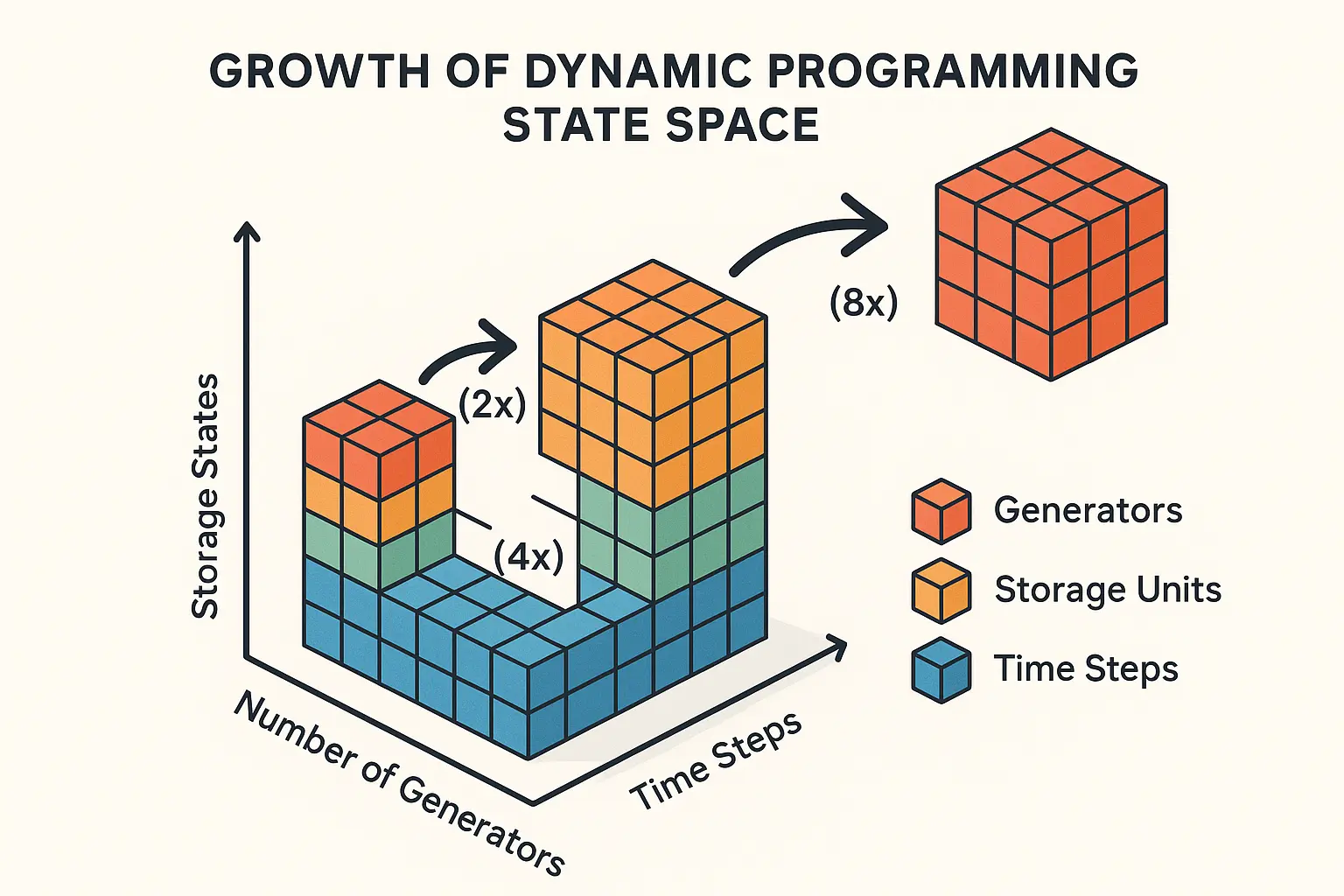
A classic DP algorithm needs to store the optimal decision for every single one of these states. For a large, real-time grid, the memory required would exceed that of the world’s most powerful supercomputers, and the time to calculate it would be longer than the age of the universe. This renders standard DP unusable for the very problems it seems designed to solve.
Algorithmic Solutions for Scalability
So, if classic DP is out, what do we do? Fortunately, researchers and engineers have developed brilliant ways to tame the curse of dimensionality. These methods trade a little bit of optimality for a massive gain in feasibility, allowing us to find “good enough” solutions in a timeframe that’s actually useful for real-time grid management.
1. Space and State Reduction Techniques
Before we abandon exact solutions entirely, we can try to be cleverer.
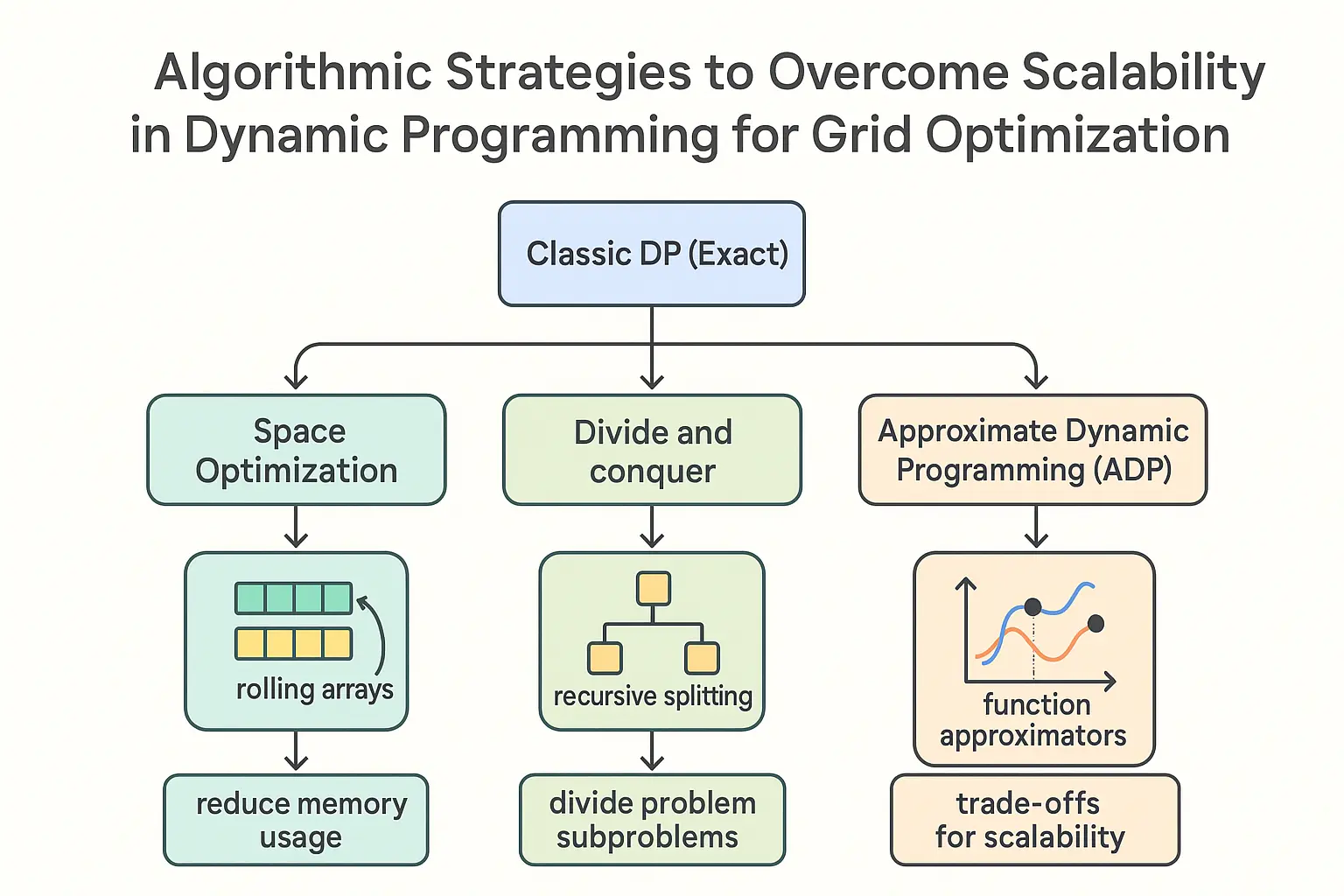
- Space Optimization: Techniques like “rolling arrays” allow us to solve DP problems without storing the entire decision table in memory, drastically reducing the space complexity.
- State Aggregation: Instead of tracking the exact charge of a battery (e.g., 87.34%), we can group states together (e.g., “around 85% full”). This simplifies the problem space at the cost of some precision.
2. Approximate Dynamic Programming (ADP)
This is where the real revolution is happening. ADP is a family of techniques that accept we can’t find the perfect solution for every possible state. Instead, it creates a smart approximation—a function that estimates the value of being in a particular state.
Think of it like a grandmaster in chess. They don’t calculate every possible move until the end of the game. Instead, they use their experience to evaluate the board and estimate which positions are most valuable. ADP does the same for the grid. By using techniques like value function approximation, it can make highly intelligent, near-optimal decisions without needing to explore the entire state space. Exploring how Approximate Dynamic Programming is revolutionizing real-time grid management is key for anyone serious about this field.
3. Hybrid Approaches
Sometimes, the best solution isn’t one algorithm but a team of them. Hybrid approaches combine the strengths of DP with other methods:
- DP + Heuristics: Use a simple, fast algorithm (a heuristic or “greedy” algorithm) to get a decent solution quickly. Then, use DP to refine and perfect the solution in the most critical areas.
- Lagrangian Relaxation: This advanced mathematical technique allows us to relax some of the grid’s complex constraints, making the problem easier for DP to solve. We then reintroduce the constraints to guide the solution back to a feasible, near-optimal state.
These algorithmic fixes are the first and most critical step. They change the very nature of the problem, transforming an impossible task into a solvable one.
Mastery: Advanced applications
Once we have a smarter algorithm, we can supercharge it with raw power. This is where software meets hardware to achieve the speeds necessary for real-time decision-making.
Hardware Acceleration for Real-time DP in Grids
The calculations involved in DP, especially the matrix operations used in ADP, are exactly the kinds of tasks that modern GPUs excel at. While your home PC’s graphics card is designed for gaming, data center GPUs like those from NVIDIA are designed for massive parallel computation.
By offloading the heavy lifting to thousands of GPU cores, we can solve complex DP problems orders of magnitude faster. As NVIDIA has shown, specialized hardware instructions (like their DPX instructions) can accelerate core DP algorithms by over 7x. This isn’t just an incremental improvement; it’s a game-changer that makes hardware acceleration for dynamic programming in smart grids a critical component of any modern optimization platform. Distributed computing architectures take this even further, splitting the problem across multiple machines to tackle continent-sized grids.
Benchmarking & Performance Analysis
In the world of real-time grid optimization, there’s no single “best” solution. It’s always a trade-off. Choosing the right approach requires understanding the balance between three key factors:
- Computation Time: How quickly can we get an answer? For real-time grids, this is non-negotiable.
- Memory Usage: How much hardware do we need to store the problem state?
- Solution Quality (Optimality): How close is our answer to the true, perfect solution? A faster, cheaper solution is useless if it wastes millions of dollars in energy.
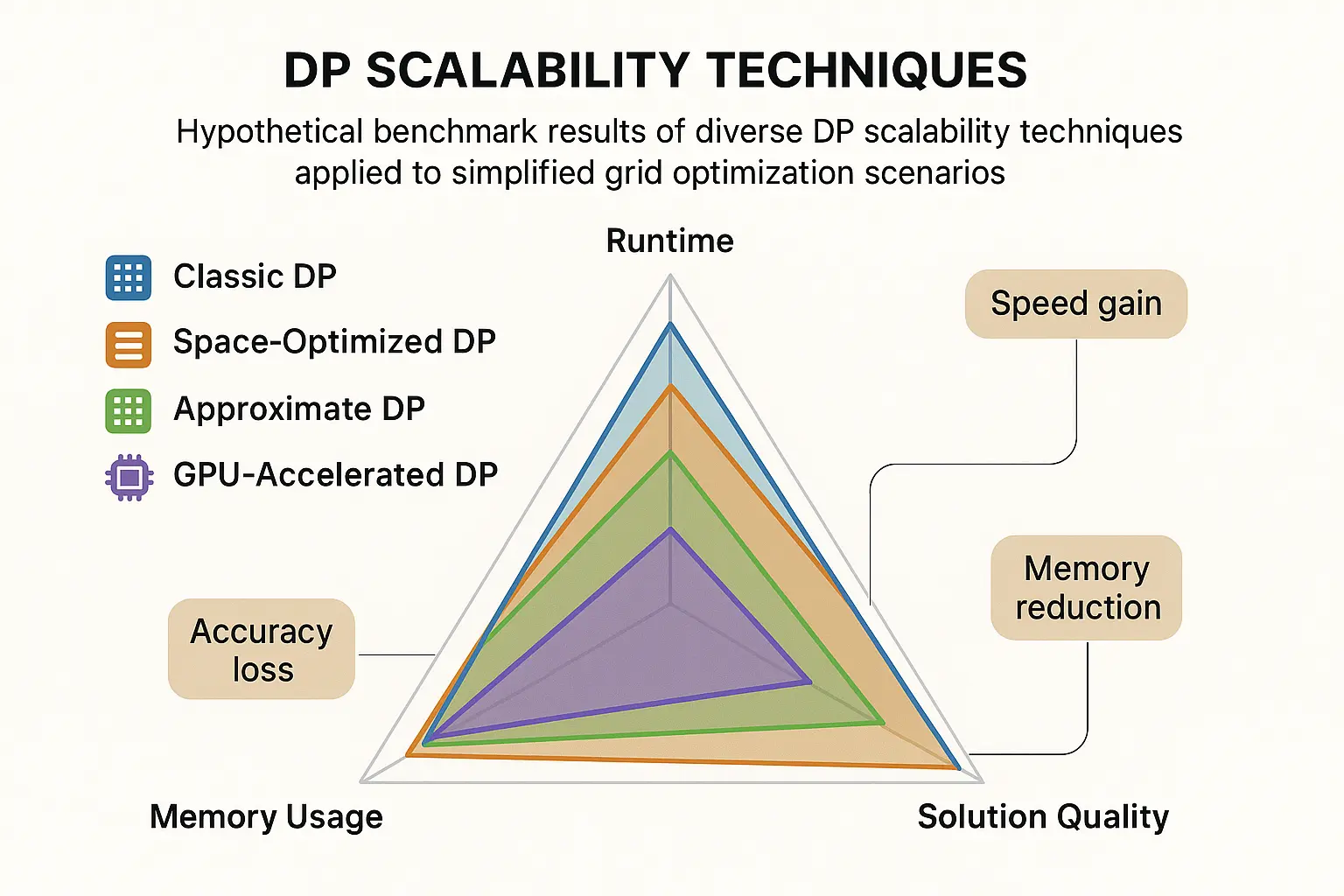
The right choice depends on the specific problem. Optimizing a city-wide battery network might demand a highly accurate ADP model running on powerful GPUs, while a smaller microgrid might be perfectly served by a simpler heuristic approach. Understanding these benchmarks for scalable DP techniques is what separates theoretical knowledge from practical, effective implementation.
Your Path Forward
The journey from understanding classic dynamic programming to implementing a scalable, real-time grid optimization system is complex, but it’s built on these core concepts. By recognizing the “curse of dimensionality” not as a dead end but as a challenge to be overcome, you can start making informed decisions.
- Start with the problem: Clearly define your grid’s state variables and constraints. Is the “curse” a real threat?
- Explore algorithmic solutions: Investigate which flavor of Approximate Dynamic Programming or which hybrid model best fits your trade-offs between speed and accuracy.
- Consider the hardware: Evaluate if the computational load justifies investing in parallel or GPU-accelerated computing.
The future of our energy systems depends on our ability to make smarter, faster, and more efficient decisions. While dynamic programming in its classic form may not be up to the task, its modern evolutions—smarter, faster, and more pragmatic—are paving the way for a truly optimized, responsive, and sustainable grid.
Frequently Asked Questions (FAQ)
Q1: What is dynamic programming (DP) in simple terms?Dynamic programming is a method for solving complex problems by breaking them down into simpler, overlapping subproblems. It solves each subproblem only once and stores the result, avoiding redundant calculations and ensuring an efficient path to the optimal solution for the larger problem.
Q2: What is the “curse of dimensionality”?The “curse of dimensionality” refers to the exponential growth in the amount of data (and computational power) needed to solve a problem as the number of variables (or dimensions) increases. In grid optimization, every new generator, battery, or time step adds a new dimension, causing the problem’s complexity to explode.
Q3: Why is standard DP so computationally expensive for grids?Standard DP tries to find the absolute best decision for every possible state of the grid. For a large grid with thousands of components and a long time horizon, the number of possible states becomes astronomically large. Calculating and storing the solution for every single one of these states requires an infeasible amount of time and memory.
Q4: Can dynamic programming really be used for real-time applications?Yes, but not in its classic form. By using techniques like Approximate Dynamic Programming (ADP) to find near-optimal solutions and leveraging hardware acceleration like GPUs for massive parallel processing, DP-based methods can be made fast enough to support real-time decision-making in complex environments like modern electrical grids.
