
The Definitive Guide to Selecting & Integrating AI Agents: Your Strategy-to-ROI Blueprint
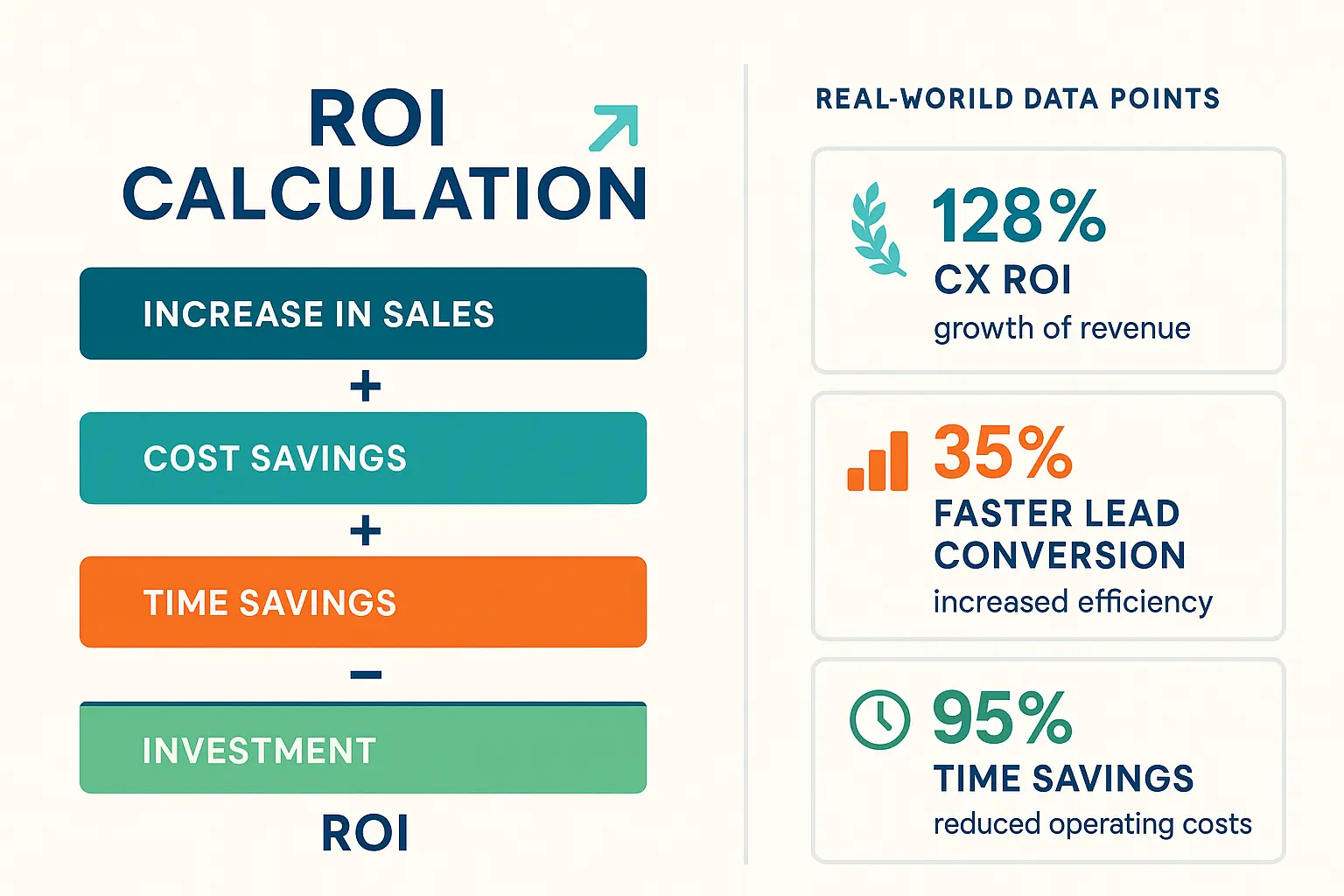
The AI agent market is on a trajectory of explosive growth, with projections suggesting a staggering 43% CAGR to become a market worth over $48 billion by 2030. The promise is immense: automating complex workflows, achieving up to 128% ROI in customer experience, and converting leads 35% faster. Yet, there’s a critical challenge that vendors rarely discuss—Gartner predicts that over 40% of agentic AI projects will be canceled by 2027 due to operational and execution failures.
The gap between potential and failure lies in strategy. Success isn’t about choosing the agent with the most features; it’s about making the right strategic choices for your business and mastering the technical integration. This guide is your blueprint for navigating that complexity. We’ll move beyond the hype to give you the vendor-agnostic frameworks and technical insights needed to select, integrate, and scale AI agents with confidence.
Understanding the AI Agent Landscape: Beyond the Hype
Before you can build a strategy, you need a clear understanding of what you’re working with. Many businesses mistakenly lump AI agents in with simple chatbots or traditional Robotic Process Automation (RPA). This is a critical error in judgment.
What is an AI Agent (Really)?
Unlike a chatbot that follows a predefined script, an AI agent is an autonomous system designed to perceive its environment, make decisions, and take actions to achieve specific goals. Think of it not as a simple Q&A tool, but as a digital team member capable of complex reasoning and execution. They operate on a continuous loop:
- Observe: The agent gathers data from various sources—user queries, system APIs, databases, documents.
- Plan: Using a Large Language Model (LLM) or Small Language Model (SLM) as its reasoning engine, the agent breaks down a complex goal into a sequence of actionable steps.
- Act: The agent executes these steps by interfacing with other software, APIs, and tools to accomplish the task.
This cycle allows an agent to handle dynamic, multi-step workflows that were previously impossible to automate, like planning a marketing campaign, analyzing sales data to find an anomaly, and then drafting an email to the relevant team.
The Critical Shift: From Single Agents to Multi-Agent Systems
The current frontier is the move toward multi-agent systems (MAS). Instead of a single agent trying to do everything, MAS involves a team of specialized agents that collaborate to solve even more complex problems. One agent might be an expert in data analysis, another in customer communication, and a third in system administration. An orchestration layer coordinates their efforts, creating a powerful, automated workforce. This is a key trend to consider for future-proofing your investment.
Strategic Selection: Choosing the Right AI Agent Solution for Your Business
With the market flooded with options, selecting the right foundation is the most critical decision you’ll make. Rushing this step is the primary reason projects fail. Your goal is to find the solution that aligns not just with your initial use case, but with your long-term strategic vision.
Step 1: Define Your Business Needs & Use Cases
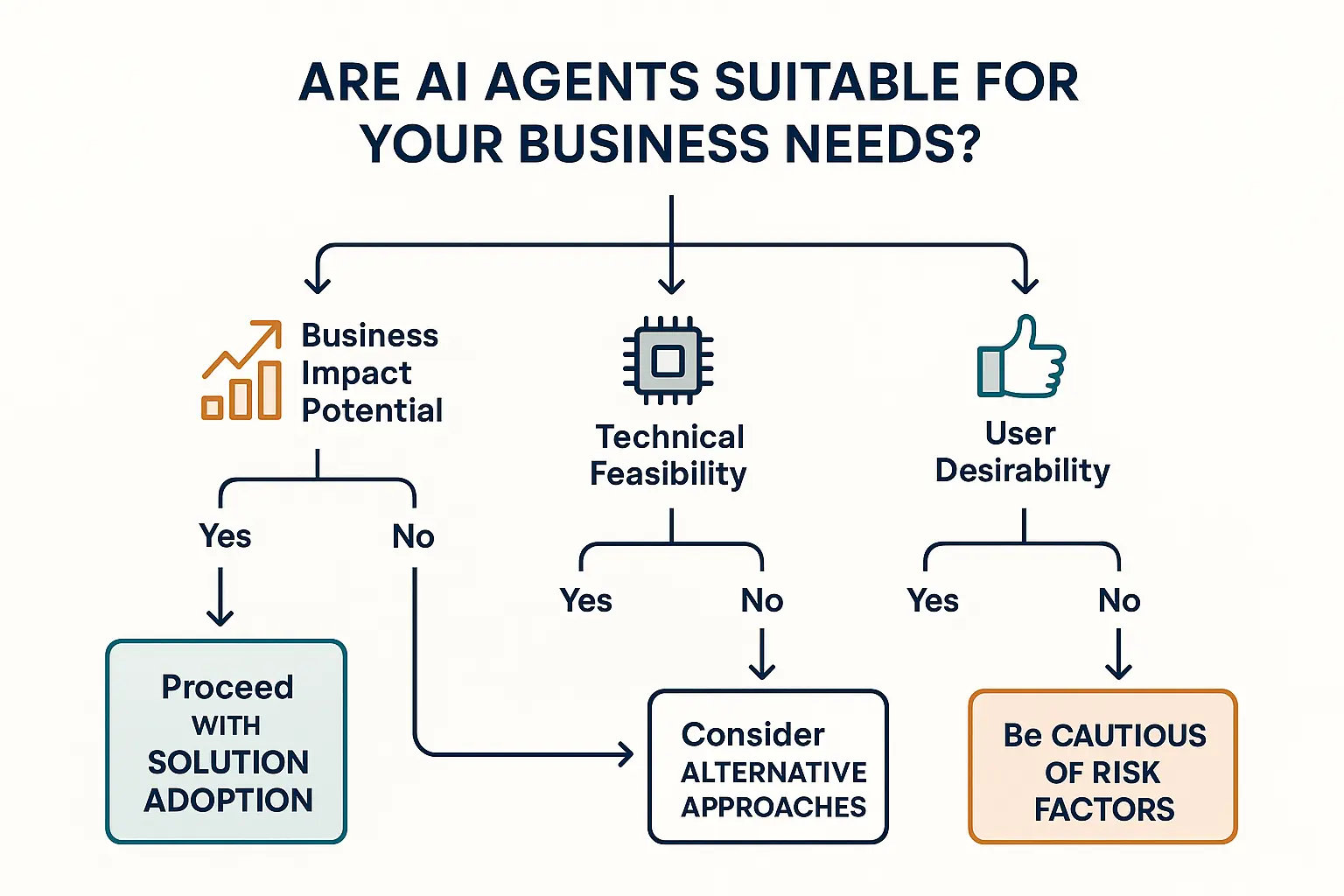
First, you need to be certain an AI agent is the right tool for the job. Not every problem requires an autonomous agent. Use a decision framework to validate your use case before you even look at vendors.
Prioritize use cases based on a combination of high business impact, technical feasibility, and strong user desirability. A project that saves millions but is hated by your team is not a win.
Step 2: Use a Vendor Evaluation Framework
Once you have a prioritized list of use cases, you can start evaluating vendors. Don’t get distracted by flashy demos. Use a structured framework that assesses solutions against your core requirements.
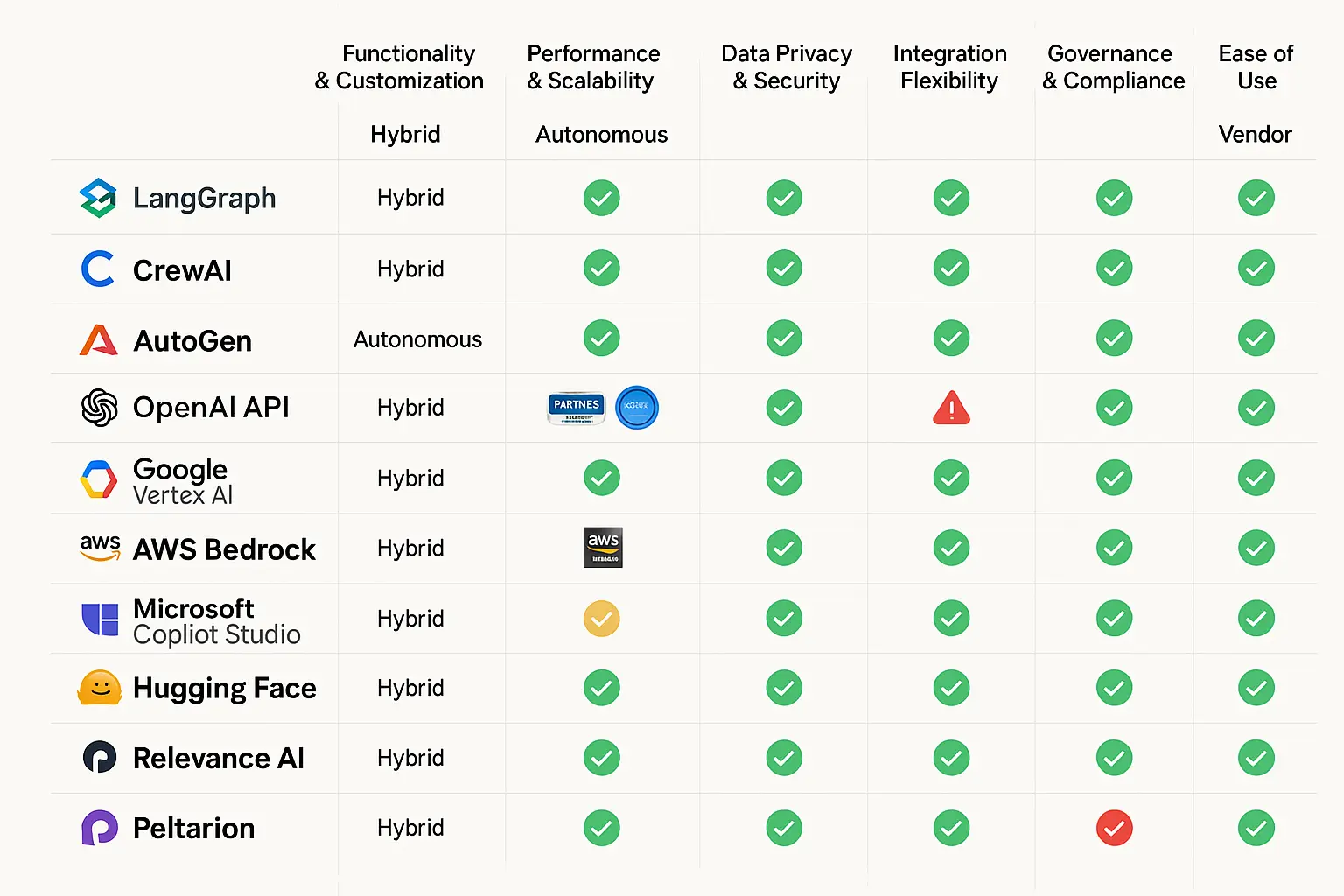
Here are the critical evaluation criteria:
- Functionality & Customization: Can the agent operate autonomously or does it require a human in the loop? Is it a pre-built solution or a flexible framework (like AutoGen or CrewAI) that requires development?
- Integration Flexibility: How easily can it connect to your existing tech stack (CRM, ERP, databases)? Does it have a robust API and pre-built connectors, or will everything require custom development?
- Data Governance & Security: This is non-negotiable. How does the platform handle sensitive data? What are its encryption standards, access controls, and compliance certifications (e.g., SOC 2, GDPR)? A powerful agent without strong governance is a liability.
- Scalability & Performance: Can the solution handle a growing number of concurrent tasks and users without degrading performance?
- Governance & Explainability: Can you audit the agent’s decisions? Is there a clear log of its actions and reasoning? This is crucial for troubleshooting and building trust within your organization.
- Ease of Use: Consider the entire lifecycle. How intuitive is the platform for both developers building the agents and business users who will interact with them? Look for solutions offering a spectrum of code, low-code, and no-code options.
- Vendor Support & Viability: How strong is the vendor’s documentation and support? Are they a stable, long-term partner or a risky startup? A strong ecosystem and community can be a significant advantage.
The Integration Imperative: Building a Seamless AI Agent Strategy Roadmap
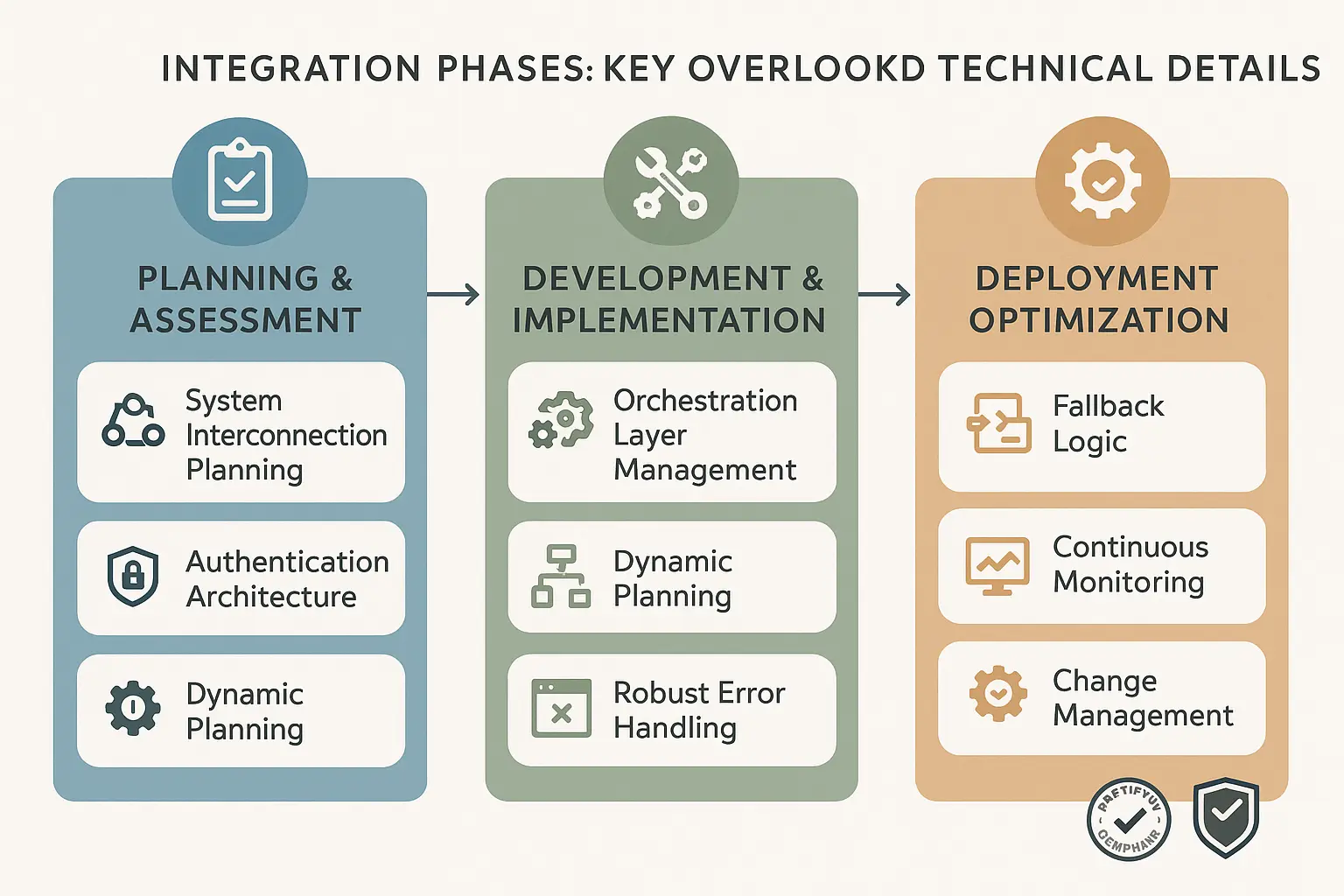
Selecting a platform is just the beginning. Successful integration is where strategy meets execution. Most high-level guides mention “integration” as a factor but fail to provide a practical roadmap. This oversight is a leading contributor to the 40% project failure rate. A robust integration plan must address the overlooked technical details proactively.
Follow this phased approach to de-risk your implementation and ensure a seamless rollout.
Phase 1: Planning & Assessment
- System Interconnection Planning: Before writing a single line of code, map out every system the agent will need to touch. Identify the specific APIs, data formats, and authentication protocols for each. This blueprint is your single source of truth for integration.
- Authentication & Access Control Architecture: Define exactly what permissions the agent will have. Treat it like a new employee. It should only have access to the data and systems it absolutely needs to perform its function (Principle of Least Privilege). This is a critical security step that is often overlooked.
Phase 2: Development & Implementation
- Orchestration Layer Management: This is the agent’s “brain.” Your implementation must account for state tracking (remembering context), tool invocation (calling the right API), and robust error handling. What happens when an API call fails? The agent must be able to recognize the failure and adjust its plan.
- Dynamic Planning Capabilities: The real world is messy. The agent must be able to adapt when it hits a roadblock. For instance, if a required database is offline, can it pivot to an alternative data source or notify a human for assistance?
- Fallback Logic & Escalation Paths: No agent is perfect. Define clear human-in-the-loop escalation paths. If an agent’s confidence score on a decision is below a certain threshold, it should automatically route the task to a human expert for review.
Phase 3: Deployment & Optimization
- Continuous Monitoring & Observability: Deployment is not the end. You need tools to monitor the agent’s performance, cost, and ethical behavior in real-time. This allows you to catch issues before they impact the business.
- Change Management & User Adoption: The best technology will fail if your team doesn’t trust or use it. Develop a clear onboarding plan. Communicate the “why” behind the agent, provide training, and establish feedback loops to continuously improve the human-AI collaboration. An internal link to an
AI agent strategy roadmapcan provide even more detail on this comprehensive process.
Measuring Success: Quantifying ROI and Impact
To secure ongoing investment and prove the value of your AI agent initiatives, you must move beyond anecdotal evidence and build a clear, data-driven ROI model. With executives reporting 88% positive ROI from GenAI projects, the potential is clear, but you need to prove it for your specific context.
Defining Your Success Metrics
Connect your agent’s performance to core business KPIs. Don’t just track “tasks completed.” Track what matters:
- Efficiency Metrics: Reduction in average handling time, increase in tasks completed per hour, reduction in operational costs.
- Effectiveness Metrics: Improvement in first-contact resolution, increase in lead conversion rates, reduction in error rates.
- Business Value Metrics: Increase in customer satisfaction scores (CSAT/NPS), growth in revenue, improvement in employee satisfaction.
By focusing on these outcomes, you create a powerful narrative for stakeholders, justifying the initial investment and paving the way for future expansion. For a deeper dive, our guide on calculating AI ROI provides templates and models.
Frequently Asked Questions (FAQ)
How do I avoid vendor lock-in with AI agent solutions?
Prioritize platforms with open standards, robust API access, and data export capabilities. Favor solutions that integrate well with a broad ecosystem rather than those that pull you into a closed, proprietary environment. A multi-LLM strategy, where you can swap out the underlying language model, also provides a crucial layer of flexibility.
What’s the real difference between an AI agent framework and a platform?
A framework (e.g., LangChain, AutoGen) is a library or toolkit for developers to build custom agents from the ground up. It offers maximum flexibility but requires significant coding expertise. A platform (e.g., Microsoft Copilot Studio, Relevance AI) is a more end-to-end solution, often with low-code/no-code interfaces, pre-built connectors, and managed infrastructure. The choice depends on your team’s technical skills and your need for customization vs. speed of deployment.
How do I ensure data security and governance when the agent connects to multiple systems?
Start with a robust identity and access management (IAM) strategy, applying the Principle of Least Privilege. Use a platform with strong encryption for data in transit and at rest. Implement detailed audit logs to track every action the agent takes. Finally, conduct regular security reviews and penetration testing, treating the agent as you would any other critical piece of enterprise software.
How much does it really cost to implement an AI agent solution?
Costs can be broken down into three areas: 1) Platform/Licensing Fees (subscription costs for the agent platform), 2) Implementation Costs (developer hours for integration, customization, and testing), and 3) Operational Costs (ongoing API call costs to LLMs, monitoring, and maintenance). Be wary of vendors who only quote the licensing fee; a total cost of ownership (TCO) model is essential for accurate budgeting.
Your Next Step: From Evaluation to Confident Action
The adoption of AI agents represents a fundamental shift in how businesses operate, promising unprecedented levels of productivity and innovation. But as the data shows, success is not guaranteed. It is the direct result of a meticulous, strategic approach to selection and a technically sound integration roadmap.
By using the frameworks in this guide, you can cut through the noise, mitigate the risks, and make confident decisions that align with your long-term goals. You can move from simply buying technology to building a strategic capability that drives real, measurable business value.
Ready to build your AI agent strategy? [Explore our AI agent applications for specific industries] to see how these principles translate into real-world success, or [schedule a consultation with our experts] to develop a customized roadmap for your business.
