
Beyond the Black Box: A Practical Guide to Trustworthy AI in Solar Energy
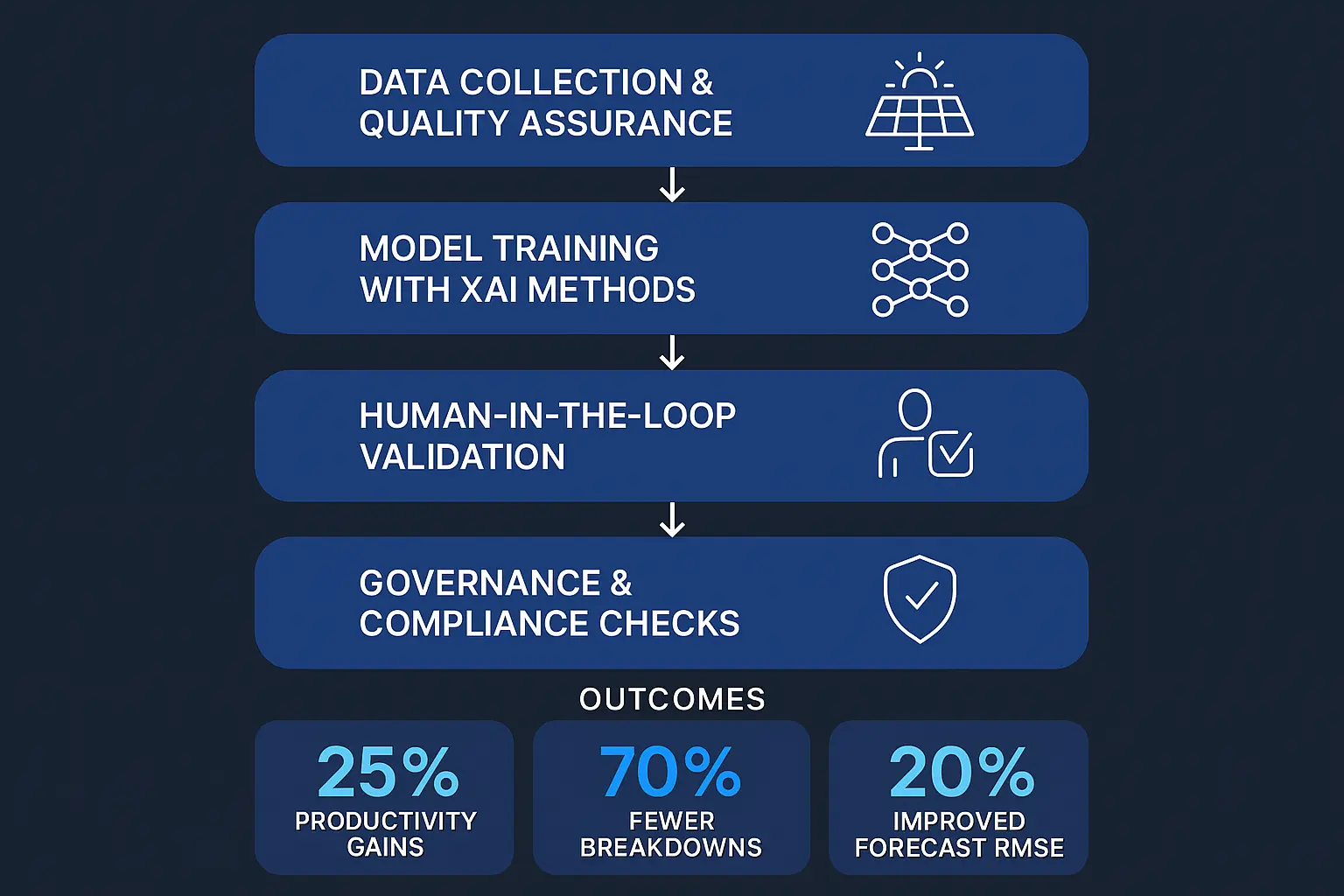
You’ve seen the projections. The market for AI in renewable energy is set to surge from $0.6 billion to $4.6 billion by 2032. You understand the potential—AI-driven systems promise up to 25% productivity gains and 70% fewer breakdowns in solar operations. But as you evaluate solutions to modernize your solar assets, a critical question emerges: How can you trust a decision you can’t understand?
Deploying AI in critical energy infrastructure isn’t like recommending a movie. When an algorithm is managing grid stability, forecasting energy production, or dispatching maintenance teams, “because the model said so” is not a sufficient answer. You’re facing the “black box” problem, and you’re right to be cautious. This guide is for you. It’s a blueprint for moving beyond the hype to build AI systems you can actually trust—systems that are transparent, accountable, and fundamentally reliable.
The Black Box Challenge: Why Explainability is Non-Negotiable in Solar
Many advanced AI models, particularly deep learning networks, operate as “black boxes.” They ingest vast amounts of data and produce incredibly accurate outputs, but the internal logic behind their conclusions can be opaque even to their creators.
In the solar sector, this opacity introduces unacceptable risks:
- Grid Stability: An AI model managing battery storage or grid feed-in makes an unexpected decision. Without understanding why, operators can’t preemptively correct course or trust the system during volatile conditions. This is critical, as AI in storage systems can cut voltage fluctuations by up to 71%—but only if operated with confidence.
- Financial Performance: An AI flags a solar panel for expensive, immediate replacement. Is it responding to a critical early indicator of failure, or is it overreacting to a minor data anomaly? The financial implications are significant, and trust requires transparency.
- Safety and Maintenance: An AI-powered drone inspection system fails to flag a developing micro-crack. If you can’t audit the model’s decision-making process, you can’t identify and fix the blind spots that could lead to catastrophic failure.
- Regulatory Compliance: As regulations like the EU AI Act emerge, organizations deploying AI in critical infrastructure will be required to demonstrate transparency and human oversight. A black box approach is a compliance dead-end.
This is where Explainable AI (XAI) and a framework for Trustworthy AI become essential. They aren’t just academic concepts; they are the fundamental engineering and governance practices required to deploy AI responsibly in the real world.
Decoding AI Decisions: Key Explainable AI (XAI) Methodologies for Solar
Explainable AI (XAI) isn’t about dumbing down your models. It’s about building tools and techniques to peer inside the black box and translate complex calculations into human-understandable insights. Several mature methodologies can be applied directly to solar energy challenges.
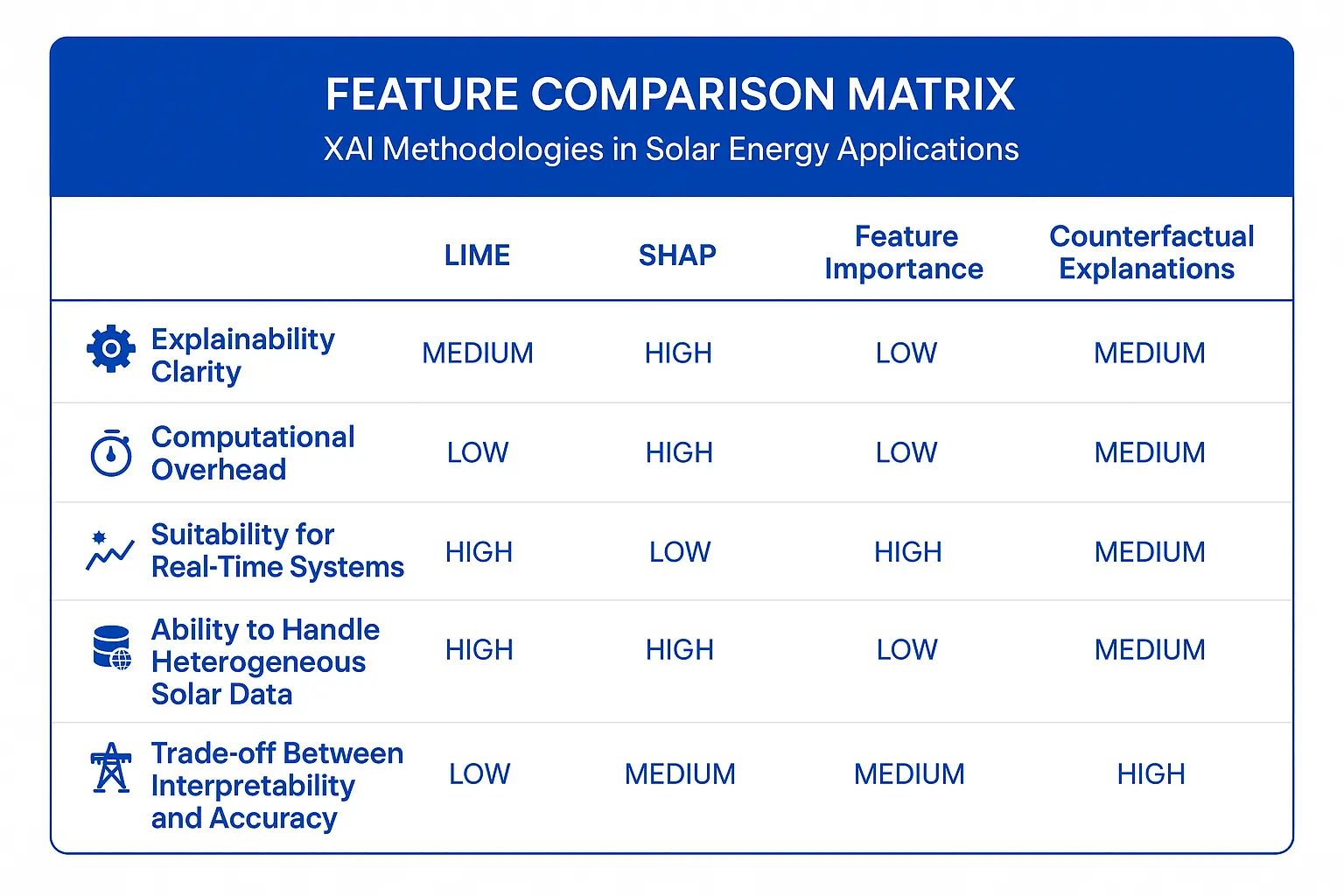
Common XAI Techniques and Their Solar Applications
- SHAP (SHapley Additive exPlanations): This powerful technique assigns a value to each feature (e.g., irradiance, temperature, humidity) to show how much it contributed to a specific prediction.
- Solar Use Case: For an AI forecasting a sudden dip in energy production, SHAP can reveal that an unexpected increase in panel temperature was the single biggest contributing factor, allowing operators to verify the prediction against real-world conditions.
- LIME (Local Interpretable Model-agnostic Explanations): LIME explains an individual prediction by creating a simpler, interpretable model around that specific data point. It’s like asking, “If the conditions were just slightly different, how would the prediction change?”
- Solar Use Case: An AI model predicts a specific inverter is about to fail. LIME can highlight that its recent voltage variance and internal temperature readings are the key local factors driving this specific alarm, distinguishing it from other healthy inverters.
- Feature Importance: This method provides a high-level view of which data features the model relies on most across all predictions.
- Solar Use Case: You might discover your predictive maintenance model for a desert-based solar farm relies far more heavily on data about airborne dust and sand than on humidity, helping you prioritize sensor cleaning and data quality for that specific feature.
Overcoming Practical Implementation Challenges
Adopting XAI isn’t without its challenges. Competing content often overlooks these real-world hurdles, but facing them is key to a successful strategy:
- The Accuracy-Explainability Trade-off: Sometimes, the most accurate models are the most complex and hardest to explain. The key is to find the right balance for each specific use case. A model predicting revenue can tolerate slightly lower accuracy for high interpretability, while a model controlling grid frequency might prioritize accuracy above all.
- Real-Time Constraints: Generating explanations takes computational power. For high-frequency decisions like grid balancing, explanations might need to be generated asynchronously or sampled, rather than for every single decision.
- Model Drift: The real world changes. Weather patterns shift, and equipment ages. An explanation from six months ago may no longer be valid. Your MLOps (Machine Learning Operations) must include continuous monitoring to detect drift and trigger model retraining and re-validation of your XAI framework.
Building Trust from the Ground Up: A Trustworthy AI Framework for Energy
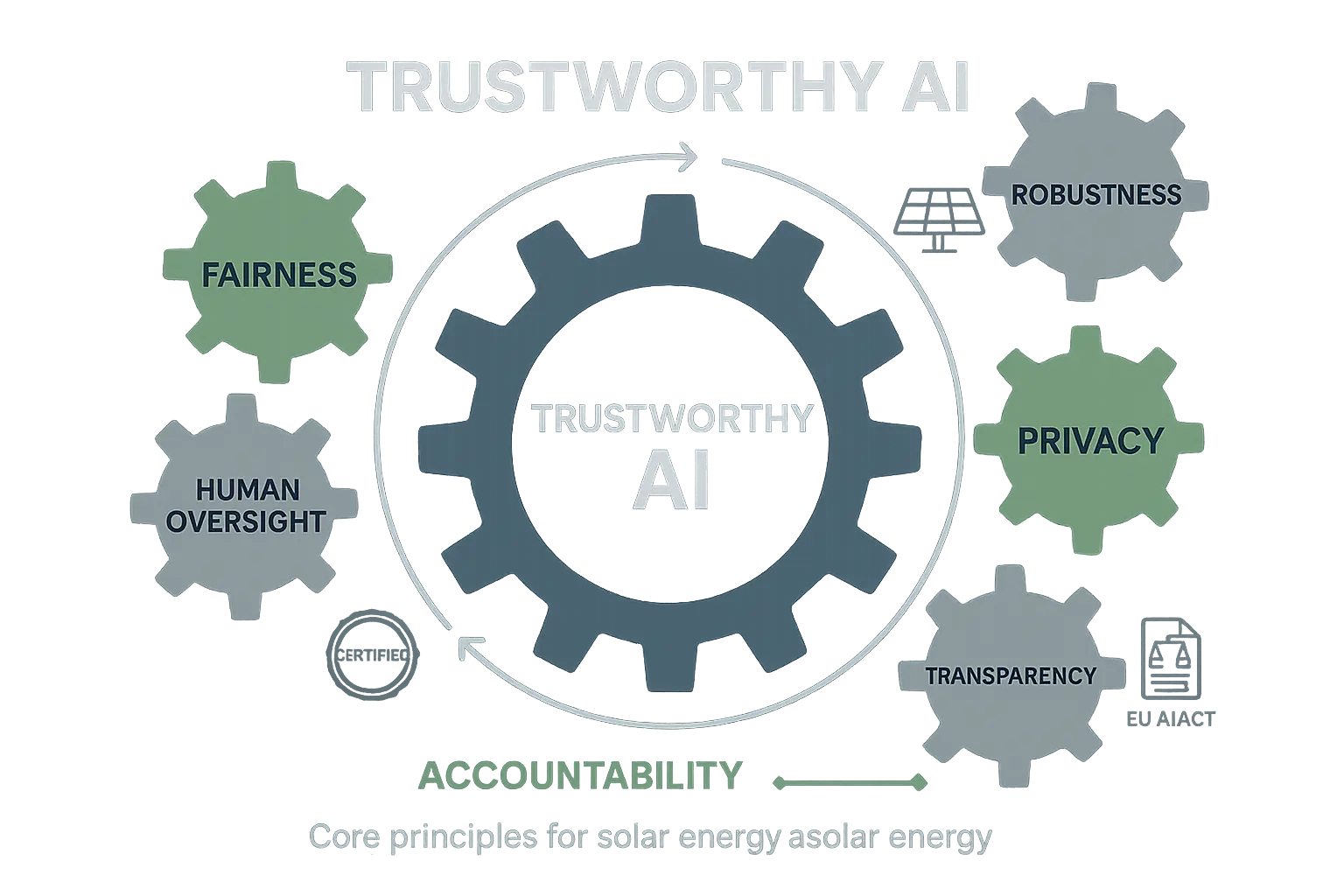
Explainable AI techniques are the tools, but Trustworthy AI is the overarching philosophy and governance structure. It’s an organization-wide commitment to building systems that are not only transparent but also fair, robust, and accountable. Leading frameworks, like those outlined by Deloitte, can be adapted specifically for the energy sector.
The Six Pillars of Trustworthy AI in Solar
- Transparency & Explainability: You know why the AI makes its decisions, using tools like SHAP and LIME.
- Fairness & Equity: The AI’s decisions do not create or reinforce biases. For example, ensuring that an AI-driven energy distribution model doesn’t consistently deprioritize certain communities during periods of high demand.
- Robustness & Reliability: The model is resilient to unexpected or adversarial inputs. It can handle a faulty sensor or an attempted cyberattack without catastrophic failure.
- Privacy: Customer data and sensitive operational data are protected throughout the AI lifecycle.
- Accountability & Governance: Clear lines of ownership are established. If an AI makes a poor decision, who is responsible? There must be a clear process for auditing, overriding, and taking corrective action.
- Human-in-the-Loop: For high-stakes decisions, the AI should augment, not replace, human expertise. The system should provide recommendations and explanations to a human operator who makes the final call.
Implementing this requires more than just code. It demands a culture of responsibility, with clear processes for risk assessment, model validation, and continuous monitoring that involve stakeholders from IT and data science to operations and legal.
From Data to Decisions: Why Data Quality is the Bedrock of Trust
Your AI is only as trustworthy as the data it’s trained on. In solar operations, data comes from a wide array of sources—IoT sensors, SCADA systems, weather APIs, and maintenance logs. Ensuring the quality and integrity of this data is a critical, often overlooked, prerequisite for building trust.
A robust data strategy for trustworthy AI involves:
- Rigorous Preprocessing: Cleaning, normalizing, and validating data from disparate sources to ensure consistency.
- Data Provenance: Maintaining a clear, auditable trail of where data came from and how it has been transformed.
- Addressing Data Gaps: Using sound statistical methods or synthetic data generation to fill in missing information without introducing bias.
Without a solid data foundation, even the most advanced XAI techniques will be explaining flawed logic, giving you a clear picture of a wrong answer.
Case Study: Trustworthy AI in Action at a Utility-Scale Solar Farm
A 500 MW solar farm in the Southwest was struggling with reactive, costly maintenance. They implemented an AI-powered predictive maintenance platform but faced pushback from experienced field engineers who didn’t trust the “black box” alerts.
The Challenge: The AI would flag components for maintenance, but engineers couldn’t see the reasoning. They often dismissed alerts as false positives, leading to several preventable failures and costly downtime.
The Solution: The operator integrated XAI into their platform. For every alert, the system now provides:
- A clear SHAP plot showing that elevated thermal readings and minor voltage fluctuations were the primary drivers of the failure prediction.
- A LIME explanation comparing the component’s recent performance to that of its healthy neighbors, highlighting the specific anomalous behavior.
- A “confidence score” based on the model’s certainty.
The Outcome:
- Increased Trust: Engineers could now see the data-driven evidence behind each alert, validating it with their own expertise. They began to trust the system as a reliable “second opinion.”
- Improved Efficiency: Trust led to action. By addressing alerts proactively, the farm saw a 30% reduction in unplanned downtime and a 15% decrease in maintenance costs within the first year. Availability gains of 2-5%, as identified in industry reviews, were realized.
- Collaborative Improvement: Engineers started providing feedback on the explanations, helping the data science team fine-tune the model by identifying when it was overweighting certain sensor data.
The Future of Responsible AI in Solar
The need for trust will only grow as AI becomes more autonomous. Look ahead to emerging trends where explainability will be a core design principle:
- Agentic AI and Digital Twins: Future AI “agents” will autonomously manage entire solar farms. These systems will rely on digital twins—virtual replicas of the physical assets—and must have embedded XAI to explain their strategic decisions to human overseers.
- AI for Secure Grids: XAI will be crucial in cybersecurity, helping analysts understand not just that an attack is happening, but how an AI-driven intrusion detection system identified the specific threat pattern.
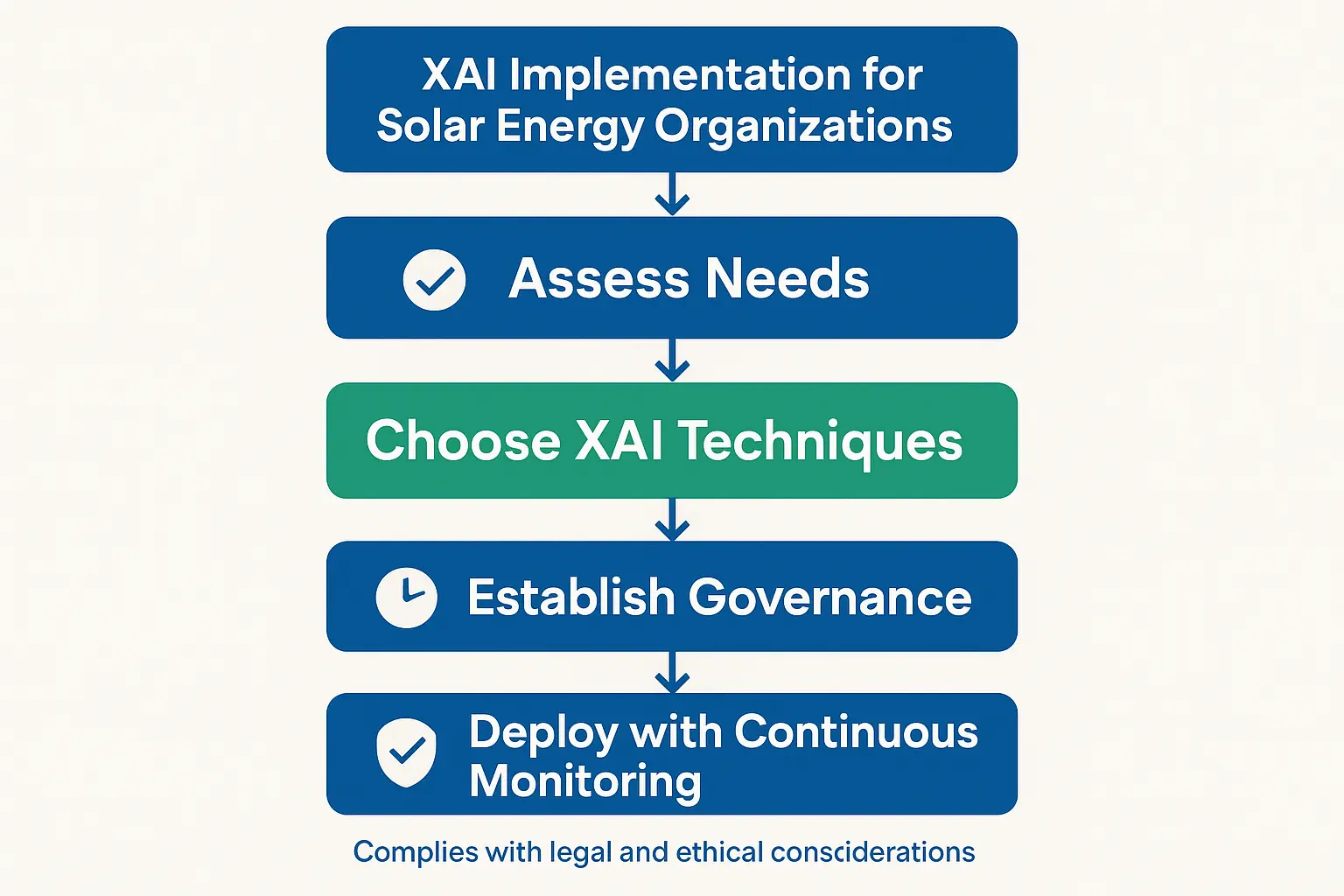
Choosing Your Path: A Decision Guide for Implementing XAI in Solar
Starting your journey toward trustworthy AI can feel daunting. Use this simple guide to structure your approach.
- Assess Your Highest-Risk Use Cases: Where would a “black box” failure have the greatest financial, safety, or operational impact? Start there. Is it grid management, O&M scheduling, or energy trading?
- Define Your Explainability Needs: Do you need real-time explanations for operators (favoring LIME) or high-level strategic insights for analysts (favoring Feature Importance and SHAP)?
- Evaluate Your Data Infrastructure: Are you confident in the quality and accessibility of your data? A data quality audit is a crucial first step.
- Build a Cross-Functional Team: Involve data scientists, operations engineers, and IT leaders from day one. Trust is built through shared understanding and ownership.
- Start with a Pilot Project: Choose one well-defined problem, like inverter failure prediction, to prove the value of an XAI-driven approach before scaling across your entire operations.
Frequently Asked Questions
1. Does implementing XAI significantly reduce my AI model’s predictive accuracy?
Not necessarily. While there can be a trade-off, modern XAI techniques like SHAP are designed to work with highly complex models without altering their performance. In many cases, the process of implementing XAI actually improves the model by revealing dependencies on poor-quality data or flawed assumptions, which can then be corrected to build a more robust and accurate system.
2. Is XAI too complex and resource-intensive for my existing team?
While XAI requires data science expertise, many platforms are emerging that package these techniques into more accessible toolkits. The key is to choose solutions that integrate with your existing workflows. The cost of implementing XAI should be weighed against the significant financial and safety risks of deploying an opaque, untrustworthy AI system in critical infrastructure.
3. We’re just starting our AI journey. Should we worry about XAI now or later?
You should worry about it now. Building trust into your AI systems from the ground up is far more effective and less costly than trying to bolt it on later. By making trustworthy AI a foundational principle of your strategy, you ensure your systems are scalable, compliant, and adopted with confidence by the teams who use them every day.
4. How does Trustworthy AI relate to ESG (Environmental, Social, and Governance) goals?
They are deeply connected. The “Governance” in ESG requires robust, transparent, and ethical management of technology. A strong Trustworthy AI framework is a tangible demonstration of good governance. It ensures your AI systems operate fairly and reliably, reinforcing your commitment to responsible and sustainable operations.
The promise of AI in solar energy is immense, but it will only be fully realized through systems built on a foundation of trust. By moving beyond the black box and embracing transparency, explainability, and robust governance, you aren’t just adopting new technology—you’re building the intelligent, reliable, and responsible energy infrastructure of the future.
Ready to build an AI strategy you can trust? Let’s explore a practical roadmap for implementing explainable and trustworthy AI in your solar operations.
