
You’re collecting more data than ever. Advanced Metering Infrastructure (AMI) has transformed your grid, promising unprecedented visibility into consumption, power quality, and network health. Yet, for many utilities, this flood of data feels more like a liability than an asset. The promise of a smarter grid gets lost in a labyrinth of data silos, incompatible systems, and persistent billing errors.
The challenge isn’t a lack of data; it’s the struggle to integrate it effectively. Poor data quality costs organizations an average of $12.9 million annually, a figure that underscores the high stakes of getting this right. This guide is for the decision-makers who need to move beyond foundational concepts and build a practical, future-proof strategy. We’ll provide the framework to navigate the complexities of utility data integration, evaluate your options with confidence, and transform raw meter reads into your most valuable operational asset.
Decoding Smart Meter Data: From Raw Reads to Actionable Insights
The journey begins at the commercial and industrial (C&I) smart meter, a device far more sophisticated than its residential counterpart. These meters don’t just measure kilowatt-hours; they capture a rich stream of high-granularity data essential for modern grid management.
A typical data packet from a C&I smart meter includes:
- Interval Consumption Data (kWh, kVARh): The core usage data, often captured in 15-minute increments or less.
- Voltage (V) and Amperage (A): Critical for monitoring power quality and diagnosing issues at the edge of the network.
- Power Factor (PF): Indicates the efficiency of electrical power usage, crucial for large industrial customers.
- Total Harmonic Distortion (THD): A key indicator of power quality disturbances that can affect sensitive equipment.
But collecting this data is only the first step. To make it trustworthy, it must undergo a rigorous data quality assurance process known as Validation, Estimation, and Editing (VEE). For C&I data, standard VEE isn’t enough. Advanced anomaly detection is required to identify irregular patterns that might indicate equipment malfunction or unusual industrial processes, ensuring the data fed into your billing and operational systems is impeccably accurate.
The AMI-MDM Synergy: Why Integration is Non-Negotiable
Two core systems orchestrate this data flow: Advanced Metering Infrastructure (AMI) and Meter Data Management (MDM). Thinking of them as separate components is the first mistake. True value is only unlocked when they operate in perfect synergy.
- Advanced Metering Infrastructure (AMI) is the “nervous system” of the smart grid. It consists of the smart meters themselves, the communication networks (like RF mesh or cellular) that transport the data, and the head-end system that receives it. AMI’s job is to collect the data reliably and frequently.
- Meter Data Management (MDM) acts as the “brain.” It’s the central repository that ingests raw data from the AMI head-end, performs the critical VEE processes, stores the cleansed data, and makes it available to other enterprise systems like billing, outage management, and customer information systems (CIS).
Without seamless integration, critical failure modes emerge. You might see delayed or incorrect bills, an inability to detect outages promptly, or “data gaps” that force manual workarounds. A truly integrated system ensures a clean, automated handoff, turning raw meter reads into billing-quality data without human intervention. This forms the foundation of modern smart grid solutions and efficient utility operations.
Navigating the Integration Labyrinth: Strategies & Best Practices for Utility Data
Connecting your AMI and MDM systems to the broader enterprise is where most projects face turbulence. The goal is to break down data silos and create a single source of truth, but legacy architectures and inconsistent data formats present significant hurdles.
Here’s a practical framework for navigating this complexity:
Common Integration Challenges:
- Data Silos: Billing, operations, and planning departments often use different systems that don’t communicate, leading to conflicting data sets.
- Inconsistent Formats: Data from different meter manufacturers or network providers can arrive in various formats, requiring complex transformations.
- Security Risks: Every integration point creates a potential vulnerability that must be secured against cyber threats.
- Change Management: Getting teams accustomed to new data workflows and trusting the automated systems is a significant organizational challenge.
Proven Solutions & Best Practices:
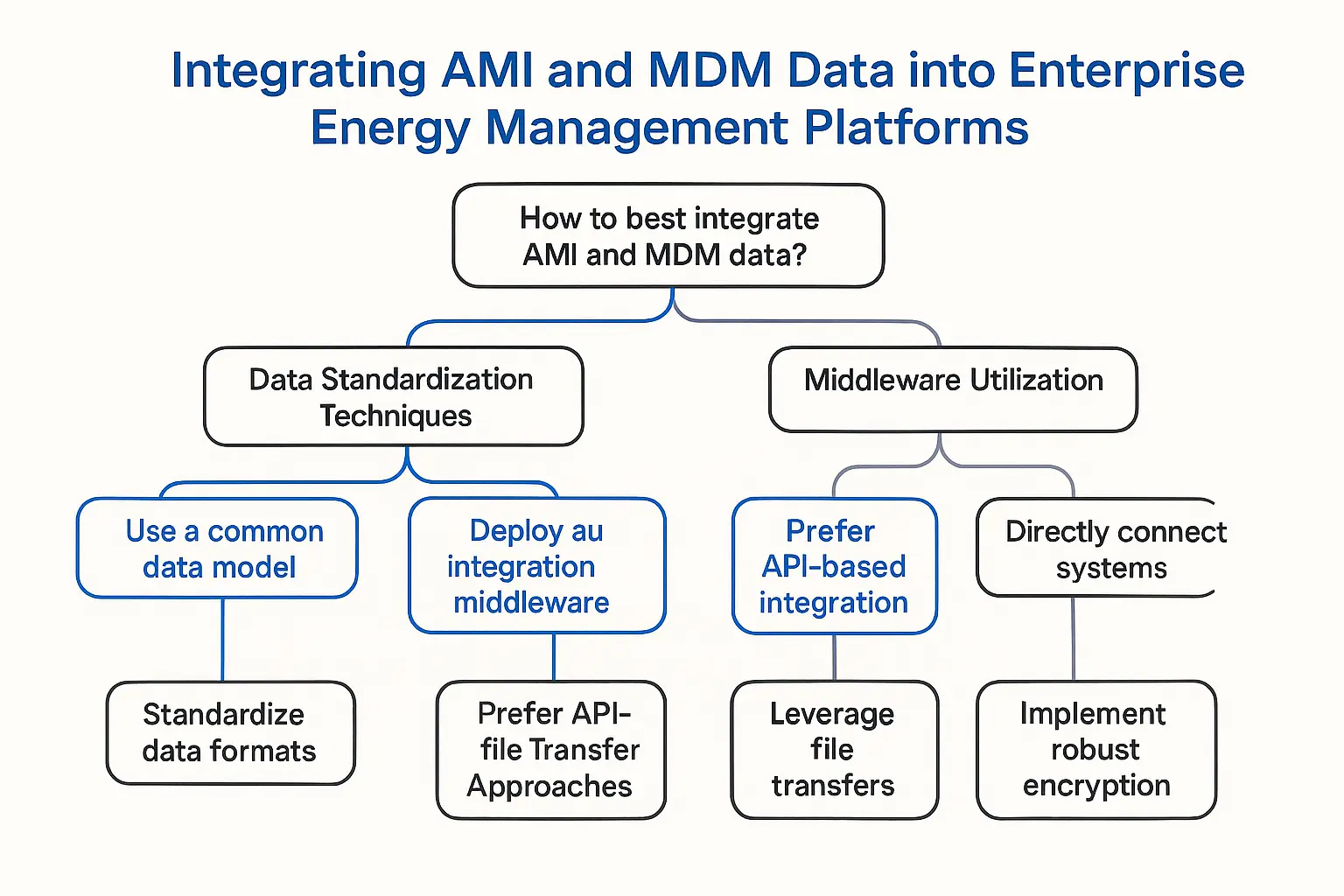
- Adopt an API-First Approach: Modern integration relies on Application Programming Interfaces (APIs) to create flexible, real-time connections between systems. This is far superior to outdated file-transfer methods that create delays and data versioning issues.
- Standardize Your Data Model: Establish a common data language across the organization. This ensures that when data moves from the MDM to an energy management platform, it’s immediately usable without further translation.
- Leverage Middleware: Specialized middleware platforms can act as a universal translator, simplifying the process of connecting dozens of different applications without having to build custom point-to-point integrations for each one.
- Prioritize Stakeholder Engagement: Involve teams from IT, operations, billing, and customer service from the very beginning. This ensures the final solution meets everyone’s needs and fosters buy-in for new processes.
The Regulatory & Security Imperative: Compliance in a Data-Driven Grid
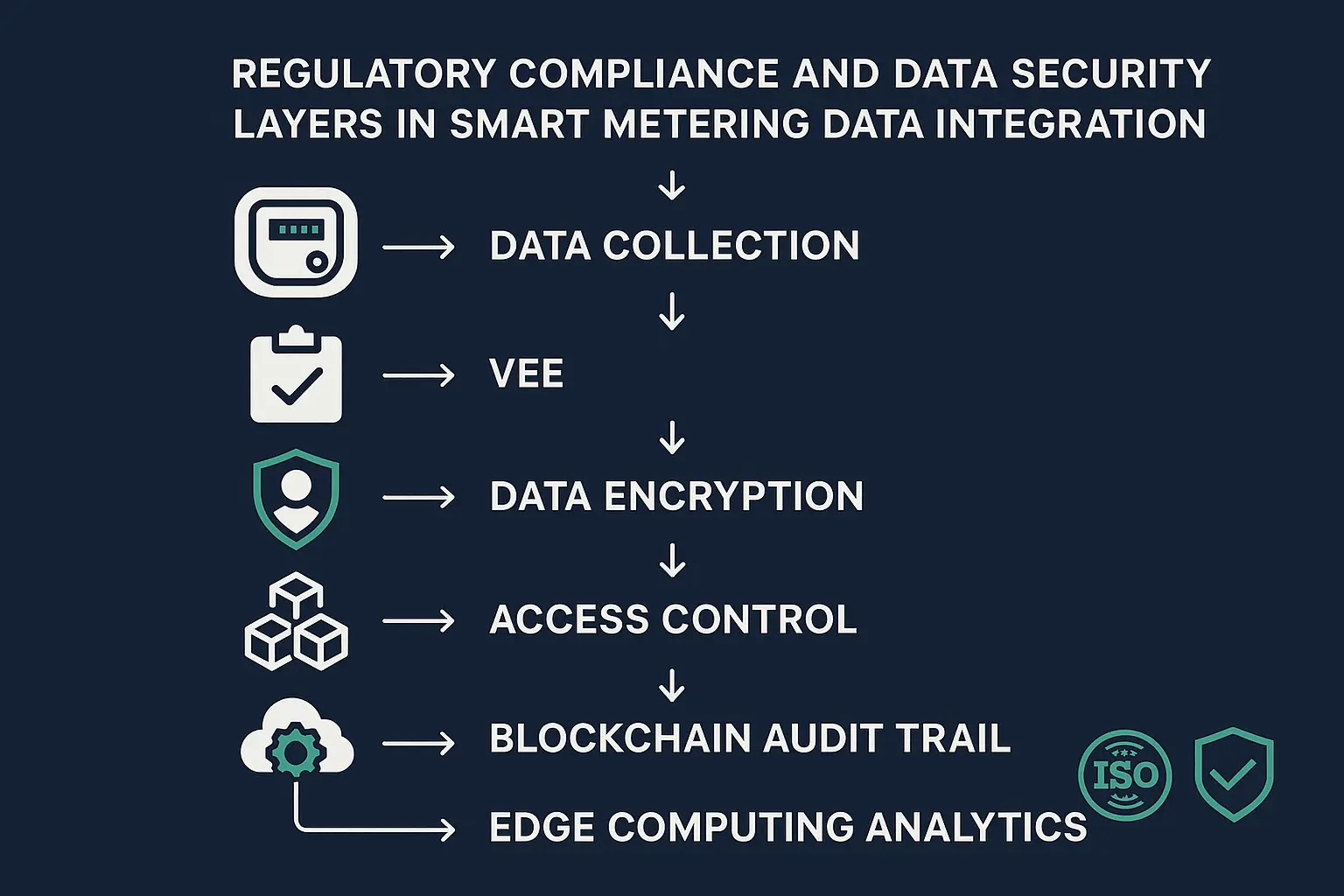
As you integrate utility data across your enterprise, you’re also navigating a complex web of regulatory and security obligations. Regulators demand proof of data accuracy for billing, while customers trust you to protect their privacy. A breach isn’t just a technical failure—it’s a catastrophic loss of trust.
Robust security requires a multi-layered approach that goes beyond basic firewalls. This includes end-to-end encryption for data in transit and at rest, strict access controls to ensure users only see the data they need, and regular security audits.
Two emerging technologies are setting a new standard for data integrity and security in the utility sector:
- Blockchain for Auditability: While often associated with cryptocurrency, blockchain’s core value is its ability to create an immutable, tamper-resistant ledger. For utilities, this provides a transparent and verifiable audit trail for every meter reading, ensuring that data used for billing or regulatory reporting has not been altered.
- Edge Computing for Local Intelligence: Instead of sending every single data point back to a central server, edge computing processes data directly on or near the smart meter. As noted in reports by Deloitte and the NY DPS, this drastically reduces network bandwidth, lowers latency, and enhances security by minimizing the amount of sensitive data transmitted over the network. It allows for near-instant outage detection and localized power quality analysis without overwhelming your central systems.
Beyond Monitoring: AI and Advanced Analytics for a Proactive Grid
Effective data integration isn’t just about improving today’s operations—it’s about enabling tomorrow’s proactive grid. Once you have a clean, accessible, and enterprise-wide data stream, you can apply artificial intelligence (AI) and machine learning (ML) to unlock transformative capabilities.
With high-quality integrated data, you can:
- Achieve Accurate Load Forecasting: AI models can analyze historical consumption data, weather patterns, and economic indicators to predict energy demand with stunning accuracy, optimizing generation and procurement.
- Optimize Demand Response: Identify the best C&I customers to participate in demand response programs and precisely measure their contribution to grid stability during peak events.
- Enable Predictive Maintenance: Analyze voltage, harmonic distortion, and load data to predict transformer or feeder failures before they happen, allowing you to shift from reactive repairs to proactive maintenance and improve grid reliability.
This is the ultimate goal: using integrated data not just to see what happened, but to predict what will happen next. By leveraging advanced data analytics services, utilities can enhance efficiency, reduce operational costs, and build a more resilient grid.
Choosing Your Path: An Evaluation Framework for Smart Metering & Data Solutions
Selecting the right technology partners is one of the most critical decisions you’ll make. With the global AMI market projected to grow at an 11.28% CAGR through 2032, the number of vendors and solutions can be overwhelming. Use this vendor-agnostic framework to cut through the marketing noise and assess what truly matters.
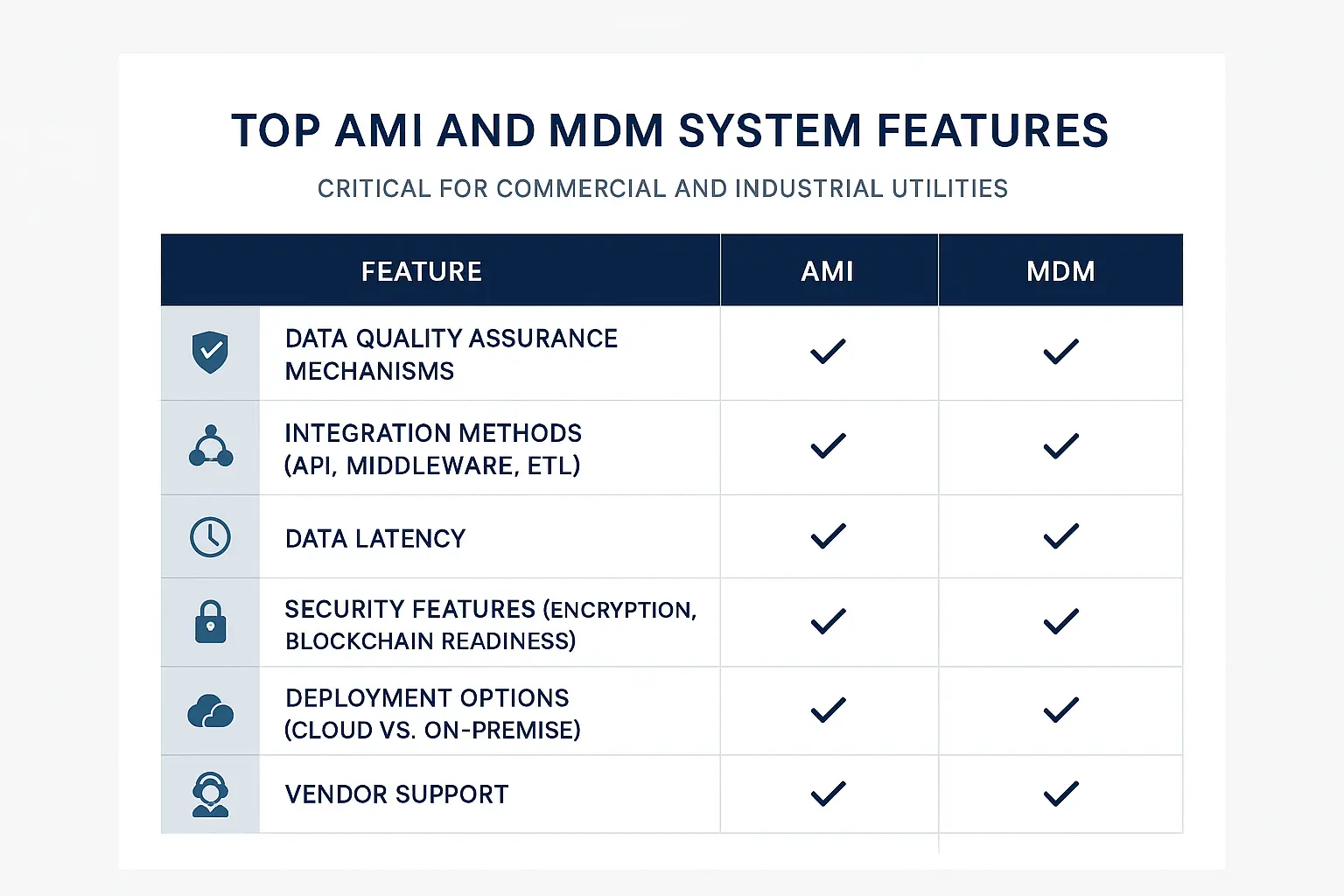
Key Evaluation Criteria for AMI/MDM Systems & Integration Partners:
- Interoperability & Open Standards: Does the system use open standards (like CIM or MultiSpeak) and provide well-documented APIs? Avoid proprietary “black box” solutions that lock you into a single vendor.
- Scalability & Performance: Can the MDM handle the massive data volumes of a full AMI rollout without performance degradation? Ask for proof points on the number of meters and data intervals processed per hour.
- Configurable VEE Rules: How easily can you configure and customize VEE rules to meet the specific needs of your C&I customers and regulatory requirements?
- Pre-Built Connectors: Does the provider offer pre-built connectors for common enterprise systems (e.g., Oracle, SAP)? This can dramatically reduce implementation time and cost.
- Deployment Model: Evaluate the pros and cons of on-premise, cloud, or hybrid deployments based on your IT strategy, security posture, and internal resources.
- Security & Compliance Roadmap: How does the vendor stay ahead of emerging cybersecurity threats and evolving regulatory landscapes? Ask for their security certifications (e.g., SOC 2, ISO 27001).
Case Studies & Real-World Impact: Proving the Value
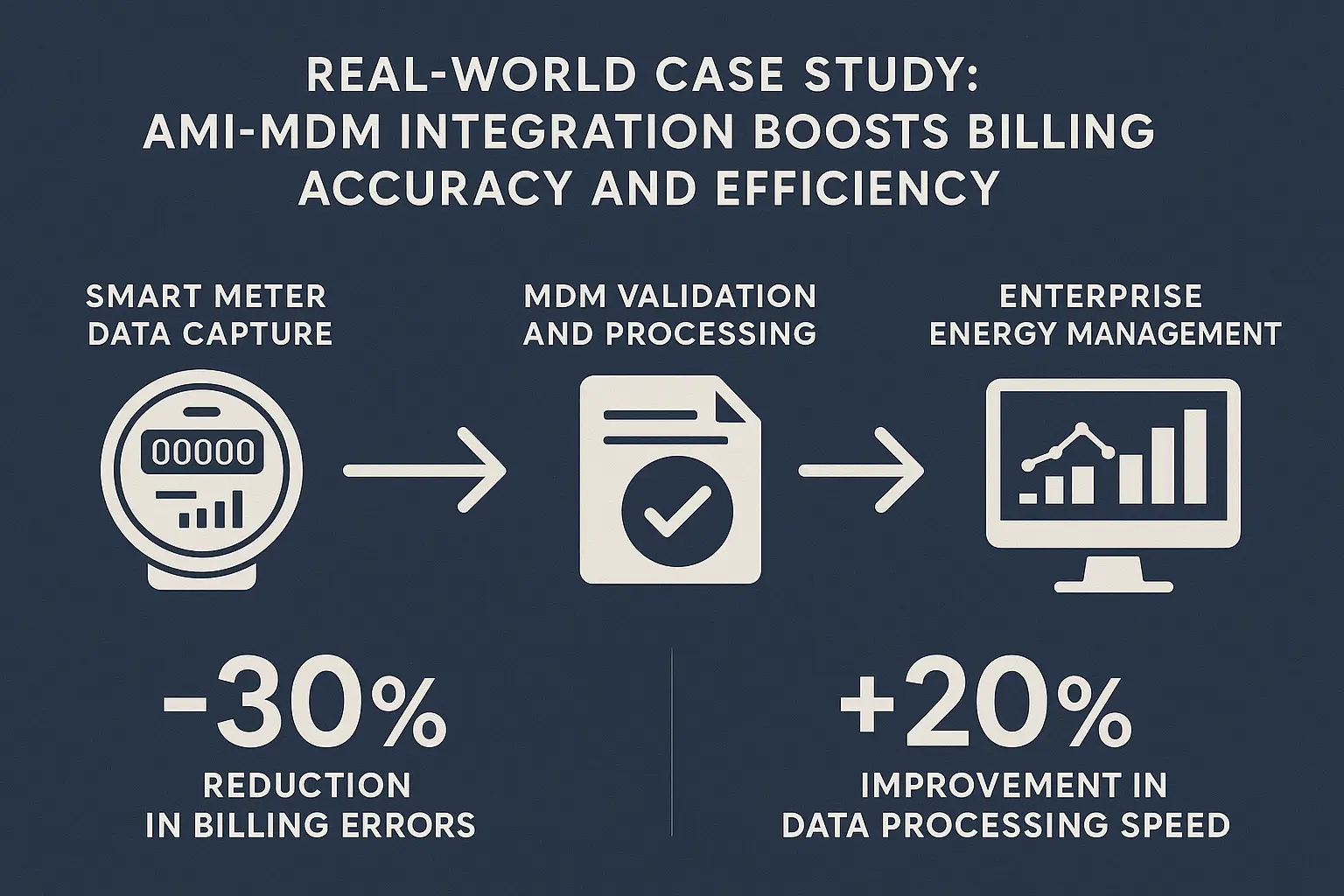
Theory is one thing; results are another. Consider a mid-sized utility that struggled with billing inaccuracies for its largest industrial customers. Manual data validation was consuming hundreds of hours per month, and disputes were eroding customer relationships.
By implementing an integrated AMI-MDM solution with an API-first architecture, they achieved:
- 95% Reduction in Manual Data Handling: Automated VEE and seamless integration with their billing system eliminated most manual workarounds.
- 80% Decrease in Billing Disputes: Highly accurate and verifiable data left no room for error, rebuilding trust with key accounts.
- 12-Hour Improvement in Outage Detection: Operations teams gained near real-time visibility into power quality at the meter level, allowing them to identify and resolve issues before they caused major disruptions.
These are the tangible, measurable outcomes of a well-executed data integration strategy. It moves smart metering from a compliance requirement to a powerful engine for operational excellence and customer satisfaction.
Frequently Asked Questions About Utility Data Integration
How do we justify the cost of a new MDM or integration platform?
Focus on the quantifiable cost of not acting. Calculate the annual cost of billing errors, manual labor for data correction, lost revenue from undetected theft, and the operational inefficiencies of poor outage response. Compare this to the ROI from improved accuracy, automation, and grid reliability.
Our IT team is already overloaded. Isn’t this too complex to implement?
Modern integration platforms and cloud-based MDM solutions are designed to reduce complexity, not add to it. Look for partners who offer managed services, pre-built connectors, and a clear implementation plan. The goal is to offload the technical burden so your team can focus on using the data, not just managing it.
We have a mix of legacy systems and new technology. Can they all be integrated?
Yes. This is a common scenario. A successful strategy doesn’t require a full “rip and replace.” By using a flexible integration layer (like middleware or an enterprise service bus), you can create a unified data fabric that connects your legacy CIS with your modern AMI system, allowing for a phased modernization approach.
How do we ensure data security across so many connected systems?
Adopt a “zero trust” security model. This means verifying every connection and user, regardless of whether they are inside or outside your network. Combine this with end-to-end encryption, robust identity and access management, and continuous security monitoring to protect your critical data infrastructure.
Building Your Future-Ready Utility
The transition to a data-driven utility is no longer a distant vision; it’s a present-day imperative. The path from collecting raw smart meter data to generating actionable intelligence is paved with strategic integration. By choosing open, scalable, and secure solutions, you can break down internal silos, enhance operational efficiency, and build a resilient grid prepared for the challenges of tomorrow.
Don’t let the value of your smart grid investment remain locked away in disparate systems. The time to build your data integration blueprint is now.
If you’re ready to move from evaluation to implementation, our team of experts can help you design a tailored integration strategy that aligns with your unique operational goals. Schedule a no-obligation consultation today to map out your utility’s data-driven future.
